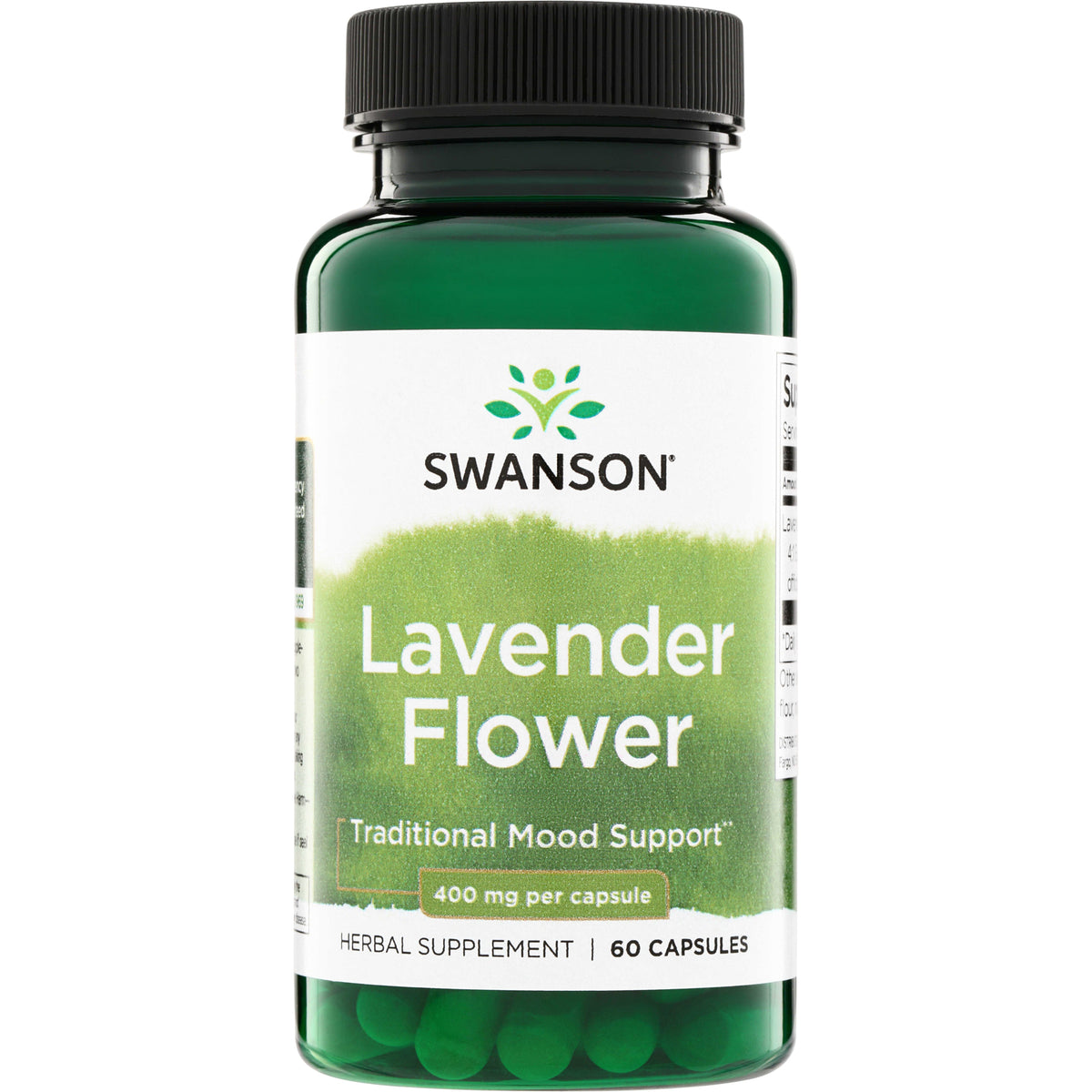
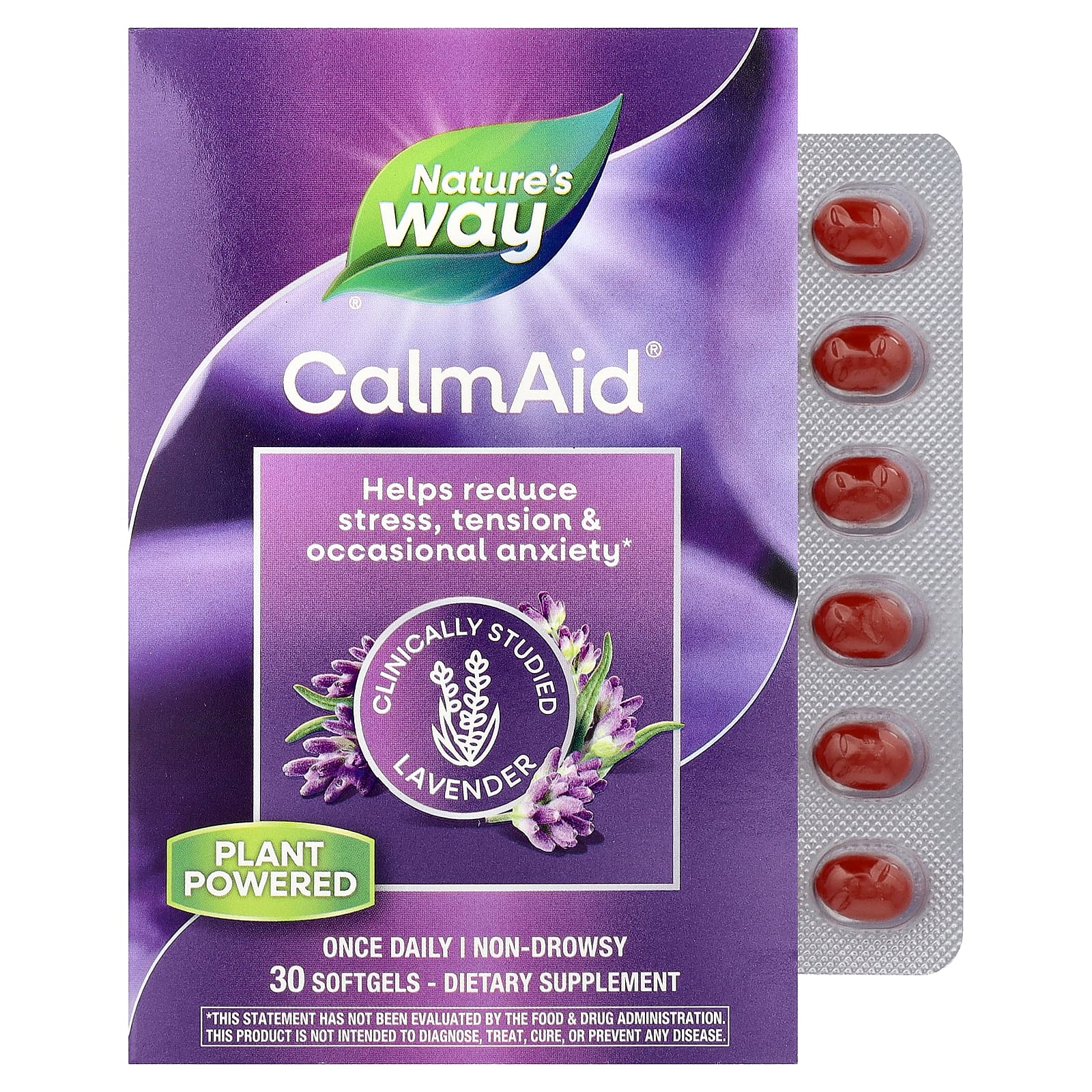
Lavender oil is the essential oil of lavender flowers, Lavandula angustifolia. The plant is native to the Mediterranean region, including Italy, France and Spain. As a supplement, the oil is sold in capsules taken by mouth. It is also used in aromatherapy and in products for the skin. Silexan, a patented lavender oil, comes in 80 mg capsules.
Terms and sources
- Lavandula angustifolia
- NCCIH gives this Latin name and lists English, common and French lavender as common names. NCCIH, Lavender: Usefulness and Safety.
- Mediterranean region
- NCCIH, Lavender: Usefulness and Safety.
- taken by mouth
- NCCIH notes that lavender “is promoted as an oral (by mouth) dietary supplement”. NCCIH, Lavender: Usefulness and Safety.
- products for the skin
- NCCIH, Lavender: Usefulness and Safety.
- a patented lavender oil
- Baldinger et al., 2014, below, calls Silexan “a patented active substance”.
- 80 mg capsules
- Baldinger et al., 2014, below.
Lavender oil in the body
Lavender oil is not a nutrient, and the body has no daily requirement for it. Trials in adults without a diagnosis measured brain scans and simulated driving.
In one study, serotonin-1A receptor binding in healthy men was lower after Silexan than after a dummy pill. Serotonin-1A is one of the receptors for serotonin, a messenger between nerve cells.
Terms and sources
- In one study
- Baldinger et al., 2014, below: 160 mg a day for at least 8 weeks, measured by PET scan.
Safety: what NCCIH says
NCCIH, on safety: "It is likely safe to consume lavender in the amounts typically used in foods."
Terms and sources
- on safety
- The NCCIH safety section, quoted in full in this paragraph and the next five. NCCIH, Lavender: Usefulness and Safety.
NCCIH adds: "Oral lavender products might be safe in the short-term and in the amounts tested in studies of anxiety or other conditions. However, some people may experience adverse effects such as diarrhea, headache, nausea, or burping."
NCCIH adds: "Aromatherapy with lavender oil is considered possibly safe, but it may cause headache or coughing."
NCCIH adds: "Topical products containing lavender may cause allergic skin reactions in some people. A few cases of swelling of breast tissue have been reported in children who used topical products containing lavender. However, it’s unclear whether the lavender was responsible for the breast swelling, a condition that can have many causes."
NCCIH adds: "There are theoretical reasons to suspect that lavender might interact with some sedative drugs or herbs, which is especially important if you have an upcoming surgical procedure. If you take any type of medicine, talk with your health care provider before using lavender or other herbal products; some herbs and medicines interact in harmful ways."
NCCIH adds: "Little is known about whether it’s safe to use lavender during pregnancy or while breastfeeding."
Where lavender oil comes from
Lavender is an aromatic, evergreen plant, NCCIH notes. Its name comes from the Latin verb lavare, to wash. Its scent is commonly used in bath products and perfumes.
Terms and sources
- aromatic, evergreen plant
- NCCIH, Lavender: Usefulness and Safety.
- lavare
- NCCIH, Lavender: Usefulness and Safety.
- bath products and perfumes
- NCCIH, Lavender: Usefulness and Safety.
Silexan is made from the flowers by steam distillation, by the trial report below. Italy’s 2018 plant list places lavender in the Lamiaceae family.
Terms and sources
- steam distillation
- Baldinger et al., 2014, below. The report also writes that Silexan has been authorized in Germany as a medicinal product.
- Lamiaceae
- Italian Ministry of Health, list of plants for food supplements, 2018.
Daily amounts and the upper limit
United States
There is no US recommended daily amount for lavender oil. The National Academies have not set an upper limit for lavender oil.
In food, lavender oil is on FDA’s list of essential oils and natural extractives “generally recognized as safe for their intended use”. As a flavoring, lavender is also on FDA’s list of spices and flavorings “generally recognized as safe for their intended use”.
Terms and sources
- FDA’s list of essential oils and natural extractives
- 21 CFR 182.20 names lavender (Lavandula officinalis Chaix.) and spike lavender (Lavandula latifolia Vill.). It also names lavandin, hybrids of the two. The listing covers essential oils, oleoresins (solvent-free) and natural extractives, including distillates.
- also on FDA’s list
- It names lavender, Lavandula officinalis Chaix. The listing covers spices and other natural seasonings and flavorings. 21 CFR 182.10.
In the NIH label database, 127 US labels list lavender oil. 94% of them list other ingredients too.
Terms and sources
- 127 US labels
- NIH Dietary Supplement Label Database, including products no longer sold. Labels where one ingredient, or one part of it, names lavender oil. Lavender or Lavandula must stand with oil or essential oil, or the label names Silexan. Lavender flower, herb or extract without the word oil is not counted. Oils called infused or cold-macerated are not counted. Another 13 name only lavandin oil, a hybrid lavender. We counted these.
- 94%
- 119 of 127. Calorie and carbohydrate rows are ignored.
Of the 127 labels, 51 also list passionflower, 21 list chamomile and 21 list lemon balm.
Terms and sources
- 51
- 19 list valerian and 17 list L-theanine. We counted these.
Of 8 labels whose only ingredient is lavender oil, 7 list 80 mg per serving. All 8 carry a precaution to consult a doctor or health professional.
Terms and sources
- 8 labels
- The other one lists 60 mg. A serving is not always a full day’s amount. We counted these.
- 7 list 80 mg
- 4 of the 7 name Silexan.
- All 8
- Label precaution statements with the words consult or physician. 5 of the 8 mention burping. We counted these.
Daily amounts and labels differ by country.
Published studies of lavender oil
By our count, 17 of the 26 study reports we found chose people by a diagnosis or complaints. Those trials are not listed here, nor are aromatherapy, massage or skin studies. On a lavender oil product taken by mouth, NCCIH notes: “the research has several limitations, such as the small sample sizes of the studies, a lack of independent funding and testing, and a lack of participant diversity.”
Terms and sources
- 17 of the 26 study reports
- We found 41 reports of lavender oil taken by mouth: 26 study reports and 15 reviews. 17 of the 26 chose people by a diagnosis, complaints or a symptom score, or before a dental procedure. We counted these.
- NCCIH notes
- NCCIH writes this about studies of a lavender oil product taken orally. NCCIH, Lavender: Usefulness and Safety.
NCCIH gives no daily amount for lavender oil, so we do not filter trials by dose.
Terms and sources
- no daily amount
- NCCIH refers only to “the amounts tested in studies” and gives no number. NCCIH, Lavender: Usefulness and Safety.
2 studies of Silexan in healthy volunteers. Against a dummy pill, 1 found lane-keeping equivalent and 1 had mixed results.
25 and 50 people. Not listed: studies in people with a diagnosis, or chosen by their complaints or a symptom score. Nor are studies around a dental procedure, in teenagers or children, or where participants took a medicine. Also not listed: aromatherapy, inhaled, massage or skin use. Nor are lavender flower, tea, tincture or syrup, blends with other herbs, or method and records studies. Nor are reviews that include such studies. In one trial, the part with a medicine group is not counted.
Our one-line summary comes first. The original is on PubMed.
Show the 2 studies
In healthy men, brain serotonin-1A binding was lower with Silexan than a dummy pill; gray matter showed no significant difference.
Trial · 25 randomized (crossover); 19 finished; PET analyzed in 17, MRI in 19. · 8 weeks per period · maker-funded
Baldinger et al., International Journal of Neuropsychopharmacology, 2014
Terms and sources
- healthy men
- 25 men aged 20 to 34 were randomized; 19 finished, and 17 had usable PET scans. A psychiatrist screened them as mentally healthy, and none had taken medicines for the mind, by the article.
- serotonin-1A binding
- How strongly a tracer attaches to serotonin-1A receptors. It was measured by PET scan, with an injected tracer, at the end of each period.
- was lower
- Lower in two large brain areas after Silexan than after the dummy pill. At the listed points of these two areas, it was about 9% to 30% lower. No area was higher. The article we read gives no side-effect counts.
- Silexan
- A lavender oil from the flowers, made by steam distillation. Two 80 mg soft capsules each morning, 160 mg a day, for at least 8 weeks. The dummy period came before or after, with a break of 14 days or more.
- a dummy pill
- Soft capsules identical in color, size and shape.
- gray matter showed no significant difference
- MRI in 19 men. A few small areas looked larger or smaller after Silexan, but none passed the authors’ correction for multiple comparisons.
- maker-funded
- The article’s Acknowledgments say: “This research was supported by Dr. Willmar Schwabe GmbH & Co. KG.” The article says Schwabe manufactures Silexan. Schwabe also provided the test capsules and the packaging with coded containers.
Study · Free full text · about 23 min to read
Our estimate at about 200 words a minute, from the PMC full text.
Study summary
25 healthy men aged 20 to 34 were randomized. Each took Silexan and identical dummy capsules, one after the other, in random order. Silexan was two 80 mg capsules, 160 mg, every morning for at least 8 weeks. A break of 14 days or more separated the two periods. At the end of each period, a PET scan with an injected tracer measured serotonin-1A receptor binding. An MRI scan measured gray matter volume. 19 men finished, and 17 had usable PET scans.
50 healthy volunteers drove a simulator after Silexan 80 mg and after a dummy pill: lane-keeping was equivalent.
Trial · 50 people · Single dose and 7 days · industry author
Möller et al., Journal of Psychiatric Research, 2020
Terms and sources
- 50 healthy volunteers
- Part 1 of the trial. Part 2 randomized 25 volunteers. It compared single doses of 160 and 320 mg with a prescription medicine and a dummy pill. It is not counted here. The abstract does not give ages.
- Silexan 80 mg
- A lavender oil preparation, taken once and then daily for 7 days. Each person also took the dummy pill, in random order.
- a dummy pill
- The abstract calls it placebo and does not describe it.
- lane-keeping was equivalent
- The 95% CI of the difference from the dummy pill stayed within the preset ±2 cm margin. The interval was −1.43 to +1.38 cm after one dose and −1.45 to +0.79 cm after 7 days. Driving errors and sleepiness were comparable to the dummy pill, in the authors’ words. The abstract gives no side-effect counts.
- industry author
- One author works at Dr. Willmar Schwabe GmbH & Co. KG, by PubMed. We read only the abstract, so we could not check the funding section.
Study · Abstract only · about 2 min to read
Abstract only. Our estimate at about 200 words a minute, from the PubMed abstract.
Study summary
In part 1, 50 healthy volunteers were randomized. Each took Silexan 80 mg and a dummy pill, one after the other, in random order. Each was taken as one dose and as daily doses for 7 days. The volunteers then drove a validated simulator calibrated against alcohol. The main measure was how much the car swerved within its lane. Part 2 randomized 25 volunteers. It compared single doses of 160 and 320 mg with a prescription medicine and a dummy pill. It is not counted here.
Information, not a prescription. Do not start, stop or combine supplements or medicines on your own.