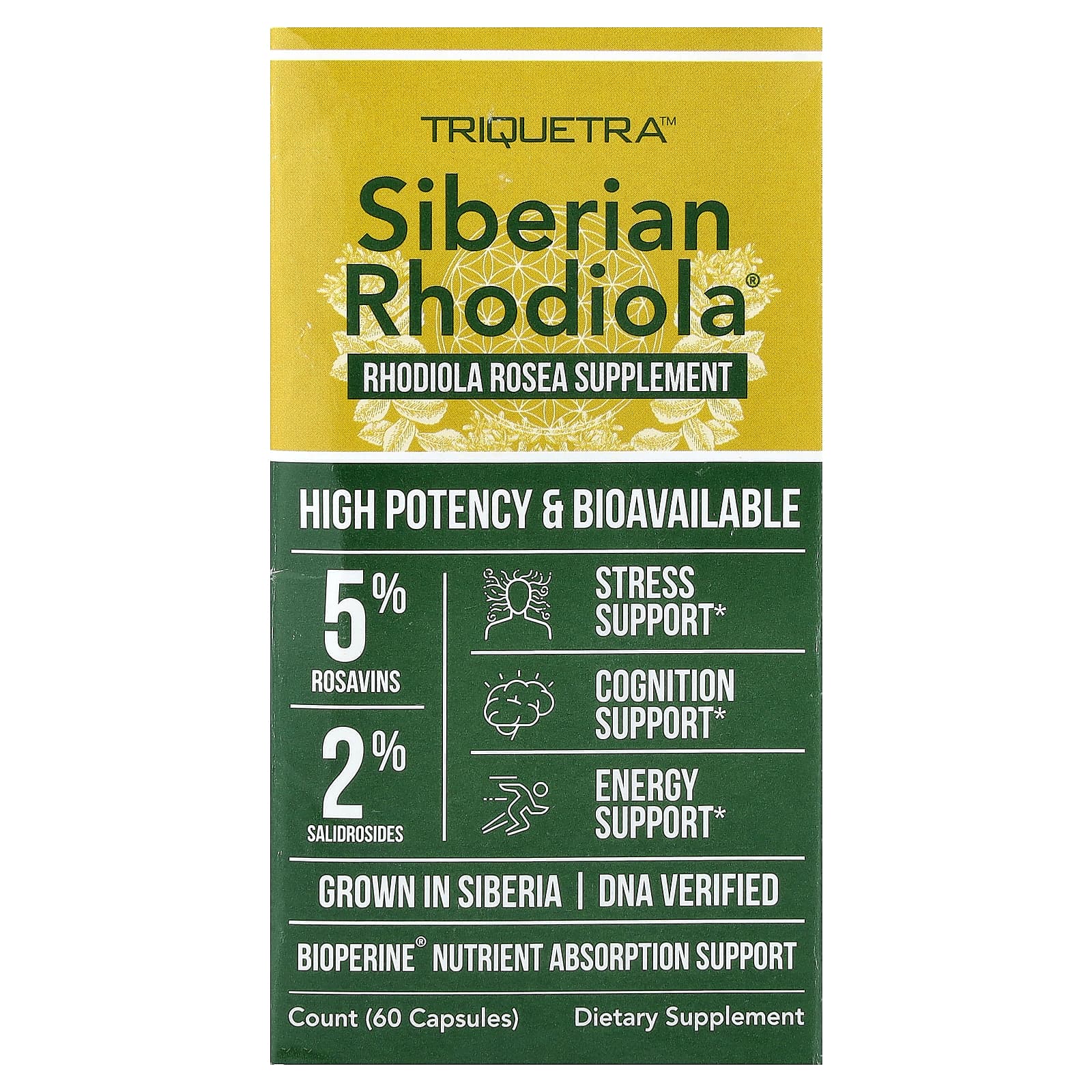
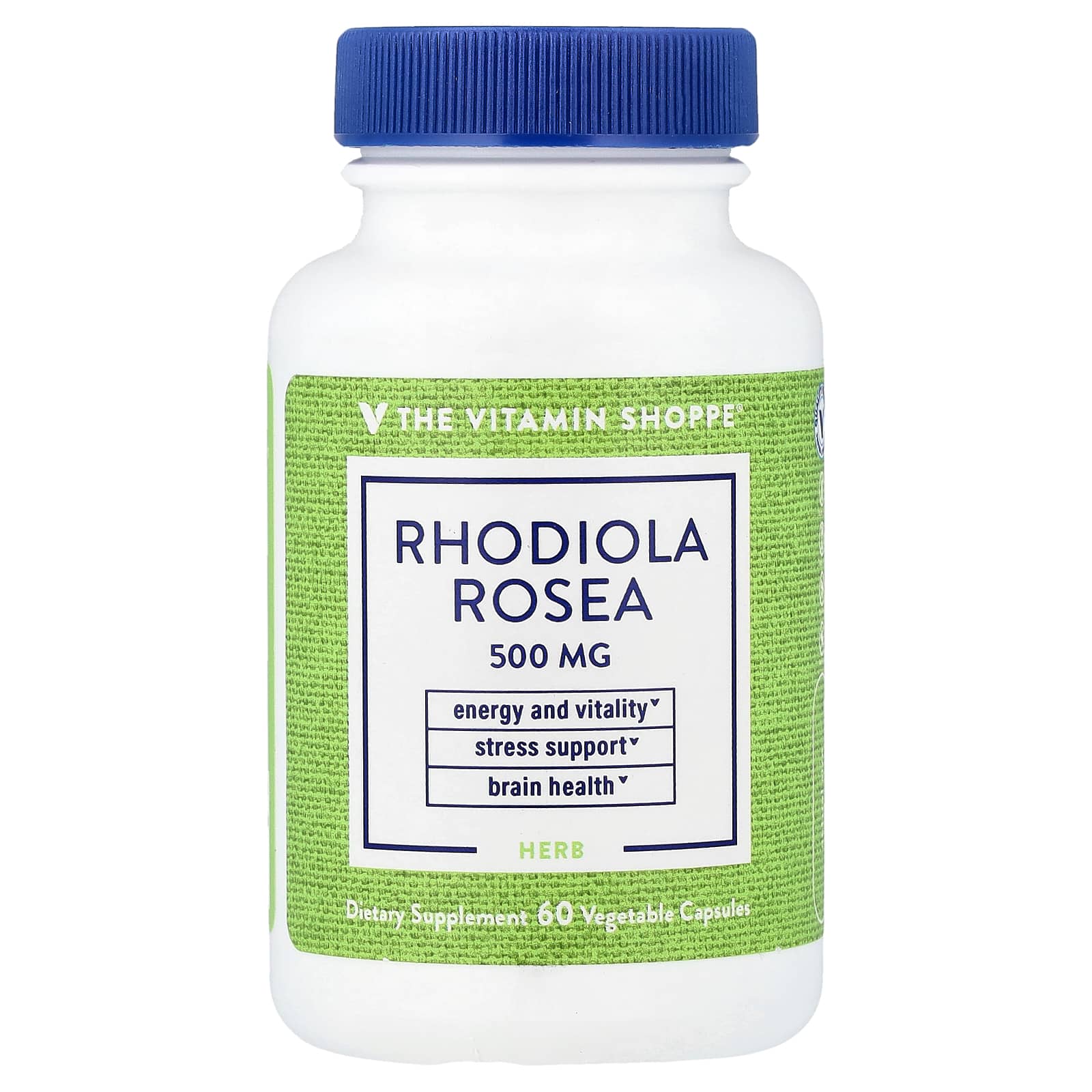
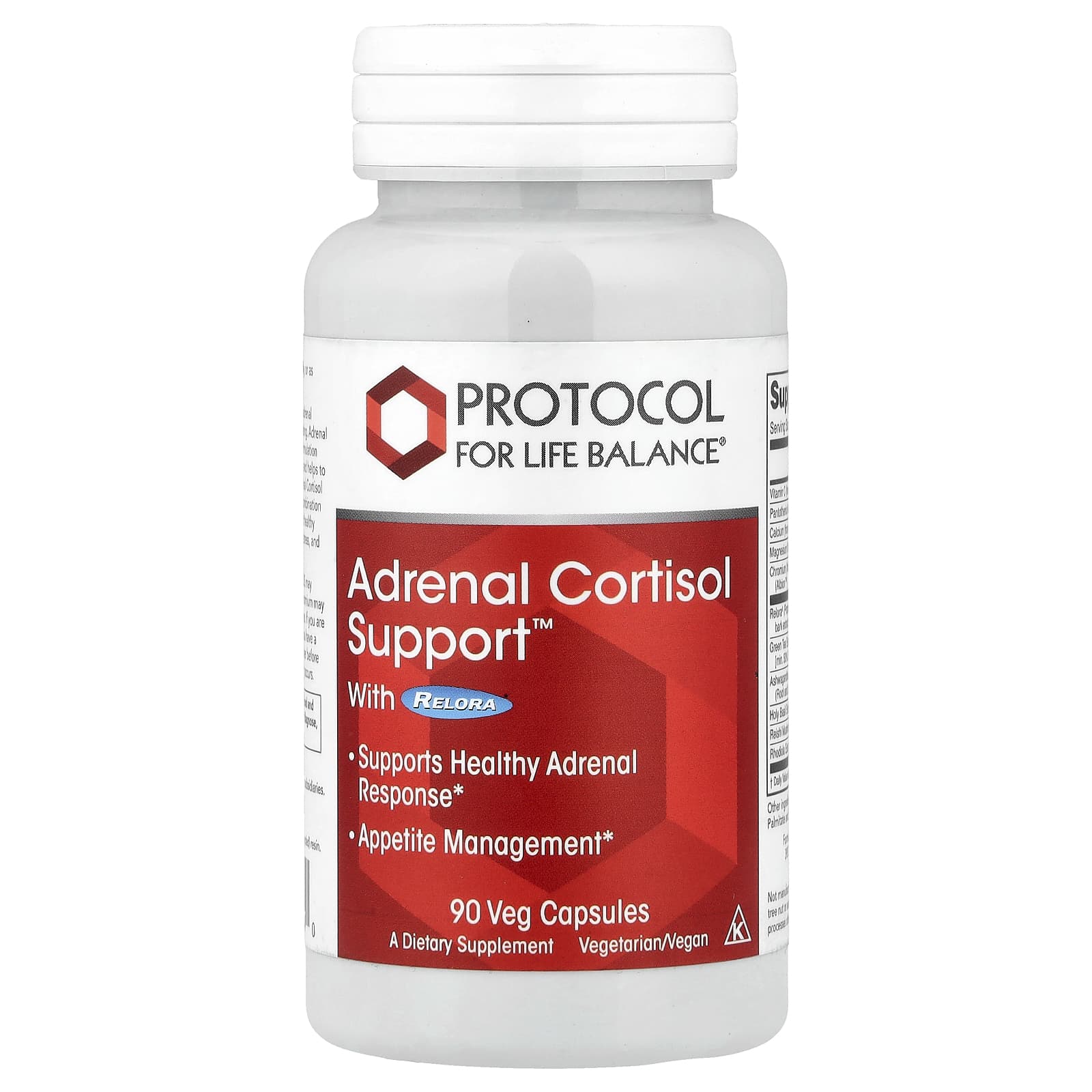
Rhodiola is a plant, Rhodiola rosea, also called golden root, arctic root or rose root. It grows in cold regions and at high altitudes. Supplements contain extracts of its root and rhizome, or root powder. Extracts are often standardized to rosavins and to salidroside, compounds of the root.
Terms and sources
- golden root
- NCCIH lists the common names arctic root, golden root, rose root, rosenroot and king's crown.
- high altitudes
- NIH National Center for Complementary and Integrative Health (NCCIH), rhodiola page.
- rhizome
- An underground stem. Panossian et al., Phytomedicine, 2010; Döring et al., Phytomedicine, 2021.
- rosavins
- Rosavin, rosin and rosarin. Punja et al., PLoS One, 2014.
Rhodiola in the body
Rhodiola is not a nutrient, and the body has no daily requirement for it. Trials of its extracts measure things such as mental fatigue tests, exercise tests and self-rated tiredness.
About 140 compounds have been isolated from its roots and rhizome. Rosavin is found only in Rhodiola rosea; salidroside is also found in other Rhodiola species. One trial report states that rosavins and salidroside occur in the plant at a 3 to 1 ratio. In several exercise trials, extracts were standardized to at least 3% rosavins and 1% salidroside.
Terms and sources
- About 140 compounds
- Among them phenylpropanoids, phenylethanoids, flavonoids and others. Panossian et al., Phytomedicine, 2010. The first author worked for the Swedish Herbal Institute.
- found only in Rhodiola rosea
- Punja et al., PLoS One, 2014. Booker et al. use rosavin as the marker that tells R. rosea apart from related species.
- 3 to 1 ratio
- Punja et al., PLoS One, 2014.
- at least 3% rosavins
- Lu et al., Frontiers in Nutrition, 2022, on the trials in its review. Some trials did not state the content.
In one trial's source, roots grown in Alberta held from 0.2% to 10% total rosavins by dry weight. In one analysis of about 40 products, about a fifth of those sold as R. rosea held no rosavin. Another analysis confirmed the labeled salidroside and rosavins in less than a quarter of products.
Terms and sources
- 0.2% to 10%
- Roots of different ages from different places in Alberta, Canada. For the trial, 4-year-old roots were extracted and standardized to 2.8%. Punja et al., PLoS One, 2014.
- about 40 products
- Powders and extracts bought from different suppliers. Most of the rest held less rosavin than products registered as herbal medicines. Booker et al., Phytomedicine, 2016.
- about a fifth
- One author of this analysis works for Dr. Willmar Schwabe GmbH, and two for CAMAG AG.
- less than a quarter
- Marchev et al., Phytochemical Analysis, 2020. A compound found only in R. crenulata among the species tested turned up in 2 of 4 products tested by NMR.
NCCIH says: "Rhodiola is possibly safe for up to 12 weeks." NCCIH adds: "Side effects may include dizziness, headache, insomnia, and either dry mouth or excessive saliva production." NCCIH also notes: "Interactions between rhodiola and losartan (a drug used for high blood pressure) have been reported." NCCIH adds: "Little is known about whether it’s safe to use rhodiola during pregnancy or while breastfeeding." NCCIH advises: "If you take any type of medicine, talk with your health care provider before using any herbal product." It adds: "some herbs and medicines interact in harmful ways."
Terms and sources
- up to 12 weeks
- NIH National Center for Complementary and Integrative Health (NCCIH), rhodiola page.
Where rhodiola comes from
Rhodiola grows in Europe, Asia and North America, in cold regions and at high altitudes. It has a long history of use in Russia, Scandinavia and other parts of Europe. It is a perennial herb of the Crassulaceae family, usually 10–30 cm tall. It grows mainly in rock crevices or among bushes.
Terms and sources
- North America
- NIH National Center for Complementary and Integrative Health (NCCIH), rhodiola page.
- long history of use
- NIH National Center for Complementary and Integrative Health (NCCIH), rhodiola page.
- Crassulaceae
- Lu et al., Frontiers in Nutrition, 2022.
- rock crevices
- Lu et al., Frontiers in Nutrition, 2022.
Supplements use the root and the rhizome. Rhodiola crenulata, a Chinese species, is believed to be a common adulterant in the R. rosea supply chain. In one trial, the extract came from 4-year-old roots grown in Alberta from DNA-checked seed.
Terms and sources
- root and the rhizome
- Panossian et al., Phytomedicine, 2010; Döring et al., Phytomedicine, 2021.
- adulterant
- A different material sold in place of the labeled one. Booker et al., Phytomedicine, 2016.
- DNA-checked seed
- Seeds from plants confirmed as R. rosea by DNA testing, grown under an Alberta government project. Punja et al., PLoS One, 2014.
Published studies of rhodiola
NCCIH states: "There isn’t enough reliable evidence to determine whether rhodiola or its components are useful for any health-related purpose." It adds: "Most of the research in people is of low-to-moderate quality."
Many trials of rhodiola enrolled people with a diagnosis or selected people by symptom scores. Those trials, trials of mixtures and trials of other Rhodiola species are not listed here.
7 studies in adults without a diagnosis: 2 found a difference, 1 none, 1 a difference against rhodiola, 3 mixed.
One review of 10 small exercise trials is listed; of its trials, only the marathon trial has its own row. Not listed: studies in people with a diagnosis, selected by symptom scores, or with participants under 18. Also not listed: studies without stated random allocation, without a dummy comparison, or with one group only. The listed review holds 2 trials not described as randomized, and one listed trial has such a part. Also not listed: a trial whose main results compare with a no-capsule period that always came first. Also not listed: a medicine-interaction study, mixtures, salidroside alone, and products whose species we could not check. Also not listed: other reviews that include such studies, children or several Rhodiola species. Also not listed: reviews whose trial list we could not read. Also not listed: a second report of the marathon trial and an eye-strain study.
Our one-line summary comes first. The original is on PubMed.
Show the 7 studies
A review of 10 small exercise trials in healthy adults found mixed results; it did not combine their data.
Review · 183 people · 1 hour to 37 days
Lu et al., Frontiers in Nutrition, 2022
Terms and sources
- 10 small exercise trials
- 183 people in all, 10 to 48 per trial, from 1 hour to 37 days. Each compared rhodiola alone with a dummy product. The review's table does not describe 2 of them as randomized. Doses were 170–1,500 mg a day, or 3 mg per kg of body weight. Three trials added a dose on the test day.
- healthy adults
- Ages about 19 to 65.
- found mixed results
- By the review's table, 2 of the 10 trials found no difference on any measure. Others reported differences on some measures only, such as effort ratings or lactate. In one trial, people completed fewer repetitions to failure with rhodiola.
- did not combine their data
- The authors cite differences between the trials. They rate the quality of most trials as low. A correction updated the reference details of the trial table.
Study · Free full text · about 15 min to read
Our estimate at about 200 words a minute, from the PMC full text.
Study summary
A systematic review collected 10 small trials of rhodiola alone against a dummy product in 183 healthy adults. Trials lasted from 1 hour to 37 days and used 170–1,500 mg a day. The authors did not combine the results. In the review's table, 2 trials found no difference on any measure. The others reported differences on some measures only. One trial found fewer repetitions to failure with rhodiola. The authors rate the quality of most trials as low. Funding: Chinese government science grants.
Marathon runners took rhodiola for 30 days; race times and muscle damage did not differ from a dummy product.
Trial · 48 people · 30 days before the race · industry author
Shanely et al., Brain, Behavior, and Immunity, 2014
Counted in the Lu 2022 review
Terms and sources
- Marathon runners
- 48 experienced marathon runners, 13 women and 35 men; 24 took rhodiola and 24 the dummy product. This is the largest trial in the Lu 2022 review.
- took rhodiola
- 600 mg of extract a day for 30 days before the race, on race day and for 7 days after.
- race times
- 3.87 hours with rhodiola and 3.93 with the dummy product. The difference was not statistically significant.
- muscle damage
- Blood markers of muscle damage and inflammation, muscle soreness and jump height. All changed after the race, with no difference between groups.
- a dummy product
- Placebo; the abstract does not describe its form.
- industry author
- Two authors list companies: PL Thomas & Co., Inc. and PoliNat SL. The Lu 2022 review names PL Thomas as the extract source. We could not read the Funding section.
Study · Abstract only · about 2 min to read
Our estimate from the abstract, at about 200 words a minute.
Study summary
A trial gave 48 experienced marathon runners rhodiola extract or a dummy product. They took 600 mg a day for 30 days before the race and 7 days after. Race times did not differ: 3.87 hours with rhodiola and 3.93 with the dummy. Muscle soreness, jump height and blood markers of muscle damage changed after the race in both groups alike. Funding: not read; two authors list companies, one of them the extract source.
After one dose of SHR-5, cadets scored higher on a mental work index than cadets given a dummy product.
Trial · 161 cadets in four groups by the abstract (PubMed 12725561); Punja 2014 (Discussion) and Ishaque 2012 (Table 1, PMC3541197) give 121, with groups 41/20/40/20 = 121 (Ishaque); the abstract does not give group sizes · One dose · funding not stated
Shevtsov et al., Phytomedicine, 2003
Terms and sources
- one dose of SHR-5
- 2 or 3 capsules of the standardized extract SHR-5; the abstract does not give mg.
- cadets
- 161 cadets aged 19 to 21 by the abstract. They were in four groups: two doses, a dummy product and a group with no capsule. Punja 2014, below, counts 121.
- mental work index
- An antifatigue index from psychometric tests: 1.04 and 1.02 with the two doses, 0.90 with the dummy product. The tests were done under fatigue and stress. The difference was statistically significant for both doses.
- a dummy product
- Placebo; the abstract does not describe its form. The two doses did not differ from each other. Punja 2014, below, notes the randomization method was unclear and the index did not appear to be validated.
- funding not stated
- We could not read the article. PubMed gives an affiliation only for the first author, a Russian Ministry of Health center.
Study · Abstract only · about 2 min to read
Our estimate from the abstract, at about 200 words a minute.
Study summary
A trial gave 161 cadets, by the abstract, one dose of the rhodiola extract SHR-5, a dummy product or nothing. Two doses were tested: 2 or 3 capsules. The index of mental work under fatigue was 1.04 and 1.02 with the doses, 0.90 with the dummy. The difference was statistically significant; the doses did not differ. Punja 2014 counts 121 cadets. Funding: not stated in what we could read.
Doctors on night duty took SHR-5 daily; fatigue test scores differed from a dummy tablet in the first period.
Trial · 56 people · 2 weeks per period · funding not stated
Darbinyan et al., Phytomedicine, 2000
Terms and sources
- Doctors on night duty
- 56 young, healthy physicians. Each took rhodiola and the dummy tablet for 2 weeks each, one after the other. A break separated the two periods.
- SHR-5 daily
- One tablet a day, a low dose of the standardized extract SHR-5; the abstract does not give mg.
- fatigue test scores
- A fatigue index from 5 tests: associative thinking, short-term memory, calculation, concentration and speed of audio-visual perception. No side effects were reported.
- in the first period
- The first 2-week period. The abstract reports a statistically significant change for this period only. It gives no result for the later period. Punja 2014, below, notes longer night duty in the second period and calls the findings inconclusive.
- funding not stated
- We could not read the article. PubMed gives an affiliation only for the first author, a university in Yerevan.
Study · Abstract only · about 2 min to read
Our estimate from the abstract, at about 200 words a minute.
Study summary
A trial gave 56 young doctors on night duty one SHR-5 tablet a day or a dummy tablet. Each took both for 2 weeks, one after the other, with a break between. A fatigue index from 5 mental tests differed in the first 2-week period. The difference was statistically significant. The abstract gives no result for the second period. Punja 2014 calls the findings inconclusive. No side effects were reported. Funding: not stated in what we could read.
Nursing students on shift work took rhodiola for 6 weeks and rated their tiredness higher than with a dummy capsule.
Trial · 48 people · 42 days
Punja et al., PLoS One, 2014
Terms and sources
- Nursing students on shift work
- 48 otherwise healthy students aged 18 to 55 at the University of Alberta, Canada; 40 were analyzed, 21 and 19.
- took rhodiola
- Two 182 mg capsules a day, plus one more if wanted, of an extract standardized to 2.8% total rosavins. Each 182 mg capsule held the extract mixed with filler. Funded by the Government of Alberta through AVAC Ltd. The funder made the capsules and had no role in the analysis or report.
- rated their tiredness higher
- Two tiredness scales, both statistically significant against rhodiola at day 42. A general health score also differed against rhodiola. Side effects: 6 people in each group.
- a dummy capsule
- Placebo capsules of the same look, weight, smell and taste, made of microcrystalline cellulose.
Study · Free full text · about 17 min to read
Our estimate at about 200 words a minute, from the PMC full text.
Study summary
A trial gave 48 nursing students on shift work rhodiola extract or a dummy capsule for 42 days. The extract was standardized to 2.8% rosavins. Each took two 182 mg capsules a day, with one more if wanted. At day 42, both tiredness scales were higher with rhodiola than with the dummy capsule. The difference was statistically significant. Side effects were reported by 6 people in each group. Funding: the Government of Alberta, through AVAC Ltd.; the funder made the capsules.
One rhodiola dose lengthened time to exhaustion versus starch; 4 weeks of daily use showed no difference.
Trial · 24 people · One dose, then 4 weeks · funding not stated
De Bock et al., International Journal of Sport Nutrition and Exercise Metabolism, 2004
Terms and sources
- One rhodiola dose
- 200 mg of extract with 3% rosavin and 1% salidroside, plus 500 mg starch, 1 hour before testing.
- time to exhaustion
- 17.2 minutes with rhodiola and 16.8 with starch, in 24 young adults, one after the other. Peak oxygen uptake was also higher. The difference was statistically significant.
- starch
- The dummy was 700 mg of starch. Reaction time, attention, limb speed and leg strength did not differ.
- 4 weeks of daily use
- 12 people took 200 mg a day or the dummy for 4 weeks. The abstract does not describe this part as randomized. None of the measured outcomes differed.
- funding not stated
- We could not read the article. PubMed gives an affiliation only for the first author, a university in Leuven.
Study · Abstract only · about 2 min to read
Our estimate from the abstract, at about 200 words a minute.
Study summary
A trial gave 24 young adults 200 mg of rhodiola extract or 700 mg of starch. Each took both, one after the other, 1 hour before tests. Time to exhaustion was 17.2 minutes with rhodiola and 16.8 with starch. The difference was statistically significant. Reaction time, attention and strength did not differ. In a second part, 12 people took 200 mg a day or the dummy for 4 weeks; no measure differed. The abstract does not describe this part as randomized. Funding: not stated in what we could read.
On 4 days of RhodioZen, fatigue tests did not differ from a dummy pill; some lifts were higher.
Trial · 18 people · 4 days per period · maker-supplied
Marcos-Frutos et al., Nutrients, 2025
Terms and sources
- RhodioZen
- 1,200 mg a day for 4 days: 300 mg pills with 3% rosavins and 1% salidroside, by the maker's analysis.
- fatigue tests
- A 30-minute Stroop test, analyzed in 16 people, and a visual tracking test. 18 trained adults, 7 of them women, took both, one after the other. Effort ratings did not differ either. No side effects were reported.
- a dummy pill
- Maltodextrin pills of 300 mg.
- some lifts were higher
- Bench-press repetitions and bench-pull speed, in 4 of 32 comparisons, after a neutral video. The other 28 did not differ. The overall rhodiola effect was not statistically significant for any lift.
- maker-supplied
- Pharmanager Ingredients, the maker of RhodioZen, provided the pills. Two authors list its R&D department and advise it. Three authors advise Life Pro Nutrition, which supplied the dummy pills. Two of them packed the blinded pill sets. The article reports no external funding.
Study · Free full text · about 18 min to read
Our estimate at about 200 words a minute, from the PMC full text.
Study summary
A trial gave 18 trained adults RhodioZen or a dummy pill for 4 days each, one after the other. The dose was 1,200 mg a day. Stroop and visual tracking tests and effort ratings did not differ. In 4 of 32 strength comparisons, results were higher with rhodiola. The overall rhodiola effect was not statistically significant for any lift. No side effects were reported. Funding: no external funding; the maker provided RhodioZen, and two authors list its R&D department.
Information, not a prescription. Do not start, stop or combine supplements or medicines on your own.