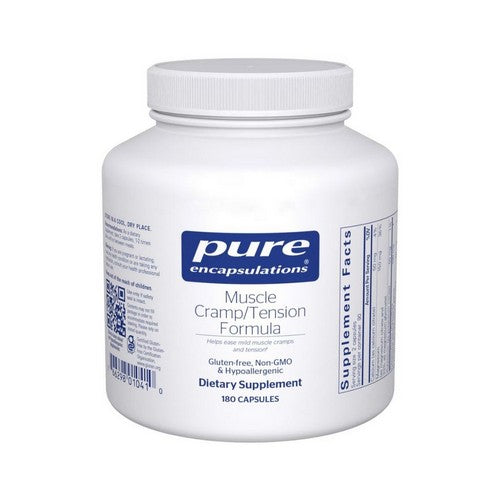
Pure Encapsulations · capsules

Muscle Cramp/Tension Formula

At the recorded label maximum: 4 capsules per day

Add to my list
Per day$0.53 – $1.07

For 2 to 4 capsules a day as stated on the label.

Per pack$48.00

180 capsules · Vita Living · checked 20 Nov 2026. Delivery is not included.

Per capsule$0.27

Pack price divided by the number of capsules in the pack.

Composition

Amounts at the recorded label maximum. Directions may give a range.

Calciumas Calcium Citrate
About this formcalcium citrate (incl. citrate malate) — about 21% of the compound is calcium itself. Absorbed without food; about 21% calcium, so tablets are larger. Reference level V0; no form is called “better” here.
100 mgat the recorded label maximum (2 servings × 50 mg; 2 capsules per serving) · as calcium itself25 mg per capsule · calculated from 50 mg per 2 capsules
5% of 2,000 mg — US upper limit for adults, National Academies2,500 mg (ages 19–50) · 2,000 mg (51 and older) · from food and supplements, adults · food is not counted here · a reference value, not a legal limit
300 mgat the recorded label maximum (2 servings × 150 mg; 2 capsules per serving) · as magnesium itself75 mg per capsule · calculated from 150 mg per 2 capsules
86% of 350 mg — US upper limit for adults, National Academiesmagnesium from supplements, adults · a reference value, not a legal limit
Passionflower (Passiflora incarnata) extract
200 mgat the recorded label maximum (2 servings × 100 mg; 2 capsules per serving)50 mg per capsule · calculated from 100 mg per 2 capsules
No limit on file for the United StatesNone on file in any country
Lemon Balm (Melissa officinalis) extract
100 mgat the recorded label maximum (2 servings × 50 mg; 2 capsules per serving)25 mg per capsule · calculated from 50 mg per 2 capsules
No limit on file for the United StatesNone on file in any country
100 mgat the recorded label maximum (2 servings × 50 mg; 2 capsules per serving)25 mg per capsule · calculated from 50 mg per 2 capsules
No limit on file for the United StatesNone on file in any country

Where no limit is shown, none is set or on file for the United States. That is not the same as having no maximum.

Manufacturer's directions

Recommendations: As a dietary supplement; take 2 capsules; 1-2 times daily; with or between meals.

Other ingredients on the label

Vegetarian Capsule (Cellulose, Water), Ascorbyl Palmitate

Limits in other countries
CountryCalciumMagnesium
United States2,000 mgreference, not a law · 5%
Comparison note2,500 mg (ages 19–50) · 2,000 mg (51 and older)
350 mgreference, not a law · 86%
Austria800 mgrecommendation · 13%375 mgrecommendation · 80%
Belgium1,600 mglaw · 6%450 mglaw · 67%
Croatia1,500 mglaw · 7%375 mglaw · 80%
Cyprus1,500 mglaw · 7%300 mglaw · 100%
Denmark1,327 mgrecommendation · 8%233 mgrecommendation · 129% · above
EAEU2,500 mglaw · 4%800 mglaw · 38%
Estonia2,500 mgrecommendation · 4%250 mgrecommendation · 120% · above
Finland2,500 mgrecommendation · 4%250 mgrecommendation · 120% · above
France800 mglaw · 13%300 mglaw · 100%
Germany500 mgrecommendation · 20%250 mgrecommendation · 120% · above
Ireland2,500 mgrecommendation · 4%250 mgrecommendation · 120% · above
Italy1,200 mgrecommendation · 8%450 mgrecommendation · 67%
Luxembourg1,600 mglaw · 6%562.5 mglaw · 53%
Malta1,500 mgrecommendation · 7%400 mgrecommendation · 75%
Norway705 mglaw · 14%350 mglaw · 86%
Poland1,500 mgrecommendation · 7%400 mgrecommendation · 75%
Switzerland750 mglaw · 13%375 mglaw · 80%

Maximum amounts per daily dose of a food supplement, as each country sets them; the share is the daily amount on the label against that maximum. Law = legally binding; recommendation = an authority's recommended maximum, not binding; reference = the U.S. upper intake level for adults from all sources (National Academies), not a legal limit. Verification level V0 · Report an error

About the ingredients

Ingredient information

Ingredient guideCalciumCalcium is the most abundant mineral in the human body. An adult body holds about 1.2–1.4 kg of it, almost all in bones and teeth. Milk, yogurt and cheese are rich sources. Supplements contain calcium as part of a compound, most often calcium carbonate or calcium citrate.Read moreShow less
Terms and sources
1.2–1.4 kg
About 1,200 g in women and 1,400 g in men. NIH Office of Dietary Supplements.

Calcium in the body

About 99% of the body's calcium is in bones and teeth. The other 1% is in the blood and soft tissues. This small part is needed for normal muscle function, nerve signaling, blood clotting and hormone release. It also takes part as blood vessels tighten and relax.

Terms and sources
bones and teeth
There it sits in hydroxyapatite, a mineral of calcium and phosphate. Linus Pauling Institute; NIH Office of Dietary Supplements.

The body keeps blood calcium in a narrow range, about 8.8–10.4 mg/dL. When intake is low, it draws calcium from bone to hold that range. A blood test therefore does not show how much calcium a person gets. Bone is rebuilt all the time; teeth are not. Vitamin D is needed to absorb calcium in the gut.

Terms and sources
8.8–10.4 mg/dL
2.2–2.6 mmol/L, total calcium in serum in healthy people. NIH Office of Dietary Supplements.
absorb calcium in the gut
Vitamin D is needed for active transport, the main route when intake is low. NIH Office of Dietary Supplements.

Information, not a prescription. Do not start, stop or combine supplements or medicines on your own.
Ingredient guideMagnesiumMagnesium is an essential mineral: the human body cannot make it and gets it from food and drinks. An adult body holds about 25 g, mostly in bone. Supplements add to it, in forms such as magnesium citrate, glycinate and oxide.Read moreShow less

Magnesium in the body

Inside cells, magnesium is the second most common positively charged mineral, after potassium. It takes part in more than 300 enzyme systems. It is needed for normal muscle and nerve function, energy metabolism, protein synthesis, and normal bones and teeth.

Terms and sources
positively charged mineral
a cation. de Baaij et al., Physiological Reviews, 2015 (PMID 25540137).
enzyme systems
Enzymes are proteins that run chemical reactions in cells. The 300 figure is from NIH ODS. A 2015 review puts the number of enzyme reactions at over 600.
energy metabolism
How cells turn food into usable energy.

About 50–60% of the body's magnesium sits in bone. Most of the rest is in muscle and other soft tissue. Less than 1% is in the blood. A blood test sees only this small part.

Terms and sources
in the blood
In serum. The usual range is 0.75–0.95 mmol/L.

Information, not a prescription. Do not start, stop or combine supplements or medicines on your own.

Ingredient guideChamomileChamomile is a plant whose dried flower heads are brewed as herbal tea and used in supplements. NCCIH describes two types, German and Roman chamomile, and its fact sheet focuses on German chamomile. Products contain dried flowers, flower extracts, liquid extracts or essential oil, alone or in blends.Read moreShow less
Terms and sources
dried flower heads
Chamomile tea is brewed from dried flower heads. McKay and Blumberg, Phytotherapy Research, 2006.
German chamomile
Matricaria recutita, also named Chamomilla recutita or Matricaria chamomilla. NCCIH, Chamomile: Usefulness and Safety.
NCCIH
NIH National Center for Complementary and Integrative Health.
flower extracts
EMA's public summary on matricaria flower names cut flowers and dry or liquid extracts, for herbal medicines. Some of these medicines combine it with other herbs. Essential oil: McKay and Blumberg, Phytotherapy Research, 2006.

Chamomile in the body

Chamomile is not a nutrient, and the body has no daily requirement for it. German chamomile is Matricaria recutita; Roman chamomile is a different plant, Chamaemelum nobile. Tea and supplements use the dried flower heads.

Terms and sources
Matricaria recutita
Also named Chamomilla recutita or Matricaria chamomilla. NCCIH, Chamomile: Usefulness and Safety.
Chamaemelum nobile
Carnat et al., Fitoterapia, 2004.
dried flower heads
McKay and Blumberg, Phytotherapy Research, 2006.

The flowers hold flavonoids, mainly apigenin, quercetin, patuletin and luteolin, and their glucosides. The essential oil of the flowers holds mainly alpha-bisabolol and its oxides, and azulenes such as chamazulene. In one analysis, apigenin and its glucosides were found in the ligulate florets, not in the tubular florets. Free apigenin does not occur in living flowers; it forms after harvest from apigenin 7-glycoside. In one study of healthy men, apigenin forms in urine equaled 34% of the apigenin in chamomile tea.

Terms and sources
flavonoids
Plant pigments of the polyphenol family. McKay and Blumberg, Phytotherapy Research, 2006.
azulenes
McKay and Blumberg, Phytotherapy Research, 2006.
ligulate florets
Ligulate means strap-shaped. Redaelli et al., Planta Medica, 1981. The first author's affiliation is the research laboratory of Bonomelli S.p.A.
forms after harvest
So its share in dried flowers depends on post-harvest conditions. Schreiber et al., Planta Medica, 1990.
one study of healthy men
Borges et al., Free Radical Biology and Medicine, 2022. The drinks were not given in random order. We could not read the full text.

NCCIH writes: “Chamomile is likely safe when used orally in amounts commonly found in teas and other foods.” It adds: “It is possibly safe when used by adults and children orally for medicinal purposes over the short term.” And: “Using chamomile on the skin in adults and children or as an oral rinse for medicinal purposes is possibly safe at certain doses and over the short term.” NCCIH notes: “Side effects are uncommon and may include nausea, dizziness, and allergic reactions, including severe hypersensitivity reactions and anaphylaxis, in some people.” It adds: “If used near the eyes, chamomile might cause eye irritation.” On allergy, NCCIH writes: “People are more likely to experience allergic reactions to chamomile if they’re allergic to related plants such as ragweed, chrysanthemums, marigolds, or daisies.” NCCIH also writes: “Chamomile might have some of the same effects as estrogen.” It adds: “Preliminary studies suggest that taking chamomile along with birth control pills might decrease the effects of birth control pills.” And: “In addition, chamomile might worsen any condition that is sensitive to exposure to estrogen, such as breast or uterine cancer.” On medicines, NCCIH writes: “Interactions between chamomile and some drugs metabolized by the liver and warfarin (a blood thinner) have been reported, and there are theoretical reasons to suspect that chamomile might interact with other drugs as well, such as sedatives.” NCCIH advises: “If you take any type of medicine, talk with your health care provider before using chamomile or other herbal products; some herbs and medicines interact in harmful ways.” It also writes: “Little is known about whether it’s safe to use chamomile during pregnancy or while breastfeeding.” This page is about chamomile taken by mouth.

Terms and sources
NCCIH writes
NIH National Center for Complementary and Integrative Health (NCCIH), Chamomile: Usefulness and Safety. Its section What Do We Know About Safety? is quoted here in full. The fact sheet focuses on German chamomile.

Information, not a prescription. Do not start, stop or combine supplements or medicines on your own.

Services

Choose the option that suits you.

Quick selection

I know my goal

$5

1–2 minutes · a few questions with fixed answers

One goal. Up to three products. Set a budget per day if you like.

Product checks
form and amount on the label, plus shop prices
Daily schedule
what to take, when, how much
Totals and limits
next to the upper limit
Reasons & sources
for each product
Prices and shops
plus food and habits
Progress
what to track, when to see a doctor

Complete the questionnaire before you pay. If no product fits any of your goals, you won’t be charged.

Order · $5View example

Full selection

I have several goals

$15

5–7 minutes · questionnaire with fixed answers

Up to three goals in one set. Where two goals overlap, one product is used for both.

Product checks
form and amount on the label, plus shop prices
Daily schedule
what to take, when, how much
Totals and limits
next to the upper limit
Reasons & sources
for each product
Prices and shops
plus food and habits
Progress
what to track, when to see a doctor

Complete the questionnaire before you pay. If no product fits any of your goals, you won’t be charged.

Order · $15View example

Expert review

I want a person to look at my supplements

$50

Written review within 48 hours of your completed questionnaire

An expert reviews your supplement list and questionnaire.

Written review
duplicates, limits, forms
Detailed questionnaire
supplements, medicines, history
Optional uploads
supplement-label photos or documents relevant to your review
Your notes
your priorities and questions
Follow-up questions
in writing, when needed
Next steps
points to discuss with your doctor

Complete the questionnaire before you pay.

Order · $50View example
Sources, label & certificates

Label record

Copied from the NIH label database (DSLD 182999) · not yet compared with the label · checked 19 Oct 2026 · Report an error

The United States has no pre-market registration for supplements.
Label on file in the NIH Dietary Supplement Label Database
checked 19 Oct 2026source: NIH DSLDReport an error

Barcode 7 66298 01041 0

Third-party certificates

Label mentions: Helps ease mild muscle cramps and tension. Not yet checked against the certifiers’ registries.

Information, not a prescription. Do not start, stop or combine supplements or medicines on your own. If you have a health condition, are pregnant or breastfeeding, take medicines, or are under 18, talk to a doctor or pharmacist first.

Photo credits

Image: © Pure Encapsulations. Shown to identify the product. Source:

Rights holders can ask us to remove an image or send official product photos: info@verateca.com.

Product photo

Pure Encapsulations Muscle Cramp/Tension Formula — enlarged pack