Nature's Answer · capsules

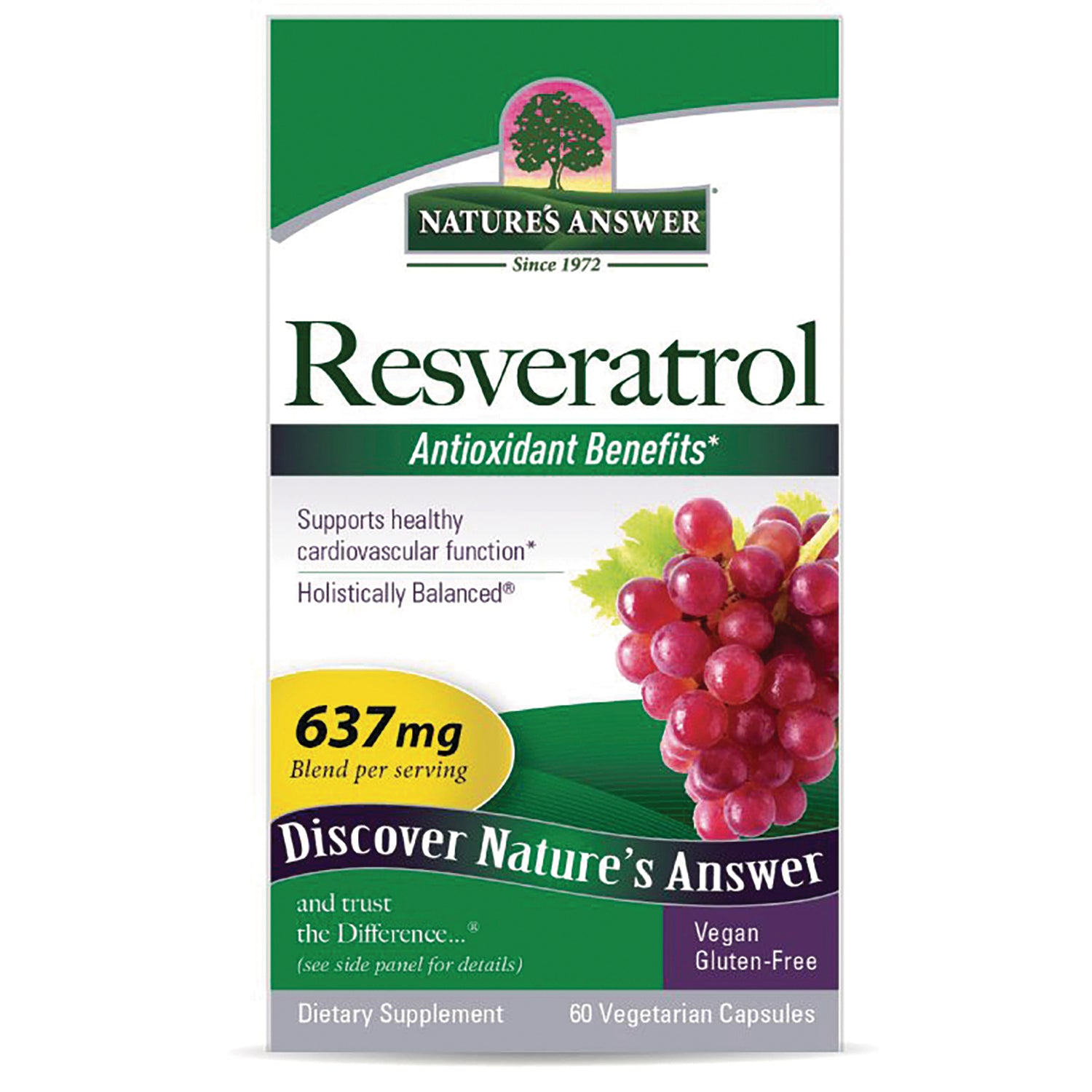
Resveratrol

At the recorded label maximum: 1 capsule per day

Add to my list
Per day$0.47

At the label maximum of 1 capsule a day.

Per pack$28.49

60 capsules · Swanson · checked 20 Nov 2026. Delivery is not included.

Per capsule$0.47

Pack price divided by the number of capsules in the pack.

Composition

Amounts at the recorded label maximum. Directions may give a range.

Amounts not disclosed. The label gives only the total weight of this blend, not the amount of each ingredient in it. Without the individual amounts, we cannot compare these ingredients with upper limits.

60 mgat the recorded label maximum (1 capsule × 60 mg)60 mg per capsule · calculated from 60 mg per 1 capsule
3% of 2,000 mg — US upper limit for adults, National Academiesfrom food and supplements, adults · food is not counted here · a reference value, not a legal limit
Grape seed extractas Proanthocyanidins
Amount not disclosedpart of Proprietary Cellular Longevity Complex · not counted
No limit on file for the United StatesNone on file in any country
Grape skin extractas Polyphenols
Amount not disclosedpart of Proprietary Cellular Longevity Complex · not counted
No limit on file for the United StatesNone on file in any country
Muscadine Grape
Amount not disclosedpart of Proprietary Cellular Longevity Complex · not counted
No limit on file for the United StatesNone on file in any country
Muscadine Grape
Amount not disclosedpart of Proprietary Cellular Longevity Complex · not counted
No limit on file for the United StatesNone on file in any country
Grape
Amount not disclosedpart of Proprietary Cellular Longevity Complex · not counted
No limit on file for the United StatesNone on file in any country
Raspberry
Amount not disclosedpart of Proprietary Cellular Longevity Complex · not counted
No limit on file for the United StatesNone on file in any country
Amount not disclosedpart of Proprietary Cellular Longevity Complex · not counted
No limit on file for the United StatesNone on file in any country
Amount not disclosedpart of Proprietary Cellular Longevity Complex · not counted
No limit on file for the United StatesNone on file in any country
Strawberry
Amount not disclosedpart of Proprietary Cellular Longevity Complex · not counted
No limit on file for the United StatesNone on file in any country
Acai
Amount not disclosedpart of Proprietary Cellular Longevity Complex · not counted
No limit on file for the United StatesNone on file in any country
Pomegranate fruit extract
Amount not disclosedpart of Proprietary Cellular Longevity Complex · not counted
No limit on file for the United StatesNone on file in any country
Green Tea leaf extractas EGCG | Polyphenols
Amount not disclosedpart of Proprietary Cellular Longevity Complex · not counted
No limit on file for the United StatesNone on file in any country
Fig
Amount not disclosedpart of Proprietary Cellular Longevity Complex · not counted
No limit on file for the United StatesNone on file in any country
Wild Blueberry
Amount not disclosedpart of Proprietary Cellular Longevity Complex · not counted
No limit on file for the United StatesNone on file in any country
Wild Bilberry
Amount not disclosedpart of Proprietary Cellular Longevity Complex · not counted
No limit on file for the United StatesNone on file in any country
Quercetin
27 mgat the recorded label maximum (1 capsule × 27 mg)27 mg per capsule · calculated from 27 mg per 1 capsule
No limit on file for the United StatesNone on file in any country

Where no limit is shown, none is set or on file for the United States. That is not the same as having no maximum.
Manufacturer's directions

Suggested Use: As a dietary supplement; take one (1) capsule daily.

Other ingredients on the label

Vegetable Cellulose, Rice Flour, Calcium Silicate, Quik-Sorb (Amla, Capsicum, Ginger)

Limits in other countries
CountryVitamin C
United States2,000 mgreference, not a law · 3%
Austria500 mgrecommendation · 12%
Belgium1,000 mglaw · 6%
Croatia800 mglaw · 8%
Cyprus2,000 mglaw · 3%
Denmark1,000 mgrecommendation · 6%
EAEU900 mglaw · 7%
Estonia—not on file
Finland—not on file
France180 mglaw · 33%
Germany250 mgrecommendation · 24%
Ireland2,000 mgrecommendation · 3%
Italy1,000 mgrecommendation · 6%
Luxembourg1,000 mglaw · 6%
Malta1,000 mgrecommendation · 6%
Norway1,000 mglaw · 6%
Poland1,000 mgrecommendation · 6%
Switzerland750 mglaw · 8%

Maximum amounts per daily dose of a food supplement, as each country sets them; the share is the daily amount on the label against that maximum. Law = legally binding; recommendation = an authority's recommended maximum, not binding; reference = the U.S. upper intake level for adults from all sources (National Academies), not a legal limit. Verification level V0 · Report an error

About the ingredients

Ingredient information

Ingredient guideVitamin CVitamin C, also called L-ascorbic acid, is a water-soluble vitamin. Most animals make vitamin C in the body; humans cannot and get it from food. Fruits and vegetables such as peppers, citrus fruits and kiwifruit are the main sources. Supplements contain it as ascorbic acid or as mineral salts such as sodium and calcium ascorbate.Read moreShow less
Terms and sources
water-soluble
It dissolves in water, not in fat. NIH Office of Dietary Supplements.

Vitamin C in the body

Vitamin C is needed to make collagen, carnitine and some neurotransmitters. It is also an antioxidant and can return used vitamin E to its active form. It is needed for normal immune function. It increases the absorption of iron from plant foods.

Terms and sources
collagen
A protein that holds together connective tissue, such as skin, tendons and blood vessels. NIH Office of Dietary Supplements.
carnitine
A substance cells need to get energy from fat. Linus Pauling Institute.
neurotransmitters
Chemical messengers between nerve cells.
antioxidant
A substance that limits damage from free radicals, reactive molecules made in cells.
iron from plant foods
Nonheme iron, the only form of iron in plant foods. NIH Office of Dietary Supplements.

An adult body holds from about 300 mg to about 2 g of vitamin C. White blood cells, the eyes, the adrenal and pituitary glands and the brain hold the most. Cells hold vitamin C in millimolar concentrations, blood plasma in micromolar concentrations. At 100 mg a day or more, cells appear to be saturated.

Terms and sources
about 300 mg
The lower figure is for very low intake. NIH Office of Dietary Supplements.
adrenal and pituitary glands
Small glands that make hormones: the adrenals sit above the kidneys, the pituitary below the brain.
millimolar
Thousandths of a mole per liter; micromolar means millionths. NIH Office of Dietary Supplements.
saturated
Holding as much as they take up. Above 200 mg a day, blood plasma levels rise little more.

The body absorbs about 70–90% of vitamin C at 30–180 mg a day. Above 1 g a day, less than 50% is absorbed, and unused vitamin C leaves in urine.

Terms and sources
less than 50%
Summary by the NIH Office of Dietary Supplements. Absorption in the gut runs through a dose-dependent transporter protein.

Information, not a prescription. Do not start, stop or combine supplements or medicines on your own.

Ingredient guideCranberryCranberry is the berry of Vaccinium macrocarpon, an evergreen shrub. Supplements contain it as juice concentrate, juice powder, whole-fruit powder or extract. Some extracts are standardized to proanthocyanidins (PACs), one group of the berry's polyphenols. On a label, the weight of the cranberry ingredient and the amount of PACs in it are easy to confuse.Read moreShow less
Terms and sources
proanthocyanidins (PACs)
NCCIH uses the abbreviation PACs.

What cranberry does in the body

Cranberries are rich in polyphenols, such as anthocyanins, PACs, flavonols and hydroxycinnamic acids.

In two trials below, polyphenol breakdown products rose in blood or urine with cranberry. With the dummy product they did not.

Terms and sources
In two trials below
Plasma (poly)phenol metabolites rose by 1.82 ± 0.57 μM with cranberry powder over 12 weeks. They did not rise with the dummy powder (Flanagan et al., 2022). Hippuric acid, caffeic acid and four related compounds rose in urine after 4 weeks of a cranberry drink. Nieman et al., 2024.

Information, not a prescription. Do not start, stop or combine supplements or medicines on your own.

Ingredient guideTart cherryTart cherry is the fruit of Prunus cerasus, also called sour cherry. Montmorency is one variety; 9 of the 12 trials below name it. Supplements contain tart cherry juice, juice concentrate, freeze-dried fruit or skin powder in capsules, or extracts. Some labels state anthocyanins, a group of red pigments, or a "mg equivalent" of whole fruit.Read moreShow less
Terms and sources
sour cherry
NIH Office of Dietary Supplements (ODS), fact sheet on supplements for exercise and athletic performance, Health Professional version. It names "[t]he Montmorency variety of tart or sour cherry (Prunus cerasus)."
one variety
Others include Balaton and Vistula. Burkhardt et al., Journal of Agricultural and Food Chemistry, 2001; Squires et al., European Journal of Nutrition, 2026.
skin powder
Powder made from tart cherry skins left after juicing, in two trials. Levers et al., Journal of the International Society of Sports Nutrition, 2015 and 2016.
anthocyanins
Plant pigments of the flavonoid family.

Tart cherry in the body

Tart cherry is not a nutrient, and the body has no daily requirement for it. Trials of tart cherry measure things such as strength after hard exercise, muscle soreness, blood markers and sleep.

NIH ODS says this variety "contains anthocyanins and other polyphenolic phytochemicals, such as quercetin." In one analysis of five products, three groups of polyphenols made up 87–99% of the total. Anthocyanins were 18% of the polyphenols in frozen fruit and 4–6% in the other four products.

Terms and sources
this variety
NIH Office of Dietary Supplements (ODS), fact sheet on supplements for exercise and athletic performance, Health Professional version.
five products
Frozen fruit, freeze-dried powder, sweetened and unsweetened dried fruit, and juice concentrate, all from one Michigan orchard company. Jawad et al., Foods, 2025.
three groups of polyphenols
Hydroxycinnamic acids (mainly chlorogenic acid), flavonols (mainly rutin) and anthocyanins.
18%
Jawad et al., Foods, 2025, measured by LC–MS-MS.

Fresh-frozen Montmorency cherries held 13.46 ng of melatonin per gram. Balaton, another tart cherry variety, held 2.06 ng per gram.

Terms and sources
13.46 ng
Measured by HPLC. Burkhardt et al., Journal of Agricultural and Food Chemistry, 2001. The orchard and the harvest time did not change the amount.
Balaton
Burkhardt et al., 2001.

NIH ODS says: "Studies have not identified any side effects of the fresh tart-cherry juice or concentrate or of supplements of dried tart-cherry-skin powder." It adds: "However, they have not adequately assessed the safety of tart-cherry dietary supplements." Its summary table lists: "No safety concerns reported for about 1/2 quart of juice or 480 mg freeze-dried Montmorency tart-cherry-skin powder per day for up to 2 weeks." The same table lists "Reported adverse effects: None known."

Terms and sources
NIH ODS says
NIH Office of Dietary Supplements (ODS), fact sheet on supplements for exercise and athletic performance, Health Professional version. The Safety paragraph, quoted in full in this and the next sentence.
1/2 quart
About 473 mL; our conversion from US quarts.

Information, not a prescription. Do not start, stop or combine supplements or medicines on your own.

Services

Choose the option that suits you.

Quick selection

I know my goal

$5

1–2 minutes · a few questions with fixed answers

One goal. Up to three products. Set a budget per day if you like.

Product checks
form and amount on the label, plus shop prices
Daily schedule
what to take, when, how much
Totals and limits
next to the upper limit
Reasons & sources
for each product
Prices and shops
plus food and habits
Progress
what to track, when to see a doctor

Complete the questionnaire before you pay. If no product fits any of your goals, you won’t be charged.

Order · $5View example

Full selection

I have several goals

$15

5–7 minutes · questionnaire with fixed answers

Up to three goals in one set. Where two goals overlap, one product is used for both.

Product checks
form and amount on the label, plus shop prices
Daily schedule
what to take, when, how much
Totals and limits
next to the upper limit
Reasons & sources
for each product
Prices and shops
plus food and habits
Progress
what to track, when to see a doctor

Complete the questionnaire before you pay. If no product fits any of your goals, you won’t be charged.

Order · $15View example

Expert review

I want a person to look at my supplements

$50

Written review within 48 hours of your completed questionnaire

An expert reviews your supplement list and questionnaire.

Written review
duplicates, limits, forms
Detailed questionnaire
supplements, medicines, history
Optional uploads
supplement-label photos or documents relevant to your review
Your notes
your priorities and questions
Follow-up questions
in writing, when needed
Next steps
points to discuss with your doctor

Complete the questionnaire before you pay.

Order · $50View example
Sources, label & certificates

Label record

Copied from the NIH label database (DSLD 184972) · not yet compared with the label · checked 19 Oct 2026 · Report an error

The United States has no pre-market registration for supplements.
Label on file in the NIH Dietary Supplement Label Database
checked 19 Oct 2026source: NIH DSLDReport an error

Barcode 0 83000 26179 4

Third-party certificates

No third-party certificate on file for this product.

Information, not a prescription. Do not start, stop or combine supplements or medicines on your own. If you have a health condition, are pregnant or breastfeeding, take medicines, or are under 18, talk to a doctor or pharmacist first.

Photo credits

Image: © Nature's Answer. Shown to identify the product. Source:

Rights holders can ask us to remove an image or send official product photos: info@verateca.com.

Product photo

Nature's Answer Resveratrol — enlarged pack