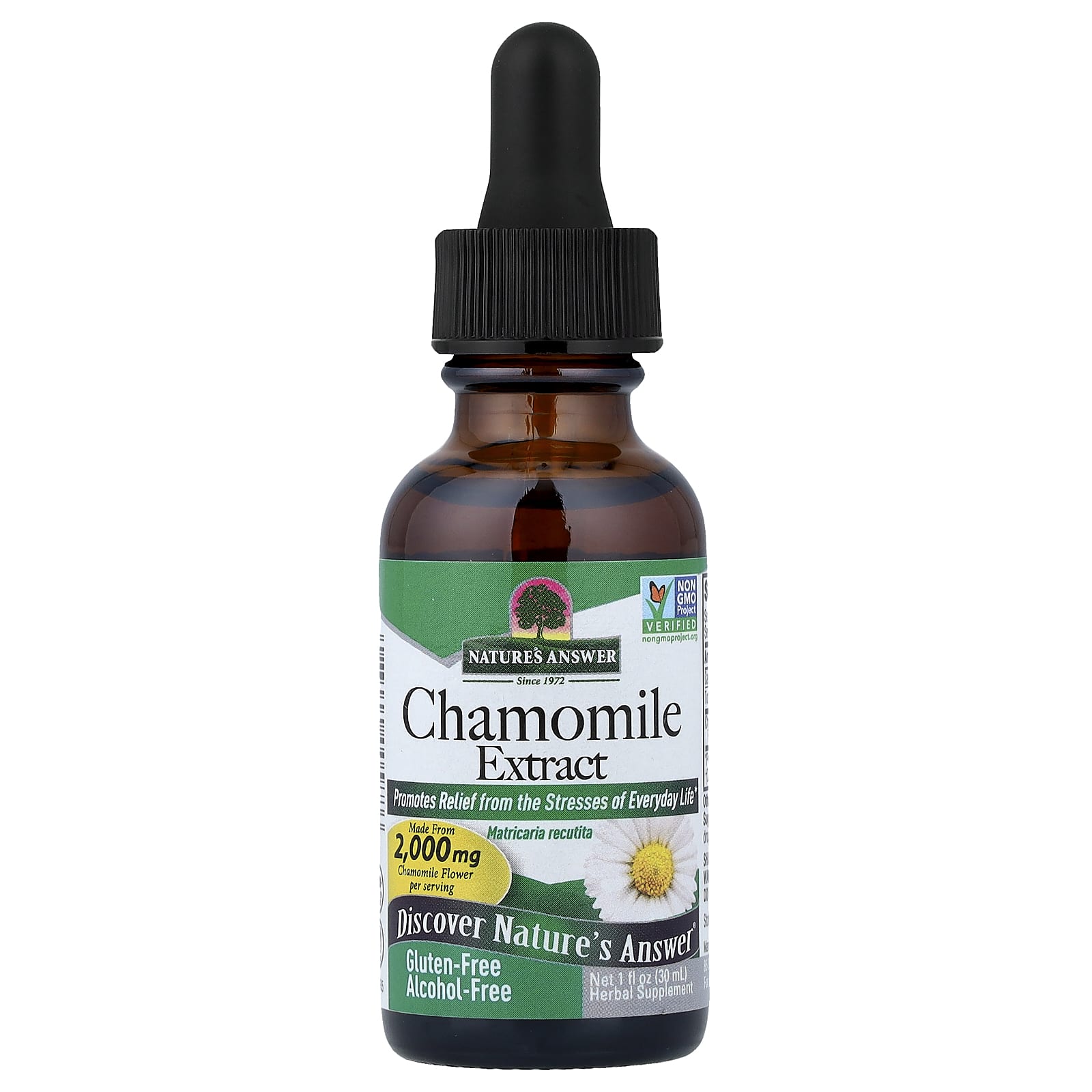
Terms and sources
- dried flower heads
- Chamomile tea is brewed from dried flower heads. McKay and Blumberg, Phytotherapy Research, 2006.
- German chamomile
- Matricaria recutita, also named Chamomilla recutita or Matricaria chamomilla. NCCIH, Chamomile: Usefulness and Safety.
- NCCIH
- NIH National Center for Complementary and Integrative Health.
- flower extracts
- EMA's public summary on matricaria flower names cut flowers and dry or liquid extracts, for herbal medicines. Some of these medicines combine it with other herbs. Essential oil: McKay and Blumberg, Phytotherapy Research, 2006.
Chamomile in the body
Chamomile is not a nutrient, and the body has no daily requirement for it. German chamomile is Matricaria recutita; Roman chamomile is a different plant, Chamaemelum nobile. Tea and supplements use the dried flower heads.
Terms and sources
- Matricaria recutita
- Also named Chamomilla recutita or Matricaria chamomilla. NCCIH, Chamomile: Usefulness and Safety.
- Chamaemelum nobile
- Carnat et al., Fitoterapia, 2004.
- dried flower heads
- McKay and Blumberg, Phytotherapy Research, 2006.
The flowers hold flavonoids, mainly apigenin, quercetin, patuletin and luteolin, and their glucosides. The essential oil of the flowers holds mainly alpha-bisabolol and its oxides, and azulenes such as chamazulene. In one analysis, apigenin and its glucosides were found in the ligulate florets, not in the tubular florets. Free apigenin does not occur in living flowers; it forms after harvest from apigenin 7-glycoside. In one study of healthy men, apigenin forms in urine equaled 34% of the apigenin in chamomile tea.
Terms and sources
- flavonoids
- Plant pigments of the polyphenol family. McKay and Blumberg, Phytotherapy Research, 2006.
- azulenes
- McKay and Blumberg, Phytotherapy Research, 2006.
- ligulate florets
- Ligulate means strap-shaped. Redaelli et al., Planta Medica, 1981. The first author's affiliation is the research laboratory of Bonomelli S.p.A.
- forms after harvest
- So its share in dried flowers depends on post-harvest conditions. Schreiber et al., Planta Medica, 1990.
- one study of healthy men
- Borges et al., Free Radical Biology and Medicine, 2022. The drinks were not given in random order. We could not read the full text.
NCCIH writes: “Chamomile is likely safe when used orally in amounts commonly found in teas and other foods.” It adds: “It is possibly safe when used by adults and children orally for medicinal purposes over the short term.” And: “Using chamomile on the skin in adults and children or as an oral rinse for medicinal purposes is possibly safe at certain doses and over the short term.” NCCIH notes: “Side effects are uncommon and may include nausea, dizziness, and allergic reactions, including severe hypersensitivity reactions and anaphylaxis, in some people.” It adds: “If used near the eyes, chamomile might cause eye irritation.” On allergy, NCCIH writes: “People are more likely to experience allergic reactions to chamomile if they’re allergic to related plants such as ragweed, chrysanthemums, marigolds, or daisies.” NCCIH also writes: “Chamomile might have some of the same effects as estrogen.” It adds: “Preliminary studies suggest that taking chamomile along with birth control pills might decrease the effects of birth control pills.” And: “In addition, chamomile might worsen any condition that is sensitive to exposure to estrogen, such as breast or uterine cancer.” On medicines, NCCIH writes: “Interactions between chamomile and some drugs metabolized by the liver and warfarin (a blood thinner) have been reported, and there are theoretical reasons to suspect that chamomile might interact with other drugs as well, such as sedatives.” NCCIH advises: “If you take any type of medicine, talk with your health care provider before using chamomile or other herbal products; some herbs and medicines interact in harmful ways.” It also writes: “Little is known about whether it’s safe to use chamomile during pregnancy or while breastfeeding.” This page is about chamomile taken by mouth.
Terms and sources
- NCCIH writes
- NIH National Center for Complementary and Integrative Health (NCCIH), Chamomile: Usefulness and Safety. Its section What Do We Know About Safety? is quoted here in full. The fact sheet focuses on German chamomile.
Information, not a prescription. Do not start, stop or combine supplements or medicines on your own.