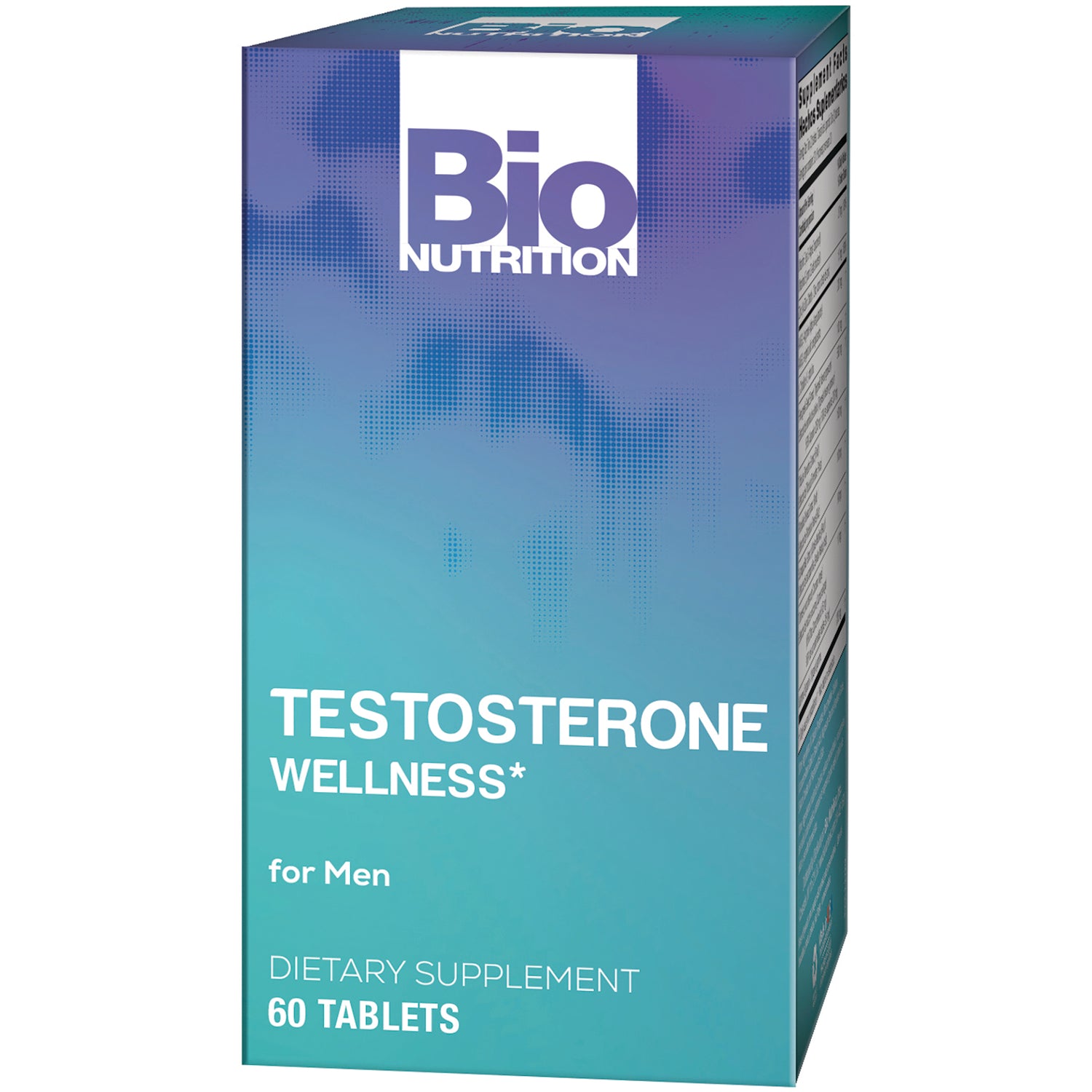
Bio Nutrition · tablets

Testosterone Wellness for Men

At the recorded label maximum: 2 tablets per day

Add to my list
Per day$0.79

At the label maximum of 2 tablets a day.

Per pack$23.77

60 tablets · Swanson · checked 20 Nov 2026. Delivery is not included.

Per tablet$0.40

Pack price divided by the number of tablets in the pack.

Composition

Amounts at the recorded label maximum. Directions may give a range.

Amounts not disclosed. The label gives only the total weight of this blend, not the amount of each ingredient in it. Without the individual amounts, we cannot compare these ingredients with upper limits.

Vitamin Eas D-Alpha-Tocopherol
About this formd-alpha-tocopherol (natural). 1 IU natural = 0.67 mg; synthetic 1 IU = 0.45 mg. Reference level V0; no form is called “better” here.
10.05 mgat the recorded label maximum (1 serving × 10.05 mg; 2 tablets per serving)5.025 mg per tablet · calculated from 10.05 mg per 2 tablets
1% of 1,000 mg — US upper limit for adults, National Academiesvitamin E from supplements, adults · a reference value, not a legal limit
Zincas Zinc Citrate
About this formzinc citrate — about 31% of the compound is zinc itself. Reference level V0; no form is called “better” here.
15 mgat the recorded label maximum (1 serving × 15 mg; 2 tablets per serving) · as zinc itself7.5 mg per tablet · calculated from 15 mg per 2 tablets
38% of 40 mg — US upper limit for adults, National Academiesfrom food and supplements, adults · food is not counted here · a reference value, not a legal limit
Fenugreek seed extractas Saponins
500 mgat the recorded label maximum (1 serving × 500 mg; 2 tablets per serving)250 mg per tablet · calculated from 500 mg per 2 tablets
No limit on file for the United StatesNone on file in any country
Tribulus terrestris extract
250 mgat the recorded label maximum (1 serving × 250 mg; 2 tablets per serving)125 mg per tablet · calculated from 250 mg per 2 tablets
No limit on file for the United StatesNone on file in any country
100 mgat the recorded label maximum (1 serving × 100 mg; 2 tablets per serving)50 mg per tablet · calculated from 100 mg per 2 tablets
No limit on file for the United StatesNone on file in any country
Sarsaparilla Extract
90 mgat the recorded label maximum (1 serving × 90 mg; 2 tablets per serving)45 mg per tablet · calculated from 90 mg per 2 tablets
No limit on file for the United StatesNone on file in any country
Curcumin extract
About this formturmeric extract standardized (curcuminoids). Reference level V0; no form is called “better” here.
10 mgat the recorded label maximum (1 serving × 10 mg; 2 tablets per serving)5 mg per tablet · calculated from 10 mg per 2 tablets
No limit on file for the United StatesNone on file in any country
Dehydroepiandrosterone
5 mgat the recorded label maximum (1 serving × 5 mg; 2 tablets per serving)2.5 mg per tablet · calculated from 5 mg per 2 tablets
No limit on file for the United StatesNone on file in any country
L-Citrulline
100 mgat the recorded label maximum (1 serving × 100 mg; 2 tablets per serving)50 mg per tablet · calculated from 100 mg per 2 tablets
No limit on file for the United StatesNone on file in any country
Amount not disclosedpart of Proprietary DHT Blocker Blend · not counted
No limit on file for the United States
Limits in other countries (2)Croatia, France
Saw Palmetto extract
Amount not disclosedpart of Proprietary DHT Blocker Blend · not counted
No limit on file for the United StatesNone on file in any country

Where no limit is shown, none is set or on file for the United States. That is not the same as having no maximum.

Manufacturer's directions

Suggested Use: Take two (2) tablets once daily with food or as recommended by a health care professional.

Other ingredients on the label

Di-Calcium Phosphate, Vegetable Cellulose, Vegetable Stearate, Silica, Pharmaceutical Glaze

Limits in other countries
CountryVitamin EZincPhytosterols
United States1,000 mgreference, not a law · 1%40 mgreference, not a law · 38%—not on file
Austria24 mgrecommendation · 42%15 mgrecommendation · 100%—not on file
Belgium39 mglaw · 26%22.5 mglaw · 67%—not on file
Croatia200 mglaw · 5%15 mglaw · 100%3,000 mglaw · not compared
Cyprus800 mglaw · 1%15 mglaw · 100%—not on file
Denmark291 mgrecommendation · 3%11 mgrecommendation · 136% · above—not on file
EAEU150 mglaw · 7%25 mglaw · 60%—not on file
Estonia300 mgrecommendation · 3%25 mgrecommendation · 60%—not on file
Finland300 mgrecommendation · 3%25 mgrecommendation · 60%—not on file
France30 mglaw · 34%15 mglaw · 100%1,700 mgrecommendation · not compared
Germany30 mgrecommendation · 34%6.5 mgrecommendation · 231% · above—not on file
Ireland300 mgrecommendation · 3%25 mgrecommendation · 60%—not on file
Italy60 mgrecommendation · 17%15 mgrecommendation · 100%—not on file
Luxembourg18 mglaw · 56%15 mglaw · 100%—not on file
Malta800 IUlaw · not compared25 mgrecommendation · 60%—not on file
Norway250 mglaw · 4%14 mglaw · 107% · above—not on file
Poland250 mgrecommendation · 4%15 mgrecommendation · 100%—not on file
Switzerland205 mglaw · 5%5.3 mglaw · 283% · above—not on file

Maximum amounts per daily dose of a food supplement, as each country sets them; the share is the daily amount on the label against that maximum. Law = legally binding; recommendation = an authority's recommended maximum, not binding; reference = the U.S. upper intake level for adults from all sources (National Academies), not a legal limit. Verification level V0 · Report an error

About the ingredients

Ingredient information

Ingredient guideVitamin EVitamin E is the name for eight fat-soluble compounds: four tocopherols and four tocotrienols. Alpha-tocopherol is the only form recognized to meet human needs. Supplements contain natural (d-) or synthetic (dl-) alpha-tocopherol, often as an ester. Three things are easy to confuse: the two forms, label units and what the upper limit counts. This article sorts them out.Read moreShow less

What vitamin E does

Vitamin E is an antioxidant that works in cell membranes. There, free radicals damage fats, and each damaged fat can damage the next. Alpha-tocopherol stops this chain reaction. Vitamin C can return used vitamin E to its active form. Vitamin E is also involved in immune function; studies in cells show roles in cell signaling.

After absorption, the liver sends alpha-tocopherol back into the blood with the alpha-tocopherol transfer protein. The liver breaks down the other forms, so blood and cells hold less of them.

In one study with labeled vitamin E, healthy women absorbed about 55% of a dose taken with a liquid meal. Vitamin E takes 9–12 hours to pass from a meal into the blood, carried in fat particles. The liver replaces the whole pool of alpha-tocopherol in blood plasma every day.

Information, not a prescription. Do not start, stop or combine supplements or medicines on your own.
Ingredient guideZincZinc is an essential mineral that the body needs for the work of hundreds of enzymes. An adult body holds about 1.5–2.5 g of it. Supplements contain zinc as part of a compound, such as zinc citrate, oxide or gluconate. Three things are easy to confuse: the label number, the recommended amounts, and what the forms do. This article sorts them out.Read moreShow less

What zinc does

Zinc-dependent enzymes are found in all six classes of enzymes, the proteins that speed up chemical reactions in cells. By one estimate, more than 3,000 human proteins have sites that bind zinc. In some of them, zinc holds a fold called a zinc finger in shape. Zinc fingers let some proteins bind DNA and switch genes on or off. Zinc also takes part in immune function, protein and DNA synthesis, cell division and the sense of taste.

Most of the body's zinc is in skeletal muscle and bone. As intake rises, the body absorbs more zinc, but a smaller share of it.

Information, not a prescription. Do not start, stop or combine supplements or medicines on your own.

Ingredient guideRhodiolaRhodiola is a plant, Rhodiola rosea, also called golden root, arctic root or rose root. It grows in cold regions and at high altitudes. Supplements contain extracts of its root and rhizome, or root powder. Extracts are often standardized to rosavins and to salidroside, compounds of the root.Read moreShow less
Terms and sources
golden root
NCCIH lists the common names arctic root, golden root, rose root, rosenroot and king's crown.
high altitudes
NIH National Center for Complementary and Integrative Health (NCCIH), rhodiola page.
rhizome
An underground stem. Panossian et al., Phytomedicine, 2010; Döring et al., Phytomedicine, 2021.
rosavins
Rosavin, rosin and rosarin. Punja et al., PLoS One, 2014.

Rhodiola in the body

Rhodiola is not a nutrient, and the body has no daily requirement for it. Trials of its extracts measure things such as mental fatigue tests, exercise tests and self-rated tiredness.

About 140 compounds have been isolated from its roots and rhizome. Rosavin is found only in Rhodiola rosea; salidroside is also found in other Rhodiola species. One trial report states that rosavins and salidroside occur in the plant at a 3 to 1 ratio. In several exercise trials, extracts were standardized to at least 3% rosavins and 1% salidroside.

Terms and sources
About 140 compounds
Among them phenylpropanoids, phenylethanoids, flavonoids and others. Panossian et al., Phytomedicine, 2010. The first author worked for the Swedish Herbal Institute.
found only in Rhodiola rosea
Punja et al., PLoS One, 2014. Booker et al. use rosavin as the marker that tells R. rosea apart from related species.
3 to 1 ratio
Punja et al., PLoS One, 2014.
at least 3% rosavins
Lu et al., Frontiers in Nutrition, 2022, on the trials in its review. Some trials did not state the content.

In one trial's source, roots grown in Alberta held from 0.2% to 10% total rosavins by dry weight. In one analysis of about 40 products, about a fifth of those sold as R. rosea held no rosavin. Another analysis confirmed the labeled salidroside and rosavins in less than a quarter of products.

Terms and sources
0.2% to 10%
Roots of different ages from different places in Alberta, Canada. For the trial, 4-year-old roots were extracted and standardized to 2.8%. Punja et al., PLoS One, 2014.
about 40 products
Powders and extracts bought from different suppliers. Most of the rest held less rosavin than products registered as herbal medicines. Booker et al., Phytomedicine, 2016.
about a fifth
One author of this analysis works for Dr. Willmar Schwabe GmbH, and two for CAMAG AG.
less than a quarter
Marchev et al., Phytochemical Analysis, 2020. A compound found only in R. crenulata among the species tested turned up in 2 of 4 products tested by NMR.

NCCIH says: "Rhodiola is possibly safe for up to 12 weeks." NCCIH adds: "Side effects may include dizziness, headache, insomnia, and either dry mouth or excessive saliva production." NCCIH also notes: "Interactions between rhodiola and losartan (a drug used for high blood pressure) have been reported." NCCIH adds: "Little is known about whether it’s safe to use rhodiola during pregnancy or while breastfeeding." NCCIH advises: "If you take any type of medicine, talk with your health care provider before using any herbal product." It adds: "some herbs and medicines interact in harmful ways."

Terms and sources
up to 12 weeks
NIH National Center for Complementary and Integrative Health (NCCIH), rhodiola page.

Information, not a prescription. Do not start, stop or combine supplements or medicines on your own.

Ingredient guidePlant sterols and stanolsPlant sterols and stanols, together called phytosterols, are plant compounds built much like cholesterol. The main plant sterols in food are beta-sitosterol, campesterol and stigmasterol. Stanols, such as sitostanol, lack one double bond; they are about 10% of food phytosterols. Supplements hold free sterols, stanols or their esters, which are bound to fatty acids, in capsules, softgels or powders.Read moreShow less
Terms and sources
built much like cholesterol
They are structurally related to cholesterol. Linus Pauling Institute, Oregon State University.
beta-sitosterol
Also written β-sitosterol. Linus Pauling Institute, Oregon State University.
lack one double bond
In the sterol ring; stanols are the saturated forms. Linus Pauling Institute, Oregon State University.
in capsules, softgels or powders
Product forms of 92 US labels with sterols or stanols alone, NIH Dietary Supplement Label Database. Tablets also appear. We counted these.

Plant sterols in the body

The body cannot make phytosterols, so all phytosterols in human blood come from the diet. Less than 5% of plant sterols eaten and less than 0.5% of plant stanols are absorbed. Gut cells pump most absorbed phytosterols straight back into the gut. Blood levels of phytosterols are usually several hundred times lower than blood cholesterol.

Terms and sources
come from the diet
Cholesterol, by contrast, comes from both the diet and the body's own production. Linus Pauling Institute, Oregon State University.
are absorbed
For cholesterol from food, the figure is about 50–60%. Linus Pauling Institute, Oregon State University.
pump
A transporter called ABCG5/G8 does this; in the liver, the same transporter moves them into bile. Linus Pauling Institute, Oregon State University.

In the gut, phytosterols take the place of cholesterol in the tiny fat droplets that carry it. More cholesterol from food and bile then leaves in the stool. LPI cites a feeding trial with 0.46 g and 2.1 g of phytosterols a day. Cholesterol absorption fell by about 10% and 25%. Cholesterol leaving in the stool rose by 36% and 74%, LPI notes.

Terms and sources
tiny fat droplets
mixed micelles: droplets of bile salts, fats and sterols that form after a meal with fat. Linus Pauling Institute, Oregon State University.
leaves in the stool
LPI: phytosterols also facilitate the excretion of biliary cholesterol in the feces.
a feeding trial
Phytosterols in drinks, compared with a dummy drink. LPI, citing Racette et al., American Journal of Clinical Nutrition, 2010.

LPI cites a meta-analysis of 124 studies of LDL cholesterol in the blood. LDL cholesterol was at least 5% lower with 0.6–1.1 g a day and about 12.4% lower with 3.3 g. These are blood measurements; LPI notes that the long-term effect on health outcomes is not known.

Terms and sources
124 studies
Ras et al., British Journal of Nutrition, 2014, as cited by LPI. Two of the three authors worked for Unilever.

Phytosterols also lower blood levels of some carotenoids, the yellow and red pigments of plants. LPI cites a meta-analysis in which blood carotenoids such as beta-carotene were about 5–20% lower with enriched foods. LPI notes that in one trial, advice to eat 5 servings of fruit and vegetables a day kept carotenoid levels.

Terms and sources
a meta-analysis
Over 1 month to 1 year. Adjusted for cholesterol, alpha-carotene, beta-carotene and lycopene may stay lower. Baumgartner et al., European Journal of Nutrition, 2017, as cited by LPI. Two of the five authors worked for Unilever.
one trial
Including 1 serving of carotenoid-rich vegetables, in people taking 2.5 g of sterol or stanol esters a day. Noakes et al., American Journal of Clinical Nutrition, 2002, as cited by LPI.

LPI notes that in the US, plant sterols and stanols added to a variety of food products are "generally recognized as safe" (GRAS), an FDA status. LPI notes that few adverse effects have been reported with regular intake for up to 1 year. LPI notes that nausea, indigestion, diarrhea and constipation have occasionally been reported. LPI notes that people with sitosterolemia should avoid foods or supplements with added plant sterols. LPI notes: Phytosterol-enriched foods and supplements are not recommended for pregnant or breastfeeding women because their safety has not been studied. LPI notes that some cholesterol medicines change how much plant sterol the body absorbs or keeps in blood.

Terms and sources
GRAS
A US status for food ingredients. Linus Pauling Institute, Oregon State University.
sitosterolemia
A very rare inherited condition in which the body absorbs and keeps far more plant sterols. Linus Pauling Institute, Oregon State University.
some cholesterol medicines
LPI: statin therapy appears to increase the absorption of plant sterols. Ezetimibe (marketed as Zetia) is another cholesterol-lowering drug that may interfere with the intestinal absorption of phytosterols.

Information, not a prescription. Do not start, stop or combine supplements or medicines on your own.

Services

Choose the option that suits you.

Quick selection

I know my goal

$5

1–2 minutes · a few questions with fixed answers

One goal. Up to three products. Set a budget per day if you like.

Product checks
form and amount on the label, plus shop prices
Daily schedule
what to take, when, how much
Totals and limits
next to the upper limit
Reasons & sources
for each product
Prices and shops
plus food and habits
Progress
what to track, when to see a doctor

Complete the questionnaire before you pay. If no product fits any of your goals, you won’t be charged.

Order · $5View example

Full selection

I have several goals

$15

5–7 minutes · questionnaire with fixed answers

Up to three goals in one set. Where two goals overlap, one product is used for both.

Product checks
form and amount on the label, plus shop prices
Daily schedule
what to take, when, how much
Totals and limits
next to the upper limit
Reasons & sources
for each product
Prices and shops
plus food and habits
Progress
what to track, when to see a doctor

Complete the questionnaire before you pay. If no product fits any of your goals, you won’t be charged.

Order · $15View example

Expert review

I want a person to look at my supplements

$50

Written review within 48 hours of your completed questionnaire

An expert reviews your supplement list and questionnaire.

Written review
duplicates, limits, forms
Detailed questionnaire
supplements, medicines, history
Optional uploads
supplement-label photos or documents relevant to your review
Your notes
your priorities and questions
Follow-up questions
in writing, when needed
Next steps
points to discuss with your doctor

Complete the questionnaire before you pay.

Order · $50View example
Sources, label & certificates

Label record

Copied from the NIH label database (DSLD 200614) · not yet compared with the label · checked 19 Oct 2026 · Report an error

The United States has no pre-market registration for supplements.
Label on file in the NIH Dietary Supplement Label Database
checked 19 Oct 2026source: NIH DSLDReport an error

Barcode 8 54936 00313 6

Third-party certificates

No third-party certificate on file for this product.

Information, not a prescription. Do not start, stop or combine supplements or medicines on your own. If you have a health condition, are pregnant or breastfeeding, take medicines, or are under 18, talk to a doctor or pharmacist first.

Photo credits

Image: © Bio Nutrition. Shown to identify the product. Source:

Rights holders can ask us to remove an image or send official product photos: info@verateca.com.

Product photo

Bio Nutrition Testosterone Wellness for Men — enlarged pack