Terry Naturally · capsules

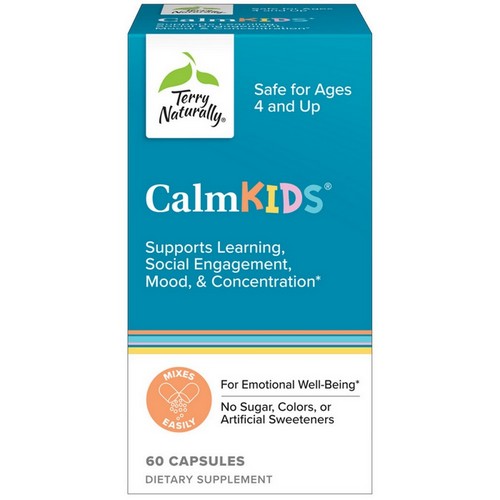
Calm Kids

At the recorded label maximum: 8 capsules per day

Add to my list
Per day$0.59

At the label maximum of 1 capsule a day.

Per pack$35.66

60 capsules · Vitacost · checked 13 Nov 2026. Delivery is not included.

Per capsule$0.59

Pack price divided by the number of capsules in the pack.

Composition

Amounts at the recorded label maximum. Directions may give a range.

40 mgat the recorded label maximum (8 capsules × 5 mg)5 mg per capsule · calculated from 5 mg per 1 capsule
40% of 100 mg — US upper limit for adults, National Academiesfrom food and supplements, adults · food is not counted here · a reference value, not a legal limit
DMAE Bitartrate
400 mgat the recorded label maximum (8 capsules × 50 mg)50 mg per capsule · calculated from 50 mg per 1 capsule
No limit on file for the United StatesNone on file in any country
Phosphatidylserineas Sunflower Lecithin
240 mgat the recorded label maximum (8 capsules × 30 mg)30 mg per capsule · calculated from 30 mg per 1 capsule
No limit on file for the United StatesNone on file in any country
200 mgat the recorded label maximum (8 capsules × 25 mg)25 mg per capsule · calculated from 25 mg per 1 capsule
No limit on file for the United StatesNone on file in any country
French Grape (Vitis vinifera) seed extractas OPCs | Polyphenols
200 mgat the recorded label maximum (8 capsules × 25 mg)25 mg per capsule · calculated from 25 mg per 1 capsule
No limit on file for the United StatesNone on file in any country
200 mgat the recorded label maximum (8 capsules × 25 mg)25 mg per capsule · calculated from 25 mg per 1 capsule
No limit on file for the United StatesNone on file in any country
N-Acetyl Cysteine
120 mgat the recorded label maximum (8 capsules × 15 mg)15 mg per capsule · calculated from 15 mg per 1 capsule
No limit on file for the United StatesNone on file in any country
120 mgat the recorded label maximum (8 capsules × 15 mg)15 mg per capsule · calculated from 15 mg per 1 capsule
No limit on file for the United States
Limits in other countries (3)Croatia, Czechia, Switzerland

Where no limit is shown, none is set or on file for the United States. That is not the same as having no maximum.

Manufacturer's directions

Recommendations: Ages 4 and up; start with 1 capsule daily and increase dosage every few days until the desired response is achieved. Do not take more than 8 times daily. Capsule may be opened and contents mixed with applesauce; yogurt; juice; etc. Mixes easily into food and drinks

Other ingredients on the label

Hydroxypropyl Methylcellulose, Silica, Cellulose powder, Vegetable Source Magnesium Stearate

Limits in other countries
CountryVitamin B6L-Taurine
United States100 mgreference, not a law · 40%—not on file
Austria5.6 mgrecommendation · 714% · above—not on file
Belgium6 mglaw · 667% · above—not on file
Croatia20 mglaw · 200% · above1,000 mglaw · 12%
Cyprus100 mglaw · 40%—not on file
Czechia—not on file2,000 mglaw · 6%
Denmark10 mgrecommendation · 400% · above—not on file
EAEU6 mglaw · 667% · above—not on file
Estonia25 mgrecommendation · 160% · above—not on file
Finland12 mgrecommendation · 333% · above—not on file
France2 mglaw · 2000% · above—not on file
Germany0.9 mgrecommendation · 4444% · above—not on file
Ireland25 mgrecommendation · 160% · above—not on file
Italy9.5 mgrecommendation · 421% · above—not on file
Luxembourg4.2 mglaw · 952% · above—not on file
Malta10 mglaw · 400% · above—not on file
Netherlands21 mglaw · 190% · above—not on file
Poland6 mgrecommendation · 667% · above—not on file
Switzerland15 mglaw · 267% · above1,000 mglaw · 12%

Maximum amounts per daily dose of a food supplement, as each country sets them; the share is the daily amount on the label against that maximum. Law = legally binding; recommendation = an authority's recommended maximum, not binding; reference = the U.S. upper intake level for adults from all sources (National Academies), not a legal limit. Verification level V0 · Report an error

About the ingredients

Ingredient information

Ingredient guideVitamin B6Vitamin B6 is the name for six related water-soluble compounds: pyridoxine, pyridoxal, pyridoxamine and their phosphate forms. Its main active form, pyridoxal 5'-phosphate (PLP), is a helper molecule for more than 100 enzymes. Supplements most often contain pyridoxine hydrochloride; some contain PLP, also called P5P. Vitamin B6 is also in multivitamins and B complex products.Read moreShow less
Terms and sources
water-soluble
They dissolve in water, not in fat. NIH Office of Dietary Supplements.
helper molecule
A coenzyme: a small molecule an enzyme needs to work. Linus Pauling Institute.
pyridoxine hydrochloride
NIH Office of Dietary Supplements names it the most common form in supplements.

Vitamin B6 in the body

Vitamin B6 takes part in more than 100 enzyme reactions, mostly in the metabolism of protein. It is involved in making neurotransmitters, the chemical messengers of the nervous system. It is also involved in immune function and in making hemoglobin, the oxygen carrier in red blood cells.

Terms and sources
more than 100 enzyme reactions
NIH Office of Dietary Supplements. It also works in the metabolism of carbohydrates and fats.
neurotransmitters
Serotonin, dopamine and GABA among them. Linus Pauling Institute.
immune function
NIH Office of Dietary Supplements.

The human body cannot make vitamin B6, so it must come from food. PLP is a helper in over 4% of all enzyme reactions. Much of the body's PLP sits in muscle, bound to the enzyme that releases glucose from stored glycogen.

Terms and sources
cannot make vitamin B6
Linus Pauling Institute.
over 4%
Linus Pauling Institute.
the enzyme
Glycogen phosphorylase. Linus Pauling Institute.

Blood PLP is the most common measure of vitamin B6 status. Levels above 30 nmol/L have been the traditional sign of enough vitamin B6 in adults.

Terms and sources
Blood PLP
Plasma pyridoxal 5'-phosphate. NIH Office of Dietary Supplements.
30 nmol/L
NIH Office of Dietary Supplements.

Information, not a prescription. Do not start, stop or combine supplements or medicines on your own.
Ingredient guideRhodiolaRhodiola is a plant, Rhodiola rosea, also called golden root, arctic root or rose root. It grows in cold regions and at high altitudes. Supplements contain extracts of its root and rhizome, or root powder. Extracts are often standardized to rosavins and to salidroside, compounds of the root.Read moreShow less
Terms and sources
golden root
NCCIH lists the common names arctic root, golden root, rose root, rosenroot and king's crown.
high altitudes
NIH National Center for Complementary and Integrative Health (NCCIH), rhodiola page.
rhizome
An underground stem. Panossian et al., Phytomedicine, 2010; Döring et al., Phytomedicine, 2021.
rosavins
Rosavin, rosin and rosarin. Punja et al., PLoS One, 2014.

Rhodiola in the body

Rhodiola is not a nutrient, and the body has no daily requirement for it. Trials of its extracts measure things such as mental fatigue tests, exercise tests and self-rated tiredness.

About 140 compounds have been isolated from its roots and rhizome. Rosavin is found only in Rhodiola rosea; salidroside is also found in other Rhodiola species. One trial report states that rosavins and salidroside occur in the plant at a 3 to 1 ratio. In several exercise trials, extracts were standardized to at least 3% rosavins and 1% salidroside.

Terms and sources
About 140 compounds
Among them phenylpropanoids, phenylethanoids, flavonoids and others. Panossian et al., Phytomedicine, 2010. The first author worked for the Swedish Herbal Institute.
found only in Rhodiola rosea
Punja et al., PLoS One, 2014. Booker et al. use rosavin as the marker that tells R. rosea apart from related species.
3 to 1 ratio
Punja et al., PLoS One, 2014.
at least 3% rosavins
Lu et al., Frontiers in Nutrition, 2022, on the trials in its review. Some trials did not state the content.

In one trial's source, roots grown in Alberta held from 0.2% to 10% total rosavins by dry weight. In one analysis of about 40 products, about a fifth of those sold as R. rosea held no rosavin. Another analysis confirmed the labeled salidroside and rosavins in less than a quarter of products.

Terms and sources
0.2% to 10%
Roots of different ages from different places in Alberta, Canada. For the trial, 4-year-old roots were extracted and standardized to 2.8%. Punja et al., PLoS One, 2014.
about 40 products
Powders and extracts bought from different suppliers. Most of the rest held less rosavin than products registered as herbal medicines. Booker et al., Phytomedicine, 2016.
about a fifth
One author of this analysis works for Dr. Willmar Schwabe GmbH, and two for CAMAG AG.
less than a quarter
Marchev et al., Phytochemical Analysis, 2020. A compound found only in R. crenulata among the species tested turned up in 2 of 4 products tested by NMR.

NCCIH says: "Rhodiola is possibly safe for up to 12 weeks." NCCIH adds: "Side effects may include dizziness, headache, insomnia, and either dry mouth or excessive saliva production." NCCIH also notes: "Interactions between rhodiola and losartan (a drug used for high blood pressure) have been reported." NCCIH adds: "Little is known about whether it’s safe to use rhodiola during pregnancy or while breastfeeding." NCCIH advises: "If you take any type of medicine, talk with your health care provider before using any herbal product." It adds: "some herbs and medicines interact in harmful ways."

Terms and sources
up to 12 weeks
NIH National Center for Complementary and Integrative Health (NCCIH), rhodiola page.

Information, not a prescription. Do not start, stop or combine supplements or medicines on your own.

Ingredient guideL-TyrosineL-tyrosine is an amino acid found in protein foods such as dairy, meat, fish, eggs, nuts and beans. The body also makes it from phenylalanine, another amino acid. The body uses tyrosine to make dopamine and noradrenaline, two chemical messengers of the brain. Supplements sell it as L-tyrosine or as N-acetyl-L-tyrosine.Read moreShow less

L-tyrosine in the body

Tyrosine is an aromatic amino acid, like phenylalanine and tryptophan. It is classed as conditionally essential: the body can make it from phenylalanine. Tyrosine is the starting material for dopamine and noradrenaline. It is also the starting material for melanin, the main pigment of skin.

Terms and sources
aromatic amino acid
Its structure contains a benzene ring. Shen et al., Frontiers in Bioengineering and Biotechnology, 2025.
conditionally essential
Made in the body when enough phenylalanine is available. van de Rest et al., Nutrients, 2017.
dopamine and noradrenaline
Catecholamines, chemical messengers of the brain and nerves. van de Rest et al., 2017.
melanin
The enzyme tyrosinase turns tyrosine into melanin step by step. Shen et al., 2025.

To enter the brain, tyrosine competes with other large amino acids for the same carrier. In one trial, blood tyrosine peaked 90 minutes after 100 or 150 mg per kg of body weight. Four hours after the dose, blood levels had not returned to their starting values.

Terms and sources
the same carrier
Transport across the blood-brain barrier. van de Rest et al., 2017.
In one trial
17 healthy adults aged 60–75. After 200 mg per kg, the peak came at 120 minutes. van de Rest et al., 2017.

Information, not a prescription. Do not start, stop or combine supplements or medicines on your own.

Ingredient guideTaurineTaurine is an amino acid that the body makes from cysteine and does not use to build proteins. Meat, seafood and milk contain it; 48 plant foods tested in one survey did not. Energy drinks add it, and supplements sell it as powder or capsules, as taurine or magnesium taurate.Read moreShow less
Terms and sources
Taurine
The name comes from the ox, Bos taurus: taurine was first isolated from ox bile. Ripps and Shen, 2012.
an amino acid
Strictly, an amino sulfonic acid: it has a sulfonate group in place of the usual carboxyl group. Ripps and Shen, 2012.

Taurine in the body

Taurine is one of the most abundant amino acids in the brain, retina, muscle and other organs. Taurine joins bile acids to form bile salts. Cells also use it to keep their volume steady and to handle calcium.

Terms and sources
most abundant
Ripps and Shen, 2012. In the rat eye, it is the most abundant amino acid in the retina, lens and cornea.
bile salts
Ripps and Shen, 2012.
keep their volume steady
It works as an osmolyte, a dissolved substance that holds water in cells. Ripps and Shen, 2012.

The body makes taurine from two amino acids, methionine and cysteine. Humans and other primates have little CSD, a key enzyme for making taurine. In one study, vegan men had blood taurine of 45 µmol/L, and meat eaters 58 µmol/L. The vegans passed about 33 mg of taurine a day in urine, and the meat eaters about 113 mg.

Terms and sources
methionine and cysteine
The last step turns hypotaurine into taurine. Ripps and Shen, 2012.
CSD
cysteine sulfinic acid decarboxylase. Cats also have little of it. Ripps and Shen, 2012.
vegan men
12 men on a vegan diet for about 4 years, and 14 men who ate meat. The vegans' food diaries showed almost no taurine. Laidlaw et al., 1988.
about 33 mg
266 and 903 µmol a day in the paper. We converted these to mg.

After a 4 g dose by mouth, blood taurine peaked in about 1.5 hours. Half of it left the blood in about 1 hour.

Terms and sources
a 4 g dose
8 healthy men, fasting, in the morning. The peak was 86 mg per liter. Ghandforoush-Sattari et al., 2010.
Half of it
elimination half-life: 1.0 hour on average.

A study in Science reported that mice given taurine from middle age lived longer. The same study found that blood taurine fell with age in mice, monkeys and people. Later studies in people found blood taurine stable or higher with age. The authors of the mouse study called for trials in people.

Terms and sources
A study in Science
Singh et al., 2023. Mice got 1,000 mg per kg of body weight a day from 14 months of age.
lived longer
Median lifespan was 10–12% longer than in untreated mice.
monkeys
Monkeys given taurine for 6 months gained less weight; the study did not measure their lifespan.
Later studies
Fernandez et al., Science, 2025: three geographically distinct groups of people, at the US National Institute on Aging. Also 137 men aged 20–93: no link with age (Marcangeli et al., Aging Cell, 2025).

Information, not a prescription. Do not start, stop or combine supplements or medicines on your own.

Services

Choose the option that suits you.

Quick selection

I know my goal

$5

1–2 minutes · a few questions with fixed answers

One goal. Up to three products. Set a budget per day if you like.

Product checks
form and amount on the label, plus shop prices
Daily schedule
what to take, when, how much
Totals and limits
next to the upper limit
Reasons & sources
for each product
Prices and shops
plus food and habits
Progress
what to track, when to see a doctor

Complete the questionnaire before you pay. If no product fits any of your goals, you won’t be charged.

Order · $5View example

Full selection

I have several goals

$15

5–7 minutes · questionnaire with fixed answers

Up to three goals in one set. Where two goals overlap, one product is used for both.

Product checks
form and amount on the label, plus shop prices
Daily schedule
what to take, when, how much
Totals and limits
next to the upper limit
Reasons & sources
for each product
Prices and shops
plus food and habits
Progress
what to track, when to see a doctor

Complete the questionnaire before you pay. If no product fits any of your goals, you won’t be charged.

Order · $15View example

Expert review

I want a person to look at my supplements

$50

Written review within 48 hours of your completed questionnaire

An expert reviews your supplement list and questionnaire.

Written review
duplicates, limits, forms
Detailed questionnaire
supplements, medicines, history
Optional uploads
supplement-label photos or documents relevant to your review
Your notes
your priorities and questions
Follow-up questions
in writing, when needed
Next steps
points to discuss with your doctor

Complete the questionnaire before you pay.

Order · $50View example
Sources, label & certificates

Label record

Copied from the NIH label database (DSLD 202505) · not yet compared with the label · checked 19 Oct 2026 · Report an error

The United States has no pre-market registration for supplements.
Label on file in the NIH Dietary Supplement Label Database
checked 19 Oct 2026source: NIH DSLDReport an error

Barcode 3 67703 20116 6

Third-party certificates

Label mentions: Money-back guarantee Calm Kids is a complete, synergistic formula that supports healthy focus, concentration, attentiveness, and emotional well-being., Supports mental focus, a calm mind & emotional well-being For your good health Terry, For additional brain health support also try Vectomega from Terry Naturally.. Not yet checked against the certifiers’ registries.

Information, not a prescription. Do not start, stop or combine supplements or medicines on your own. If you have a health condition, are pregnant or breastfeeding, take medicines, or are under 18, talk to a doctor or pharmacist first.

Photo credits

Image: © Terry Naturally. Shown to identify the product. Source:

Rights holders can ask us to remove an image or send official product photos: info@verateca.com.

Product photo

Terry Naturally Calm Kids — enlarged pack