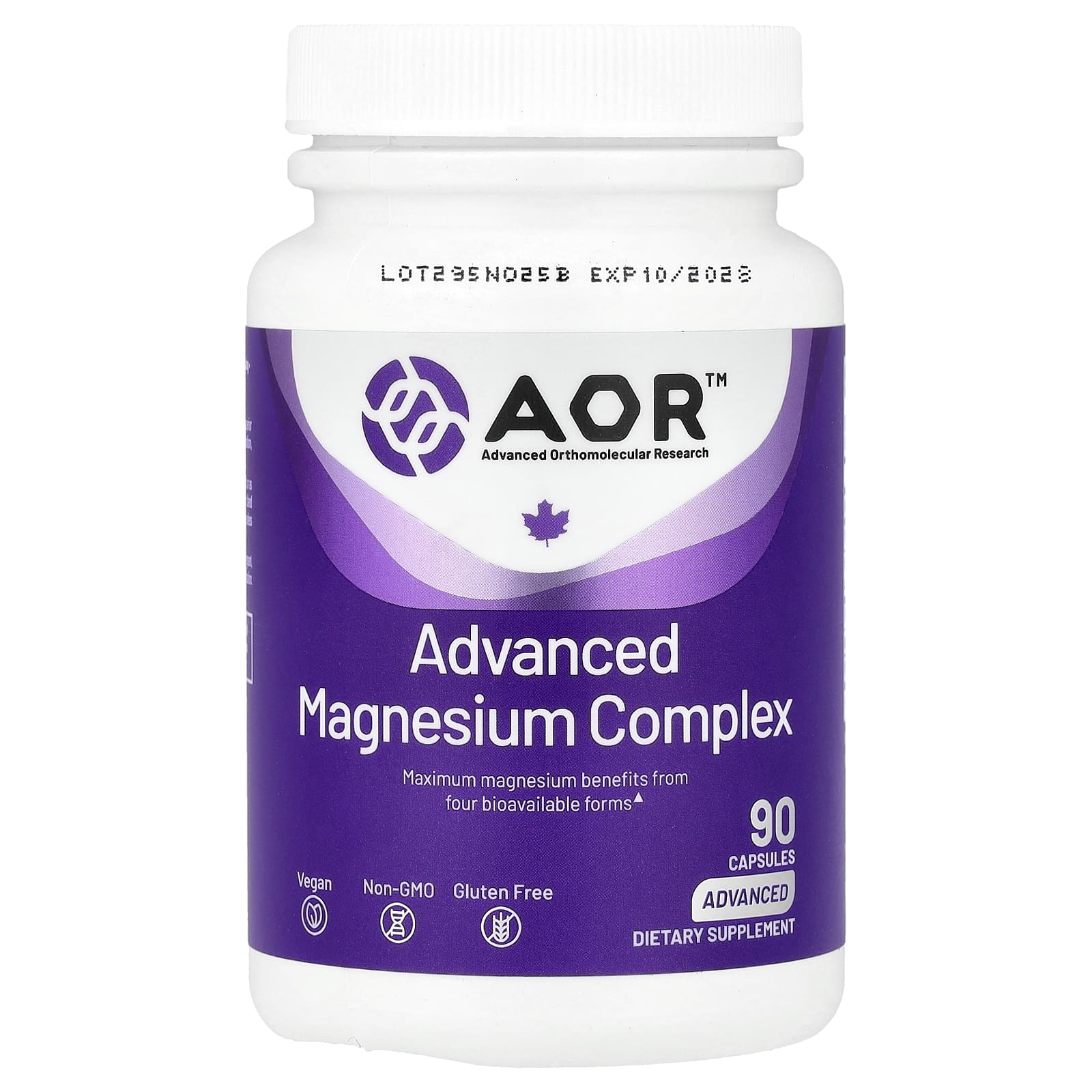
AOR Advanced Orthomolecular Research Advanced · capsules

Advanced Magnesium Complex

At the recorded label maximum: 3 capsules per day

Add to my list
Per day$0.26 – $0.77

For 1 to 3 capsules a day as stated on the label.

Per pack$23.06

90 capsules · Vitacost · checked 22 Oct 2026. Delivery is not included.

Per capsule$0.26

Pack price divided by the number of capsules in the pack.

Composition

Amounts at the recorded label maximum. Directions may give a range.

At the recorded label maximum, one ingredient is above the limit that applies in the United States: Magnesium 900 mg (US upper limit for adults, National Academies: 350 mg).

Talk to a doctor or pharmacist.

Vitamin Cas Magnesium Ascorbate
900 mgat the recorded label maximum (3 capsules × 300 mg)
45% of 2,000 mg — US upper limit for adults, National Academiesfrom food and supplements, adults · food is not counted here · a reference value, not a legal limit
Vitamin Cas Magnesium Ascorbate
300 mgat the recorded label maximum (3 capsules × 100 mg)
15% of 2,000 mg — US upper limit for adults, National Academiesfrom food and supplements, adults · food is not counted here · a reference value, not a legal limit
Magnesiumas Magnesium Ascorbate | Magnesium Aspartate | Magnesium Glycinate | Magnesium Malate
900 mgat the recorded label maximum (3 capsules × 300 mg) · as magnesium itself
257% ↑ of 350 mg — US upper limit for adults, National Academiesmagnesium from supplements, adults · a reference value, not a legal limit
Magnesiumas Magnesium Ascorbate | Magnesium Aspartate | Magnesium Glycinate | Magnesium Malate
300 mgat the recorded label maximum (3 capsules × 100 mg) · as magnesium itself
86% of 350 mg — US upper limit for adults, National Academiesmagnesium from supplements, adults · a reference value, not a legal limit
Glycineas Magnesium Glycinate
4,320 mgat the recorded label maximum (3 capsules × 1,440 mg)
No limit on file for the United States
Limits in other countries (1)Switzerland
Glycineas Magnesium Glycinate
1,440 mgat the recorded label maximum (3 capsules × 480 mg)
No limit on file for the United States
Limits in other countries (1)Switzerland

Where no limit is shown, none is set or on file for the United States. That is not the same as having no maximum.

Manufacturer's directions

Directions: Take 1 capsule 1-3 times daily with/without food; or as directed by a health care practitioner.

Other ingredients on the label

Microcrystalline Cellulose, Capsule (Hypromellose, and purified Water), Sodium Stearyl Fumarate

Limits in other countries
CountryVitamin CMagnesiumGlycine
United States2,000 mgreference, not a law · 60%350 mgreference, not a law · 343% · above—not on file
Austria500 mgrecommendation · 240% · above375 mgrecommendation · 320% · above—not on file
Belgium1,000 mglaw · 120% · above450 mglaw · 267% · above—not on file
Croatia800 mglaw · 150% · above375 mglaw · 320% · above—not on file
Cyprus2,000 mglaw · 60%300 mglaw · 400% · above—not on file
Denmark1,000 mgrecommendation · 120% · above233 mgrecommendation · 515% · above—not on file
EAEU900 mglaw · 133% · above800 mglaw · 150% · above—not on file
Estonia—not on file250 mgrecommendation · 480% · above—not on file
Finland—not on file250 mgrecommendation · 480% · above—not on file
France180 mglaw · 667% · above300 mglaw · 400% · above—not on file
Germany250 mgrecommendation · 480% · above250 mgrecommendation · 480% · above—not on file
Ireland2,000 mgrecommendation · 60%250 mgrecommendation · 480% · above—not on file
Italy1,000 mgrecommendation · 120% · above450 mgrecommendation · 267% · above—not on file
Luxembourg1,000 mglaw · 120% · above562.5 mglaw · 213% · above—not on file
Malta1,000 mgrecommendation · 120% · above400 mgrecommendation · 300% · above—not on file
Norway1,000 mglaw · 120% · above350 mglaw · 343% · above—not on file
Poland1,000 mgrecommendation · 120% · above400 mgrecommendation · 300% · above—not on file
Switzerland750 mglaw · 160% · above375 mglaw · 320% · above5,000 mglaw · 115% · above

Maximum amounts per daily dose of a food supplement, as each country sets them; the share is the daily amount on the label against that maximum. Law = legally binding; recommendation = an authority's recommended maximum, not binding; reference = the U.S. upper intake level for adults from all sources (National Academies), not a legal limit. Verification level V0 · Report an error

About the ingredients

Ingredient information

Ingredient guideVitamin CVitamin C, also called L-ascorbic acid, is a water-soluble vitamin. Most animals make vitamin C in the body; humans cannot and get it from food. Fruits and vegetables such as peppers, citrus fruits and kiwifruit are the main sources. Supplements contain it as ascorbic acid or as mineral salts such as sodium and calcium ascorbate.Read moreShow less
Terms and sources
water-soluble
It dissolves in water, not in fat. NIH Office of Dietary Supplements.

Vitamin C in the body

Vitamin C is needed to make collagen, carnitine and some neurotransmitters. It is also an antioxidant and can return used vitamin E to its active form. It is needed for normal immune function. It increases the absorption of iron from plant foods.

Terms and sources
collagen
A protein that holds together connective tissue, such as skin, tendons and blood vessels. NIH Office of Dietary Supplements.
carnitine
A substance cells need to get energy from fat. Linus Pauling Institute.
neurotransmitters
Chemical messengers between nerve cells.
antioxidant
A substance that limits damage from free radicals, reactive molecules made in cells.
iron from plant foods
Nonheme iron, the only form of iron in plant foods. NIH Office of Dietary Supplements.

An adult body holds from about 300 mg to about 2 g of vitamin C. White blood cells, the eyes, the adrenal and pituitary glands and the brain hold the most. Cells hold vitamin C in millimolar concentrations, blood plasma in micromolar concentrations. At 100 mg a day or more, cells appear to be saturated.

Terms and sources
about 300 mg
The lower figure is for very low intake. NIH Office of Dietary Supplements.
adrenal and pituitary glands
Small glands that make hormones: the adrenals sit above the kidneys, the pituitary below the brain.
millimolar
Thousandths of a mole per liter; micromolar means millionths. NIH Office of Dietary Supplements.
saturated
Holding as much as they take up. Above 200 mg a day, blood plasma levels rise little more.

The body absorbs about 70–90% of vitamin C at 30–180 mg a day. Above 1 g a day, less than 50% is absorbed, and unused vitamin C leaves in urine.

Terms and sources
less than 50%
Summary by the NIH Office of Dietary Supplements. Absorption in the gut runs through a dose-dependent transporter protein.

Information, not a prescription. Do not start, stop or combine supplements or medicines on your own.

Ingredient guideMagnesiumMagnesium is an essential mineral: the human body cannot make it and gets it from food and drinks. An adult body holds about 25 g, mostly in bone. Supplements add to it, in forms such as magnesium citrate, glycinate and oxide.Read moreShow less

Magnesium in the body

Inside cells, magnesium is the second most common positively charged mineral, after potassium. It takes part in more than 300 enzyme systems. It is needed for normal muscle and nerve function, energy metabolism, protein synthesis, and normal bones and teeth.

Terms and sources
positively charged mineral
a cation. de Baaij et al., Physiological Reviews, 2015 (PMID 25540137).
enzyme systems
Enzymes are proteins that run chemical reactions in cells. The 300 figure is from NIH ODS. A 2015 review puts the number of enzyme reactions at over 600.
energy metabolism
How cells turn food into usable energy.

About 50–60% of the body's magnesium sits in bone. Most of the rest is in muscle and other soft tissue. Less than 1% is in the blood. A blood test sees only this small part.

Terms and sources
in the blood
In serum. The usual range is 0.75–0.95 mmol/L.

Information, not a prescription. Do not start, stop or combine supplements or medicines on your own.

Ingredient guideGlycineGlycine is the lightest amino acid. It is found in protein foods and is plentiful in collagen. The body also makes it, mostly from serine, another amino acid. The body uses glycine to build proteins and to make glutathione and creatine.Read moreShow less

Glycine in the body

Its molar mass is 75.07 g per mole, the lowest of the amino acids. It is a building block of proteins. The body also uses it to make glutathione, creatine and purine nucleotides.

Terms and sources
75.07 g per mole
The review calls glycine the lightest amino acid. Ramos-Jiménez et al., Sports, 2024, a review of glycine and exercise.
glutathione
The review links glutathione to limiting free radicals. Ramos-Jiménez et al., Sports, 2024.

In the nervous system, glycine is an inhibitory messenger. In blood plasma, glycine makes up about 11.5% of all amino acids.

Terms and sources
inhibitory messenger
An inhibitory neurotransmitter: it makes nerve cells less likely to fire. Ramos-Jiménez et al., Sports, 2024.
about 11.5%
The review gives normal plasma levels of 0.17–0.33 mM. Ramos-Jiménez et al., Sports, 2024.

Information, not a prescription. Do not start, stop or combine supplements or medicines on your own.

Need help choosing?

Choose the option that suits you.

Quick selection

I know my goal

$5

1–2 minutes · a few questions with fixed answers

One goal. Up to three products. Set a budget per day if you like.

Product checks
form and amount on the label, plus shop prices
Daily schedule
what to take, when, how much
Totals and limits
next to the upper limit
Reasons & sources
for each product
Prices and shops
plus food and habits
Progress
what to track, when to see a doctor

Complete the questionnaire before you pay. If no product fits any of your goals, you won’t be charged.

Order · $5View example

Full selection

I have several goals

$15

5–7 minutes · questionnaire with fixed answers

Up to three goals in one set. Where two goals overlap, one product is used for both.

Product checks
form and amount on the label, plus shop prices
Daily schedule
what to take, when, how much
Totals and limits
next to the upper limit
Reasons & sources
for each product
Prices and shops
plus food and habits
Progress
what to track, when to see a doctor

Complete the questionnaire before you pay. If no product fits any of your goals, you won’t be charged.

Order · $15View example

Expert review

I want a person to look at my supplements

$50

Written review within 48 hours of your completed questionnaire

An expert reviews your supplement list and questionnaire.

Written review
duplicates, limits, forms
Detailed questionnaire
supplements, medicines, history
Optional uploads
supplement-label photos or documents relevant to your review
Your notes
your priorities and questions
Follow-up questions
in writing, when needed
Next steps
points to discuss with your doctor

Complete the questionnaire before you pay.

Order · $50View example
Sources, label & certificates

Label record

Copied from the NIH label database (DSLD 214423) · not yet compared with the label · checked 2 Nov 2026 · Report an error

The United States has no pre-market registration for supplements.
Label on file in the NIH Dietary Supplement Label Database
checked 2 Nov 2026source: NIH DSLDReport an error

Barcode 6 24917 08333 0

Third-party certificates

No third-party certificate on file for this product.

Information, not a prescription. Do not start, stop or combine supplements or medicines on your own. If you have a health condition, are pregnant or breastfeeding, take medicines, or are under 18, talk to a doctor or pharmacist first.

Photo credits

Image: © AOR Advanced Orthomolecular Research Advanced. Shown to identify the product. Source: iherb.com

Rights holders can ask us to remove an image or send official product photos: info@verateca.com.

Product photo

AOR Advanced Orthomolecular Research Advanced Advanced Magnesium Complex — enlarged pack