JYM Supplement Science · powder

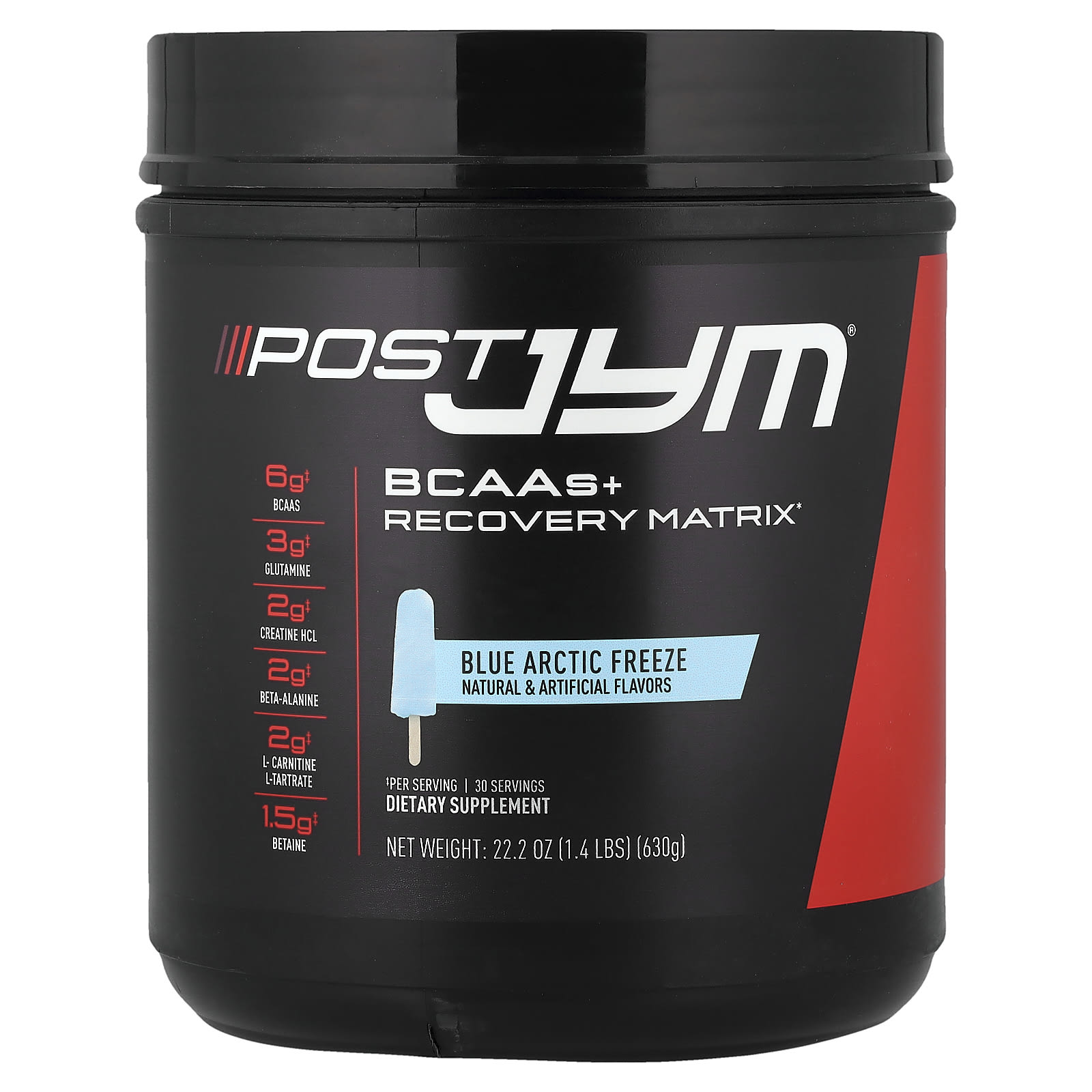
Post JYM BCAAs+ Recovery Matrix Blue Arctic Freeze

21 Grams [1 Scoop] · how many a day not stated

Add to my list
Per day$1.50

Calculated at 1 serving a day. The label does not state how many to take daily.

Per pack$44.99

22 ozs; 1.4 lbs; 630 g · Vitacost · checked 22 Oct 2026. Delivery is not included.

Per serving$1.50

Pack price divided by the number of servings in the pack.

Composition

Recorded amounts. How many servings a day is not stated.

41 mgrecorded amount; daily frequency not stated · as calcium itself
2% of 2,000 mg — US upper limit for adults, National Academies2,500 mg (ages 19–50) · 2,000 mg (51 and older) · from food and supplements, adults · food is not counted here · a reference value, not a legal limit
L-Glutamine
3,000 mgrecorded amount; daily frequency not stated
No limit on file for the United StatesNone on file in any country
2,000 mgrecorded amount; daily frequency not stated
No limit on file for the United States
Limits in other countries (3)Croatia, France, Switzerland
CarnoSynas Beta-Alanine
2,000 mgrecorded amount; daily frequency not stated
No limit on file for the United StatesNone on file in any country
L-Carnitine L-Tartrate
2,000 mgrecorded amount; daily frequency not stated
No limit on file for the United StatesNone on file in any country
Betaine
1,500 mgrecorded amount; daily frequency not stated
No limit on file for the United States
Limits in other countries (3)Croatia, France, Switzerland
1,000 mgrecorded amount; daily frequency not stated
No limit on file for the United States
Limits in other countries (3)Croatia, Czechia, Switzerland
L-Leucine
3,600 mgrecorded amount; daily frequency not stated
No limit on file for the United StatesNone on file in any country
L-Isoleucine
1,200 mgrecorded amount; daily frequency not stated
No limit on file for the United StatesNone on file in any country
L-Valine
1,200 mgrecorded amount; daily frequency not stated
No limit on file for the United StatesNone on file in any country
Black Pepper extract
5.3 mgrecorded amount; daily frequency not stated
No limit on file for the United StatesNone on file in any country

Where no limit is shown, none is set or on file for the United States. That is not the same as having no maximum.

Manufacturer's directions

Directions: As a dietary supplement; mix 1 scoop of Post JYM Recovery Matrix into 16-24 oz. water; preferably within 30 minutes after workouts. Consider drinking over the course of 15-30 minutes. For better results; consider using Pre JYM prior to workouts.

Other ingredients on the label

Natural and Artificial flavor, Citric Acid, Calcium Silicate, Salt, Sucralose, Acesulfame Potassium, Malic Acid, FD&C Blue #1

Limits in other countries
CountryCalciumCreatine HClBetaineTaurine
United States2,000 mgreference, not a law · 2%
Comparison note2,500 mg (ages 19–50) · 2,000 mg (51 and older)
—not on file—not on file—not on file
Austria800 mgrecommendation · 5%—not on file—not on file—not on file
Belgium1,600 mglaw · 3%—not on file—not on file—not on file
Croatia1,500 mglaw · 3%3,000 mglaw · 67%1,500 mglaw · 100%1,000 mglaw · 100%
Cyprus1,500 mglaw · 3%—not on file—not on file—not on file
Czechia—not on file—not on file—not on file2,000 mglaw · 50%
Denmark1,327 mgrecommendation · 3%—not on file—not on file—not on file
EAEU2,500 mglaw · 2%—not on file—not on file—not on file
Estonia2,500 mgrecommendation · 2%—not on file—not on file—not on file
Finland2,500 mgrecommendation · 2%—not on file—not on file—not on file
France800 mglaw · 5%3,000 mglaw · 67%400 mgrecommendation · 375% · above—not on file
Germany500 mgrecommendation · 8%—not on file—not on file—not on file
Ireland2,500 mgrecommendation · 2%—not on file—not on file—not on file
Italy1,200 mgrecommendation · 3%—not on file—not on file—not on file
Luxembourg1,600 mglaw · 3%—not on file—not on file—not on file
Malta1,500 mgrecommendation · 3%—not on file—not on file—not on file
Norway705 mglaw · 6%—not on file—not on file—not on file
Poland1,500 mgrecommendation · 3%—not on file—not on file—not on file
Switzerland750 mglaw · 5%3,000 mglaw · 67%1,500 mglaw · 100%1,000 mglaw · 100%

Maximum amounts per daily dose of a food supplement, as each country sets them; the share is the daily amount on the label against that maximum. Law = legally binding; recommendation = an authority's recommended maximum, not binding; reference = the U.S. upper intake level for adults from all sources (National Academies), not a legal limit. Verification level V0 · Report an error

About the ingredients

Ingredient information

Ingredient guideCalciumCalcium is the most abundant mineral in the human body. An adult body holds about 1.2–1.4 kg of it, almost all in bones and teeth. Milk, yogurt and cheese are rich sources. Supplements contain calcium as part of a compound, most often calcium carbonate or calcium citrate.Read moreShow less
Terms and sources
1.2–1.4 kg
About 1,200 g in women and 1,400 g in men. NIH Office of Dietary Supplements.

Calcium in the body

About 99% of the body's calcium is in bones and teeth. The other 1% is in the blood and soft tissues. This small part is needed for normal muscle function, nerve signaling, blood clotting and hormone release. It also takes part as blood vessels tighten and relax.

Terms and sources
bones and teeth
There it sits in hydroxyapatite, a mineral of calcium and phosphate. Linus Pauling Institute; NIH Office of Dietary Supplements.

The body keeps blood calcium in a narrow range, about 8.8–10.4 mg/dL. When intake is low, it draws calcium from bone to hold that range. A blood test therefore does not show how much calcium a person gets. Bone is rebuilt all the time; teeth are not. Vitamin D is needed to absorb calcium in the gut.

Terms and sources
8.8–10.4 mg/dL
2.2–2.6 mmol/L, total calcium in serum in healthy people. NIH Office of Dietary Supplements.
absorb calcium in the gut
Vitamin D is needed for active transport, the main route when intake is low. NIH Office of Dietary Supplements.

Information, not a prescription. Do not start, stop or combine supplements or medicines on your own.
Ingredient guideCreatineCreatine is a compound that the body makes from amino acids and stores mostly in muscle. Meat and fish also contain it. In supplements it comes as a powder or capsules, in forms such as creatine monohydrate, creatine HCl and buffered creatine.Read moreShow less

Creatine in the body

The body makes creatine from three amino acids: glycine, arginine and methionine. The kidneys carry out the first step and the liver the next ones. Together they make about 1 g of creatine a day.

Terms and sources
amino acids
the building blocks of protein. NIH Office of Dietary Supplements.
the first step
Chilibeck et al., 2017. NIH names the liver and kidneys together.
about 1 g
NIH Office of Dietary Supplements.

About 95% of the body's creatine is in skeletal muscle, with small amounts in the brain. About two thirds of muscle creatine is bound to phosphate, as phosphocreatine. Muscle cells use phosphocreatine to remake ATP, the energy carrier of cells, during short, intense efforts. An adult weighing 70 kg (154 lb) holds about 120 g of creatine and phosphocreatine.

Terms and sources
About 95%
International Society of Sports Nutrition, 2017.
ATP
adenosine triphosphate. NIH Office of Dietary Supplements.
about 120 g
NIH Office of Dietary Supplements.

Each day, about 1–2% of muscle creatine turns into creatinine, which leaves the body in urine. To keep stores steady, the body replaces about 1–3 g a day; about half comes from food. On a usual diet with 1–2 g of creatine a day, muscle stores are about 60–80% full.

Terms and sources
creatinine
a breakdown product of creatine. International Society of Sports Nutrition, 2017.
60–80% full
saturated. In studies, supplements raised muscle creatine and phosphocreatine by 20–40%. International Society of Sports Nutrition, 2017.

Information, not a prescription. Do not start, stop or combine supplements or medicines on your own.

Ingredient guideTaurineTaurine is an amino acid that the body makes from cysteine and does not use to build proteins. Meat, seafood and milk contain it; 48 plant foods tested in one survey did not. Energy drinks add it, and supplements sell it as powder or capsules, as taurine or magnesium taurate.Read moreShow less
Terms and sources
Taurine
The name comes from the ox, Bos taurus: taurine was first isolated from ox bile. Ripps and Shen, 2012.
an amino acid
Strictly, an amino sulfonic acid: it has a sulfonate group in place of the usual carboxyl group. Ripps and Shen, 2012.

Taurine in the body

Taurine is one of the most abundant amino acids in the brain, retina, muscle and other organs. Taurine joins bile acids to form bile salts. Cells also use it to keep their volume steady and to handle calcium.

Terms and sources
most abundant
Ripps and Shen, 2012. In the rat eye, it is the most abundant amino acid in the retina, lens and cornea.
bile salts
Ripps and Shen, 2012.
keep their volume steady
It works as an osmolyte, a dissolved substance that holds water in cells. Ripps and Shen, 2012.

The body makes taurine from two amino acids, methionine and cysteine. Humans and other primates have little CSD, a key enzyme for making taurine. In one study, vegan men had blood taurine of 45 µmol/L, and meat eaters 58 µmol/L. The vegans passed about 33 mg of taurine a day in urine, and the meat eaters about 113 mg.

Terms and sources
methionine and cysteine
The last step turns hypotaurine into taurine. Ripps and Shen, 2012.
CSD
cysteine sulfinic acid decarboxylase. Cats also have little of it. Ripps and Shen, 2012.
vegan men
12 men on a vegan diet for about 4 years, and 14 men who ate meat. The vegans' food diaries showed almost no taurine. Laidlaw et al., 1988.
about 33 mg
266 and 903 µmol a day in the paper. We converted these to mg.

After a 4 g dose by mouth, blood taurine peaked in about 1.5 hours. Half of it left the blood in about 1 hour.

Terms and sources
a 4 g dose
8 healthy men, fasting, in the morning. The peak was 86 mg per liter. Ghandforoush-Sattari et al., 2010.
Half of it
elimination half-life: 1.0 hour on average.

A study in Science reported that mice given taurine from middle age lived longer. The same study found that blood taurine fell with age in mice, monkeys and people. Later studies in people found blood taurine stable or higher with age. The authors of the mouse study called for trials in people.

Terms and sources
A study in Science
Singh et al., 2023. Mice got 1,000 mg per kg of body weight a day from 14 months of age.
lived longer
Median lifespan was 10–12% longer than in untreated mice.
monkeys
Monkeys given taurine for 6 months gained less weight; the study did not measure their lifespan.
Later studies
Fernandez et al., Science, 2025: three geographically distinct groups of people, at the US National Institute on Aging. Also 137 men aged 20–93: no link with age (Marcangeli et al., Aging Cell, 2025).

Information, not a prescription. Do not start, stop or combine supplements or medicines on your own.

Need help choosing?

Choose the option that suits you.

Quick selection

I know my goal

$5

1–2 minutes · a few questions with fixed answers

One goal. Up to three products. Set a budget per day if you like.

Product checks
form and amount on the label, plus shop prices
Daily schedule
what to take, when, how much
Totals and limits
next to the upper limit
Reasons & sources
for each product
Prices and shops
plus food and habits
Progress
what to track, when to see a doctor

Complete the questionnaire before you pay. If no product fits any of your goals, you won’t be charged.

Order · $5View example

Full selection

I have several goals

$15

5–7 minutes · questionnaire with fixed answers

Up to three goals in one set. Where two goals overlap, one product is used for both.

Product checks
form and amount on the label, plus shop prices
Daily schedule
what to take, when, how much
Totals and limits
next to the upper limit
Reasons & sources
for each product
Prices and shops
plus food and habits
Progress
what to track, when to see a doctor

Complete the questionnaire before you pay. If no product fits any of your goals, you won’t be charged.

Order · $15View example

Expert review

I want a person to look at my supplements

$50

Written review within 48 hours of your completed questionnaire

An expert reviews your supplement list and questionnaire.

Written review
duplicates, limits, forms
Detailed questionnaire
supplements, medicines, history
Optional uploads
supplement-label photos or documents relevant to your review
Your notes
your priorities and questions
Follow-up questions
in writing, when needed
Next steps
points to discuss with your doctor

Complete the questionnaire before you pay.

Order · $50View example
Sources, label & certificates

Label record

Copied from the NIH label database (DSLD 216080) · not yet compared with the label · checked 2 Nov 2026 · Report an error

The United States has no pre-market registration for supplements.
Label on file in the NIH Dietary Supplement Label Database
checked 2 Nov 2026source: NIH DSLDReport an error

Barcode 8 17047 02141 3

Third-party certificates

No third-party certificate on file for this product.

Information, not a prescription. Do not start, stop or combine supplements or medicines on your own. If you have a health condition, are pregnant or breastfeeding, take medicines, or are under 18, talk to a doctor or pharmacist first.

Photo credits

Image: © JYM Supplement Science. Shown to identify the product. Source: iherb.com

Rights holders can ask us to remove an image or send official product photos: info@verateca.com.

Product photo

JYM Supplement Science Post JYM BCAAs+ Recovery Matrix Blue Arctic Freeze — enlarged pack