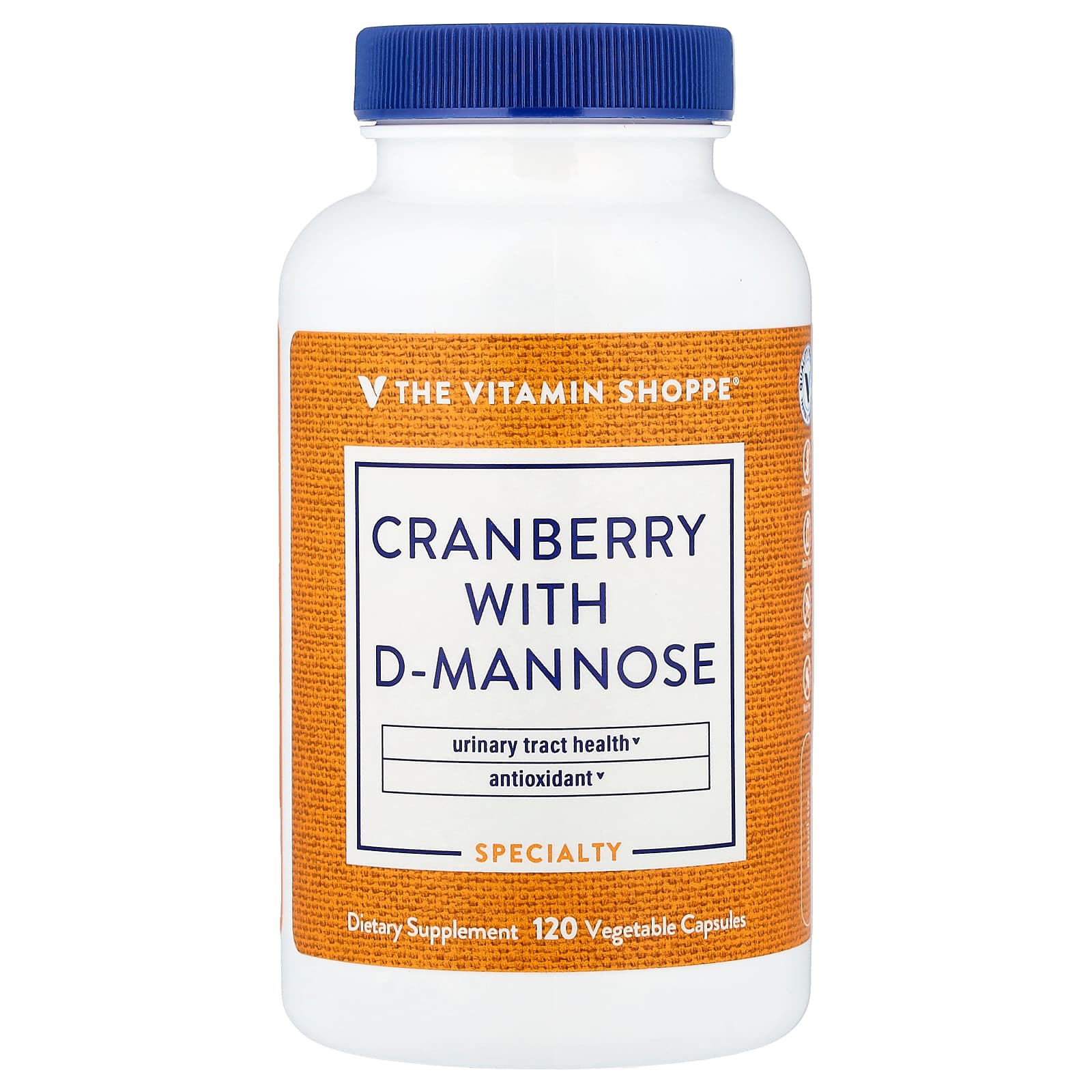
The Vitamin Shoppe · capsules

Cranberry with D-Mannose

At the recorded label maximum: 3 servings (2 Vegetable Capsules each) per day

Add to my list
Per day$3.04

At the label maximum of 6 capsules a day.

Per pack$30.44

60 capsules · iHerb · checked 26 Oct 2026. Delivery is not included.

Per capsule$0.51

Pack price divided by the number of capsules in the pack.

Composition

Amounts at the recorded label maximum. Directions may give a range.

Vitamin Cas Ascorbic Acid
180 mgat the recorded label maximum (3 servings × 60 mg; 2 Vegetable Capsules per serving)
9% of 2,000 mg — US upper limit for adults, National Academiesfrom food and supplements, adults · food is not counted here · a reference value, not a legal limit
3,000 mgat the recorded label maximum (3 servings × 1,000 mg; 2 Vegetable Capsules per serving)
No limit on file for the United StatesNone on file in any country
1,200 mgat the recorded label maximum (3 servings × 400 mg; 2 Vegetable Capsules per serving)
No limit on file for the United StatesNone on file in any country

Where no limit is shown, none is set or on file for the United States. That is not the same as having no maximum.

Manufacturer's directions

Directions: Take two (2) vegetable capsules up to three (3) times daily; preferably with meals.

Other ingredients on the label

Vegetable Capsule (Hypromellose), Rice Extract Blend, Rice Flour, Tricalcium Phosphate, Silicon Dioxide (SiO2)

Limits in other countries
CountryVitamin C
United States2,000 mgreference, not a law · 9%
Austria500 mgrecommendation · 36%
Belgium1,000 mglaw · 18%
Croatia800 mglaw · 23%
Cyprus2,000 mglaw · 9%
Denmark1,000 mgrecommendation · 18%
EAEU900 mglaw · 20%
Estonia—not on file
Finland—not on file
France180 mglaw · 100%
Germany250 mgrecommendation · 72%
Ireland2,000 mgrecommendation · 9%
Italy1,000 mgrecommendation · 18%
Luxembourg1,000 mglaw · 18%
Malta1,000 mgrecommendation · 18%
Norway1,000 mglaw · 18%
Poland1,000 mgrecommendation · 18%
Switzerland750 mglaw · 24%

Maximum amounts per daily dose of a food supplement, as each country sets them; the share is the daily amount on the label against that maximum. Law = legally binding; recommendation = an authority's recommended maximum, not binding; reference = the U.S. upper intake level for adults from all sources (National Academies), not a legal limit. Verification level V0 · Report an error

About the ingredients

Ingredient information

Ingredient guideVitamin CVitamin C, also called L-ascorbic acid, is a water-soluble vitamin. Most animals make vitamin C in the body; humans cannot and get it from food. Fruits and vegetables such as peppers, citrus fruits and kiwifruit are the main sources. Supplements contain it as ascorbic acid or as mineral salts such as sodium and calcium ascorbate.Read moreShow less
Terms and sources
water-soluble
It dissolves in water, not in fat. NIH Office of Dietary Supplements.

Vitamin C in the body

Vitamin C is needed to make collagen, carnitine and some neurotransmitters. It is also an antioxidant and can return used vitamin E to its active form. It is needed for normal immune function. It increases the absorption of iron from plant foods.

Terms and sources
collagen
A protein that holds together connective tissue, such as skin, tendons and blood vessels. NIH Office of Dietary Supplements.
carnitine
A substance cells need to get energy from fat. Linus Pauling Institute.
neurotransmitters
Chemical messengers between nerve cells.
antioxidant
A substance that limits damage from free radicals, reactive molecules made in cells.
iron from plant foods
Nonheme iron, the only form of iron in plant foods. NIH Office of Dietary Supplements.

An adult body holds from about 300 mg to about 2 g of vitamin C. White blood cells, the eyes, the adrenal and pituitary glands and the brain hold the most. Cells hold vitamin C in millimolar concentrations, blood plasma in micromolar concentrations. At 100 mg a day or more, cells appear to be saturated.

Terms and sources
about 300 mg
The lower figure is for very low intake. NIH Office of Dietary Supplements.
adrenal and pituitary glands
Small glands that make hormones: the adrenals sit above the kidneys, the pituitary below the brain.
millimolar
Thousandths of a mole per liter; micromolar means millionths. NIH Office of Dietary Supplements.
saturated
Holding as much as they take up. Above 200 mg a day, blood plasma levels rise little more.

The body absorbs about 70–90% of vitamin C at 30–180 mg a day. Above 1 g a day, less than 50% is absorbed, and unused vitamin C leaves in urine.

Terms and sources
less than 50%
Summary by the NIH Office of Dietary Supplements. Absorption in the gut runs through a dose-dependent transporter protein.

Information, not a prescription. Do not start, stop or combine supplements or medicines on your own.

Ingredient guideD-mannoseD-mannose is a simple sugar sold as a powder to stir into water and as capsules or tablets. The body makes its own D-mannose, mainly from glucose, and also gets small amounts from fruit. It is sold alone or mixed with cranberry extract and other ingredients.Read moreShow less
Terms and sources
simple sugar
A monosaccharide. It is one of nine sugar units common in the sugar chains of animal cells. Ala-Jaakkola et al., Nutrition Journal, 2022.
mainly from glucose
It also comes from the breakdown of the body's own sugar chains. Ala-Jaakkola et al., Nutrition Journal, 2022. Danisco Sweeteners Oy, part of International Flavors & Fragrances, paid for this review. All four authors worked there.
mixed with cranberry extract
Ala-Jaakkola et al., Nutrition Journal, 2022.

D-mannose in the body

Cells build D-mannose into the sugar chains attached to many proteins. D-mannose can also be broken down for energy. Blood normally holds 50 to 100 µmol/L of it.

Terms and sources
sugar chains
Glycans. Attaching them to proteins is called glycosylation. Ala-Jaakkola et al., Nutrition Journal, 2022.
µmol/L
Micromoles per liter. Ala-Jaakkola et al., Nutrition Journal, 2022. Alton and colleagues measured about 55 µmol/L before a dose.

In one study, blood mannose peaked 1–2 hours after a dose and fell by half in about 4 hours. A 2022 review gives 20–35% of a dose in urine within 60 minutes. In Ganda 1979, one of the two studies it cites, mannose was infused into a vein. In Tanabe 2026, below, nearly 0% of a 5 g dose by mouth reached urine within 8 hours. In Hayashi 2025, below, urine mannose did not rise significantly after 1 g by mouth.

Terms and sources
In one study
Single doses of 0.07–0.21 g per kg of body weight. Healthy adults and people with a rare inherited condition, including children, took part. Alton et al., Biochemical and Molecular Medicine, 1997.
A 2022 review
Ala-Jaakkola et al., Nutrition Journal, 2022. Danisco Sweeteners Oy, part of International Flavors & Fragrances, paid for this review. All four authors worked there.
Ganda 1979
Ganda et al., 1979, infused 0.5 g per kg over 3 minutes. Within 60 minutes, 35% of the dose was in urine. PubMed indexes the other study, Wood and Cahill, 1963, under infusions; we could not read its text.
Tanabe 2026
SUNUS Co., Ltd. and a Japanese government program paid for this study. A SUNUS patent application relates to this work. The paper presents 1,5-anhydro-D-mannitol as reaching urine more efficiently than D-mannose.
Hayashi 2025
SUNUS Co., Ltd. and a Japanese government program paid for this study. All five authors worked for SUNUS. The paper draws on two patents for 1-deoxymannose, another name for 1,5-anhydro-D-mannitol. It reports urine levels of 1-deoxymannose significantly higher than of D-mannose at every time point.

Information, not a prescription. Do not start, stop or combine supplements or medicines on your own.

Ingredient guideCranberryCranberry is the berry of Vaccinium macrocarpon, an evergreen shrub. It grows in wet habitats in the Northeastern and North Central parts of North America. Supplements contain the berry as juice concentrate, juice powder, whole-fruit powder or extract. Some extracts are standardized to proanthocyanidins (PACs), a group of the berry's polyphenols.Read moreShow less
Terms and sources
evergreen shrub
NCCIH, Cranberry: Usefulness and Safety. NCCIH also lists Vaccinium oxycoccos under the same name.
wet habitats
NCCIH, Cranberry: Usefulness and Safety.
proanthocyanidins (PACs)
NCCIH uses the abbreviation PACs. Trial reports below measured them by different lab methods.

Cranberry in the body

Cranberry is not a nutrient, and the body has no daily requirement for it. Trials below in adults without a diagnosis measured memory, mood, arteries, blood fats, antioxidant capacity and urine.

In two trials below, cranberry polyphenol breakdown products in blood or urine rose with cranberry, not with the dummy product.

Terms and sources
In two trials below
Plasma (poly)phenol metabolites rose by 1.82 ± 0.57 μM with cranberry powder over 12 weeks. They did not rise with the dummy powder (Flanagan et al., 2022). Hippuric acid, caffeic acid and four related compounds rose in urine after 4 weeks of a cranberry drink. Nieman et al., 2024.

Information, not a prescription. Do not start, stop or combine supplements or medicines on your own.

Need help choosing?

Choose the option that suits you.

Quick selection

I know my goal

$5

1–2 minutes · a few questions with fixed answers

One goal. Up to three products. Set a budget per day if you like.

Product checks
form and amount on the label, plus shop prices
Daily schedule
what to take, when, how much
Totals and limits
next to the upper limit
Reasons & sources
for each product
Prices and shops
plus food and habits
Progress
what to track, when to see a doctor

Complete the questionnaire before you pay. If no product fits any of your goals, you won’t be charged.

Order · $5View example

Full selection

I have several goals

$15

5–7 minutes · questionnaire with fixed answers

Up to three goals in one set. Where two goals overlap, one product is used for both.

Product checks
form and amount on the label, plus shop prices
Daily schedule
what to take, when, how much
Totals and limits
next to the upper limit
Reasons & sources
for each product
Prices and shops
plus food and habits
Progress
what to track, when to see a doctor

Complete the questionnaire before you pay. If no product fits any of your goals, you won’t be charged.

Order · $15View example

Expert review

I want a person to look at my supplements

$50

Written review within 48 hours of your completed questionnaire

An expert reviews your supplement list and questionnaire.

Written review
duplicates, limits, forms
Detailed questionnaire
supplements, medicines, history
Optional uploads
supplement-label photos or documents relevant to your review
Your notes
your priorities and questions
Follow-up questions
in writing, when needed
Next steps
points to discuss with your doctor

Complete the questionnaire before you pay.

Order · $50View example
Sources, label & certificates

Label record

Copied from the NIH label database (DSLD 217995) · not yet compared with the label · checked 2 Nov 2026 · Report an error

The United States has no pre-market registration for supplements.
Label on file in the NIH Dietary Supplement Label Database
checked 2 Nov 2026source: NIH DSLDReport an error

Barcode 7 66536 02366 0

Third-party certificates

No third-party certificate on file for this product.

Information, not a prescription. Do not start, stop or combine supplements or medicines on your own. If you have a health condition, are pregnant or breastfeeding, take medicines, or are under 18, talk to a doctor or pharmacist first.

Photo credits

Image: © The Vitamin Shoppe. Shown to identify the product. Source: iherb.com

Rights holders can ask us to remove an image or send official product photos: info@verateca.com.

Product photo

The Vitamin Shoppe Cranberry with D-Mannose — enlarged pack