Terms and sources
- Taurine
- The name comes from the ox, Bos taurus: taurine was first isolated from ox bile. Ripps and Shen, 2012.
- an amino acid
- Strictly, an amino sulfonic acid: it has a sulfonate group in place of the usual carboxyl group. Ripps and Shen, 2012.
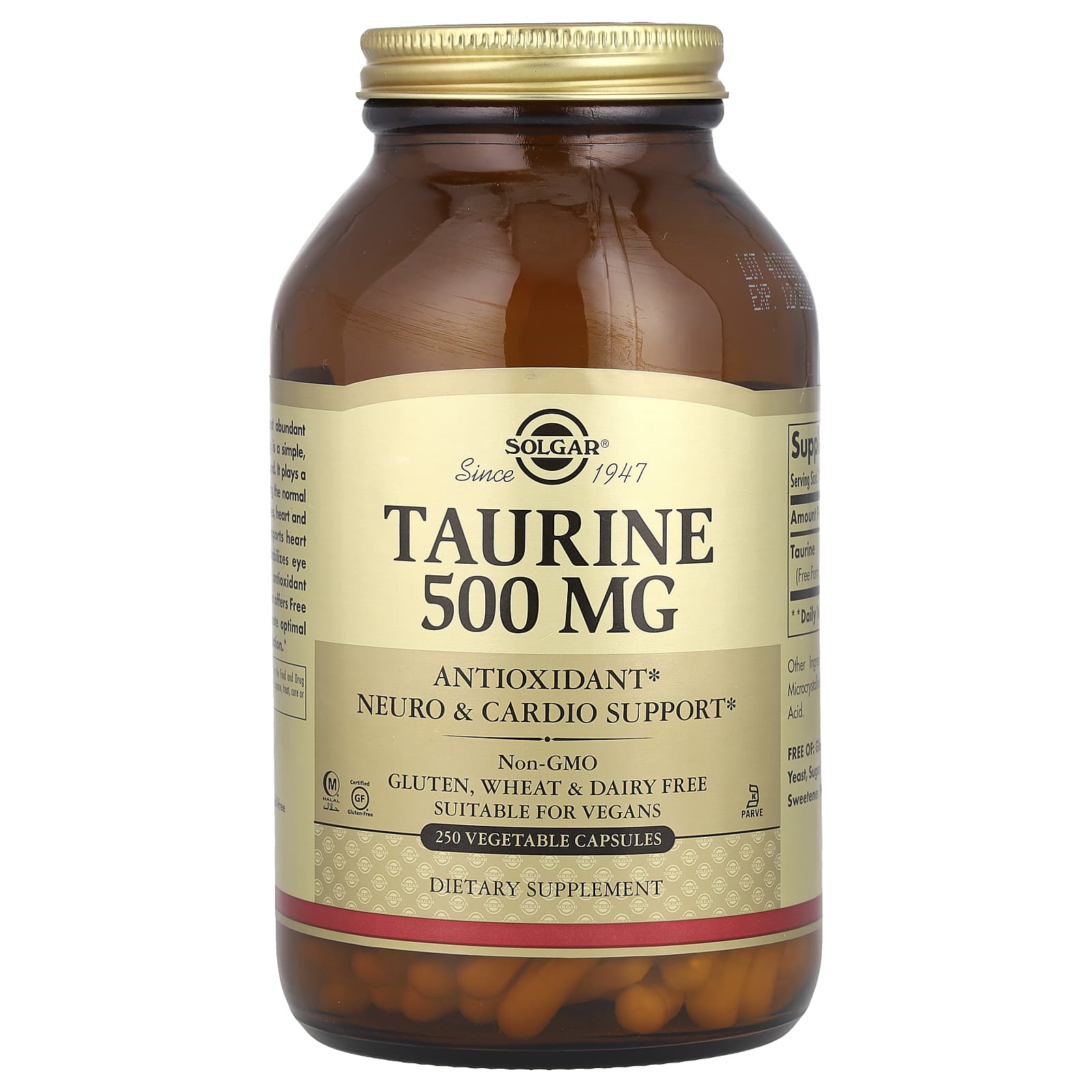
Taurine in the body
Taurine is one of the most abundant amino acids in the brain, retina, muscle and other organs. Taurine joins bile acids to form bile salts. Cells also use it to keep their volume steady and to handle calcium.
Terms and sources
- most abundant
- Ripps and Shen, 2012. In the rat eye, it is the most abundant amino acid in the retina, lens and cornea.
- bile salts
- Ripps and Shen, 2012.
- keep their volume steady
- It works as an osmolyte, a dissolved substance that holds water in cells. Ripps and Shen, 2012.
The body makes taurine from two amino acids, methionine and cysteine. Humans and other primates have little CSD, a key enzyme for making taurine. In one study, vegan men had blood taurine of 45 µmol/L, and meat eaters 58 µmol/L. The vegans passed about 33 mg of taurine a day in urine, and the meat eaters about 113 mg.
Terms and sources
- methionine and cysteine
- The last step turns hypotaurine into taurine. Ripps and Shen, 2012.
- CSD
- cysteine sulfinic acid decarboxylase. Cats also have little of it. Ripps and Shen, 2012.
- vegan men
- 12 men on a vegan diet for about 4 years, and 14 men who ate meat. The vegans' food diaries showed almost no taurine. Laidlaw et al., 1988.
- about 33 mg
- 266 and 903 µmol a day in the paper. We converted these to mg.
After a 4 g dose by mouth, blood taurine peaked in about 1.5 hours. Half of it left the blood in about 1 hour.
Terms and sources
- a 4 g dose
- 8 healthy men, fasting, in the morning. The peak was 86 mg per liter. Ghandforoush-Sattari et al., 2010.
- Half of it
- elimination half-life: 1.0 hour on average.
A study in Science reported that mice given taurine from middle age lived longer. The same study found that blood taurine fell with age in mice, monkeys and people. Later studies in people found blood taurine stable or higher with age. The authors of the mouse study called for trials in people.
Terms and sources
- A study in Science
- Singh et al., 2023. Mice got 1,000 mg per kg of body weight a day from 14 months of age.
- lived longer
- Median lifespan was 10–12% longer than in untreated mice.
- monkeys
- Monkeys given taurine for 6 months gained less weight; the study did not measure their lifespan.
- Later studies
- Fernandez et al., Science, 2025: three geographically distinct groups of people, at the US National Institute on Aging. Also 137 men aged 20–93: no link with age (Marcangeli et al., Aging Cell, 2025).
Information, not a prescription. Do not start, stop or combine supplements or medicines on your own.