Country Life · capsules

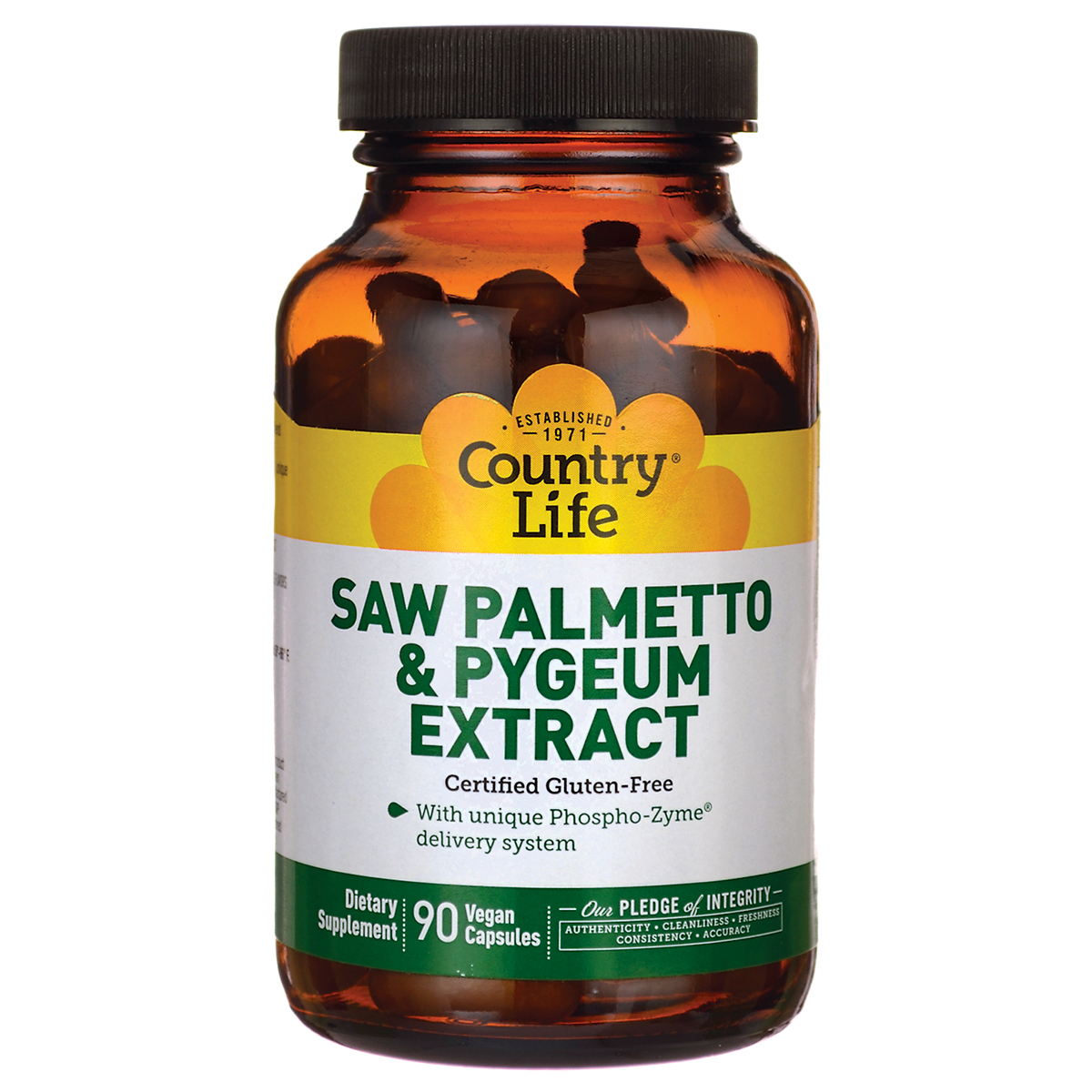
Saw Palmetto & Pygeum Extract

At the recorded label maximum: 2 capsules per day

Add to my list
Per day$0.58

At the label maximum of 2 capsules a day.

Per pack$25.99

90 capsules · Country Life · checked 20 Nov 2026. Delivery is not included.

Per capsule$0.29

Pack price divided by the number of capsules in the pack.

Composition

Amounts at the recorded label maximum. Directions may give a range.

Amounts not disclosed. The label gives only the total weight of this blend, not the amount of each ingredient in it. Without the individual amounts, we cannot compare these ingredients with upper limits.

Saw Palmetto Soy Lecithin Complex Providing
242 mgat the recorded label maximum (1 serving × 242 mg; 2 capsules per serving)
No limit on file for the United StatesNone on file in any country
Saw Palmetto extract Oil
Amount not disclosedpart of Saw Palmetto Soy Lecithin Complex Providing · not counted
No limit on file for the United StatesNone on file in any country
Soy Lecithin
Amount not disclosedpart of Saw Palmetto Soy Lecithin Complex Providing · not counted
No limit on file for the United StatesNone on file in any country
Amount not disclosedpart of Proprietary Blend · not counted
No limit on file for the United States
Limits in other countries (2)Croatia, France
Lipase
Amount not disclosedpart of Proprietary Blend · not counted
No limit on file for the United StatesNone on file in any country

Where no limit is shown, none is set or on file for the United States. That is not the same as having no maximum.

Manufacturer's directions

Directions: Adult males take two (2) capsules daily with food or as directed by a health care professional.

Other ingredients on the label

Cellulose, Cellulose, Calcium Silicate, Magnesium Stearate, Silica, Maltodextrin

Limits in other countries
CountryVegetable Oil Phytosterols
Croatia3,000 mglaw · not compared
France1,700 mgrecommendation · not compared

Maximum amounts per daily dose of a food supplement, as each country sets them; the share is the daily amount on the label against that maximum. Law = legally binding; recommendation = an authority's recommended maximum, not binding; reference = the U.S. upper intake level for adults from all sources (National Academies), not a legal limit. Verification level V0 · Report an error

About the ingredients

Ingredient information

Ingredient guidePlant sterols and stanolsPlant sterols and stanols, together called phytosterols, are plant compounds built much like cholesterol. The main plant sterols in food are beta-sitosterol, campesterol and stigmasterol. Stanols, such as sitostanol, lack one double bond; they are about 10% of food phytosterols. Supplements hold free sterols, stanols or their esters, which are bound to fatty acids, in capsules, softgels or powders.Read moreShow less
Terms and sources
built much like cholesterol
They are structurally related to cholesterol. Linus Pauling Institute, Oregon State University.
beta-sitosterol
Also written β-sitosterol. Linus Pauling Institute, Oregon State University.
lack one double bond
In the sterol ring; stanols are the saturated forms. Linus Pauling Institute, Oregon State University.
in capsules, softgels or powders
Product forms of 92 US labels with sterols or stanols alone, NIH Dietary Supplement Label Database. Tablets also appear. We counted these.

Plant sterols in the body

The body cannot make phytosterols, so all phytosterols in human blood come from the diet. Less than 5% of plant sterols eaten and less than 0.5% of plant stanols are absorbed. Gut cells pump most absorbed phytosterols straight back into the gut. Blood levels of phytosterols are usually several hundred times lower than blood cholesterol.

Terms and sources
come from the diet
Cholesterol, by contrast, comes from both the diet and the body's own production. Linus Pauling Institute, Oregon State University.
are absorbed
For cholesterol from food, the figure is about 50–60%. Linus Pauling Institute, Oregon State University.
pump
A transporter called ABCG5/G8 does this; in the liver, the same transporter moves them into bile. Linus Pauling Institute, Oregon State University.

In the gut, phytosterols take the place of cholesterol in the tiny fat droplets that carry it. More cholesterol from food and bile then leaves in the stool. LPI cites a feeding trial with 0.46 g and 2.1 g of phytosterols a day. Cholesterol absorption fell by about 10% and 25%. Cholesterol leaving in the stool rose by 36% and 74%, LPI notes.

Terms and sources
tiny fat droplets
mixed micelles: droplets of bile salts, fats and sterols that form after a meal with fat. Linus Pauling Institute, Oregon State University.
leaves in the stool
LPI: phytosterols also facilitate the excretion of biliary cholesterol in the feces.
a feeding trial
Phytosterols in drinks, compared with a dummy drink. LPI, citing Racette et al., American Journal of Clinical Nutrition, 2010.

LPI cites a meta-analysis of 124 studies of LDL cholesterol in the blood. LDL cholesterol was at least 5% lower with 0.6–1.1 g a day and about 12.4% lower with 3.3 g. These are blood measurements; LPI notes that the long-term effect on health outcomes is not known.

Terms and sources
124 studies
Ras et al., British Journal of Nutrition, 2014, as cited by LPI. Two of the three authors worked for Unilever.

Phytosterols also lower blood levels of some carotenoids, the yellow and red pigments of plants. LPI cites a meta-analysis in which blood carotenoids such as beta-carotene were about 5–20% lower with enriched foods. LPI notes that in one trial, advice to eat 5 servings of fruit and vegetables a day kept carotenoid levels.

Terms and sources
a meta-analysis
Over 1 month to 1 year. Adjusted for cholesterol, alpha-carotene, beta-carotene and lycopene may stay lower. Baumgartner et al., European Journal of Nutrition, 2017, as cited by LPI. Two of the five authors worked for Unilever.
one trial
Including 1 serving of carotenoid-rich vegetables, in people taking 2.5 g of sterol or stanol esters a day. Noakes et al., American Journal of Clinical Nutrition, 2002, as cited by LPI.

LPI notes that in the US, plant sterols and stanols added to a variety of food products are "generally recognized as safe" (GRAS), an FDA status. LPI notes that few adverse effects have been reported with regular intake for up to 1 year. LPI notes that nausea, indigestion, diarrhea and constipation have occasionally been reported. LPI notes that people with sitosterolemia should avoid foods or supplements with added plant sterols. LPI notes: Phytosterol-enriched foods and supplements are not recommended for pregnant or breastfeeding women because their safety has not been studied. LPI notes that some cholesterol medicines change how much plant sterol the body absorbs or keeps in blood.

Terms and sources
GRAS
A US status for food ingredients. Linus Pauling Institute, Oregon State University.
sitosterolemia
A very rare inherited condition in which the body absorbs and keeps far more plant sterols. Linus Pauling Institute, Oregon State University.
some cholesterol medicines
LPI: statin therapy appears to increase the absorption of plant sterols. Ezetimibe (marketed as Zetia) is another cholesterol-lowering drug that may interfere with the intestinal absorption of phytosterols.

Information, not a prescription. Do not start, stop or combine supplements or medicines on your own.
Services

Choose the option that suits you.

Quick selection

I know my goal

$5

1–2 minutes · a few questions with fixed answers

One goal. Up to three products. Set a budget per day if you like.

Product checks
form and amount on the label, plus shop prices
Daily schedule
what to take, when, how much
Totals and limits
next to the upper limit
Reasons & sources
for each product
Prices and shops
plus food and habits
Progress
what to track, when to see a doctor

Complete the questionnaire before you pay. If no product fits any of your goals, you won’t be charged.

Order · $5View example

Full selection

I have several goals

$15

5–7 minutes · questionnaire with fixed answers

Up to three goals in one set. Where two goals overlap, one product is used for both.

Product checks
form and amount on the label, plus shop prices
Daily schedule
what to take, when, how much
Totals and limits
next to the upper limit
Reasons & sources
for each product
Prices and shops
plus food and habits
Progress
what to track, when to see a doctor

Complete the questionnaire before you pay. If no product fits any of your goals, you won’t be charged.

Order · $15View example

Expert review

I want a person to look at my supplements

$50

Written review within 48 hours of your completed questionnaire

An expert reviews your supplement list and questionnaire.

Written review
duplicates, limits, forms
Detailed questionnaire
supplements, medicines, history
Optional uploads
supplement-label photos or documents relevant to your review
Your notes
your priorities and questions
Follow-up questions
in writing, when needed
Next steps
points to discuss with your doctor

Complete the questionnaire before you pay.

Order · $50View example
Sources, label & certificates

Label record

Copied from the NIH label database (DSLD 230800) · not yet compared with the label · checked 19 Oct 2026 · Report an error

The United States has no pre-market registration for supplements.
Label on file in the NIH Dietary Supplement Label Database
checked 19 Oct 2026source: NIH DSLDReport an error

Barcode 0 15794 01900 8

Third-party certificates

Label mentions: Yes Recyclable packaging Yes Manufacturing supports wind power. Not yet checked against the certifiers’ registries.

Information, not a prescription. Do not start, stop or combine supplements or medicines on your own. If you have a health condition, are pregnant or breastfeeding, take medicines, or are under 18, talk to a doctor or pharmacist first.

Photo credits

Image: © Country Life. Shown to identify the product. Source:

Rights holders can ask us to remove an image or send official product photos: info@verateca.com.

Product photo

Country Life Saw Palmetto & Pygeum Extract — enlarged pack