Life Extension · softgels

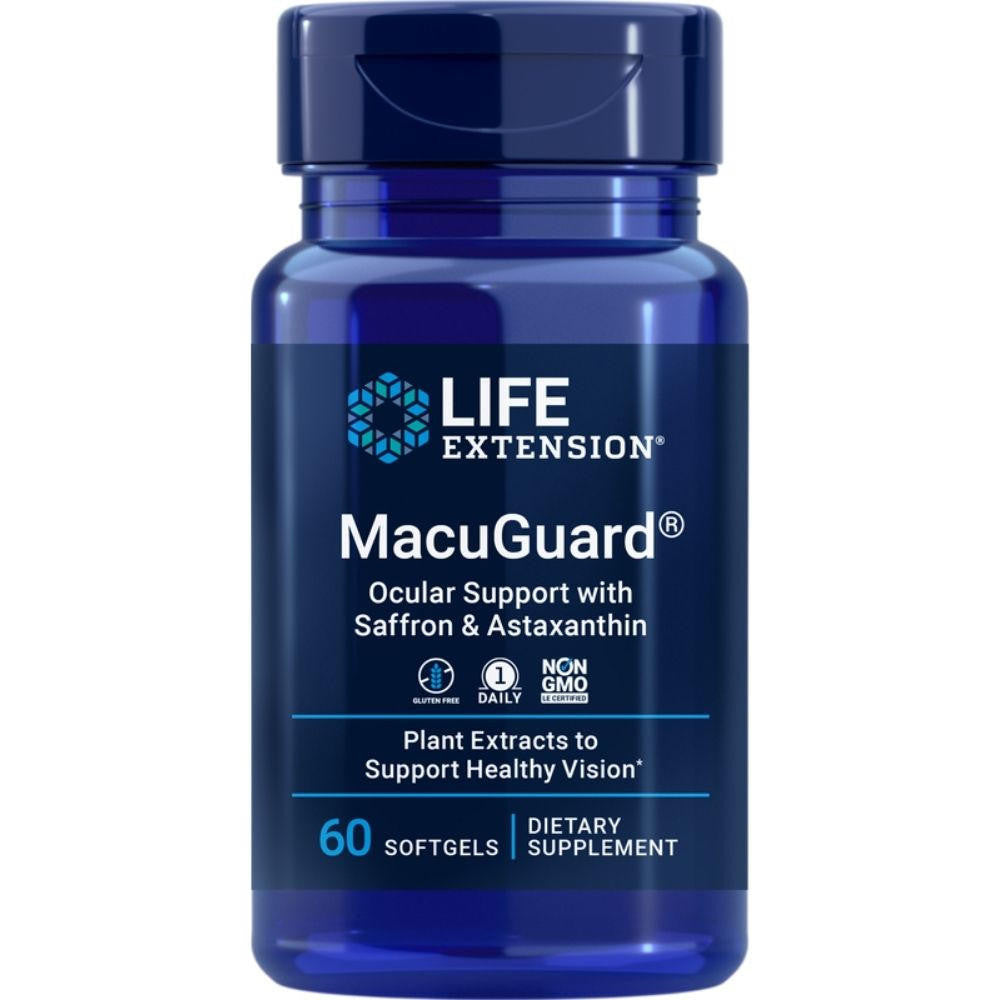
MacuGuard Ocular Support with Saffron & Astaxanthin

At the recorded label maximum: 1 softgel per day

Add to my list
Per day$0.54

At the label maximum of 1 softgel a day.

Per pack$32.25

60 softgels · Supplement Warehouse · checked 20 Nov 2026. Delivery is not included.

Per softgel$0.54

Pack price divided by the number of softgels in the pack.

Composition

Amounts at the recorded label maximum. Directions may give a range.

Amounts not disclosed. The label gives only the total weight of this blend, not the amount of each ingredient in it. Without the individual amounts, we cannot compare these ingredients with upper limits.

Marigold extract
Amount not disclosedpart of MacuGuard Proprietary Blend · not counted
No limit on file for the United StatesNone on file in any country
10 mgat the recorded label maximum (1 softgel × 10 mg)10 mg per softgel · calculated from 10 mg per 1 softgel
No limit on file for the United States
Limits in other countries (3)Croatia, Eurasian Economic Union (EAEU), Switzerland
4 mgat the recorded label maximum (1 softgel × 4 mg)
No limit on file for the United States
Limits in other countries (2)Eurasian Economic Union (EAEU), Switzerland
Amount not disclosedpart of MacuGuard Proprietary Blend · not counted
No limit on file for the United States
Limits in other countries (2)Eurasian Economic Union (EAEU), Switzerland
20 mgat the recorded label maximum (1 softgel × 20 mg)20 mg per softgel · calculated from 20 mg per 1 softgel
No limit on file for the United StatesNone on file in any country
6 mgat the recorded label maximum (1 softgel × 6 mg)6 mg per softgel · calculated from 6 mg per 1 softgel
No limit on file for the United States
Limits in other countries (1)Eurasian Economic Union (EAEU)

Where no limit is shown, none is set or on file for the United States. That is not the same as having no maximum.

Manufacturer's directions

Read the entire label and follow the directions carefully prior to use.Directions: Take one (1) softgel daily; with food; or as recommended by a healthcare practitioner. 1 Daily

Other ingredients on the label

Gelatin, extra virgin Olive Oil, Glycerin, Safflower Oil, Palm Oil, purified Water, Beeswax, Acacia Gum, Annatto color, Potato Maltodextrin

Limits in other countries
Countryfree LuteinTrans-Zeaxanthinnatural Astaxanthin
Croatia20 mglaw · 50%—not on file—not on file
EAEU10 mglaw · 100%3 mglaw · 133% · above6 mglaw · 100%
Switzerland20 mglaw · 50%2 mglaw · 200% · above—not on file

Maximum amounts per daily dose of a food supplement, as each country sets them; the share is the daily amount on the label against that maximum. Law = legally binding; recommendation = an authority's recommended maximum, not binding; reference = the U.S. upper intake level for adults from all sources (National Academies), not a legal limit. Verification level V0 · Report an error

About the ingredients

Ingredient information

Ingredient guideLuteinLutein is a yellow carotenoid, a pigment that plants make. Dark green leafy vegetables such as spinach and kale are rich food sources. In the eye, lutein and its close relative zeaxanthin collect in the macula, the center of the retina. Supplements contain it as free lutein or as lutein esters, often together with zeaxanthin.Read moreShow less
Terms and sources
carotenoid
One of a family of more than 750 yellow, orange and red pigments. Linus Pauling Institute.

Lutein in the body

Lutein belongs to the xanthophylls, carotenoids that contain oxygen. The body cannot turn lutein into vitamin A. Lutein and zeaxanthin are isomers: the same atoms in a slightly different arrangement.

Terms and sources
xanthophylls
Zeaxanthin is also a xanthophyll. Linus Pauling Institute.
vitamin A
Lutein, zeaxanthin and lycopene have no vitamin A activity; beta-carotene has. Linus Pauling Institute.
isomers
Some food analyses do not separate the two and report them as lutein + zeaxanthin.

In the macula, lutein, zeaxanthin and meso-zeaxanthin form the macular pigment. Depending on its density, the macular pigment absorbs up to 90% of blue light. Lutein and zeaxanthin in the eye come only from the diet. Lutein and zeaxanthin are also the only carotenoids in the lens of the eye.

Terms and sources
meso-zeaxanthin
Made in the body from lutein. Linus Pauling Institute.
up to 90%
Linus Pauling Institute.
lens
The clear part of the eye that focuses light on the retina.

Lutein also collects in the brain. Studies measure the macular pigment as optical density, on a scale from 0 to 1.

Terms and sources
in the brain
Linus Pauling Institute. Levels in the macula and in the brain are correlated in some studies.
optical density
Macular pigment optical density, MPOD. It reflects the lutein and zeaxanthin in the macula. Wilson et al., 2021.

Information, not a prescription. Do not start, stop or combine supplements or medicines on your own.
Ingredient guideZeaxanthinZeaxanthin is a yellow carotenoid, a pigment that plants make. Yellow corn, bell peppers and egg yolk are sources of it. In the eye, zeaxanthin and its close relative lutein collect in the macula, the center of the retina. Many supplements pair it with a larger amount of lutein; some contain zeaxanthin alone.Read moreShow less
Terms and sources
carotenoid
One of a family of more than 750 yellow, orange and red pigments. Linus Pauling Institute.
sources of it
Linus Pauling Institute. Dark green leafy vegetables are rich in lutein but low in zeaxanthin.
some contain zeaxanthin alone
Linus Pauling Institute.

Zeaxanthin in the body

Zeaxanthin belongs to the xanthophylls, carotenoids that contain oxygen. The body cannot turn zeaxanthin into vitamin A. Zeaxanthin and lutein are isomers: the same atoms in a slightly different arrangement.

Terms and sources
xanthophylls
Lutein is also a xanthophyll. Linus Pauling Institute.
vitamin A
Lutein, zeaxanthin and lycopene have no vitamin A activity; beta-carotene has. Linus Pauling Institute.
isomers
Some food analyses do not separate the two and report them as lutein + zeaxanthin. Linus Pauling Institute.

In the macula, zeaxanthin, lutein and meso-zeaxanthin form the macular pigment. Depending on its density, the macular pigment absorbs up to 90% of blue light. Zeaxanthin and lutein in the eye come only from the diet. Zeaxanthin and lutein are also the only carotenoids in the lens of the eye.

Terms and sources
meso-zeaxanthin
Made in the body from lutein. Linus Pauling Institute.
up to 90%
Linus Pauling Institute.
lens
The clear part of the eye that focuses light on the retina.

Studies measure the macular pigment as optical density, on a scale from 0 to 1.

Terms and sources
optical density
Macular pigment optical density, MPOD. It reflects the lutein and zeaxanthin in the macula. Wilson et al., 2021.

Information, not a prescription. Do not start, stop or combine supplements or medicines on your own.

Ingredient guideSaffronSaffron is the dried stigmas of the flower of Crocus sativus, a plant of the iris family. It is used as a spice and as a food color. Supplements contain saffron extracts; makers may state their content of crocins or safranal, compounds of saffron. Branded extracts include affron, Safr'Inside and Satiereal.Read moreShow less
Terms and sources
Crocus sativus
Family Iridaceae. Jackson et al., Frontiers in Nutrition, 2021; Hasheminasab et al., Health Science Reports, 2026.
food color
Saffron colors and flavors food and is also used in cosmetics. Bostan et al., Iranian Journal of Basic Medical Sciences, 2017.
crocins or safranal
Crocins give saffron its color; safranal gives its smell. Bostan et al., Iranian Journal of Basic Medical Sciences, 2017.
Branded extracts
Names as given in the trial reports cited on this page.

Saffron in the body

Saffron is not a nutrient, and the body has no daily requirement for it. Trials of its extracts measure things such as self-rated mood, sleep and stress.

The dried stigmas contain about 150 compounds, and fewer than half of them have been identified. Crocin gives the spice its yellow-orange color, picrocrocin its bitter taste and safranal its smell. Fresh stigmas lack safranal; it forms from picrocrocin as the stigmas are dried and stored.

Terms and sources
about 150 compounds
Volatile and non-volatile compounds. Bostan et al., Iranian Journal of Basic Medical Sciences, 2017. Fewer than half identified: Hasheminasab et al., Health Science Reports, 2026.
Crocin
A carotenoid pigment. Bostan et al., Iranian Journal of Basic Medical Sciences, 2017. Hasheminasab et al., Health Science Reports, 2026.
forms from picrocrocin
An enzyme splits picrocrocin during drying and storage. Tufail et al., Food Science & Nutrition, 2025.

Trial reports of branded extracts state the share of chosen compounds, such as crocins or safranal. Crocetin is a breakdown product of crocin. In one 8-week trial, urine crocetin was 0.46 ng/mg creatinine with saffron extract and 0.05 with a dummy pill.

Terms and sources
Trial reports of branded extracts
affron: Lopresti et al., 2022. Safr'Inside: Pouchieu et al., 2023.
Crocetin
Jackson et al., Frontiers in Nutrition, 2021.
0.46 ng/mg creatinine
Nanograms of crocetin per milligram of creatinine, a urine measure that allows for how dilute the urine is. Average of weeks 2 to 8; Safr'Inside, 30 mg a day. Jackson et al., Frontiers in Nutrition, 2021.

A review of 102 trials found saffron generally well tolerated at usual amounts over short periods. Side effects were mostly mild and passing; the most common were stomach upsets, such as nausea. Within the common range of 15–100 mg a day, higher amounts did not bring clearly more side effects. The review could not set an amount at which side effects begin. It asks for extra care in older people and in people with mental health conditions. It asks the same for people taking medicines that slow blood clotting, after one case of bleeding. It also lists people who are pregnant or breastfeeding, because safety data for them are limited. For much higher amounts or long use, the review advises medical supervision.

Terms and sources
102 trials
Trials of saffron alone: ground stigma or extracts, in healthy people and in people with various conditions. Hasheminasab et al., Health Science Reports, 2026.
stomach upsets
Also changes in appetite and stomach pain. Headache was also reported. Hasheminasab et al., Health Science Reports, 2026.
one case of bleeding
A man taking a blood-thinning medicine with a saffron supplement; the bleeding stopped when he stopped both. Hasheminasab et al., Health Science Reports, 2026.
much higher amounts or long use
Above the common range of 15–100 mg a day, or for long periods. Hasheminasab et al., Health Science Reports, 2026.

Information, not a prescription. Do not start, stop or combine supplements or medicines on your own.

Ingredient guideAstaxanthinAstaxanthin is a red carotenoid, a fat-soluble pigment made by some algae and yeasts. It is found in the flesh of salmon and trout and in the shells of shrimp and other crustaceans. Astaxanthin can come from the alga Haematococcus pluvialis, from yeast or from chemical synthesis. It comes free or as esters, bound to fatty acids.Read moreShow less
Terms and sources
carotenoid
One of a family of more than 750 pigments. Linus Pauling Institute.
in the shells
Park et al., 2010.
chemical synthesis
Ambati et al., 2014. The synthetic form differs chemically from algae astaxanthin (Brendler and Williamson, 2019).
esters
See the forms below. Ambati et al., 2014.

Astaxanthin in the body

Astaxanthin belongs to the xanthophylls, carotenoids that contain oxygen. Its molecule has two rings, each with a hydroxyl and a keto group, joined by a long chain. The body cannot turn astaxanthin into vitamin A.

Terms and sources
xanthophylls
Ambati et al., 2014.
keto group
Its chemical name is 3,3'-dihydroxy-β,β-carotene-4,4'-dione. Molar mass 596.84 g/mol. Ambati et al., 2014.
vitamin A
It has no provitamin A activity in people, unlike beta-carotene. Ambati et al., 2014.

After a dose with a meal, astaxanthin travels in the blood with fat-carrying particles. In a study of 3 men given 100 mg, levels peaked at about 7 hours and halved in 21 hours. Astaxanthin esters are split during absorption; only free astaxanthin was found in the blood.

Terms and sources
fat-carrying particles
In 3 men given 100 mg: 36–64% in VLDL and chylomicrons, 29% in LDL, 24% in HDL. Østerlie et al., 2000.
halved in 21 hours
Østerlie et al., 2000: elimination half-life 21 ± 11 hours. It was about 16 hours in 32 men (Mercke Odeberg et al., 2003). In 3 other men given esters, it was about 52 hours (Coral-Hinostroza et al., 2004).
only free astaxanthin
3 men given astaxanthin diesters; no esters were detected in plasma. Coral-Hinostroza et al., 2004.

Information, not a prescription. Do not start, stop or combine supplements or medicines on your own.

Services

Choose the option that suits you.

Quick selection

I know my goal

$5

1–2 minutes · a few questions with fixed answers

One goal. Up to three products. Set a budget per day if you like.

Product checks
form and amount on the label, plus shop prices
Daily schedule
what to take, when, how much
Totals and limits
next to the upper limit
Reasons & sources
for each product
Prices and shops
plus food and habits
Progress
what to track, when to see a doctor

Complete the questionnaire before you pay. If no product fits any of your goals, you won’t be charged.

Order · $5View example

Full selection

I have several goals

$15

5–7 minutes · questionnaire with fixed answers

Up to three goals in one set. Where two goals overlap, one product is used for both.

Product checks
form and amount on the label, plus shop prices
Daily schedule
what to take, when, how much
Totals and limits
next to the upper limit
Reasons & sources
for each product
Prices and shops
plus food and habits
Progress
what to track, when to see a doctor

Complete the questionnaire before you pay. If no product fits any of your goals, you won’t be charged.

Order · $15View example

Expert review

I want a person to look at my supplements

$50

Written review within 48 hours of your completed questionnaire

An expert reviews your supplement list and questionnaire.

Written review
duplicates, limits, forms
Detailed questionnaire
supplements, medicines, history
Optional uploads
supplement-label photos or documents relevant to your review
Your notes
your priorities and questions
Follow-up questions
in writing, when needed
Next steps
points to discuss with your doctor

Complete the questionnaire before you pay.

Order · $50View example
Sources, label & certificates

Label record

Copied from the NIH label database (DSLD 232206) · not yet compared with the label · checked 19 Oct 2026 · Report an error

The United States has no pre-market registration for supplements.
Label on file in the NIH Dietary Supplement Label Database
checked 19 Oct 2026source: NIH DSLDReport an error

Barcode 7 37870 19936 6

Third-party certificates

No third-party certificate on file for this product.

Information, not a prescription. Do not start, stop or combine supplements or medicines on your own. If you have a health condition, are pregnant or breastfeeding, take medicines, or are under 18, talk to a doctor or pharmacist first.

Photo credits

Image: © Life Extension. Shown to identify the product. Source:

Rights holders can ask us to remove an image or send official product photos: info@verateca.com.

Product photo

Life Extension MacuGuard Ocular Support with Saffron & Astaxanthin — enlarged pack