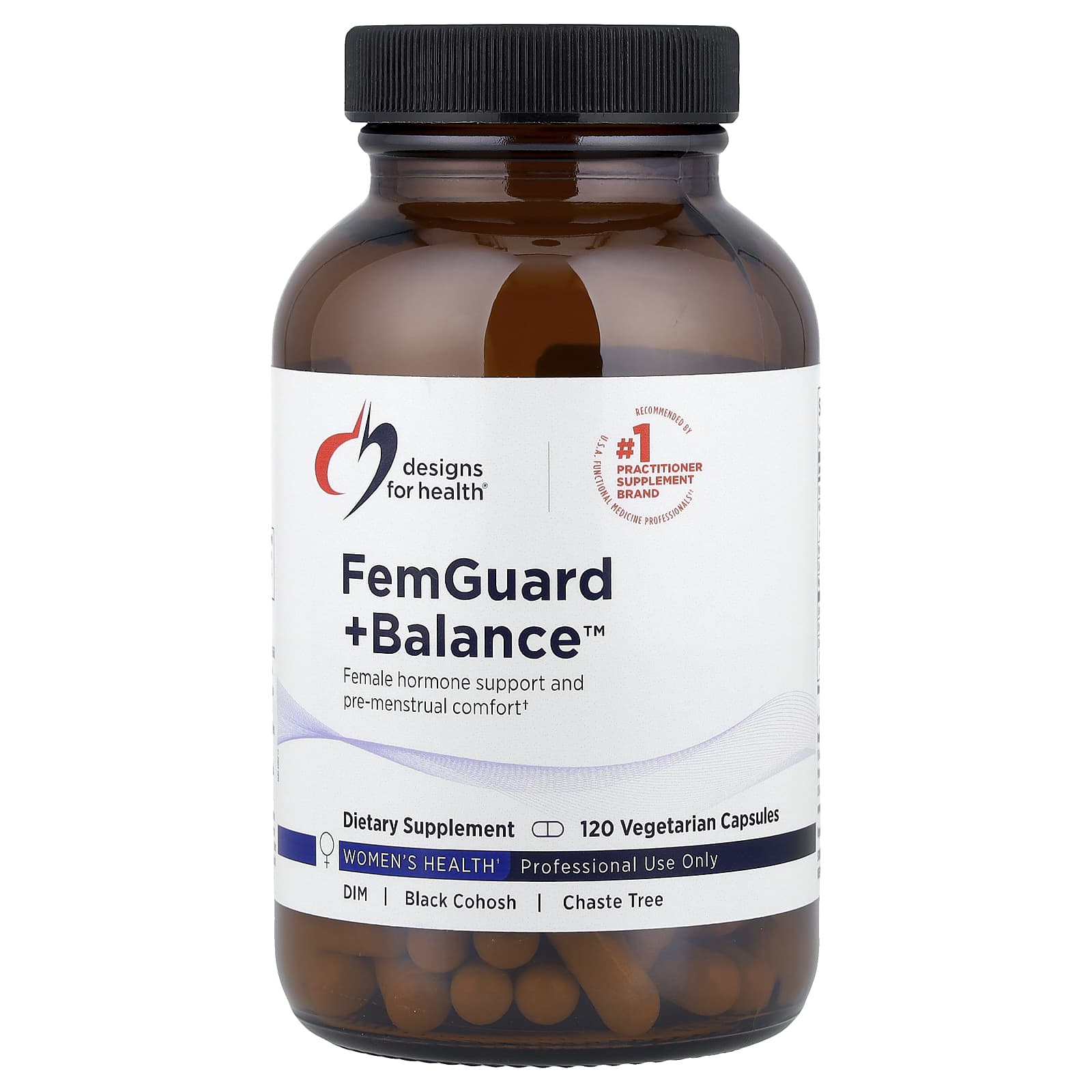
Designs for Health · capsules

FemGuard + Balance

At the recorded label maximum: 4 capsules per day

Add to my list
Per day$2.18

At the label maximum of 4 capsules a day.

Per pack$65.49

120 capsules · Vitacost · checked 22 Oct 2026. Delivery is not included.

Per capsule$0.55

Pack price divided by the number of capsules in the pack.

Composition

Amounts at the recorded label maximum. Directions may give a range.

30 mgat the recorded label maximum (1 serving × 30 mg; 4 capsules per serving)
30% of 100 mg — US upper limit for adults, National Academiesfrom food and supplements, adults · food is not counted here · a reference value, not a legal limit
20 mgat the recorded label maximum (1 serving × 20 mg; 4 capsules per serving)
20% of 100 mg — US upper limit for adults, National Academiesfrom food and supplements, adults · food is not counted here · a reference value, not a legal limit
10 mgat the recorded label maximum (1 serving × 10 mg; 4 capsules per serving)
10% of 100 mg — US upper limit for adults, National Academiesfrom food and supplements, adults · food is not counted here · a reference value, not a legal limit
Vitamin B12as Methylcobalamin
About this formmethylcobalamin. Reference level V0; no form is called “better” here.
400 mcgat the recorded label maximum (1 serving × 400 mcg; 4 capsules per serving)100 mcg per capsule · calculated from 400 mcg per 4 capsules
No US upper limitNational Academies: not determined — too little data on harm
Limits in other countries (9)Austria, Croatia, Cyprus, Eurasian Economic Union (EAEU), France, Germany, Italy, Malta, Poland
Calciumas Calcium D-Glucarate | DimaCal Di-Calcium Malate | TRAACS Calcium Glycinate Chelate
About this formcalcium bisglycinate / chelate. Reference level V0; no form is called “better” here.
124 mgat the recorded label maximum (1 serving × 124 mg; 4 capsules per serving) · as calcium itself31 mg per capsule · calculated from 124 mg per 4 capsules
6% of 2,000 mg — US upper limit for adults, National Academies2,500 mg (ages 19–50) · 2,000 mg (51 and older) · from food and supplements, adults · food is not counted here · a reference value, not a legal limit
Magnesiumas DiMagnesium Malate | TRAACS Magnesium Glycinate Chelate buffered
50 mgat the recorded label maximum (1 serving × 50 mg; 4 capsules per serving) · as magnesium itself12.5 mg per capsule · calculated from 50 mg per 4 capsules
14% of 350 mg — US upper limit for adults, National Academiesmagnesium from supplements, adults · a reference value, not a legal limit
Phosphatidylcholineas Soy Lecithin
200 mgat the recorded label maximum (1 serving × 200 mg; 4 capsules per serving)50 mg per capsule · calculated from 200 mg per 4 capsules
No limit on file for the United StatesNone on file in any country
Green Tea Extractas EGCG | Polyphenols
100 mgat the recorded label maximum (1 serving × 100 mg; 4 capsules per serving)25 mg per capsule · calculated from 100 mg per 4 capsules
No limit on file for the United StatesNone on file in any country
Diindolylmethane
100 mgat the recorded label maximum (1 serving × 100 mg; 4 capsules per serving)25 mg per capsule · calculated from 100 mg per 4 capsules
No limit on file for the United StatesNone on file in any country
Black Cohosh extractas Triterpene Glycosides
100 mgat the recorded label maximum (1 serving × 100 mg; 4 capsules per serving)25 mg per capsule · calculated from 100 mg per 4 capsules
No limit on file for the United StatesNone on file in any country
100 mgat the recorded label maximum (1 serving × 100 mg; 4 capsules per serving)25 mg per capsule · calculated from 100 mg per 4 capsules
No limit on file for the United StatesNone on file in any country
Turmericas Curcuminoids
About this formturmeric extract standardized (curcuminoids). Reference level V0; no form is called “better” here.
50 mgat the recorded label maximum (1 serving × 50 mg; 4 capsules per serving)12.5 mg per capsule · calculated from 50 mg per 4 capsules
No limit on file for the United StatesNone on file in any country
Rosemary Extractas Carnosic Acid
50 mgat the recorded label maximum (1 serving × 50 mg; 4 capsules per serving)12.5 mg per capsule · calculated from 50 mg per 4 capsules
No limit on file for the United StatesNone on file in any country
Trans Resveratrol
20 mgat the recorded label maximum (1 serving × 20 mg; 4 capsules per serving)5 mg per capsule · calculated from 20 mg per 4 capsules
No limit on file for the United StatesNone on file in any country
Grape seed extractas Proanthocyanidins
25 mgat the recorded label maximum (1 serving × 25 mg; 4 capsules per serving)6.25 mg per capsule · calculated from 25 mg per 4 capsules
No limit on file for the United StatesNone on file in any country

Where no limit is shown, none is set or on file for the United States. That is not the same as having no maximum.

Manufacturer's directions

Recommended Use: As a dietary supplement; take four capsules per day; or as directed by your health care practitioner.

Other ingredients on the label

Microcrystalline Cellulose, Vegetable Stearate, Silicon Dioxide (SiO2)

Limits in other countries
CountryPyridoxal 5-PhosphateVitamin B12CalciumMagnesium
United States100 mgreference, not a law · 60%—not on file2,000 mgreference, not a law · 6%
Comparison note2,500 mg (ages 19–50) · 2,000 mg (51 and older)
350 mgreference, not a law · 14%
Austria5.6 mgrecommendation · 1071% · above25 mcgrecommendation · 1600% · above800 mgrecommendation · 16%375 mgrecommendation · 13%
Belgium6 mglaw · 1000% · above—not on file1,600 mglaw · 8%450 mglaw · 11%
Croatia20 mglaw · 300% · above25 mcglaw · 1600% · above1,500 mglaw · 8%375 mglaw · 13%
Cyprus100 mglaw · 60%3,000 mcglaw · 13%1,500 mglaw · 8%300 mglaw · 17%
Denmark10 mgrecommendation · 600% · above—not on file1,327 mgrecommendation · 9%233 mgrecommendation · 21%
EAEU6 mglaw · 1000% · above9 mcglaw · 4444% · above2,500 mglaw · 5%800 mglaw · 6%
Estonia25 mgrecommendation · 240% · above—not on file2,500 mgrecommendation · 5%250 mgrecommendation · 20%
Finland12 mgrecommendation · 500% · above—not on file2,500 mgrecommendation · 5%250 mgrecommendation · 20%
France2 mglaw · 3000% · above3 mcglaw · 13333% · above800 mglaw · 16%300 mglaw · 17%
Germany0.9 mgrecommendation · 6667% · above25 mcgrecommendation · 1600% · above500 mgrecommendation · 25%250 mgrecommendation · 20%
Ireland25 mgrecommendation · 240% · above—not on file2,500 mgrecommendation · 5%250 mgrecommendation · 20%
Italy9.5 mgrecommendation · 632% · above1,000 mcgrecommendation · 40%1,200 mgrecommendation · 10%450 mgrecommendation · 11%
Luxembourg4.2 mglaw · 1429% · above—not on file1,600 mglaw · 8%562.5 mglaw · 9%
Malta10 mglaw · 600% · above1,000 mcgrecommendation · 40%1,500 mgrecommendation · 8%400 mgrecommendation · 13%
Netherlands21 mglaw · 286% · above—not on file—not on file—not on file
Norway—not on file—not on file705 mglaw · 18%350 mglaw · 14%
Poland6 mgrecommendation · 1000% · above100 mcgrecommendation · 400% · above1,500 mgrecommendation · 8%400 mgrecommendation · 13%
Switzerland15 mglaw · 400% · above—not on file750 mglaw · 17%375 mglaw · 13%

Maximum amounts per daily dose of a food supplement, as each country sets them; the share is the daily amount on the label against that maximum. Law = legally binding; recommendation = an authority's recommended maximum, not binding; reference = the U.S. upper intake level for adults from all sources (National Academies), not a legal limit. Verification level V0 · Report an error

About the ingredients

Ingredient information

Ingredient guideVitamin B6Vitamin B6 is the name for six related water-soluble compounds: pyridoxine, pyridoxal, pyridoxamine and their phosphate forms. Its main active form, pyridoxal 5'-phosphate (PLP), is a helper molecule for more than 100 enzymes. Supplements most often contain pyridoxine hydrochloride; some contain PLP, also called P5P. Vitamin B6 is also in multivitamins and B complex products.Read moreShow less
Terms and sources
water-soluble
They dissolve in water, not in fat. NIH Office of Dietary Supplements.
helper molecule
A coenzyme: a small molecule an enzyme needs to work. Linus Pauling Institute.
pyridoxine hydrochloride
NIH Office of Dietary Supplements names it the most common form in supplements.

Vitamin B6 in the body

Vitamin B6 takes part in more than 100 enzyme reactions, mostly in the metabolism of protein. It is involved in making neurotransmitters, the chemical messengers of the nervous system. It is also involved in immune function and in making hemoglobin, the oxygen carrier in red blood cells.

Terms and sources
more than 100 enzyme reactions
NIH Office of Dietary Supplements. It also works in the metabolism of carbohydrates and fats.
neurotransmitters
Serotonin, dopamine and GABA among them. Linus Pauling Institute.
immune function
NIH Office of Dietary Supplements.

The human body cannot make vitamin B6, so it must come from food. PLP is a helper in over 4% of all enzyme reactions. Much of the body's PLP sits in muscle, bound to the enzyme that releases glucose from stored glycogen.

Terms and sources
cannot make vitamin B6
Linus Pauling Institute.
over 4%
Linus Pauling Institute.
the enzyme
Glycogen phosphorylase. Linus Pauling Institute.

Blood PLP is the most common measure of vitamin B6 status. Levels above 30 nmol/L have been the traditional sign of enough vitamin B6 in adults.

Terms and sources
Blood PLP
Plasma pyridoxal 5'-phosphate. NIH Office of Dietary Supplements.
30 nmol/L
NIH Office of Dietary Supplements.

Information, not a prescription. Do not start, stop or combine supplements or medicines on your own.
Ingredient guideVitamin B12Vitamin B12 is a water-soluble vitamin that contains the mineral cobalt. Only certain bacteria and archaea can make it. People get it from foods of animal origin, fortified foods and supplements. Supplements use four forms: cyanocobalamin, methylcobalamin, adenosylcobalamin and hydroxocobalamin.Read moreShow less
Terms and sources
cobalt
Because of the cobalt, compounds with vitamin B12 activity are called cobalamins. NIH Office of Dietary Supplements.
archaea
A group of single-celled microbes. Linus Pauling Institute, Oregon State University.

Vitamin B12 in the body

Vitamin B12 has the largest and most complex chemical structure of all the vitamins. It is the only vitamin that contains a metal, cobalt. In the body, it works with two enzymes. One of them turns homocysteine into the amino acid methionine.

Terms and sources
two enzymes
Methionine synthase and L-methylmalonyl-CoA mutase. NIH Office of Dietary Supplements.
homocysteine
Blood homocysteine rises quickly as vitamin B12 status declines. NIH Office of Dietary Supplements.

Vitamin B12 is needed for the development and function of the nervous system, red blood cell formation and DNA synthesis. Methylcobalamin and adenosylcobalamin are the forms the body uses. The body stores about 1–5 mg, roughly 1,000 to 2,000 times the amount a person eats in a day. In people with enough vitamin B12, supplements do not appear to change athletic performance or endurance.

Terms and sources
forms the body uses
The metabolically active forms; adenosylcobalamin is also written 5-deoxyadenosylcobalamin. Cyanocobalamin and hydroxocobalamin become active after the body converts them.
athletic performance
Summary by the NIH Office of Dietary Supplements.

In food, vitamin B12 is bound to protein, and stomach acid and enzymes release it. It then binds to intrinsic factor, a protein made in the stomach. Vitamin B12 in supplements and fortified foods is already free and skips the release step.

Terms and sources
intrinsic factor
The pair is absorbed at the end of the small intestine. NIH Office of Dietary Supplements.

Information, not a prescription. Do not start, stop or combine supplements or medicines on your own.

Ingredient guideCalciumCalcium is the most abundant mineral in the human body. An adult body holds about 1.2–1.4 kg of it, almost all in bones and teeth. Milk, yogurt and cheese are rich sources. Supplements contain calcium as part of a compound, most often calcium carbonate or calcium citrate.Read moreShow less
Terms and sources
1.2–1.4 kg
About 1,200 g in women and 1,400 g in men. NIH Office of Dietary Supplements.

Calcium in the body

About 99% of the body's calcium is in bones and teeth. The other 1% is in the blood and soft tissues. This small part is needed for normal muscle function, nerve signaling, blood clotting and hormone release. It also takes part as blood vessels tighten and relax.

Terms and sources
bones and teeth
There it sits in hydroxyapatite, a mineral of calcium and phosphate. Linus Pauling Institute; NIH Office of Dietary Supplements.

The body keeps blood calcium in a narrow range, about 8.8–10.4 mg/dL. When intake is low, it draws calcium from bone to hold that range. A blood test therefore does not show how much calcium a person gets. Bone is rebuilt all the time; teeth are not. Vitamin D is needed to absorb calcium in the gut.

Terms and sources
8.8–10.4 mg/dL
2.2–2.6 mmol/L, total calcium in serum in healthy people. NIH Office of Dietary Supplements.
absorb calcium in the gut
Vitamin D is needed for active transport, the main route when intake is low. NIH Office of Dietary Supplements.

Information, not a prescription. Do not start, stop or combine supplements or medicines on your own.

Ingredient guideMagnesiumMagnesium is an essential mineral: the human body cannot make it and gets it from food and drinks. An adult body holds about 25 g, mostly in bone. Supplements add to it, in forms such as magnesium citrate, glycinate and oxide.Read moreShow less

Magnesium in the body

Inside cells, magnesium is the second most common positively charged mineral, after potassium. It takes part in more than 300 enzyme systems. It is needed for normal muscle and nerve function, energy metabolism, protein synthesis, and normal bones and teeth.

Terms and sources
positively charged mineral
a cation. de Baaij et al., Physiological Reviews, 2015 (PMID 25540137).
enzyme systems
Enzymes are proteins that run chemical reactions in cells. The 300 figure is from NIH ODS. A 2015 review puts the number of enzyme reactions at over 600.
energy metabolism
How cells turn food into usable energy.

About 50–60% of the body's magnesium sits in bone. Most of the rest is in muscle and other soft tissue. Less than 1% is in the blood. A blood test sees only this small part.

Terms and sources
in the blood
In serum. The usual range is 0.75–0.95 mmol/L.

Information, not a prescription. Do not start, stop or combine supplements or medicines on your own.

Ingredient guideBlack cohoshBlack cohosh is a plant, Actaea racemosa, also called Cimicifuga racemosa. It is a perennial of the buttercup family, native to North America. Supplements contain its root and rhizome, as powder, liquid extracts or dried extracts in pills. Extracts are often standardized to triterpene glycosides, compounds of the root.Read moreShow less
Terms and sources
Actaea racemosa
NCCIH lists the common names black cohosh, black snakeroot, macrotys, bugbane, bugwort, rattleroot and rattleweed.
buttercup family
NIH Office of Dietary Supplements, black cohosh fact sheet for health professionals.
rhizome
An underground stem. NIH Office of Dietary Supplements.
triterpene glycosides
NIH notes that products are frequently standardized to at least 1 mg of triterpene glycosides per daily dose.

Black cohosh in the body

Black cohosh is not a nutrient, and the body has no daily requirement for it. Trials of its extracts in women around menopause measure hot flashes, night sweats and symptom scores.

NIH notes that available preparations vary considerably in chemical composition. NIH adds that the compounds behind any effect are not known. Compounds named as candidates include triterpene glycosides such as actein and 23-epi-26-deoxyactein. In one study, 15 women after menopause took single doses with 1.4, 2.8 or 5.6 mg of 23-epi-26-deoxyactein. Its half-life in blood was about 2 hours at all three doses. Less than 0.01% of the dose was recovered in urine within 24 hours.

Terms and sources
23-epi-26-deoxyactein
NIH also names resins, such as cimicifugin, and caffeic, isoferulic and fukinolic acids. NIH Office of Dietary Supplements.
15 women after menopause
A 75% ethanol extract. van Breemen et al., Clinical Pharmacology and Therapeutics, 2010.
half-life
The time for the blood level to fall by half. van Breemen et al., 2010.
Less than 0.01%
Of the 23-epi-26-deoxyactein taken. van Breemen et al., 2010.

NIH, health risks: "Clinical trials using various black cohosh preparations to treat menopausal symptoms have shown that its use is associated with a low incidence of adverse effects." NIH adds: "The most commonly reported side effects are gastrointestinal upset and rashes, both of which are mild and transient." NIH adds: "Other reported adverse effects in clinical trials have included breast pain/enlargement, infection, vaginal bleeding/spotting, and musculoskeletal complaints, although their incidence was similar in women taking black cohosh and those taking placebo." NIH adds: "Most studies have examined black cohosh use for short periods, typically 6 months or less, so no published studies have assessed the long-term safety of black cohosh in humans."

Terms and sources
health risks
The NIH section on health risks, quoted in full in this paragraph and the next three. Reference numbers are left out. NIH Office of Dietary Supplements.

NIH, on the liver: "Across the world, reports have described at least 83 cases of liver damage—including hepatitis, liver failure, elevated liver enzymes, and assorted other liver injuries—associated with black cohosh use." NIH adds: "However, there is no evidence of a causal relationship." NIH adds: "It is possible that at least some reported cases of hepatotoxicity were due to impurities, adulterants, or incorrect Acteae species in the black cohosh products used." NIH adds: "However, no one independently analyzed these products to confirm the existence of these problems."

Terms and sources
Acteae
Spelled this way in the NIH text; the genus is Actaea.

NIH, on labels: "In 2007, the Australian Department of Health began requiring that products containing black cohosh carry the following label statement: 'Warning: Black cohosh may harm the liver in some individuals. Use under the supervision of a healthcare professional'." NIH adds: "In 2008, the U.S. Pharmacopeia (a nonprofit standard-setting organization for foods and drugs) recommended labeling black cohosh products with the following cautionary statement: 'Discontinue use and consult a healthcare practitioner if you have a liver disorder or develop symptoms of liver trouble, such as abdominal pain, dark urine, or jaundice'." NIH adds: "However, the U.S. Food and Drug Administration does not require such a warning on black cohosh product labels."

NIH adds: "The American Herbal Products Association recommends that pregnant women not take black cohosh except under the supervision of their health care provider because studies have not rigorously evaluated its use during pregnancy." NIH adds: "The U.S. Pharmacopeia advises that individuals with liver disorders should also avoid black cohosh." NIH adds: "It adds that users who develop symptoms of liver trouble, such as abdominal pain, dark urine, or jaundice, while taking the supplement should discontinue use and contact their doctor." NIH, on medicines: "Black cohosh is not known to have any clinically relevant interactions with medications, although this has not been systematically studied."

Terms and sources
on medicines
The NIH section on interactions with medications, quoted in full. NIH Office of Dietary Supplements.

NCCIH, on safety: "While black cohosh has been used safely in research studies that lasted as long as a year and is generally well tolerated, concerns have been raised that it may cause liver damage in some people." NCCIH adds: "Cases of liver damage—some very serious—have been reported in people taking products labeled as black cohosh." NCCIH adds: "These problems are rare, and it’s uncertain whether black cohosh was responsible for them." NCCIH adds: "If you take black cohosh, consult your health care provider if you develop symptoms of liver damage such as dark urine and fatigue." NCCIH adds: "Some commercial black cohosh products have been found to contain the wrong herb or to contain mixtures of black cohosh and other herbs that are not listed on the label." NCCIH adds: "It is possible but not proven that these contaminants might be responsible for cases of liver damage linked to black cohosh products." NCCIH adds: "Black cohosh and blue cohosh (Caulophyllum thalictroides) are different herbs." NCCIH adds: "Blue cohosh may cause adverse effects such as high blood pressure, high blood sugar, and chest pain." NCCIH adds: "The use of blue cohosh to induce labor has been associated with life-threatening complications in the infant, including seizures." NCCIH adds: "It’s uncertain whether black cohosh is safe for women who have had hormone-sensitive conditions such as breast or uterine cancer." NCCIH adds: "If you take any type of medicine, talk with your health care provider before using black cohosh or other herbal products; some herbs and medicines interact in harmful ways." NCCIH adds: "Black cohosh may not be safe for use during pregnancy or while breastfeeding."

Terms and sources
on safety
The NCCIH safety section, quoted in full in this paragraph. NIH National Center for Complementary and Integrative Health (NCCIH), black cohosh page.

Information, not a prescription. Do not start, stop or combine supplements or medicines on your own.

Ingredient guideChasteberry (Vitex agnus-castus fruit)Chasteberry is the fruit of the chaste tree, Vitex agnus-castus, a shrub native to the Mediterranean and Central Asia. NCCIH states that extracts may be prepared from the leaves, stems, flowers and seeds. This page covers what US labels list, and what NCCIH writes about side effects and medicines.Read moreShow less
Terms and sources
fruit
NCCIH writes of “Chasteberry fruit extract”. NCCIH, Chasteberry: Usefulness and Safety.
native to the Mediterranean and Central Asia
NCCIH: native to “the Mediterranean and Central Asia regions”. NCCIH, Chasteberry: Usefulness and Safety.
NCCIH
NIH National Center for Complementary and Integrative Health. In full: “Extracts of chasteberry may be prepared from the herb’s leaves, stems, flowers, and seeds.” Chasteberry: Usefulness and Safety.

Chasteberry in the body

Chasteberry is not a nutrient, and the body has no daily requirement for it.

NCCIH writes: “Chasteberry is generally well tolerated in the short term.” It adds: “Chasteberry fruit extract has been used safely in research studies for up to 3 months.” It notes: “Side effects are generally mild and may include nausea, stomach pain, diarrhea, headache, or itching.” And: “Chasteberry supplementation may not be safe for women with hormone-sensitive conditions, such as breast, uterine, or ovarian cancer.” It also writes: “The use of chasteberry during pregnancy or while breastfeeding may be unsafe.” NCCIH advises: “If you take any type of medicine, talk with your health care provider before using any herbal product”. It adds: “some herbs and medicines interact in harmful ways”.

Terms and sources
NCCIH writes
NIH National Center for Complementary and Integrative Health (NCCIH), Chasteberry: Usefulness and Safety. Its section What Do We Know About Safety? is quoted here in full.
breastfeeding
“Some preclinical evidence states that the use of chasteberry during pregnancy or while breastfeeding may be unsafe.” NCCIH, section How Much Do We Know?
NCCIH advises
From its section Keep in Mind. This sentence and the next are one NCCIH sentence, quoted in full and split at its semicolon.

Information, not a prescription. Do not start, stop or combine supplements or medicines on your own.

Need help choosing?

Choose the option that suits you.

Quick selection

I know my goal

$5

1–2 minutes · a few questions with fixed answers

One goal. Up to three products. Set a budget per day if you like.

Product checks
form and amount on the label, plus shop prices
Daily schedule
what to take, when, how much
Totals and limits
next to the upper limit
Reasons & sources
for each product
Prices and shops
plus food and habits
Progress
what to track, when to see a doctor

Complete the questionnaire before you pay. If no product fits any of your goals, you won’t be charged.

Order · $5View example

Full selection

I have several goals

$15

5–7 minutes · questionnaire with fixed answers

Up to three goals in one set. Where two goals overlap, one product is used for both.

Product checks
form and amount on the label, plus shop prices
Daily schedule
what to take, when, how much
Totals and limits
next to the upper limit
Reasons & sources
for each product
Prices and shops
plus food and habits
Progress
what to track, when to see a doctor

Complete the questionnaire before you pay. If no product fits any of your goals, you won’t be charged.

Order · $15View example

Expert review

I want a person to look at my supplements

$50

Written review within 48 hours of your completed questionnaire

An expert reviews your supplement list and questionnaire.

Written review
duplicates, limits, forms
Detailed questionnaire
supplements, medicines, history
Optional uploads
supplement-label photos or documents relevant to your review
Your notes
your priorities and questions
Follow-up questions
in writing, when needed
Next steps
points to discuss with your doctor

Complete the questionnaire before you pay.

Order · $50View example
Sources, label & certificates

Label record

Copied from the NIH label database (DSLD 23332) · not yet compared with the label · checked 2 Nov 2026 · Report an error

The United States has no pre-market registration for supplements.
Label on file in the NIH Dietary Supplement Label Database
checked 2 Nov 2026source: NIH DSLDReport an error

Barcode 8 79452 00081 0

Third-party certificates

No third-party certificate on file for this product.

Information, not a prescription. Do not start, stop or combine supplements or medicines on your own. If you have a health condition, are pregnant or breastfeeding, take medicines, or are under 18, talk to a doctor or pharmacist first.

Photo credits

Image: © Designs for Health. Shown to identify the product. Source: iherb.com

Rights holders can ask us to remove an image or send official product photos: info@verateca.com.

Product photo

Designs for Health FemGuard + Balance — enlarged pack