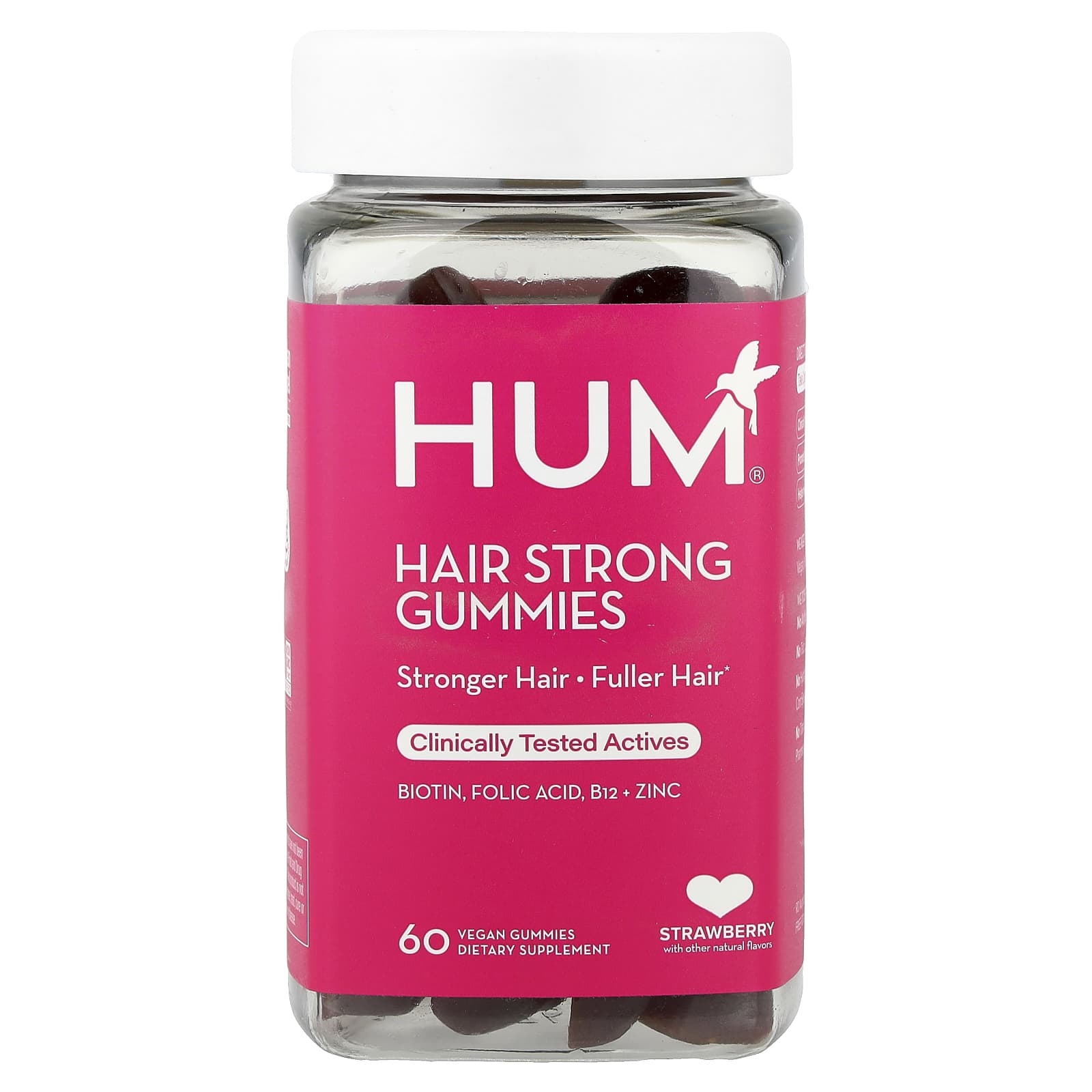
HUM · gummies

Hair Sweet Hair Berry

At the recorded label maximum: 2 gummies per day

Add to my list
Per day$0.87

At the label maximum of 2 gummies a day.

Per pack$26.00

60 gummies · Source & Self · checked 15 Nov 2026. Delivery is not included.

Per gummy$0.43

Pack price divided by the number of gummies in the pack.

Composition

Amounts at the recorded label maximum. Directions may give a range.

Vitamin B12as Cyanocobalamin
About this formcyanocobalamin. Most studied and cheapest form. Reference level V0; no form is called “better” here.
850 mcgat the recorded label maximum (1 serving × 850 mcg; 2 gummies per serving)425 mcg per gummy · calculated from 850 mcg per 2 gummies
No US upper limitNational Academies: not determined — too little data on harm
Limits in other countries (9)Austria, Croatia, Cyprus, Eurasian Economic Union (EAEU), France, Germany, Italy, Malta, Poland
Folic Acid
About this formfolic acid. Reference level V0; no form is called “better” here.
500 mcgat the recorded label maximum (1 serving × 500 mcg; 2 gummies per serving)250 mcg per gummy · calculated from 500 mcg per 2 gummies
50% of 1,000 mcg — US upper limit for adults, National Academiesfolic acid from supplements, adults · a reference value, not a legal limit
5 mgat the recorded label maximum (1 serving × 5 mg; 2 gummies per serving)2.5 mg per gummy · calculated from 5 mg per 2 gummies
No US upper limitNational Academies: not determined — too little data on harm
Limits in other countries (7)Austria, Croatia, Cyprus, Eurasian Economic Union (EAEU), France, Italy, Malta
Zincas Zinc Citrate
About this formzinc citrate — about 31% of the compound is zinc itself. Reference level V0; no form is called “better” here.
20 mgat the recorded label maximum (1 serving × 20 mg; 2 gummies per serving) · as zinc itself10 mg per gummy · calculated from 20 mg per 2 gummies
50% of 40 mg — US upper limit for adults, National Academiesfrom food and supplements, adults · food is not counted here · a reference value, not a legal limit
PABA
25 mgat the recorded label maximum (1 serving × 25 mg; 2 gummies per serving)12.5 mg per gummy · calculated from 25 mg per 2 gummies
No limit on file for the United States
Limits in other countries (1)Eurasian Economic Union (EAEU)
Fo-Ti extract
10 mgat the recorded label maximum (1 serving × 10 mg; 2 gummies per serving)5 mg per gummy · calculated from 10 mg per 2 gummies
No limit on file for the United StatesNone on file in any country

Where no limit is shown, none is set or on file for the United States. That is not the same as having no maximum.

Manufacturer's directions

Recommended by leading nutritionistsTake 2 gummies per day

Other ingredients on the label

evaporated Cane, Tapioca Syrup, purified Water, Pectin, Citric Acid, organic Fruit powder blend (organic Blueberry, organic Cranberry, organic Lemon, organic Orange, organic Pomegranate, organic Raspberry, organic Strawberry, organic Tart Cherry), Natural flavor (Mixed Berry), Potassium Citrate, Natural Color, Vegetable Oil, Carnauba Wax

Limits in other countries
CountryVitamin B12Folic AcidBiotinZinc
United States—not on file1,000 mcgreference, not a law · 50%—not on file40 mgreference, not a law · 50%
Austria25 mcgrecommendation · 3400% · above600 mcgrecommendation · 83%150 mcgrecommendation · 3333% · above15 mgrecommendation · 133% · above
Belgium—not on file500 mcglaw · 100%—not on file22.5 mglaw · 89%
Croatia25 mcglaw · 3400% · above600 mcglaw · 83%150 mcglaw · 3333% · above15 mglaw · 133% · above
Cyprus3,000 mcglaw · 28%400 mcglaw · 125% · above2,500 mcglaw · 200% · above15 mglaw · 133% · above
Denmark—not on file1,000 mcgrecommendation · 50%—not on file11 mgrecommendation · 182% · above
EAEU9 mcglaw · 9444% · above600 mcglaw · 83%150 mcglaw · 3333% · above25 mglaw · 80%
Estonia—not on file1,000 mcgrecommendation · 50%—not on file25 mgrecommendation · 80%
Finland—not on file1,000 mcgrecommendation · 50%—not on file25 mgrecommendation · 80%
France3 mcglaw · 28333% · above200 mcglaw · 250% · above450 mcglaw · 1111% · above15 mglaw · 133% · above
Germany25 mcgrecommendation · 3400% · above200 mcgrecommendation · 250% · above—not on file6.5 mgrecommendation · 308% · above
Ireland—not on file1,000 mcgrecommendation · 50%—not on file25 mgrecommendation · 80%
Italy1,000 mcgrecommendation · 85%400 mcgrecommendation · 125% · above450 mcgrecommendation · 1111% · above15 mgrecommendation · 133% · above
Luxembourg—not on file400 mcglaw · 125% · above—not on file15 mglaw · 133% · above
Malta1,000 mcgrecommendation · 85%1,000 mcgrecommendation · 50%900 mcgrecommendation · 556% · above25 mgrecommendation · 80%
Norway—not on file960 mcglaw · 52%—not on file14 mglaw · 143% · above
Poland100 mcgrecommendation · 850% · above600 mcgrecommendation · 83%—not on file15 mgrecommendation · 133% · above
Switzerland—not on file750 mcglaw · 67%—not on file5.3 mglaw · 377% · above

Maximum amounts per daily dose of a food supplement, as each country sets them; the share is the daily amount on the label against that maximum. Law = legally binding; recommendation = an authority's recommended maximum, not binding; reference = the U.S. upper intake level for adults from all sources (National Academies), not a legal limit. Verification level V0 · 1 more ingredients have limits on file · Report an error

About the ingredients

Ingredient information

Ingredient guideVitamin B12Vitamin B12 is a water-soluble vitamin that contains the mineral cobalt. Only certain bacteria and archaea can make it. People get it from foods of animal origin, fortified foods and supplements. Supplements use four forms: cyanocobalamin, methylcobalamin, adenosylcobalamin and hydroxocobalamin.Read moreShow less
Terms and sources
cobalt
Because of the cobalt, compounds with vitamin B12 activity are called cobalamins. NIH Office of Dietary Supplements.
archaea
A group of single-celled microbes. Linus Pauling Institute, Oregon State University.

Vitamin B12 in the body

Vitamin B12 has the largest and most complex chemical structure of all the vitamins. It is the only vitamin that contains a metal, cobalt. In the body, it works with two enzymes. One of them turns homocysteine into the amino acid methionine.

Terms and sources
two enzymes
Methionine synthase and L-methylmalonyl-CoA mutase. NIH Office of Dietary Supplements.
homocysteine
Blood homocysteine rises quickly as vitamin B12 status declines. NIH Office of Dietary Supplements.

Vitamin B12 is needed for the development and function of the nervous system, red blood cell formation and DNA synthesis. Methylcobalamin and adenosylcobalamin are the forms the body uses. The body stores about 1–5 mg, roughly 1,000 to 2,000 times the amount a person eats in a day. In people with enough vitamin B12, supplements do not appear to change athletic performance or endurance.

Terms and sources
forms the body uses
The metabolically active forms; adenosylcobalamin is also written 5-deoxyadenosylcobalamin. Cyanocobalamin and hydroxocobalamin become active after the body converts them.
athletic performance
Summary by the NIH Office of Dietary Supplements.

In food, vitamin B12 is bound to protein, and stomach acid and enzymes release it. It then binds to intrinsic factor, a protein made in the stomach. Vitamin B12 in supplements and fortified foods is already free and skips the release step.

Terms and sources
intrinsic factor
The pair is absorbed at the end of the small intestine. NIH Office of Dietary Supplements.

Information, not a prescription. Do not start, stop or combine supplements or medicines on your own.
Ingredient guideFolateFolate is a water-soluble B vitamin, also called vitamin B9. It occurs naturally in many foods. Folic acid is the synthetic form used in most supplements and in fortified foods. Some supplements contain L-methylfolate or folinic acid instead. Folate is also in multivitamins, prenatal vitamins and B complex products.Read moreShow less
Terms and sources
water-soluble
It dissolves in water, not in fat. NIH Office of Dietary Supplements.
synthetic form
NIH Office of Dietary Supplements: the fully oxidized form of the vitamin.
L-methylfolate
Also called 5-MTHF or L-5-methyltetrahydrofolate. NIH Office of Dietary Supplements.
prenatal vitamins
NIH Office of Dietary Supplements lists these product types.

Folate in the body

Folate is a helper molecule that moves single carbon units between other molecules. It is needed to make DNA and RNA and to process amino acids. Folate and vitamin B12 work in the same step that turns homocysteine into the amino acid methionine.

Terms and sources
helper molecule
A coenzyme. NIH Office of Dietary Supplements. The name comes from foliage: green leafy vegetables are rich in folate, Linus Pauling Institute.
DNA and RNA
NIH Office of Dietary Supplements: folate is required for proper cell division.
same step
Methionine synthase needs both folate, as 5-methyltetrahydrofolate, and vitamin B12. Linus Pauling Institute.

Folic acid is not active until the body converts it into natural folates. The main form of folate in blood plasma is L-methylfolate. When the converting enzyme is at capacity, unconverted folic acid appears in the blood. A US national survey found unconverted folic acid in 96% of blood samples.

Terms and sources
not active
Linus Pauling Institute: folic acid "has no biological activity unless converted into folates".
main form
NIH Office of Dietary Supplements.
converting enzyme
Dihydrofolate reductase. Its activity varies greatly between people. NIH Office of Dietary Supplements.
96% of blood samples
Serum samples, NHANES 2007–2008, people aged 1 year and older. Linus Pauling Institute.

The body holds about 15 to 30 mg of folate, about half of it in the liver. Gut bacteria also make folate; how much of it the body uses is unclear. Red blood cell folate reflects intake over the longer term; folate in the blood fluid reflects recent intake. Blood homocysteine is a common marker of folate status, though vitamin B12 and other factors also affect it.

Terms and sources
15 to 30 mg
NIH Office of Dietary Supplements.
Gut bacteria
NIH Office of Dietary Supplements: folate made in the colon can be absorbed there.
Red blood cell folate
NIH Office of Dietary Supplements: above 140 ng/mL indicates adequate status. For serum folate, the cutoff is 3 ng/mL.
common marker
NIH Office of Dietary Supplements calls it a functional indicator that is not highly specific.

A common gene variant, MTHFR 677C>T, makes the enzyme that forms L-methylfolate less active. Depending on the population, 3% to 32% of people carry two copies.

Terms and sources
MTHFR 677C>T
Linus Pauling Institute. With two copies of the variant, enzyme activity is about 65% lower; with one copy, about 30% lower.
3% to 32%
20% to 53% carry one copy. Linus Pauling Institute.

Information, not a prescription. Do not start, stop or combine supplements or medicines on your own.

Ingredient guideBiotinBiotin is a water-soluble B vitamin; labels also call it vitamin B7. Many foods contain it, mostly bound to protein. Mammals cannot make biotin, but some bacteria, yeasts, molds, algae and plants can. Supplements sell it alone, in B-complex products and in some multivitamins.Read moreShow less
Terms and sources
vitamin B7
Or D-biotin or vitamin H. Names as written on labels in the NIH Dietary Supplement Label Database.
some bacteria, yeasts, molds, algae and plants
Linus Pauling Institute, Oregon State University.

Biotin in the body

Biotin works with five enzymes called carboxylases. They carry out key steps in the metabolism of fatty acids, glucose and amino acids. Biotin also has roles in gene regulation and cell signaling. It was discovered in 1927, and 40 more years of research were needed to establish it as a vitamin.

Terms and sources
five enzymes
Propionyl-CoA carboxylase, pyruvate carboxylase, methylcrotonyl-CoA carboxylase and acetyl-CoA carboxylases 1 and 2. NIH Office of Dietary Supplements.
1927
Linus Pauling Institute, Oregon State University.

In food, most biotin is bound to protein. Gut enzymes, including one called biotinidase, release free biotin, which the small intestine absorbs. Most biotin in the body is stored in the liver. Most bacteria in the gut make biotin; whether people absorb meaningful amounts of it is unknown. In healthy adults, blood biotin is 133–329 pmol/L. Blood biotin rises with large doses taken by mouth.

Terms and sources
biotinidase
The enzyme that frees biotin from its protein-bound forms. NIH Office of Dietary Supplements.
Most bacteria in the gut
Linus Pauling Institute, Oregon State University.
blood biotin
Serum biotin. In urine: 18–127 nmol per 24 hours. NIH Office of Dietary Supplements.

NIH notes that biotin supplements “are often promoted for hair, skin, and nail health.” It adds: “However, these claims are supported, at best, by only a few case reports and small studies.” It also notes: “Future studies are needed to determine whether biotin supplements might improve hair, nail, and skin health, especially among healthy individuals.”

Terms and sources
NIH notes
NIH Office of Dietary Supplements, Biotin fact sheet for health professionals, section on hair, nail and skin health.

Information, not a prescription. Do not start, stop or combine supplements or medicines on your own.

Ingredient guideZincZinc is an essential mineral that the body needs for the work of hundreds of enzymes. An adult body holds about 1.5–2.5 g of it. Oysters, meat and other seafood are rich sources. Supplements contain zinc as part of a compound, such as zinc citrate, zinc oxide or zinc gluconate.Read moreShow less
Terms and sources
1.5–2.5 g
About 1.5 g in women and 2.5 g in men. NIH Office of Dietary Supplements.

Zinc in the body

Zinc-dependent enzymes are found in all six classes of enzymes. More than 3,000 human proteins have sites that bind zinc. In some proteins, zinc holds a fold called a zinc finger in shape. Zinc also takes part in immune function, protein and DNA synthesis, cell division and the sense of taste.

Terms and sources
all six classes of enzymes
Enzymes are proteins that speed up chemical reactions in cells. The classes are those of the International Union of Biochemistry and Molecular Biology. Linus Pauling Institute.
More than 3,000
An estimate from searches of protein data. Linus Pauling Institute.
zinc finger
Zinc fingers let some proteins bind DNA and switch genes on or off. Linus Pauling Institute.
sense of taste
NIH Office of Dietary Supplements.

Most of the body's zinc is in skeletal muscle and bone. In healthy people, blood zinc is usually 80–120 mcg/dL. These blood values do not always follow how much zinc a person gets from food or supplements. As intake rises, the body absorbs more zinc, but a smaller share of it.

Terms and sources
80–120 mcg/dL
Serum or plasma zinc, 12–18 micromoles per liter. NIH Office of Dietary Supplements.
do not always follow
They also vary with age, sex and the time of the blood draw. NIH Office of Dietary Supplements.
a smaller share
Fractional absorption drops as intake rises. NIH Office of Dietary Supplements.

NIH notes: "High zinc intakes can cause nausea, dizziness, headaches, gastric distress, vomiting, and loss of appetite. If used for weeks, doses of 50 mg zinc or more—typically from supplements or excessive use of denture adhesive creams that contain zinc—can interfere with copper absorption (which can cause low copper status), reduce immune function, and lower HDL cholesterol levels. The amount of zinc obtained from food is rarely as high as 50 mg, so the zinc in foods is unlikely to cause zinc toxicity. Very high doses of zinc from supplements (142 mg/day) might also interfere with magnesium absorption and disrupt magnesium balance."

Terms and sources
NIH notes
NIH Office of Dietary Supplements, Zinc fact sheet for health professionals, section on health risks from excessive zinc.

Information, not a prescription. Do not start, stop or combine supplements or medicines on your own.

Need help choosing?

Choose the option that suits you.

Quick selection

I know my goal

$5

1–2 minutes · a few questions with fixed answers

One goal. Up to three products. Set a budget per day if you like.

Product checks
form and amount on the label, plus shop prices
Daily schedule
what to take, when, how much
Totals and limits
next to the upper limit
Reasons & sources
for each product
Prices and shops
plus food and habits
Progress
what to track, when to see a doctor

Complete the questionnaire before you pay. If no product fits any of your goals, you won’t be charged.

Order · $5View example

Full selection

I have several goals

$15

5–7 minutes · questionnaire with fixed answers

Up to three goals in one set. Where two goals overlap, one product is used for both.

Product checks
form and amount on the label, plus shop prices
Daily schedule
what to take, when, how much
Totals and limits
next to the upper limit
Reasons & sources
for each product
Prices and shops
plus food and habits
Progress
what to track, when to see a doctor

Complete the questionnaire before you pay. If no product fits any of your goals, you won’t be charged.

Order · $15View example

Expert review

I want a person to look at my supplements

$50

Written review within 48 hours of your completed questionnaire

An expert reviews your supplement list and questionnaire.

Written review
duplicates, limits, forms
Detailed questionnaire
supplements, medicines, history
Optional uploads
supplement-label photos or documents relevant to your review
Your notes
your priorities and questions
Follow-up questions
in writing, when needed
Next steps
points to discuss with your doctor

Complete the questionnaire before you pay.

Order · $50View example
Sources, label & certificates

Label record

Copied from the NIH label database (DSLD 241692) · not yet compared with the label · checked 2 Nov 2026 · Report an error

The United States has no pre-market registration for supplements.
Label on file in the NIH Dietary Supplement Label Database
checked 2 Nov 2026source: NIH DSLDReport an error

Barcode 8 55514 00537 5

Third-party certificates

No third-party certificate on file for this product.

Information, not a prescription. Do not start, stop or combine supplements or medicines on your own. If you have a health condition, are pregnant or breastfeeding, take medicines, or are under 18, talk to a doctor or pharmacist first.

Photo credits

Image: © HUM. Shown to identify the product. Source: iherb.com

Rights holders can ask us to remove an image or send official product photos: info@verateca.com.

Product photo

HUM Hair Sweet Hair Berry — enlarged pack