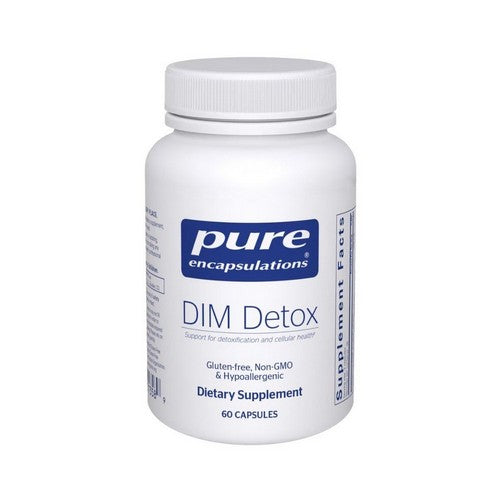
Pure Encapsulations · capsules

DIM Detox

At the recorded label maximum: 6 capsules per day

Add to my list
Per day$1.93

At the label maximum of 2 capsules a day.

Per pack$58.00

60 capsules · Vitacost · checked 21 Nov 2026. Delivery is not included.

Per capsule$0.97

Pack price divided by the number of capsules in the pack.

Composition

Amounts at the recorded label maximum. Directions may give a range.

Amounts not disclosed. The label gives only the total weight of this blend, not the amount of each ingredient in it. Without the individual amounts, we cannot compare these ingredients with upper limits.

BioResponse DIM Diindolylmethane Complexas Diindolylmethane
300 mgat the recorded label maximum (3 servings × 100 mg; 2 capsules per serving)
No limit on file for the United StatesNone on file in any country
Diindolylmethane
Amount not disclosedpart of BioResponse DIM Diindolylmethane Complex · not counted
No limit on file for the United StatesNone on file in any country
Vitamin Eas Tocophersolan
Amount not disclosedpart of BioResponse DIM Diindolylmethane Complex · not counted
Not compared with 1,000 mg — US upper limit for adults, National Academiesvitamin E from supplements, adults · a reference value, not a legal limit
Phosphatidylcholine
Amount not disclosedpart of BioResponse DIM Diindolylmethane Complex · not counted
No limit on file for the United StatesNone on file in any country
Amount not disclosedpart of BioResponse DIM Diindolylmethane Complex · not counted
No US upper limitNational Academies: not determined — too little data on harm
Limits in other countries (2)Eurasian Economic Union (EAEU), France
Alpha Lipoic Acid
600 mgat the recorded label maximum (3 servings × 200 mg; 2 capsules per serving)100 mg per capsule · calculated from 200 mg per 2 capsules
No limit on file for the United States
Limits in other countries (1)Eurasian Economic Union (EAEU)
N-Acetyl-L-Cysteine
600 mgat the recorded label maximum (3 servings × 200 mg; 2 capsules per serving)100 mg per capsule · calculated from 200 mg per 2 capsules
No limit on file for the United StatesNone on file in any country
Milk Thistle (Silybum marianum) extractas Silymarin
450 mgat the recorded label maximum (3 servings × 150 mg; 2 capsules per serving)75 mg per capsule · calculated from 150 mg per 2 capsules
No limit on file for the United StatesNone on file in any country
L-Methionine
600 mgat the recorded label maximum (3 servings × 200 mg; 2 capsules per serving)100 mg per capsule · calculated from 200 mg per 2 capsules
No limit on file for the United StatesNone on file in any country
300 mgat the recorded label maximum (3 servings × 100 mg; 2 capsules per serving)50 mg per capsule · calculated from 100 mg per 2 capsules
No limit on file for the United States
Limits in other countries (1)Switzerland
300 mgat the recorded label maximum (3 servings × 100 mg; 2 capsules per serving)50 mg per capsule · calculated from 100 mg per 2 capsules
No limit on file for the United States
Limits in other countries (3)Croatia, Czechia, Switzerland

Where no limit is shown, none is set or on file for the United States. That is not the same as having no maximum.

Manufacturer's directions

Recommendations: As a dietary supplement; take 2 capsules daily; with meals.

Other ingredients on the label

Vegetarian Capsule (Cellulose, Water), hypoallergenic Plant Fiber (Cellulose), Ascorbyl Palmitate

Limits in other countries
CountryVitamin ESilicaAlpha Lipoic AcidGlycine
United States1,000 mgreference, not a law · not compared—not on file—not on file—not on file
Austria24 mgrecommendation · not compared—not on file—not on file—not on file
Belgium39 mglaw · not compared—not on file—not on file—not on file
Croatia200 mglaw · not compared—not on file—not on file—not on file
Cyprus800 mglaw · not compared—not on file—not on file—not on file
Denmark291 mgrecommendation · not compared—not on file—not on file—not on file
EAEU150 mglaw · not compared50 mglaw · not compared100 mglaw · 600% · above—not on file
Estonia300 mgrecommendation · not compared—not on file—not on file—not on file
Finland300 mgrecommendation · not compared—not on file—not on file—not on file
France30 mglaw · not compared700 mgrecommendation · not compared—not on file—not on file
Germany30 mgrecommendation · not compared—not on file—not on file—not on file
Ireland300 mgrecommendation · not compared—not on file—not on file—not on file
Italy60 mgrecommendation · not compared—not on file—not on file—not on file
Luxembourg18 mglaw · not compared—not on file—not on file—not on file
Malta800 IUlaw · not compared—not on file—not on file—not on file
Norway250 mglaw · not compared—not on file—not on file—not on file
Poland250 mgrecommendation · not compared—not on file—not on file—not on file
Switzerland205 mglaw · not compared—not on file—not on file5,000 mglaw · 6%

Maximum amounts per daily dose of a food supplement, as each country sets them; the share is the daily amount on the label against that maximum. Law = legally binding; recommendation = an authority's recommended maximum, not binding; reference = the U.S. upper intake level for adults from all sources (National Academies), not a legal limit. Verification level V0 · 1 more ingredients have limits on file · Report an error

About the ingredients

Ingredient information

Ingredient guideVitamin EVitamin E is the name for eight fat-soluble compounds: four tocopherols and four tocotrienols. Alpha-tocopherol is the only form recognized to meet human needs. Supplements contain natural (d-) or synthetic (dl-) alpha-tocopherol, often as an ester. Three things are easy to confuse: the two forms, label units and what the upper limit counts. This article sorts them out.Read moreShow less

What vitamin E does

Vitamin E is an antioxidant that works in cell membranes. There, free radicals damage fats, and each damaged fat can damage the next. Alpha-tocopherol stops this chain reaction. Vitamin C can return used vitamin E to its active form. Vitamin E is also involved in immune function; studies in cells show roles in cell signaling.

After absorption, the liver sends alpha-tocopherol back into the blood with the alpha-tocopherol transfer protein. The liver breaks down the other forms, so blood and cells hold less of them.

In one study with labeled vitamin E, healthy women absorbed about 55% of a dose taken with a liquid meal. Vitamin E takes 9–12 hours to pass from a meal into the blood, carried in fat particles. The liver replaces the whole pool of alpha-tocopherol in blood plasma every day.

Information, not a prescription. Do not start, stop or combine supplements or medicines on your own.
Ingredient guideSiliconSilicon is a chemical element found in food and water. Foods hold it as silica and silicates; water holds orthosilicic acid, EFSA notes. Whether the human body needs it has not been proven. Supplements use choline-stabilized orthosilicic acid (ch-OSA), monomethylsilanetriol (MMST), silicon dioxide (silica), or horsetail and bamboo extracts.Read moreShow less
Terms and sources
silica and silicates
EFSA, 2004: "Silicon occurs naturally in foods as silicon dioxide (silica) and silicates".
orthosilicic acid
Written Si(OH)4. EFSA, 2004: "Silicon in water is present as ortho-silicic acid Si(OH)4".
has not been proven
National Academies, 2001: "A biological role of silicon in humans has not yet been identified". EFSA, 2004: "Silicon has not been shown to be essential for humans".
Supplements use
Forms used in the trials below, in EU lists and in Italy's list of plants for supplements. The forms section below compares them.

Silicon in the body

In blood, silicon exists almost entirely as silicic acid, the National Academies note. As much as 50 percent of ingested silicon is excreted in urine, the National Academies note.

Terms and sources
the National Academies note
National Academies, 2001: "Silicon in blood exists almost entirely as silicic acid and is not bound to proteins".
excreted in urine
National Academies, 2001: "as much as 50 percent of ingested silicon is excreted in the urine". They write that this suggests "some dietary forms of silicon are well absorbed".

A biological role of silicon in humans has not yet been identified, the National Academies write.

Terms and sources
has not yet been identified
National Academies, 2001: "A biological role of silicon in humans has not yet been identified". EFSA, 2004: "Silicon has not been shown to be essential for humans". The National Academies add that various connective tissues "contain most of the silicon present in the body".

Information, not a prescription. Do not start, stop or combine supplements or medicines on your own.

Ingredient guideGlycineGlycine is the lightest amino acid. It is found in protein foods and is plentiful in collagen. The body also makes it, mostly from serine, another amino acid. The body uses glycine to build proteins and to make glutathione and creatine.Read moreShow less

Glycine in the body

Its molar mass is 75.07 g per mole, the lowest of the amino acids. It is a building block of proteins. The body also uses it to make glutathione, creatine and purine nucleotides.

Terms and sources
75.07 g per mole
The review calls glycine the lightest amino acid. Ramos-Jiménez et al., Sports, 2024, a review of glycine and exercise.
glutathione
The review links glutathione to limiting free radicals. Ramos-Jiménez et al., Sports, 2024.

In the nervous system, glycine is an inhibitory messenger. In blood plasma, glycine makes up about 11.5% of all amino acids.

Terms and sources
inhibitory messenger
An inhibitory neurotransmitter: it makes nerve cells less likely to fire. Ramos-Jiménez et al., Sports, 2024.
about 11.5%
The review gives normal plasma levels of 0.17–0.33 mM. Ramos-Jiménez et al., Sports, 2024.

Information, not a prescription. Do not start, stop or combine supplements or medicines on your own.

Ingredient guideTaurineTaurine is an amino acid that the body makes from cysteine and does not use to build proteins. Meat, seafood and milk contain it; 48 plant foods tested in one survey did not. Energy drinks add it, and supplements sell it as powder or capsules, as taurine or magnesium taurate.Read moreShow less
Terms and sources
Taurine
The name comes from the ox, Bos taurus: taurine was first isolated from ox bile. Ripps and Shen, 2012.
an amino acid
Strictly, an amino sulfonic acid: it has a sulfonate group in place of the usual carboxyl group. Ripps and Shen, 2012.

Taurine in the body

Taurine is one of the most abundant amino acids in the brain, retina, muscle and other organs. Taurine joins bile acids to form bile salts. Cells also use it to keep their volume steady and to handle calcium.

Terms and sources
most abundant
Ripps and Shen, 2012. In the rat eye, it is the most abundant amino acid in the retina, lens and cornea.
bile salts
Ripps and Shen, 2012.
keep their volume steady
It works as an osmolyte, a dissolved substance that holds water in cells. Ripps and Shen, 2012.

The body makes taurine from two amino acids, methionine and cysteine. Humans and other primates have little CSD, a key enzyme for making taurine. In one study, vegan men had blood taurine of 45 µmol/L, and meat eaters 58 µmol/L. The vegans passed about 33 mg of taurine a day in urine, and the meat eaters about 113 mg.

Terms and sources
methionine and cysteine
The last step turns hypotaurine into taurine. Ripps and Shen, 2012.
CSD
cysteine sulfinic acid decarboxylase. Cats also have little of it. Ripps and Shen, 2012.
vegan men
12 men on a vegan diet for about 4 years, and 14 men who ate meat. The vegans' food diaries showed almost no taurine. Laidlaw et al., 1988.
about 33 mg
266 and 903 µmol a day in the paper. We converted these to mg.

After a 4 g dose by mouth, blood taurine peaked in about 1.5 hours. Half of it left the blood in about 1 hour.

Terms and sources
a 4 g dose
8 healthy men, fasting, in the morning. The peak was 86 mg per liter. Ghandforoush-Sattari et al., 2010.
Half of it
elimination half-life: 1.0 hour on average.

A study in Science reported that mice given taurine from middle age lived longer. The same study found that blood taurine fell with age in mice, monkeys and people. Later studies in people found blood taurine stable or higher with age. The authors of the mouse study called for trials in people.

Terms and sources
A study in Science
Singh et al., 2023. Mice got 1,000 mg per kg of body weight a day from 14 months of age.
lived longer
Median lifespan was 10–12% longer than in untreated mice.
monkeys
Monkeys given taurine for 6 months gained less weight; the study did not measure their lifespan.
Later studies
Fernandez et al., Science, 2025: three geographically distinct groups of people, at the US National Institute on Aging. Also 137 men aged 20–93: no link with age (Marcangeli et al., Aging Cell, 2025).

Information, not a prescription. Do not start, stop or combine supplements or medicines on your own.

Services

Choose the option that suits you.

Quick selection

I know my goal

$5

1–2 minutes · a few questions with fixed answers

One goal. Up to three products. Set a budget per day if you like.

Product checks
form and amount on the label, plus shop prices
Daily schedule
what to take, when, how much
Totals and limits
next to the upper limit
Reasons & sources
for each product
Prices and shops
plus food and habits
Progress
what to track, when to see a doctor

Complete the questionnaire before you pay. If no product fits any of your goals, you won’t be charged.

Order · $5View example

Full selection

I have several goals

$15

5–7 minutes · questionnaire with fixed answers

Up to three goals in one set. Where two goals overlap, one product is used for both.

Product checks
form and amount on the label, plus shop prices
Daily schedule
what to take, when, how much
Totals and limits
next to the upper limit
Reasons & sources
for each product
Prices and shops
plus food and habits
Progress
what to track, when to see a doctor

Complete the questionnaire before you pay. If no product fits any of your goals, you won’t be charged.

Order · $15View example

Expert review

I want a person to look at my supplements

$50

Written review within 48 hours of your completed questionnaire

An expert reviews your supplement list and questionnaire.

Written review
duplicates, limits, forms
Detailed questionnaire
supplements, medicines, history
Optional uploads
supplement-label photos or documents relevant to your review
Your notes
your priorities and questions
Follow-up questions
in writing, when needed
Next steps
points to discuss with your doctor

Complete the questionnaire before you pay.

Order · $50View example
Sources, label & certificates

Label record

Copied from the NIH label database (DSLD 246048) · not yet compared with the label · checked 19 Oct 2026 · Report an error

The United States has no pre-market registration for supplements.
Label on file in the NIH Dietary Supplement Label Database
checked 19 Oct 2026source: NIH DSLDReport an error

Barcode 7 66298 01358 9

Third-party certificates

No third-party certificate on file for this product.

Information, not a prescription. Do not start, stop or combine supplements or medicines on your own. If you have a health condition, are pregnant or breastfeeding, take medicines, or are under 18, talk to a doctor or pharmacist first.

Photo credits

Image: © Pure Encapsulations. Shown to identify the product. Source:

Rights holders can ask us to remove an image or send official product photos: info@verateca.com.

Product photo

Pure Encapsulations DIM Detox — enlarged pack