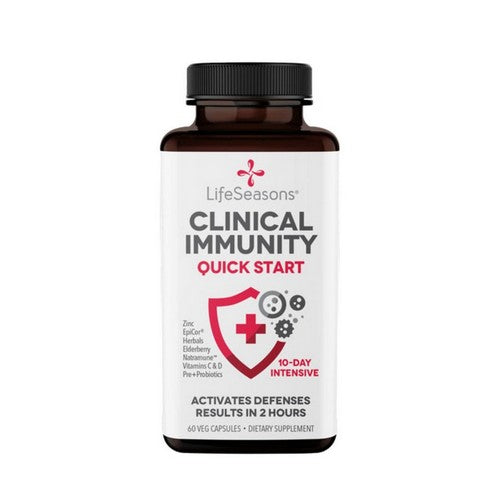
LifeSeasons · capsules

Clinical Immunity Quick-Start

At the recorded label maximum: 12 capsules per day

Add to my list
Per day$6.00

At the label maximum of 12 capsules a day.

Per pack$29.99

60 capsules · Vitacost · checked 13 Nov 2026. Delivery is not included.

Per capsule$0.50

Pack price divided by the number of capsules in the pack.

Composition

Amounts at the recorded label maximum. Directions may give a range.

Amounts not disclosed. The label gives only the total weight of this blend, not the amount of each ingredient in it. Without the individual amounts, we cannot compare these ingredients with upper limits.

Vitamin Cas PureWay-C
2,000 mgat the recorded label maximum (2 servings × 1,000 mg; 6 capsules per serving)166.666666666667 mg per capsule · calculated from 1,000 mg per 6 capsules
100% of 2,000 mg — US upper limit for adults, National Academiesfrom food and supplements, adults · food is not counted here · a reference value, not a legal limit
Vitamin D3as Cholecalciferol
About this formvitamin D3 (cholecalciferol). Raises vitamin D levels more than D2. Reference level V0; no form is called “better” here.
100 mcgat the recorded label maximum (2 servings × 50 mcg; 6 capsules per serving)8.33333333333334 mcg per capsule · calculated from 50 mcg per 6 capsules
100% of 100 mcg — US upper limit for adults, National Academiesfrom food and supplements, adults · food is not counted here · a reference value, not a legal limit
Zincas Zinc Gluconate
About this formzinc gluconate — about 14% of the compound is zinc itself. Reference level V0; no form is called “better” here.
30 mgat the recorded label maximum (2 servings × 15 mg; 6 capsules per serving) · as zinc itself2.5 mg per capsule · calculated from 15 mg per 6 capsules
75% of 40 mg — US upper limit for adults, National Academiesfrom food and supplements, adults · food is not counted here · a reference value, not a legal limit
Olive
Amount not disclosedpart of Herb Blend · not counted
No limit on file for the United StatesNone on file in any country
Amount not disclosedpart of Herb Blend · not counted
No limit on file for the United States
Limits in other countries (1)Czechia
200 mgat the recorded label maximum (2 servings × 100 mg; 6 capsules per serving)16.6666666666667 mg per capsule · calculated from 100 mg per 6 capsules
No limit on file for the United StatesNone on file in any country
Bacillus coagulans probiotic
23 mgat the recorded label maximum (2 servings × 11.5 mg; 6 capsules per serving)1.91666666666667 mg per capsule · calculated from 11.5 mg per 6 capsules
No limit on file for the United StatesNone on file in any country

Where no limit is shown, none is set or on file for the United States. That is not the same as having no maximum.

Manufacturer's directions

Directions: Take 6 capsules daily (or 3 capsules twice daily) for 10 consecutive days.Tip: To help maintain optimal immunity; take LifeSeasons Clinical Immunity Daily Boost formula after finishing this product.

Other ingredients on the label

Vegetarian Capsule (Hypromellose), Rice Bran, Stearic Acid (C18:0)

Limits in other countries
CountryVitamin CVitamin D3ZincEchinacea purpurea
United States2,000 mgreference, not a law · 100%100 mcgreference, not a law · 100%40 mgreference, not a law · 75%—not on file
Austria500 mgrecommendation · 400% · above20 mcgrecommendation · 500% · above15 mgrecommendation · 200% · above—not on file
Belgium1,000 mglaw · 200% · above75 mcglaw · 133% · above22.5 mglaw · 133% · above—not on file
Croatia800 mglaw · 250% · above10 mcglaw · 1000% · above15 mglaw · 200% · above—not on file
Cyprus2,000 mglaw · 100%10 mcglaw · 1000% · above15 mglaw · 200% · above—not on file
Czechia—not on file—not on file—not on file500 mglaw · not compared
Denmark1,000 mgrecommendation · 200% · above95 mcgrecommendation · 105% · above11 mgrecommendation · 273% · above—not on file
EAEU900 mglaw · 222% · above15 mcglaw · 667% · above25 mglaw · 120% · above—not on file
Estonia—not on file100 mcgrecommendation · 100%25 mgrecommendation · 120% · above—not on file
Finland—not on file100 mcgrecommendation · 100%25 mgrecommendation · 120% · above—not on file
France180 mglaw · 1111% · above5 mcglaw · 2000% · above15 mglaw · 200% · above—not on file
Germany250 mgrecommendation · 800% · above20 mcgrecommendation · 500% · above6.5 mgrecommendation · 462% · above—not on file
Ireland2,000 mgrecommendation · 100%100 mcgrecommendation · 100%25 mgrecommendation · 120% · above—not on file
Italy1,000 mgrecommendation · 200% · above50 mcgrecommendation · 200% · above15 mgrecommendation · 200% · above—not on file
Luxembourg1,000 mglaw · 200% · above50 mcglaw · 200% · above15 mglaw · 200% · above—not on file
Malta1,000 mgrecommendation · 200% · above25 mcgrecommendation · 400% · above25 mgrecommendation · 120% · above—not on file
Netherlands—not on file75 mcglaw · 133% · above—not on file—not on file
Norway1,000 mglaw · 200% · above80 mcglaw · 125% · above14 mglaw · 214% · above—not on file
Poland1,000 mgrecommendation · 200% · above50 mcgrecommendation · 200% · above15 mgrecommendation · 200% · above—not on file
Switzerland750 mglaw · 267% · above70 mcglaw · 143% · above5.3 mglaw · 566% · above—not on file

Maximum amounts per daily dose of a food supplement, as each country sets them; the share is the daily amount on the label against that maximum. Law = legally binding; recommendation = an authority's recommended maximum, not binding; reference = the U.S. upper intake level for adults from all sources (National Academies), not a legal limit. Verification level V0 · Report an error

About the ingredients

Ingredient information

Ingredient guideVitamin CVitamin C, also called L-ascorbic acid, is a water-soluble vitamin. Most animals make vitamin C in the body; humans cannot and get it from food. Fruits and vegetables such as peppers, citrus fruits and kiwifruit are the main sources. Supplements contain it as ascorbic acid or as mineral salts such as sodium and calcium ascorbate.Read moreShow less
Terms and sources
water-soluble
It dissolves in water, not in fat. NIH Office of Dietary Supplements.

Vitamin C in the body

Vitamin C is needed to make collagen, carnitine and some neurotransmitters. It is also an antioxidant and can return used vitamin E to its active form. It is needed for normal immune function. It increases the absorption of iron from plant foods.

Terms and sources
collagen
A protein that holds together connective tissue, such as skin, tendons and blood vessels. NIH Office of Dietary Supplements.
carnitine
A substance cells need to get energy from fat. Linus Pauling Institute.
neurotransmitters
Chemical messengers between nerve cells.
antioxidant
A substance that limits damage from free radicals, reactive molecules made in cells.
iron from plant foods
Nonheme iron, the only form of iron in plant foods. NIH Office of Dietary Supplements.

An adult body holds from about 300 mg to about 2 g of vitamin C. White blood cells, the eyes, the adrenal and pituitary glands and the brain hold the most. Cells hold vitamin C in millimolar concentrations, blood plasma in micromolar concentrations. At 100 mg a day or more, cells appear to be saturated.

Terms and sources
about 300 mg
The lower figure is for very low intake. NIH Office of Dietary Supplements.
adrenal and pituitary glands
Small glands that make hormones: the adrenals sit above the kidneys, the pituitary below the brain.
millimolar
Thousandths of a mole per liter; micromolar means millionths. NIH Office of Dietary Supplements.
saturated
Holding as much as they take up. Above 200 mg a day, blood plasma levels rise little more.

The body absorbs about 70–90% of vitamin C at 30–180 mg a day. Above 1 g a day, less than 50% is absorbed, and unused vitamin C leaves in urine.

Terms and sources
less than 50%
Summary by the NIH Office of Dietary Supplements. Absorption in the gut runs through a dose-dependent transporter protein.

Information, not a prescription. Do not start, stop or combine supplements or medicines on your own.

Ingredient guideVitamin DVitamin D is a fat-soluble vitamin. The skin makes it when ultraviolet light from the sun reaches it, and a few foods contain it. Supplements contain one or both of its two main forms: vitamin D3 and vitamin D2. Labels state the amount in micrograms (mcg), international units (IU) or both.Read moreShow less
Terms and sources
fat-soluble
It dissolves in fat, not in water. NIH Office of Dietary Supplements.

Vitamin D in the body

Vitamin D from the sun, food and supplements is inactive at first. The liver turns it into 25-hydroxyvitamin D, the form a blood test measures. Mainly the kidneys then make the active form.

Terms and sources
25-hydroxyvitamin D
Also called calcidiol or 25(OH)D. Results come in nmol/L or ng/mL; 50 nmol/L equals 20 ng/mL.
active form
1,25-dihydroxyvitamin D, also called calcitriol.

Vitamin D is needed for normal absorption of calcium from the gut and for normal bones. It is also needed for normal muscle and immune function. Many tissues in the body carry vitamin D receptors.

Terms and sources
vitamin D receptors
Proteins in cells that respond to the active form of vitamin D. NIH Office of Dietary Supplements.

Information, not a prescription. Do not start, stop or combine supplements or medicines on your own.

Ingredient guideZincZinc is an essential mineral that the body needs for the work of hundreds of enzymes. An adult body holds about 1.5–2.5 g of it. Supplements contain zinc as part of a compound, such as zinc citrate, oxide or gluconate. Three things are easy to confuse: the label number, the recommended amounts, and what the forms do. This article sorts them out.Read moreShow less

What zinc does

Zinc-dependent enzymes are found in all six classes of enzymes, the proteins that speed up chemical reactions in cells. By one estimate, more than 3,000 human proteins have sites that bind zinc. In some of them, zinc holds a fold called a zinc finger in shape. Zinc fingers let some proteins bind DNA and switch genes on or off. Zinc also takes part in immune function, protein and DNA synthesis, cell division and the sense of taste.

Most of the body's zinc is in skeletal muscle and bone. As intake rises, the body absorbs more zinc, but a smaller share of it.

Information, not a prescription. Do not start, stop or combine supplements or medicines on your own.

Ingredient guideEchinaceaEchinacea is a group of flowering plants closely related to sunflowers, daisies and ragweed, also called purple coneflower. The plants are native to areas east of the Rocky Mountains in the United States. Supplements use three species: Echinacea purpurea, E. angustifolia and E. pallida. The parts used are the root, the flower and the herb.Read moreShow less
Terms and sources
closely related to sunflowers, daisies and ragweed
NCCIH, Echinacea: Usefulness and Safety.
purple coneflower
NCCIH lists the common names echinacea, purple coneflower, coneflower and American coneflower. NCCIH, Echinacea: Usefulness and Safety.
east of the Rocky Mountains
NCCIH, Echinacea: Usefulness and Safety.
three species
The Latin names NCCIH lists. NCCIH, Echinacea: Usefulness and Safety.
the root, the flower and the herb
flos, herba, radix: the parts Italy's plant list names for each species. Italian Ministry of Health, 2018.

Echinacea in the body

Echinacea is not a nutrient, and the body has no daily requirement for it. Trials below in adults without a diagnosis measured white blood cell activity and red blood cell markers.

Information, not a prescription. Do not start, stop or combine supplements or medicines on your own.

Ingredient guideElderberryElderberry is the dark purple berry of the European or black elder tree, Sambucus nigra. The tree grows in Europe, North America, Western Asia and North Africa. Supplements contain the berry as juice concentrate, powder or extract. Some extracts are standardized to anthocyanins, the berry's purple pigments.Read moreShow less
Terms and sources
dark purple berry
NCCIH, Elderberry: Usefulness and Safety.
grows in Europe
NCCIH, Elderberry: Usefulness and Safety.
anthocyanins
Given as cyanidin glycosides in one trial report below. Curtis et al., 2009.

Elderberry in the body

Elderberry is not a nutrient, and the body has no daily requirement for it. Trials below in adults without a diagnosis measured blood fats, sugar and insulin.

In one 12-week trial, anthocyanins did not build up in blood with daily intake. Mela et al. write that gut enzymes, mainly lactase-phloridzin hydrolase, convert such pigments to their aglycone forms.

Terms and sources
In one 12-week trial
The abstract states: “We observed no plasma accumulation of anthocyanins.” Curtis et al., Journal of Nutrition, 2009, below.
lactase-phloridzin hydrolase
The enzyme that also digests milk sugar. Mela et al., Nutrition and Metabolism, 2020, a trial report below.

Information, not a prescription. Do not start, stop or combine supplements or medicines on your own.

Services

Choose the option that suits you.

Quick selection

I know my goal

$5

1–2 minutes · a few questions with fixed answers

One goal. Up to three products. Set a budget per day if you like.

Product checks
form and amount on the label, plus shop prices
Daily schedule
what to take, when, how much
Totals and limits
next to the upper limit
Reasons & sources
for each product
Prices and shops
plus food and habits
Progress
what to track, when to see a doctor

Complete the questionnaire before you pay. If no product fits any of your goals, you won’t be charged.

Order · $5View example

Full selection

I have several goals

$15

5–7 minutes · questionnaire with fixed answers

Up to three goals in one set. Where two goals overlap, one product is used for both.

Product checks
form and amount on the label, plus shop prices
Daily schedule
what to take, when, how much
Totals and limits
next to the upper limit
Reasons & sources
for each product
Prices and shops
plus food and habits
Progress
what to track, when to see a doctor

Complete the questionnaire before you pay. If no product fits any of your goals, you won’t be charged.

Order · $15View example

Expert review

I want a person to look at my supplements

$50

Written review within 48 hours of your completed questionnaire

An expert reviews your supplement list and questionnaire.

Written review
duplicates, limits, forms
Detailed questionnaire
supplements, medicines, history
Optional uploads
supplement-label photos or documents relevant to your review
Your notes
your priorities and questions
Follow-up questions
in writing, when needed
Next steps
points to discuss with your doctor

Complete the questionnaire before you pay.

Order · $50View example
Sources, label & certificates

Label record

Copied from the NIH label database (DSLD 247956) · not yet compared with the label · checked 19 Oct 2026 · Report an error

The United States has no pre-market registration for supplements.
Label on file in the NIH Dietary Supplement Label Database
checked 19 Oct 2026source: NIH DSLDReport an error

Barcode 8 10034 44500 1

Third-party certificates

No third-party certificate on file for this product.

Information, not a prescription. Do not start, stop or combine supplements or medicines on your own. If you have a health condition, are pregnant or breastfeeding, take medicines, or are under 18, talk to a doctor or pharmacist first.

Photo credits

Image: © LifeSeasons. Shown to identify the product. Source:

Rights holders can ask us to remove an image or send official product photos: info@verateca.com.

Product photo

LifeSeasons Clinical Immunity Quick-Start — enlarged pack