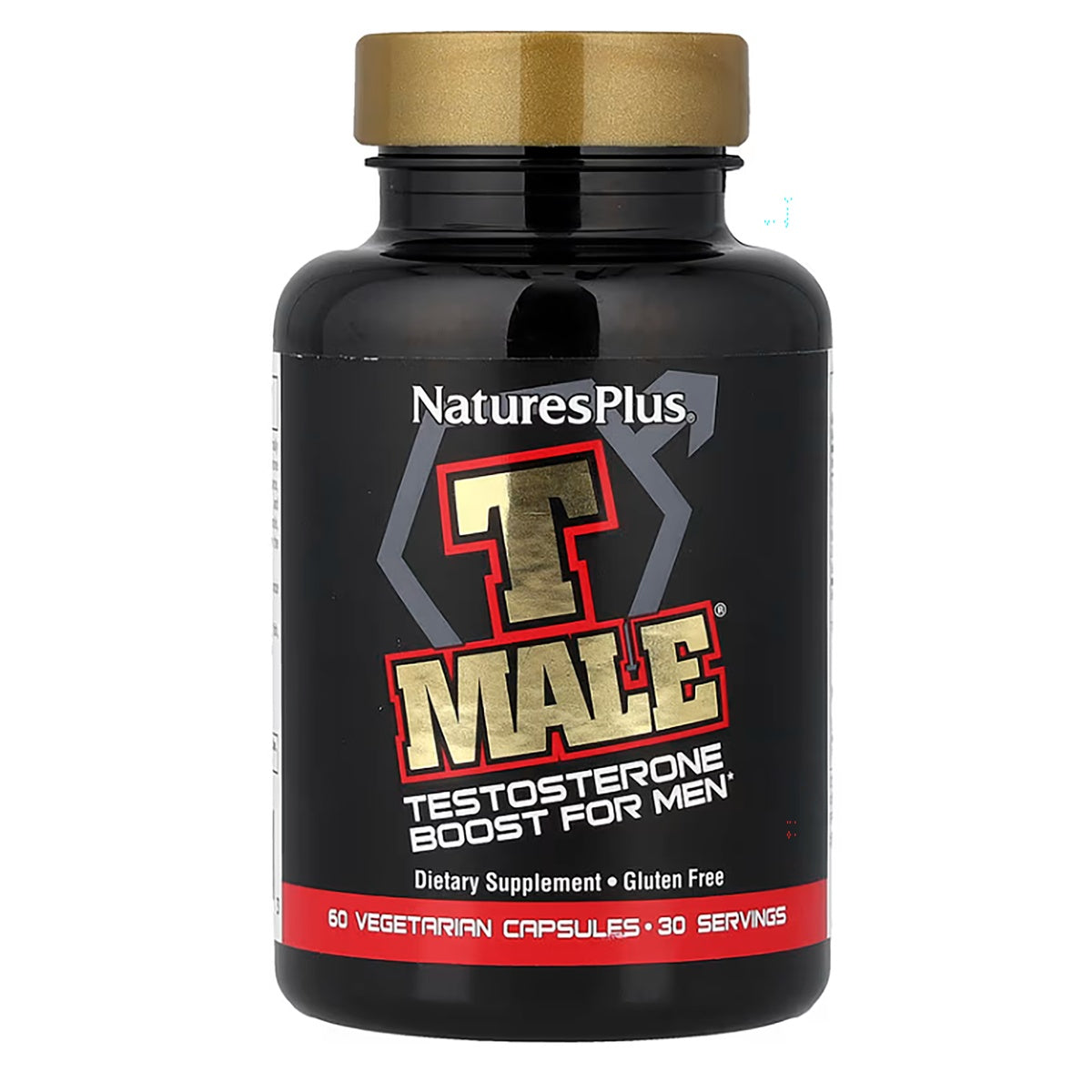
NaturesPlus · capsules

T Male

At the recorded label maximum: 2 capsules per day

Add to my list
Per day$0.96

At the label maximum of 2 capsules a day.

Per pack$28.86

60 capsules · Swanson · checked 20 Nov 2026. Delivery is not included.

Per capsule$0.48

Pack price divided by the number of capsules in the pack.

Composition

Amounts at the recorded label maximum. Directions may give a range.

Amounts not disclosed. The label gives only the total weight of this blend, not the amount of each ingredient in it. Without the individual amounts, we cannot compare these ingredients with upper limits.

60 mgat the recorded label maximum (1 serving × 60 mg; 2 capsules per serving)30 mg per capsule · calculated from 60 mg per 2 capsules
3% of 2,000 mg — US upper limit for adults, National Academiesfrom food and supplements, adults · food is not counted here · a reference value, not a legal limit
Vitamin Eas D-Alpha-Tocopheryl Acetate
About this formd-alpha-tocopherol (natural). 1 IU natural = 0.67 mg; synthetic 1 IU = 0.45 mg. Reference level V0; no form is called “better” here.
20 mgat the recorded label maximum (1 serving × 20 mg; 2 capsules per serving)10 mg per capsule · calculated from 20 mg per 2 capsules
2% of 1,000 mg — US upper limit for adults, National Academiesvitamin E from supplements, adults · a reference value, not a legal limit
2 mgat the recorded label maximum (1 serving × 2 mg; 2 capsules per serving)1 mg per capsule · calculated from 2 mg per 2 capsules
2% of 100 mg — US upper limit for adults, National Academiesfrom food and supplements, adults · food is not counted here · a reference value, not a legal limit
Calciumas Calcium Citrate
About this formcalcium citrate (incl. citrate malate) — about 21% of the compound is calcium itself. Absorbed without food; about 21% calcium, so tablets are larger. Reference level V0; no form is called “better” here.
11 mgat the recorded label maximum (1 serving × 11 mg; 2 capsules per serving) · as calcium itself5.5 mg per capsule · calculated from 11 mg per 2 capsules
<1% of 2,000 mg — US upper limit for adults, National Academies2,500 mg (ages 19–50) · 2,000 mg (51 and older) · from food and supplements, adults · food is not counted here · a reference value, not a legal limit
Magnesiumas Magnesium Aspartate
About this formmagnesium aspartate — about 8% of the compound is magnesium itself. Reference level V0; no form is called “better” here.
80 mgat the recorded label maximum (1 serving × 80 mg; 2 capsules per serving) · as magnesium itself40 mg per capsule · calculated from 80 mg per 2 capsules
23% of 350 mg — US upper limit for adults, National Academiesmagnesium from supplements, adults · a reference value, not a legal limit
Zincas Zinc Aspartate
About this formzinc methionine / aspartate / ascorbate. Reference level V0; no form is called “better” here.
30 mgat the recorded label maximum (1 serving × 30 mg; 2 capsules per serving) · as zinc itself15 mg per capsule · calculated from 30 mg per 2 capsules
75% of 40 mg — US upper limit for adults, National Academiesfrom food and supplements, adults · food is not counted here · a reference value, not a legal limit
35 mcgat the recorded label maximum (1 serving × 35 mcg; 2 capsules per serving)17.5 mcg per capsule · calculated from 35 mcg per 2 capsules
9% of 400 mcg — US upper limit for adults, National Academiesfrom food and supplements, adults · food is not counted here · a reference value, not a legal limit
FuranoMax Fenugreek extractas Fenugreek Furans | Furanostanols | Stanols
300 mgat the recorded label maximum (1 serving × 300 mg; 2 capsules per serving)150 mg per capsule · calculated from 300 mg per 2 capsules
No limit on file for the United StatesNone on file in any country
Garlic extract
Amount not disclosedpart of T MALE Proprietary Nutrient Blend · not counted
No limit on file for the United StatesNone on file in any country
Amount not disclosedpart of T MALE Proprietary Nutrient Blend · not counted
No limit on file for the United StatesNone on file in any country
Tribulus terrestris
Amount not disclosedpart of T MALE Proprietary Nutrient Blend · not counted
No limit on file for the United StatesNone on file in any country
Turmericas Curcuminoids
About this formturmeric extract standardized (curcuminoids). Reference level V0; no form is called “better” here.
Amount not disclosedpart of T MALE Proprietary Nutrient Blend · not counted
No limit on file for the United StatesNone on file in any country
Propionyl-L-Carnitine
Amount not disclosedpart of T MALE Proprietary Nutrient Blend · not counted
No limit on file for the United StatesNone on file in any country
Amount not disclosedpart of T MALE Proprietary Nutrient Blend · not counted
No limit on file for the United StatesNone on file in any country
L-Histidine
Amount not disclosedpart of T MALE Proprietary Nutrient Blend · not counted
No limit on file for the United StatesNone on file in any country
L-Phenylalanine
Amount not disclosedpart of T MALE Proprietary Nutrient Blend · not counted
No limit on file for the United StatesNone on file in any country
Boronas Boron Citrate
5.5 mgat the recorded label maximum (1 serving × 5.5 mg; 2 capsules per serving)2.75 mg per capsule · calculated from 5.5 mg per 2 capsules
28% of 20 mg — US upper limit for adults, National Academiesfrom food and supplements, adults · food is not counted here · a reference value, not a legal limit

Where no limit is shown, none is set or on file for the United States. That is not the same as having no maximum.

Manufacturer's directions

Directions: As a dietary supplement for adults; take 2 capsules once daily for maintenance or twice daily for faster activity.

Other ingredients on the label

Vegetable Cellulose, Green Tea extract, Calcium Carbonate (Ca Carbonate, CaCO3), Microcrystalline Cellulose

Limits in other countries
CountryVitamin CVitamin EVitamin B6Calcium
United States2,000 mgreference, not a law · 3%1,000 mgreference, not a law · 2%100 mgreference, not a law · 2%2,000 mgreference, not a law · 1%
Comparison note2,500 mg (ages 19–50) · 2,000 mg (51 and older)
Austria500 mgrecommendation · 12%24 mgrecommendation · 83%5.6 mgrecommendation · 36%800 mgrecommendation · 1%
Belgium1,000 mglaw · 6%39 mglaw · 51%6 mglaw · 33%1,600 mglaw · 1%
Croatia800 mglaw · 8%200 mglaw · 10%20 mglaw · 10%1,500 mglaw · 1%
Cyprus2,000 mglaw · 3%800 mglaw · 3%100 mglaw · 2%1,500 mglaw · 1%
Denmark1,000 mgrecommendation · 6%291 mgrecommendation · 7%10 mgrecommendation · 20%1,327 mgrecommendation · 1%
EAEU900 mglaw · 7%150 mglaw · 13%6 mglaw · 33%2,500 mglaw · 0%
Estonia—not on file300 mgrecommendation · 7%25 mgrecommendation · 8%2,500 mgrecommendation · 0%
Finland—not on file300 mgrecommendation · 7%12 mgrecommendation · 17%2,500 mgrecommendation · 0%
France180 mglaw · 33%30 mglaw · 67%2 mglaw · 100%800 mglaw · 1%
Germany250 mgrecommendation · 24%30 mgrecommendation · 67%0.9 mgrecommendation · 222% · above500 mgrecommendation · 2%
Ireland2,000 mgrecommendation · 3%300 mgrecommendation · 7%25 mgrecommendation · 8%2,500 mgrecommendation · 0%
Italy1,000 mgrecommendation · 6%60 mgrecommendation · 33%9.5 mgrecommendation · 21%1,200 mgrecommendation · 1%
Luxembourg1,000 mglaw · 6%18 mglaw · 111% · above4.2 mglaw · 48%1,600 mglaw · 1%
Malta1,000 mgrecommendation · 6%800 IUlaw · not compared10 mglaw · 20%1,500 mgrecommendation · 1%
Netherlands—not on file—not on file21 mglaw · 10%—not on file
Norway1,000 mglaw · 6%250 mglaw · 8%—not on file705 mglaw · 2%
Poland1,000 mgrecommendation · 6%250 mgrecommendation · 8%6 mgrecommendation · 33%1,500 mgrecommendation · 1%
Switzerland750 mglaw · 8%205 mglaw · 10%15 mglaw · 13%750 mglaw · 1%

Maximum amounts per daily dose of a food supplement, as each country sets them; the share is the daily amount on the label against that maximum. Law = legally binding; recommendation = an authority's recommended maximum, not binding; reference = the U.S. upper intake level for adults from all sources (National Academies), not a legal limit. Verification level V0 · 4 more ingredients have limits on file · Report an error

About the ingredients

Ingredient information

Ingredient guideVitamin CVitamin C, also called L-ascorbic acid, is a water-soluble vitamin. Most animals make vitamin C in the body; humans cannot and get it from food. Fruits and vegetables such as peppers, citrus fruits and kiwifruit are the main sources. Supplements contain it as ascorbic acid or as mineral salts such as sodium and calcium ascorbate.Read moreShow less
Terms and sources
water-soluble
It dissolves in water, not in fat. NIH Office of Dietary Supplements.

Vitamin C in the body

Vitamin C is needed to make collagen, carnitine and some neurotransmitters. It is also an antioxidant and can return used vitamin E to its active form. It is needed for normal immune function. It increases the absorption of iron from plant foods.

Terms and sources
collagen
A protein that holds together connective tissue, such as skin, tendons and blood vessels. NIH Office of Dietary Supplements.
carnitine
A substance cells need to get energy from fat. Linus Pauling Institute.
neurotransmitters
Chemical messengers between nerve cells.
antioxidant
A substance that limits damage from free radicals, reactive molecules made in cells.
iron from plant foods
Nonheme iron, the only form of iron in plant foods. NIH Office of Dietary Supplements.

An adult body holds from about 300 mg to about 2 g of vitamin C. White blood cells, the eyes, the adrenal and pituitary glands and the brain hold the most. Cells hold vitamin C in millimolar concentrations, blood plasma in micromolar concentrations. At 100 mg a day or more, cells appear to be saturated.

Terms and sources
about 300 mg
The lower figure is for very low intake. NIH Office of Dietary Supplements.
adrenal and pituitary glands
Small glands that make hormones: the adrenals sit above the kidneys, the pituitary below the brain.
millimolar
Thousandths of a mole per liter; micromolar means millionths. NIH Office of Dietary Supplements.
saturated
Holding as much as they take up. Above 200 mg a day, blood plasma levels rise little more.

The body absorbs about 70–90% of vitamin C at 30–180 mg a day. Above 1 g a day, less than 50% is absorbed, and unused vitamin C leaves in urine.

Terms and sources
less than 50%
Summary by the NIH Office of Dietary Supplements. Absorption in the gut runs through a dose-dependent transporter protein.

Information, not a prescription. Do not start, stop or combine supplements or medicines on your own.
Ingredient guideVitamin EVitamin E is the name for eight fat-soluble compounds: four tocopherols and four tocotrienols. Alpha-tocopherol is the only form recognized to meet human needs. Supplements contain natural (d-) or synthetic (dl-) alpha-tocopherol, often as an ester. Three things are easy to confuse: the two forms, label units and what the upper limit counts. This article sorts them out.Read moreShow less

What vitamin E does

Vitamin E is an antioxidant that works in cell membranes. There, free radicals damage fats, and each damaged fat can damage the next. Alpha-tocopherol stops this chain reaction. Vitamin C can return used vitamin E to its active form. Vitamin E is also involved in immune function; studies in cells show roles in cell signaling.

After absorption, the liver sends alpha-tocopherol back into the blood with the alpha-tocopherol transfer protein. The liver breaks down the other forms, so blood and cells hold less of them.

In one study with labeled vitamin E, healthy women absorbed about 55% of a dose taken with a liquid meal. Vitamin E takes 9–12 hours to pass from a meal into the blood, carried in fat particles. The liver replaces the whole pool of alpha-tocopherol in blood plasma every day.

Information, not a prescription. Do not start, stop or combine supplements or medicines on your own.

Ingredient guideVitamin B6Vitamin B6 is the name for six related water-soluble compounds: pyridoxine, pyridoxal, pyridoxamine and their phosphate forms. Its main active form, pyridoxal 5'-phosphate (PLP), is a helper molecule for more than 100 enzymes. Supplements most often contain pyridoxine hydrochloride; some contain PLP, also called P5P. Vitamin B6 is also in multivitamins and B complex products.Read moreShow less
Terms and sources
water-soluble
They dissolve in water, not in fat. NIH Office of Dietary Supplements.
helper molecule
A coenzyme: a small molecule an enzyme needs to work. Linus Pauling Institute.
pyridoxine hydrochloride
NIH Office of Dietary Supplements names it the most common form in supplements.

Vitamin B6 in the body

Vitamin B6 takes part in more than 100 enzyme reactions, mostly in the metabolism of protein. It is involved in making neurotransmitters, the chemical messengers of the nervous system. It is also involved in immune function and in making hemoglobin, the oxygen carrier in red blood cells.

Terms and sources
more than 100 enzyme reactions
NIH Office of Dietary Supplements. It also works in the metabolism of carbohydrates and fats.
neurotransmitters
Serotonin, dopamine and GABA among them. Linus Pauling Institute.
immune function
NIH Office of Dietary Supplements.

The human body cannot make vitamin B6, so it must come from food. PLP is a helper in over 4% of all enzyme reactions. Much of the body's PLP sits in muscle, bound to the enzyme that releases glucose from stored glycogen.

Terms and sources
cannot make vitamin B6
Linus Pauling Institute.
over 4%
Linus Pauling Institute.
the enzyme
Glycogen phosphorylase. Linus Pauling Institute.

Blood PLP is the most common measure of vitamin B6 status. Levels above 30 nmol/L have been the traditional sign of enough vitamin B6 in adults.

Terms and sources
Blood PLP
Plasma pyridoxal 5'-phosphate. NIH Office of Dietary Supplements.
30 nmol/L
NIH Office of Dietary Supplements.

Information, not a prescription. Do not start, stop or combine supplements or medicines on your own.

Ingredient guideCalciumCalcium is the most abundant mineral in the human body. An adult body holds about 1.2–1.4 kg of it, almost all in bones and teeth. Milk, yogurt and cheese are rich sources. Supplements contain calcium as part of a compound, most often calcium carbonate or calcium citrate.Read moreShow less
Terms and sources
1.2–1.4 kg
About 1,200 g in women and 1,400 g in men. NIH Office of Dietary Supplements.

Calcium in the body

About 99% of the body's calcium is in bones and teeth. The other 1% is in the blood and soft tissues. This small part is needed for normal muscle function, nerve signaling, blood clotting and hormone release. It also takes part as blood vessels tighten and relax.

Terms and sources
bones and teeth
There it sits in hydroxyapatite, a mineral of calcium and phosphate. Linus Pauling Institute; NIH Office of Dietary Supplements.

The body keeps blood calcium in a narrow range, about 8.8–10.4 mg/dL. When intake is low, it draws calcium from bone to hold that range. A blood test therefore does not show how much calcium a person gets. Bone is rebuilt all the time; teeth are not. Vitamin D is needed to absorb calcium in the gut.

Terms and sources
8.8–10.4 mg/dL
2.2–2.6 mmol/L, total calcium in serum in healthy people. NIH Office of Dietary Supplements.
absorb calcium in the gut
Vitamin D is needed for active transport, the main route when intake is low. NIH Office of Dietary Supplements.

Information, not a prescription. Do not start, stop or combine supplements or medicines on your own.

Ingredient guideMagnesiumMagnesium is an essential mineral: the human body cannot make it and gets it from food and drinks. An adult body holds about 25 g, mostly in bone. Supplements add to it, in forms such as magnesium citrate, glycinate and oxide.Read moreShow less

Magnesium in the body

Inside cells, magnesium is the second most common positively charged mineral, after potassium. It takes part in more than 300 enzyme systems. It is needed for normal muscle and nerve function, energy metabolism, protein synthesis, and normal bones and teeth.

Terms and sources
positively charged mineral
a cation. de Baaij et al., Physiological Reviews, 2015 (PMID 25540137).
enzyme systems
Enzymes are proteins that run chemical reactions in cells. The 300 figure is from NIH ODS. A 2015 review puts the number of enzyme reactions at over 600.
energy metabolism
How cells turn food into usable energy.

About 50–60% of the body's magnesium sits in bone. Most of the rest is in muscle and other soft tissue. Less than 1% is in the blood. A blood test sees only this small part.

Terms and sources
in the blood
In serum. The usual range is 0.75–0.95 mmol/L.

Information, not a prescription. Do not start, stop or combine supplements or medicines on your own.

Ingredient guideZincZinc is an essential mineral that the body needs for the work of hundreds of enzymes. An adult body holds about 1.5–2.5 g of it. Supplements contain zinc as part of a compound, such as zinc citrate, oxide or gluconate. Three things are easy to confuse: the label number, the recommended amounts, and what the forms do. This article sorts them out.Read moreShow less

What zinc does

Zinc-dependent enzymes are found in all six classes of enzymes, the proteins that speed up chemical reactions in cells. By one estimate, more than 3,000 human proteins have sites that bind zinc. In some of them, zinc holds a fold called a zinc finger in shape. Zinc fingers let some proteins bind DNA and switch genes on or off. Zinc also takes part in immune function, protein and DNA synthesis, cell division and the sense of taste.

Most of the body's zinc is in skeletal muscle and bone. As intake rises, the body absorbs more zinc, but a smaller share of it.

Information, not a prescription. Do not start, stop or combine supplements or medicines on your own.

Ingredient guideSeleniumSelenium is an essential mineral that the body builds into about 25 proteins called selenoproteins. Brazil nuts, seafood, meat and poultry are rich food sources, and plant foods vary with the soil. Supplements contain it as selenomethionine, selenium yeast, sodium selenite, sodium selenate or other forms.Read moreShow less
Terms and sources
selenoproteins
In these proteins, selenium sits inside the amino acid selenocysteine. NIH Office of Dietary Supplements; Linus Pauling Institute.
selenium yeast
Yeast grown in a high-selenium medium; it holds selenium mainly as selenomethionine. NIH Office of Dietary Supplements.

Selenium in the body

Selenoproteins include glutathione peroxidases, thioredoxin reductases and selenoprotein P. Their roles include thyroid hormone metabolism, DNA synthesis, reproduction and protection from oxidative damage. The thyroid gland holds more selenium for its size than any other organ. Selenoprotein P, made mainly in the liver, carries selenium to other tissues.

Terms and sources
glutathione peroxidases
Enzymes that break down hydrogen peroxide and fat peroxides. Linus Pauling Institute.
thyroid hormone metabolism
NIH Office of Dietary Supplements.
more selenium for its size
NIH: "Selenium concentration is higher in the thyroid gland than in any other organ in the body…"
carries selenium
Linus Pauling Institute.

About 28% to 46% of the body's selenium is in skeletal muscle. The body keeps its selenium steady mainly through the urine. Selenomethionine can also be built into ordinary body proteins in place of the amino acid methionine. Blood selenium of 8 mcg/dL or more is usually considered sufficient in healthy people. Research suggests that selenoprotein P and glutathione peroxidase rise with supplements only when selenium status is low, NIH notes.

Terms and sources
28% to 46%
NIH Office of Dietary Supplements.
through the urine
At higher intakes, selenium also leaves through the lungs and in stool. NIH Office of Dietary Supplements.
in place of the amino acid methionine
Only proteins with selenocysteine count as selenoproteins. Linus Pauling Institute.
8 mcg/dL
Plasma or serum selenium. Hair and nail selenium show intake over months or years. NIH Office of Dietary Supplements.
NIH notes
NIH Office of Dietary Supplements.

NIH notes: "Selenosis is the result of chronically high intakes of selenium. It is most commonly characterized by hair loss and nail brittleness or loss, but other signs and symptoms can include a garlic odor in the breath, a metallic taste in the mouth, skin rash, nausea, diarrhea, fatigue, irritability, and nervous system abnormalities. The Tolerable Upper Intake Level for selenium is 400 mcg for adults, and it ranges from 45 mcg to 400 mcg for infants, children, and adolescents, depending on age."

Terms and sources
NIH notes
NIH Office of Dietary Supplements, Selenium fact sheet for health professionals, section on health risks from excessive selenium. The opening paragraph.

NIH continues: "Chronically high intakes of the organic and inorganic forms of selenium have similar effects. Early indicators of excess intake are a garlic odor in the breath and a metallic taste in the mouth. The most common clinical signs of chronically high selenium intakes, or selenosis, are hair loss and nail brittleness or loss. Other signs and symptoms include skin rash, nausea, diarrhea, fatigue, irritability, and nervous system abnormalities."

Terms and sources
NIH continues
The next paragraph of the same NIH section.

It continues: "As discussed earlier, Brazil nuts contain very high amounts of selenium (68–91 mcg per nut) and could cause selenium toxicity if consumed regularly. Acute selenium toxicity has resulted from the ingestion of misformulated over-the-counter products that contain very large amounts of selenium. In 2008, for example, 201 people experienced severe adverse reactions from taking a liquid dietary supplement that contained 200 times the labeled amount of selenium. Acute selenium toxicity can cause severe gastrointestinal and neurological symptoms; acute respiratory distress syndrome; myocardial infarction; hair loss; muscle tenderness; tremors; lightheadedness; facial flushing; kidney failure; cardiac failure; and, in rare cases, death."

Terms and sources
It continues
The next paragraph of the same NIH section.

NIH also describes a subgroup result from SELECT, a large trial of 200 mcg a day in men. NIH notes: "Further investigation in a case-cohort of 1,739 men with prostate cancer and 3,117 matched controls from the SELECT trial found that selenium supplementation did not affect prostate cancer risk in men with low baseline selenium status (based on toenail selenium levels). However, the researchers did find an increased risk of high-grade prostate cancer in men with higher baseline selenium status (≥60th percentile of toenail selenium) and recommended that men over age 55 avoid selenium supplementation at doses that exceed recommended dietary intakes."

Terms and sources
subgroup result from SELECT
NIH Office of Dietary Supplements, Selenium fact sheet for health professionals, section on selenium and health.

Information, not a prescription. Do not start, stop or combine supplements or medicines on your own.

Ingredient guidePanax ginsengPanax ginseng is a plant whose root is sold as Asian, Korean or Chinese ginseng. It is native to Korea, northeastern China and far-eastern Siberia. Supplements contain dried or steamed root as powder, or root extracts. Extracts are often standardized to ginsenosides, a group of plant compounds.Read moreShow less
Terms and sources
Panax ginseng
Also called red ginseng or white ginseng, after how the root is prepared. NCCIH lists these common names.
ginsenosides
Also called panaxosides. Triterpene saponins, by Lee et al., 2016.

Panax ginseng in the body

Panax ginseng is not a nutrient, and the body has no daily requirement for it. Trials of it measure things such as memory tests, self-rated tiredness and mood.

Its root contains many compounds. Ginsenosides are thought to be the most important of them. Standardized root extracts have known amounts of ginsenosides.

Terms and sources
many compounds
NIH National Center for Complementary and Integrative Health (NCCIH).
the most important
NCCIH: those thought to be most important are called ginsenosides, or panaxosides. They are also found in leaves, stems and berries, by the HRG80 trial report.
Standardized
Root extracts with known and reproducible amounts of ginsenosides. Lee et al., 2016.

Several different plants are sold as ginseng. American ginseng is a related species, Panax quinquefolius, from North America. Siberian ginseng is Eleutherococcus senticosus, a plant of another genus. Ashwagandha, sometimes called Indian ginseng, does not belong to the ginseng family.

Terms and sources
Panax quinquefolius
Lee et al., 2016. The Geng 2010 review counted any Panax species as ginseng.
another genus
Its rhizomes and bark are used; its compounds include eleutherosides. Kos et al., Molecules, 2025.
Indian ginseng
NIH Office of Dietary Supplements, ashwagandha fact sheet.

NCCIH says that taking Asian ginseng by mouth, for up to 6 months, in recommended amounts "appears to be safe for most people." NCCIH notes that questions have been raised about its long-term safety. NCCIH also notes that "some experts recommend against its use for infants, children, and women who are pregnant or breastfeeding." Little is known about using it on the skin, where it might cause irritation and burning. Trouble sleeping is its most common side effect. NCCIH lists uncommon reported side effects: severe rash, liver damage and severe allergic reactions. In the words of NCCIH, Asian ginseng "may worsen autoimmune disorders and interfere with blood clotting." It might lower blood sugar; NCCIH advises: "If you have diabetes, consult your health care provider before using Asian ginseng." It might interact with some medicines. NCCIH notes that some studies suggest it "may be unsafe when taken orally during pregnancy." One of its compounds has been found to cause birth defects in animals. NCCIH advises: "If you're considering using Asian ginseng while pregnant, consult your health care provider." NCCIH adds: "Little is known about whether it's safe to use Asian ginseng while breastfeeding." For people who take any medicine, NCCIH advises talking with a health care provider first: "some herbs and medicines interact in harmful ways."

Terms and sources
up to 6 months
Short-term use, in the words of NCCIH, Asian ginseng page.

Information, not a prescription. Do not start, stop or combine supplements or medicines on your own.

Ingredient guideRhodiolaRhodiola is a plant, Rhodiola rosea, also called golden root, arctic root or rose root. It grows in cold regions and at high altitudes. Supplements contain extracts of its root and rhizome, or root powder. Extracts are often standardized to rosavins and to salidroside, compounds of the root.Read moreShow less
Terms and sources
golden root
NCCIH lists the common names arctic root, golden root, rose root, rosenroot and king's crown.
high altitudes
NIH National Center for Complementary and Integrative Health (NCCIH), rhodiola page.
rhizome
An underground stem. Panossian et al., Phytomedicine, 2010; Döring et al., Phytomedicine, 2021.
rosavins
Rosavin, rosin and rosarin. Punja et al., PLoS One, 2014.

Rhodiola in the body

Rhodiola is not a nutrient, and the body has no daily requirement for it. Trials of its extracts measure things such as mental fatigue tests, exercise tests and self-rated tiredness.

About 140 compounds have been isolated from its roots and rhizome. Rosavin is found only in Rhodiola rosea; salidroside is also found in other Rhodiola species. One trial report states that rosavins and salidroside occur in the plant at a 3 to 1 ratio. In several exercise trials, extracts were standardized to at least 3% rosavins and 1% salidroside.

Terms and sources
About 140 compounds
Among them phenylpropanoids, phenylethanoids, flavonoids and others. Panossian et al., Phytomedicine, 2010. The first author worked for the Swedish Herbal Institute.
found only in Rhodiola rosea
Punja et al., PLoS One, 2014. Booker et al. use rosavin as the marker that tells R. rosea apart from related species.
3 to 1 ratio
Punja et al., PLoS One, 2014.
at least 3% rosavins
Lu et al., Frontiers in Nutrition, 2022, on the trials in its review. Some trials did not state the content.

In one trial's source, roots grown in Alberta held from 0.2% to 10% total rosavins by dry weight. In one analysis of about 40 products, about a fifth of those sold as R. rosea held no rosavin. Another analysis confirmed the labeled salidroside and rosavins in less than a quarter of products.

Terms and sources
0.2% to 10%
Roots of different ages from different places in Alberta, Canada. For the trial, 4-year-old roots were extracted and standardized to 2.8%. Punja et al., PLoS One, 2014.
about 40 products
Powders and extracts bought from different suppliers. Most of the rest held less rosavin than products registered as herbal medicines. Booker et al., Phytomedicine, 2016.
about a fifth
One author of this analysis works for Dr. Willmar Schwabe GmbH, and two for CAMAG AG.
less than a quarter
Marchev et al., Phytochemical Analysis, 2020. A compound found only in R. crenulata among the species tested turned up in 2 of 4 products tested by NMR.

NCCIH says: "Rhodiola is possibly safe for up to 12 weeks." NCCIH adds: "Side effects may include dizziness, headache, insomnia, and either dry mouth or excessive saliva production." NCCIH also notes: "Interactions between rhodiola and losartan (a drug used for high blood pressure) have been reported." NCCIH adds: "Little is known about whether it’s safe to use rhodiola during pregnancy or while breastfeeding." NCCIH advises: "If you take any type of medicine, talk with your health care provider before using any herbal product." It adds: "some herbs and medicines interact in harmful ways."

Terms and sources
up to 12 weeks
NIH National Center for Complementary and Integrative Health (NCCIH), rhodiola page.

Information, not a prescription. Do not start, stop or combine supplements or medicines on your own.

Services

Choose the option that suits you.

Quick selection

I know my goal

$5

1–2 minutes · a few questions with fixed answers

One goal. Up to three products. Set a budget per day if you like.

Product checks
form and amount on the label, plus shop prices
Daily schedule
what to take, when, how much
Totals and limits
next to the upper limit
Reasons & sources
for each product
Prices and shops
plus food and habits
Progress
what to track, when to see a doctor

Complete the questionnaire before you pay. If no product fits any of your goals, you won’t be charged.

Order · $5View example

Full selection

I have several goals

$15

5–7 minutes · questionnaire with fixed answers

Up to three goals in one set. Where two goals overlap, one product is used for both.

Product checks
form and amount on the label, plus shop prices
Daily schedule
what to take, when, how much
Totals and limits
next to the upper limit
Reasons & sources
for each product
Prices and shops
plus food and habits
Progress
what to track, when to see a doctor

Complete the questionnaire before you pay. If no product fits any of your goals, you won’t be charged.

Order · $15View example

Expert review

I want a person to look at my supplements

$50

Written review within 48 hours of your completed questionnaire

An expert reviews your supplement list and questionnaire.

Written review
duplicates, limits, forms
Detailed questionnaire
supplements, medicines, history
Optional uploads
supplement-label photos or documents relevant to your review
Your notes
your priorities and questions
Follow-up questions
in writing, when needed
Next steps
points to discuss with your doctor

Complete the questionnaire before you pay.

Order · $50View example
Sources, label & certificates

Label record

Copied from the NIH label database (DSLD 250474) · not yet compared with the label · checked 19 Oct 2026 · Report an error

The United States has no pre-market registration for supplements.
Label on file in the NIH Dietary Supplement Label Database
checked 19 Oct 2026source: NIH DSLDReport an error

Barcode 0 97467 04871 3

Third-party certificates

No third-party certificate on file for this product.

Information, not a prescription. Do not start, stop or combine supplements or medicines on your own. If you have a health condition, are pregnant or breastfeeding, take medicines, or are under 18, talk to a doctor or pharmacist first.

Photo credits

Image: © NaturesPlus. Shown to identify the product. Source:

Rights holders can ask us to remove an image or send official product photos: info@verateca.com.

Product photo

NaturesPlus T Male — enlarged pack