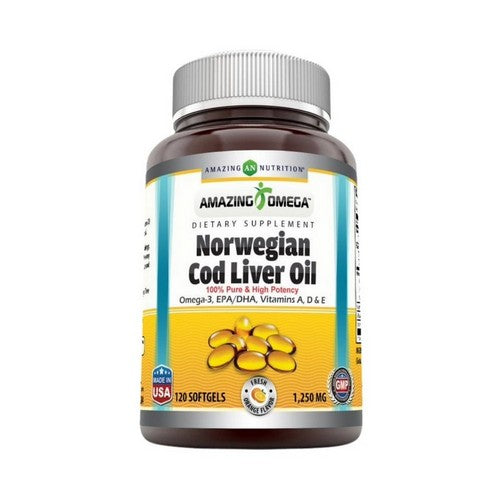
AN Amazing Nutrition Amazing Omega · softgels

Norwegian Cod Liver Oil 1250 mg Fresh Orange Flavor

At the recorded label maximum: 2 softgels per day

Add to my list
Per day$0.14 – $0.27

For 1 to 2 softgels a day as stated on the label.

Per pack$16.49

120 softgels · Vitacost · checked 13 Nov 2026. Delivery is not included.

Per softgel$0.14

Pack price divided by the number of softgels in the pack.

Composition

Amounts at the recorded label maximum. Directions may give a range.

Eicosapentaenoic Acidas TG
220 mgat the recorded label maximum (2 softgels × 110 mg)110 mg per softgel · calculated from 110 mg per 1 softgel
No limit on file for the United StatesNone on file in any country
250 mgat the recorded label maximum (2 softgels × 125 mg)125 mg per softgel · calculated from 125 mg per 1 softgel
No limit on file for the United States
Limits in other countries (1)Switzerland
Vitamin Aas Cod Fish Liver | Retinyl Palmitate
About this formretinol / retinyl esters. Reference level V0; no form is called “better” here.
1.88 mgat the recorded label maximum (2 softgels × 937.5 mcg)937.5 mcg per softgel · calculated from 937.5 mcg per 1 softgel
63% of 3 mg — US upper limit for adults, National Academiesfrom food and supplements, adults · food is not counted here · a reference value, not a legal limit
Vitamin Das Cholecalciferol | Cod Fish Liver
About this formvitamin D3 (cholecalciferol). Raises vitamin D levels more than D2. Reference level V0; no form is called “better” here.
31.25 mcgat the recorded label maximum (2 softgels × 15.625 mcg)15.625 mcg per softgel · calculated from 15.625 mcg per 1 softgel
31% of 100 mcg — US upper limit for adults, National Academiesfrom food and supplements, adults · food is not counted here · a reference value, not a legal limit
Vitamin E Naturalas D-Alpha-Tocopherol
About this formd-alpha-tocopherol (natural). 1 IU natural = 0.67 mg; synthetic 1 IU = 0.45 mg. Reference level V0; no form is called “better” here.
17.42 mgat the recorded label maximum (2 softgels × 8.71 mg)8.71 mg per softgel · calculated from 8.71 mg per 1 softgel
2% of 1,000 mg — US upper limit for adults, National Academiesvitamin E natural from supplements, adults · a reference value, not a legal limit

Where no limit is shown, none is set or on file for the United States. That is not the same as having no maximum.

Manufacturer's directions

Suggested use: As a dietary supplement; adults take one (1) to two (2) softgels daily with food or as directed by a healthcare professional.

Other ingredients on the label

Cod Liver Oil, natural Orange flavor, Softgel capsules (Gelatin, Glycerin, & purified Water)

Limits in other countries
CountryDocosahexaenoic AcidVitamin AVitamin DVitamin E Natural
United States—not on file3,000 mcgreference, not a law · 63%100 mcgreference, not a law · 31%1,000 mgreference, not a law · 2%
Austria—not on file900 mcgrecommendation · 208% · above20 mcgrecommendation · 156% · above24 mgrecommendation · 73%
Belgium—not on file1,200 mcglaw · 156% · above75 mcglaw · 42%39 mglaw · 45%
Croatia—not on file1,500 mcglaw · 125% · above10 mcglaw · 313% · above200 mglaw · 9%
Cyprus—not on file2,300 mcglaw · 82%10 mcglaw · 313% · above800 mglaw · 2%
Denmark—not on file—not on file95 mcgrecommendation · 33%291 mgrecommendation · 6%
EAEU—not on file3,000 mcglaw · 63%15 mcglaw · 208% · above150 mglaw · 12%
Estonia—not on file3,000 mcgrecommendation · 63%100 mcgrecommendation · 31%300 mgrecommendation · 6%
Finland—not on file3,000 mcgrecommendation · 63%100 mcgrecommendation · 31%300 mgrecommendation · 6%
France—not on file800 mcglaw · 234% · above5 mcglaw · 625% · above30 mglaw · 58%
Germany—not on file200 mcgrecommendation · 938% · above20 mcgrecommendation · 156% · above30 mgrecommendation · 58%
Ireland—not on file3,000 mcgrecommendation · 63%100 mcgrecommendation · 31%300 mgrecommendation · 6%
Italy—not on file1,200 mcgrecommendation · 156% · above50 mcgrecommendation · 63%60 mgrecommendation · 29%
Luxembourg—not on file1,200 mcglaw · 156% · above50 mcglaw · 63%18 mglaw · 97%
Malta—not on file1,500 mcgrecommendation · 125% · above25 mcgrecommendation · 125% · above800 IUlaw · not compared
Netherlands—not on file1,200 mcglaw · 156% · above75 mcglaw · 42%—not on file
Norway—not on file—not on file80 mcglaw · 39%250 mglaw · 7%
Poland—not on file800 mcgrecommendation · 234% · above50 mcgrecommendation · 63%250 mgrecommendation · 7%
Switzerland1,000 mglaw · 25%1,360 mcglaw · 138% · above70 mcglaw · 45%205 mglaw · 8%

Maximum amounts per daily dose of a food supplement, as each country sets them; the share is the daily amount on the label against that maximum. Law = legally binding; recommendation = an authority's recommended maximum, not binding; reference = the U.S. upper intake level for adults from all sources (National Academies), not a legal limit. Verification level V0 · Report an error

About the ingredients

Ingredient information

Ingredient guideDHA (docosahexaenoic acid)DHA, or docosahexaenoic acid, is an omega-3 fatty acid with 22 carbon atoms. Microalgae make it, and fish take it up through the food chain. Supplements contain DHA from fish oil or from algal oil, alone or together with EPA, another omega-3.Read moreShow less
Terms and sources
omega-3 fatty acid
A polyunsaturated fat with its first double bond three carbons from the end of the chain. NIH Office of Dietary Supplements.

DHA in the body

DHA is written C22:6n-3: 22 carbon atoms and 6 double bonds. It is especially high in the retina, the brain and sperm, NIH notes. LPI calls DHA the predominant polyunsaturated fat in the retina and in nerve cells. The retina conserves and recycles DHA even when omega-3 intake is low, LPI notes. NIH names DHA and arachidonic acid, an omega-6, as the two most prevalent long-chain polyunsaturated fats in the brain.

Terms and sources
C22:6n-3
The n-3 means the first double bond is three carbons from the methyl end. NIH Office of Dietary Supplements.
retina
The light-sensing layer at the back of the eye.
LPI
Linus Pauling Institute, page on essential fatty acids.

NIH notes that DHA accumulates most rapidly during the third trimester of pregnancy. The body makes only small amounts of DHA from ALA, the plant omega-3. DHA can also be turned back into EPA. The page Omega-3 fatty acids covers the whole family, EPA and the forms of fish oil.

Terms and sources
third trimester
NIH adds that DHA in the retina is complete by birth. The brain keeps adding DHA for the first 2 years.
small amounts
In separate studies, young men converted 0–4% of ALA to DHA, and young women about 9%. Linus Pauling Institute.
turned back into EPA
Six weeks of 1.62 g of DHA a day: an estimated 7.4–11.4% by serum fats. By platelet fats, 12.3–13.8%. Linus Pauling Institute.

Information, not a prescription. Do not start, stop or combine supplements or medicines on your own.

Ingredient guideVitamin AVitamin A is the name for a group of fat-soluble compounds, mainly retinol and retinyl esters. Animal foods contain it as preformed vitamin A; plants contain carotenoids, some of which the body converts into it. Supplements contain retinyl acetate, retinyl palmitate, beta-carotene or a combination. Amounts are given in mcg RAE; older labels used IU.Read moreShow less
Terms and sources
fat-soluble
They dissolve in fat, not in water. NIH Office of Dietary Supplements.
carotenoids
Provitamin A carotenoids: beta-carotene, alpha-carotene and beta-cryptoxanthin. NIH Office of Dietary Supplements.
mcg RAE
Micrograms of retinol activity equivalents. The unit counts how much retinol each form gives the body.

Vitamin A in the body

Vitamin A is part of rhodopsin, the protein in the retina that responds to light. It is needed for normal vision. It is also involved in immune function, cell communication, growth and development, and reproduction.

Terms and sources
rhodopsin
The light-sensitive pigment of the eye's rod cells, which see in dim light. NIH Office of Dietary Supplements; Linus Pauling Institute.
normal vision
NIH Office of Dietary Supplements. It is also needed for the normal surface of the eye.
cell communication
NIH Office of Dietary Supplements. Vitamin A takes part in the growth and specialization of cells.

The body turns retinol into retinal and retinoic acid, the two main active forms. Most of the body's vitamin A is stored in the liver as retinyl esters. Blood retinol levels stay steady until the stores in the liver are almost used up.

Terms and sources
retinoic acid
It switches genes on and off; Linus Pauling Institute counts more than 500 genes that respond to it.
retinyl esters
Retinol joined to a fatty acid, such as retinyl palmitate. NIH Office of Dietary Supplements.
stay steady
NIH Office of Dietary Supplements. So a blood test is not always a reliable guide to the stores. See Green 2016 below: normal blood retinol with low stores.

Plants make hundreds of carotenoids; only about 10% of them can be converted to retinol. The body converts beta-carotene into vitamin A in the gut, through an enzyme. Lutein, zeaxanthin and lycopene are carotenoids that the body does not convert into vitamin A.

Terms and sources
about 10%
Linus Pauling Institute.
an enzyme
Beta-carotene monooxygenase type 1 (BCMO1). Conversion rates may vary with genes. NIH Office of Dietary Supplements.
does not convert
NIH Office of Dietary Supplements calls them non-provitamin A carotenoids.

Information, not a prescription. Do not start, stop or combine supplements or medicines on your own.

Ingredient guideVitamin DVitamin D is a fat-soluble vitamin. The skin makes it when ultraviolet light from the sun reaches it, and a few foods contain it. Supplements contain one or both of its two main forms: vitamin D3 and vitamin D2. Labels state the amount in micrograms (mcg), international units (IU) or both.Read moreShow less
Terms and sources
fat-soluble
It dissolves in fat, not in water. NIH Office of Dietary Supplements.

Vitamin D in the body

Vitamin D from the sun, food and supplements is inactive at first. The liver turns it into 25-hydroxyvitamin D, the form a blood test measures. Mainly the kidneys then make the active form.

Terms and sources
25-hydroxyvitamin D
Also called calcidiol or 25(OH)D. Results come in nmol/L or ng/mL; 50 nmol/L equals 20 ng/mL.
active form
1,25-dihydroxyvitamin D, also called calcitriol.

Vitamin D is needed for normal absorption of calcium from the gut and for normal bones. It is also needed for normal muscle and immune function. Many tissues in the body carry vitamin D receptors.

Terms and sources
vitamin D receptors
Proteins in cells that respond to the active form of vitamin D. NIH Office of Dietary Supplements.

Information, not a prescription. Do not start, stop or combine supplements or medicines on your own.

Ingredient guideVitamin EVitamin E is the name for eight fat-soluble compounds: four tocopherols and four tocotrienols. Alpha-tocopherol is the only form recognized to meet human needs. Supplements contain natural (d-) or synthetic (dl-) alpha-tocopherol, often as an ester. Three things are easy to confuse: the two forms, label units and what the upper limit counts. This article sorts them out.Read moreShow less

What vitamin E does

Vitamin E is an antioxidant that works in cell membranes. There, free radicals damage fats, and each damaged fat can damage the next. Alpha-tocopherol stops this chain reaction. Vitamin C can return used vitamin E to its active form. Vitamin E is also involved in immune function; studies in cells show roles in cell signaling.

After absorption, the liver sends alpha-tocopherol back into the blood with the alpha-tocopherol transfer protein. The liver breaks down the other forms, so blood and cells hold less of them.

In one study with labeled vitamin E, healthy women absorbed about 55% of a dose taken with a liquid meal. Vitamin E takes 9–12 hours to pass from a meal into the blood, carried in fat particles. The liver replaces the whole pool of alpha-tocopherol in blood plasma every day.

Information, not a prescription. Do not start, stop or combine supplements or medicines on your own.

Services

Choose the option that suits you.

Quick selection

I know my goal

$5

1–2 minutes · a few questions with fixed answers

One goal. Up to three products. Set a budget per day if you like.

Product checks
form and amount on the label, plus shop prices
Daily schedule
what to take, when, how much
Totals and limits
next to the upper limit
Reasons & sources
for each product
Prices and shops
plus food and habits
Progress
what to track, when to see a doctor

Complete the questionnaire before you pay. If no product fits any of your goals, you won’t be charged.

Order · $5View example

Full selection

I have several goals

$15

5–7 minutes · questionnaire with fixed answers

Up to three goals in one set. Where two goals overlap, one product is used for both.

Product checks
form and amount on the label, plus shop prices
Daily schedule
what to take, when, how much
Totals and limits
next to the upper limit
Reasons & sources
for each product
Prices and shops
plus food and habits
Progress
what to track, when to see a doctor

Complete the questionnaire before you pay. If no product fits any of your goals, you won’t be charged.

Order · $15View example

Expert review

I want a person to look at my supplements

$50

Written review within 48 hours of your completed questionnaire

An expert reviews your supplement list and questionnaire.

Written review
duplicates, limits, forms
Detailed questionnaire
supplements, medicines, history
Optional uploads
supplement-label photos or documents relevant to your review
Your notes
your priorities and questions
Follow-up questions
in writing, when needed
Next steps
points to discuss with your doctor

Complete the questionnaire before you pay.

Order · $50View example
Sources, label & certificates

Label record

Copied from the NIH label database (DSLD 251719) · not yet compared with the label · checked 19 Oct 2026 · Report an error

The United States has no pre-market registration for supplements.
Label on file in the NIH Dietary Supplement Label Database
checked 19 Oct 2026source: NIH DSLDReport an error

Barcode 8 10180 02938 4

Third-party certificates

No third-party certificate on file for this product.

Information, not a prescription. Do not start, stop or combine supplements or medicines on your own. If you have a health condition, are pregnant or breastfeeding, take medicines, or are under 18, talk to a doctor or pharmacist first.

Photo credits

Image: © AN Amazing Nutrition Amazing Omega. Shown to identify the product. Source:

Rights holders can ask us to remove an image or send official product photos: info@verateca.com.

Product photo

AN Amazing Nutrition Amazing Omega Norwegian Cod Liver Oil 1250 mg Fresh Orange Flavor — enlarged pack