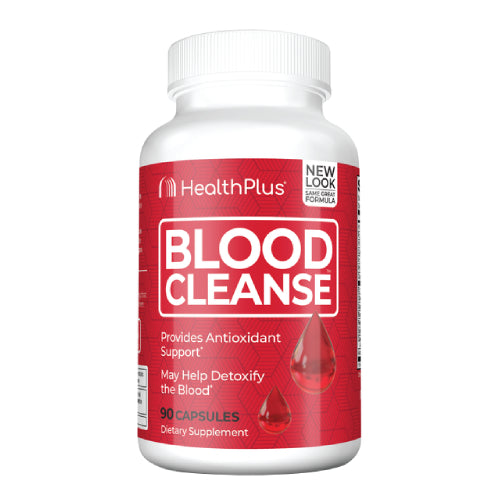
Health Plus · capsules

Blood Cleanse

At the recorded label maximum: 2 capsules per day

Add to my list
Per day$0.55

At the label maximum of 2 capsules a day.

Per pack$24.80

90 capsules · Vitacost · checked 13 Nov 2026. Delivery is not included.

Per capsule$0.28

Pack price divided by the number of capsules in the pack.

Composition

Amounts at the recorded label maximum. Directions may give a range.

Amounts not disclosed. The label gives only the total weight of this blend, not the amount of each ingredient in it. Without the individual amounts, we cannot compare these ingredients with upper limits.

Vitamin Aas Beta-Carotene
About this formbeta-carotene (provitamin A). Converted to vitamin A only as needed; not comparable with retinol by dose. Reference level V0; no form is called “better” here.
378 mcgat the recorded label maximum (1 serving × 378 mcg; 2 capsules per serving)189 mcg per capsule · calculated from 378 mcg per 2 capsules
Not compared with 3,000 mcg — US upper limit for adults, National Academiesthe limit counts retinol only · a reference value, not a legal limit
Folic Acid
About this formfolic acid. Reference level V0; no form is called “better” here.
400 mcgat the recorded label maximum (1 serving × 400 mcg; 2 capsules per serving)200 mcg per capsule · calculated from 400 mcg per 2 capsules
40% of 1,000 mcg — US upper limit for adults, National Academiesfolic acid from supplements, adults · a reference value, not a legal limit
Vitamin B12as Cyanocobalamin
About this formcyanocobalamin. Most studied and cheapest form. Reference level V0; no form is called “better” here.
100 mcgat the recorded label maximum (1 serving × 100 mcg; 2 capsules per serving)50 mcg per capsule · calculated from 100 mcg per 2 capsules
No US upper limitNational Academies: not determined — too little data on harm
Limits in other countries (9)Austria, Croatia, Cyprus, Eurasian Economic Union (EAEU), France, Germany, Italy, Malta, Poland
79 mgat the recorded label maximum (1 serving × 79 mg; 2 capsules per serving) · as calcium itself39.5 mg per capsule · calculated from 79 mg per 2 capsules
4% of 2,000 mg — US upper limit for adults, National Academies2,500 mg (ages 19–50) · 2,000 mg (51 and older) · from food and supplements, adults · food is not counted here · a reference value, not a legal limit
400 mcgat the recorded label maximum (1 serving × 400 mcg; 2 capsules per serving) · as iron itself200 mcg per capsule · calculated from 400 mcg per 2 capsules
<1% of 45 mg — US upper limit for adults, National Academiesfrom food and supplements, adults · food is not counted here · a reference value, not a legal limit
Phosphorusas Phosphorus Amino Acid Chelate
120 mgat the recorded label maximum (1 serving × 120 mg; 2 capsules per serving)60 mg per capsule · calculated from 120 mg per 2 capsules
4% of 3,000 mg — US upper limit for adults, National Academies4,000 mg (ages 19–70) · 3,000 mg (71 and older) · from food and supplements, adults · food is not counted here · a reference value, not a legal limit
800 mcgat the recorded label maximum (1 serving × 800 mcg; 2 capsules per serving)400 mcg per capsule · calculated from 800 mcg per 2 capsules
8% of 10 mg — US upper limit for adults, National Academiesfrom food and supplements, adults · food is not counted here · a reference value, not a legal limit
300 mgat the recorded label maximum (1 serving × 300 mg; 2 capsules per serving)150 mg per capsule · calculated from 300 mg per 2 capsules
No limit on file for the United States
Limits in other countries (1)Czechia
125 mgat the recorded label maximum (1 serving × 125 mg; 2 capsules per serving)62.5 mg per capsule · calculated from 125 mg per 2 capsules
4% of 3,500 mg — US upper limit for adults, National Academiesfrom food and supplements, adults · food is not counted here · a reference value, not a legal limit
Dandelion
60 mgat the recorded label maximum (1 serving × 60 mg; 2 capsules per serving)30 mg per capsule · calculated from 60 mg per 2 capsules
No limit on file for the United StatesNone on file in any country
Burdock
35 mgat the recorded label maximum (1 serving × 35 mg; 2 capsules per serving)17.5 mg per capsule · calculated from 35 mg per 2 capsules
No limit on file for the United StatesNone on file in any country
Red Clover
35 mgat the recorded label maximum (1 serving × 35 mg; 2 capsules per serving)17.5 mg per capsule · calculated from 35 mg per 2 capsules
No limit on file for the United StatesNone on file in any country
Sodium Copper Chlorophyllin
10 mgat the recorded label maximum (1 serving × 10 mg; 2 capsules per serving)5 mg per capsule · calculated from 10 mg per 2 capsules
No limit on file for the United StatesNone on file in any country
Amount not disclosedpart of Carotenoid Complex · not counted
No limit on file for the United States
Limits in other countries (2)Eurasian Economic Union (EAEU), Switzerland
Amount not disclosedpart of Carotenoid Complex · not counted
No limit on file for the United States
Limits in other countries (3)Croatia, Eurasian Economic Union (EAEU), Switzerland
100 mcgat the recorded label maximum (1 serving × 100 mcg; 2 capsules per serving)50 mcg per capsule · calculated from 100 mcg per 2 capsules
No limit on file for the United States
Limits in other countries (1)Eurasian Economic Union (EAEU)

Where no limit is shown, none is set or on file for the United States. That is not the same as having no maximum.

Manufacturer's directions

Suggested use: Take 2 capsules once daily.

Other ingredients on the label

Gelatin, Magnesium Stearate

Limits in other countries
CountryVitamin AFolic AcidVitamin B12Calcium
United States3,000 mcgreference, not a law · not compared1,000 mcgreference, not a law · 40%—not on file2,000 mgreference, not a law · 4%
Comparison note2,500 mg (ages 19–50) · 2,000 mg (51 and older)
Austria900 mcgrecommendation · 42%600 mcgrecommendation · 67%25 mcgrecommendation · 400% · above800 mgrecommendation · 10%
Belgium1,200 mcglaw · 32%500 mcglaw · 80%—not on file1,600 mglaw · 5%
Croatia1,500 mcglaw · 25%600 mcglaw · 67%25 mcglaw · 400% · above1,500 mglaw · 5%
Cyprus2,300 mcglaw · 16%400 mcglaw · 100%3,000 mcglaw · 3%1,500 mglaw · 5%
Denmark—not on file1,000 mcgrecommendation · 40%—not on file1,327 mgrecommendation · 6%
EAEU3,000 mcglaw · 13%600 mcglaw · 67%9 mcglaw · 1111% · above2,500 mglaw · 3%
Estonia3,000 mcgrecommendation · 13%1,000 mcgrecommendation · 40%—not on file2,500 mgrecommendation · 3%
Finland3,000 mcgrecommendation · 13%1,000 mcgrecommendation · 40%—not on file2,500 mgrecommendation · 3%
France800 mcglaw · 47%200 mcglaw · 200% · above3 mcglaw · 3333% · above800 mglaw · 10%
Germany200 mcgrecommendation · 189% · above200 mcgrecommendation · 200% · above25 mcgrecommendation · 400% · above500 mgrecommendation · 16%
Ireland3,000 mcgrecommendation · 13%1,000 mcgrecommendation · 40%—not on file2,500 mgrecommendation · 3%
Italy1,200 mcgrecommendation · 32%400 mcgrecommendation · 100%1,000 mcgrecommendation · 10%1,200 mgrecommendation · 7%
Luxembourg1,200 mcglaw · 32%400 mcglaw · 100%—not on file1,600 mglaw · 5%
Malta1,500 mcgrecommendation · 25%1,000 mcgrecommendation · 40%1,000 mcgrecommendation · 10%1,500 mgrecommendation · 5%
Netherlands1,200 mcglaw · 32%—not on file—not on file—not on file
Norway—not on file960 mcglaw · 42%—not on file705 mglaw · 11%
Poland800 mcgrecommendation · 47%600 mcgrecommendation · 67%100 mcgrecommendation · 100%1,500 mgrecommendation · 5%
Switzerland1,360 mcglaw · 28%750 mcglaw · 53%—not on file750 mglaw · 11%

Maximum amounts per daily dose of a food supplement, as each country sets them; the share is the daily amount on the label against that maximum. Law = legally binding; recommendation = an authority's recommended maximum, not binding; reference = the U.S. upper intake level for adults from all sources (National Academies), not a legal limit. Verification level V0 · 8 more ingredients have limits on file · Report an error

About the ingredients

Ingredient information

Ingredient guideVitamin AVitamin A is the name for a group of fat-soluble compounds, mainly retinol and retinyl esters. Animal foods contain it as preformed vitamin A; plants contain carotenoids, some of which the body converts into it. Supplements contain retinyl acetate, retinyl palmitate, beta-carotene or a combination. Amounts are given in mcg RAE; older labels used IU.Read moreShow less
Terms and sources
fat-soluble
They dissolve in fat, not in water. NIH Office of Dietary Supplements.
carotenoids
Provitamin A carotenoids: beta-carotene, alpha-carotene and beta-cryptoxanthin. NIH Office of Dietary Supplements.
mcg RAE
Micrograms of retinol activity equivalents. The unit counts how much retinol each form gives the body.

Vitamin A in the body

Vitamin A is part of rhodopsin, the protein in the retina that responds to light. It is needed for normal vision. It is also involved in immune function, cell communication, growth and development, and reproduction.

Terms and sources
rhodopsin
The light-sensitive pigment of the eye's rod cells, which see in dim light. NIH Office of Dietary Supplements; Linus Pauling Institute.
normal vision
NIH Office of Dietary Supplements. It is also needed for the normal surface of the eye.
cell communication
NIH Office of Dietary Supplements. Vitamin A takes part in the growth and specialization of cells.

The body turns retinol into retinal and retinoic acid, the two main active forms. Most of the body's vitamin A is stored in the liver as retinyl esters. Blood retinol levels stay steady until the stores in the liver are almost used up.

Terms and sources
retinoic acid
It switches genes on and off; Linus Pauling Institute counts more than 500 genes that respond to it.
retinyl esters
Retinol joined to a fatty acid, such as retinyl palmitate. NIH Office of Dietary Supplements.
stay steady
NIH Office of Dietary Supplements. So a blood test is not always a reliable guide to the stores. See Green 2016 below: normal blood retinol with low stores.

Plants make hundreds of carotenoids; only about 10% of them can be converted to retinol. The body converts beta-carotene into vitamin A in the gut, through an enzyme. Lutein, zeaxanthin and lycopene are carotenoids that the body does not convert into vitamin A.

Terms and sources
about 10%
Linus Pauling Institute.
an enzyme
Beta-carotene monooxygenase type 1 (BCMO1). Conversion rates may vary with genes. NIH Office of Dietary Supplements.
does not convert
NIH Office of Dietary Supplements calls them non-provitamin A carotenoids.

Information, not a prescription. Do not start, stop or combine supplements or medicines on your own.
Ingredient guideFolateFolate is a water-soluble B vitamin, also called vitamin B9. It occurs naturally in many foods. Folic acid is the synthetic form used in most supplements and in fortified foods. Some supplements contain L-methylfolate or folinic acid instead. Folate is also in multivitamins, prenatal vitamins and B complex products.Read moreShow less
Terms and sources
water-soluble
It dissolves in water, not in fat. NIH Office of Dietary Supplements.
synthetic form
NIH Office of Dietary Supplements: the fully oxidized form of the vitamin.
L-methylfolate
Also called 5-MTHF or L-5-methyltetrahydrofolate. NIH Office of Dietary Supplements.
prenatal vitamins
NIH Office of Dietary Supplements lists these product types.

Folate in the body

Folate is a helper molecule that moves single carbon units between other molecules. It is needed to make DNA and RNA and to process amino acids. Folate and vitamin B12 work in the same step that turns homocysteine into the amino acid methionine.

Terms and sources
helper molecule
A coenzyme. NIH Office of Dietary Supplements. The name comes from foliage: green leafy vegetables are rich in folate, Linus Pauling Institute.
DNA and RNA
NIH Office of Dietary Supplements: folate is required for proper cell division.
same step
Methionine synthase needs both folate, as 5-methyltetrahydrofolate, and vitamin B12. Linus Pauling Institute.

Folic acid is not active until the body converts it into natural folates. The main form of folate in blood plasma is L-methylfolate. When the converting enzyme is at capacity, unconverted folic acid appears in the blood. A US national survey found unconverted folic acid in 96% of blood samples.

Terms and sources
not active
Linus Pauling Institute: folic acid "has no biological activity unless converted into folates".
main form
NIH Office of Dietary Supplements.
converting enzyme
Dihydrofolate reductase. Its activity varies greatly between people. NIH Office of Dietary Supplements.
96% of blood samples
Serum samples, NHANES 2007–2008, people aged 1 year and older. Linus Pauling Institute.

The body holds about 15 to 30 mg of folate, about half of it in the liver. Gut bacteria also make folate; how much of it the body uses is unclear. Red blood cell folate reflects intake over the longer term; folate in the blood fluid reflects recent intake. Blood homocysteine is a common marker of folate status, though vitamin B12 and other factors also affect it.

Terms and sources
15 to 30 mg
NIH Office of Dietary Supplements.
Gut bacteria
NIH Office of Dietary Supplements: folate made in the colon can be absorbed there.
Red blood cell folate
NIH Office of Dietary Supplements: above 140 ng/mL indicates adequate status. For serum folate, the cutoff is 3 ng/mL.
common marker
NIH Office of Dietary Supplements calls it a functional indicator that is not highly specific.

A common gene variant, MTHFR 677C>T, makes the enzyme that forms L-methylfolate less active. Depending on the population, 3% to 32% of people carry two copies.

Terms and sources
MTHFR 677C>T
Linus Pauling Institute. With two copies of the variant, enzyme activity is about 65% lower; with one copy, about 30% lower.
3% to 32%
20% to 53% carry one copy. Linus Pauling Institute.

Information, not a prescription. Do not start, stop or combine supplements or medicines on your own.

Ingredient guideVitamin B12Vitamin B12 is a water-soluble vitamin that contains the mineral cobalt. Only certain bacteria and archaea can make it. People get it from foods of animal origin, fortified foods and supplements. Supplements use four forms: cyanocobalamin, methylcobalamin, adenosylcobalamin and hydroxocobalamin.Read moreShow less
Terms and sources
cobalt
Because of the cobalt, compounds with vitamin B12 activity are called cobalamins. NIH Office of Dietary Supplements.
archaea
A group of single-celled microbes. Linus Pauling Institute, Oregon State University.

Vitamin B12 in the body

Vitamin B12 has the largest and most complex chemical structure of all the vitamins. It is the only vitamin that contains a metal, cobalt. In the body, it works with two enzymes. One of them turns homocysteine into the amino acid methionine.

Terms and sources
two enzymes
Methionine synthase and L-methylmalonyl-CoA mutase. NIH Office of Dietary Supplements.
homocysteine
Blood homocysteine rises quickly as vitamin B12 status declines. NIH Office of Dietary Supplements.

Vitamin B12 is needed for the development and function of the nervous system, red blood cell formation and DNA synthesis. Methylcobalamin and adenosylcobalamin are the forms the body uses. The body stores about 1–5 mg, roughly 1,000 to 2,000 times the amount a person eats in a day. In people with enough vitamin B12, supplements do not appear to change athletic performance or endurance.

Terms and sources
forms the body uses
The metabolically active forms; adenosylcobalamin is also written 5-deoxyadenosylcobalamin. Cyanocobalamin and hydroxocobalamin become active after the body converts them.
athletic performance
Summary by the NIH Office of Dietary Supplements.

In food, vitamin B12 is bound to protein, and stomach acid and enzymes release it. It then binds to intrinsic factor, a protein made in the stomach. Vitamin B12 in supplements and fortified foods is already free and skips the release step.

Terms and sources
intrinsic factor
The pair is absorbed at the end of the small intestine. NIH Office of Dietary Supplements.

Information, not a prescription. Do not start, stop or combine supplements or medicines on your own.

Ingredient guideCalciumCalcium is the most abundant mineral in the human body. An adult body holds about 1.2–1.4 kg of it, almost all in bones and teeth. Milk, yogurt and cheese are rich sources. Supplements contain calcium as part of a compound, most often calcium carbonate or calcium citrate.Read moreShow less
Terms and sources
1.2–1.4 kg
About 1,200 g in women and 1,400 g in men. NIH Office of Dietary Supplements.

Calcium in the body

About 99% of the body's calcium is in bones and teeth. The other 1% is in the blood and soft tissues. This small part is needed for normal muscle function, nerve signaling, blood clotting and hormone release. It also takes part as blood vessels tighten and relax.

Terms and sources
bones and teeth
There it sits in hydroxyapatite, a mineral of calcium and phosphate. Linus Pauling Institute; NIH Office of Dietary Supplements.

The body keeps blood calcium in a narrow range, about 8.8–10.4 mg/dL. When intake is low, it draws calcium from bone to hold that range. A blood test therefore does not show how much calcium a person gets. Bone is rebuilt all the time; teeth are not. Vitamin D is needed to absorb calcium in the gut.

Terms and sources
8.8–10.4 mg/dL
2.2–2.6 mmol/L, total calcium in serum in healthy people. NIH Office of Dietary Supplements.
absorb calcium in the gut
Vitamin D is needed for active transport, the main route when intake is low. NIH Office of Dietary Supplements.

Information, not a prescription. Do not start, stop or combine supplements or medicines on your own.

Ingredient guideIronIron is an essential mineral that the body uses to carry oxygen in the blood. An adult body holds about 3 to 4 g of iron, most of it in hemoglobin. Meat, seafood and grain foods made with fortified flour are major sources. Supplements contain iron as part of a compound, such as ferrous sulfate, ferrous fumarate or ferrous bisglycinate.Read moreShow less
Terms and sources
3 to 4 g
NIH Office of Dietary Supplements. The Linus Pauling Institute estimates 2.3 g in women and 3.8 g in men.

Iron in the body

Iron is part of hemoglobin, the red blood cell protein that carries oxygen from the lungs to the tissues. It is also part of myoglobin, a protein that carries and stores oxygen in muscle cells. Iron is needed for physical growth, the work of cells and making some hormones. Hundreds of proteins and enzymes contain iron, including those that make energy in cells.

Terms and sources
hemoglobin
NIH Office of Dietary Supplements.
myoglobin
Linus Pauling Institute. Its 2016 update was paid for in part by a grant from Bayer Consumer Care AG.
making some hormones
NIH Office of Dietary Supplements.
Hundreds of proteins
Including cytochromes, which carry electrons when cells make ATP, their main energy molecule. Linus Pauling Institute.

The body loses very little iron, so it reuses most of what it has. About 20 mg of iron a day is recovered from old red blood cells. To cover losses, the gut absorbs only 1–2 mg of iron a day. A hormone made in the liver, hepcidin, sets how much iron the gut takes up. Spare iron is stored as ferritin in the liver, spleen and bone marrow.

Terms and sources
loses very little iron
Small amounts leave in urine, stool, sweat and shed skin cells; more is lost with menstrual blood. NIH Office of Dietary Supplements.
About 20 mg
The same article gives about 35 mg a day for all iron recycling. Linus Pauling Institute. Its 2016 update was paid for in part by a grant from Bayer Consumer Care AG.
1–2 mg
Linus Pauling Institute.
hepcidin
When stores are full, hepcidin blocks iron uptake from food; when they are low, it is barely made. Linus Pauling Institute; NIH.
ferritin
A storage protein. Its level in blood is a common test of iron stores. NIH Office of Dietary Supplements.

NIH notes: "Adults with normal intestinal function have very little risk of iron overload from dietary sources of iron. However, supplements containing 25 mg iron or more can reduce zinc absorption and plasma zinc concentrations. High-dose iron supplements can also cause gastrointestinal effects, including gastric upset, constipation, nausea, abdominal pain, vomiting, and diarrhea. Taking iron supplements with food can help minimize these adverse effects. Case reports, some of which involved doses of 130 mg iron, suggest that some people develop even more serious gastrointestinal effects, including gastritis and gastric lesions (along with iron deposits in the gastric mucosa in some cases)." It goes on: "Acute intakes of more than 20 mg/kg iron (about 1,365 mg iron for a person weighing 150 pounds [lb]) from supplements or medicines can lead to corrosive necrosis of the intestine, which might lead to fluid and blood loss, shock, tissue damage, and organ failure, especially if food is not taken at the same time as the iron. In severe cases (e.g., one-time ingestions of 60 mg/kg, or about 4,090 mg iron for a 150-lb person), overdoses of iron can lead to multisystem organ failure, coma, convulsions, and even death." NIH continues: "Between 1983 and 2000, at least 43 U.S. children died from ingesting supplements containing high doses of iron (36–443 mg iron/kg body weight). Accidental ingestion of iron supplements caused about a third of poisoning deaths among children reported in the United States between 1983 and 1991." It adds: "In 1997, FDA began requiring oral supplements containing more than 30 mg elemental iron per dose to be sold in single-dose packaging with strong warning labels. At the same time, many manufacturers voluntarily replaced the sugar coating on iron tablets with film coatings. Between 1998 and 2002, only one child death due to ingesting an iron-containing tablet was reported. As a result of a court decision, FDA removed its single-dose packaging requirement for iron supplements in 2003. FDA currently requires that iron-containing dietary supplements sold in solid form (e.g., tablets or capsules but not powders) carry the following label statement: “WARNING: Accidental overdose of iron-containing products is a leading cause of fatal poisoning in children under 6. Keep this product out of reach of children. In case of accidental overdose, call a doctor or poison control center immediately”. In addition, since 1978, the Consumer Product Safety Commission has required manufacturers to package dietary supplements that contain 250 mg or more elemental iron per container in child-resistant bottles or packaging to prevent accidental poisoning." NIH adds: "Hemochromatosis, a disease caused by a mutation in the hemochromatosis (HFE) gene, is associated with an excessive buildup of iron in the body. About 1 in 10 Whites carry the most common HFE mutation (C282Y), but only 4.4 Whites per 1,000 are homozygous for the mutation and have hemochromatosis. The condition is much less common in other ethnic groups. Without treatment by periodic chelation or phlebotomy, people with hereditary hemochromatosis typically develop signs of iron toxicity by their 30s. These effects can include liver cirrhosis, hepatocellular carcinoma, heart disease, and impaired pancreatic function. The American Association for the Study of Liver Diseases recommends that treatment of hemochromatosis include the avoidance of iron and vitamin C supplements."

Terms and sources
NIH notes
NIH Office of Dietary Supplements, Iron fact sheet for health professionals, section on health risks from excessive iron. The next paragraphs follow in the order of that section.
It adds
Same NIH section, the paragraph on packaging and label rules. In the United States, 21 CFR 101.17(e) requires the same statement.
NIH adds
Same NIH section, next paragraph.

Information, not a prescription. Do not start, stop or combine supplements or medicines on your own.

Ingredient guideCopperCopper is an essential mineral that several enzymes need in order to work. An adult body holds about 50–120 mg of it, and only small amounts are stored. Supplements offer it in several forms. Three things are easy to confuse: the number on the label, the recommended amounts, and what the forms do. This article sorts them out.Read moreShow less

What copper does

Copper-dependent enzymes are called cuproenzymes. They take part in energy production, iron metabolism, building connective tissue and making brain signaling chemicals. One of them, ceruloplasmin, carries 60–95% of the copper in blood plasma, says the Linus Pauling Institute. Defense against oxidative damage depends mainly on copper-containing enzymes called superoxide dismutases.

Almost two-thirds of the body's copper is in the skeleton and muscle. Most copper leaves the body in bile, and a small amount in urine. The body keeps its copper level steady through absorption in the gut and release from the liver into bile.

Information, not a prescription. Do not start, stop or combine supplements or medicines on your own.

Ingredient guideEchinaceaEchinacea is a group of flowering plants closely related to sunflowers, daisies and ragweed, also called purple coneflower. The plants are native to areas east of the Rocky Mountains in the United States. Supplements use three species: Echinacea purpurea, E. angustifolia and E. pallida. The parts used are the root, the flower and the herb.Read moreShow less
Terms and sources
closely related to sunflowers, daisies and ragweed
NCCIH, Echinacea: Usefulness and Safety.
purple coneflower
NCCIH lists the common names echinacea, purple coneflower, coneflower and American coneflower. NCCIH, Echinacea: Usefulness and Safety.
east of the Rocky Mountains
NCCIH, Echinacea: Usefulness and Safety.
three species
The Latin names NCCIH lists. NCCIH, Echinacea: Usefulness and Safety.
the root, the flower and the herb
flos, herba, radix: the parts Italy's plant list names for each species. Italian Ministry of Health, 2018.

Echinacea in the body

Echinacea is not a nutrient, and the body has no daily requirement for it. Trials below in adults without a diagnosis measured white blood cell activity and red blood cell markers.

Information, not a prescription. Do not start, stop or combine supplements or medicines on your own.

Ingredient guideCholineCholine is an essential nutrient found in eggs, meat, fish, milk and some beans and vegetables. Supplements contain it as choline bitartrate, choline chloride, alpha-GPC, phosphatidylcholine or lecithin. Three things are easy to confuse: the number on the label, the recommended amounts, and what the forms do. This article sorts them out.Read moreShow less

What choline does

The body needs choline to make phosphatidylcholine and sphingomyelin, two fats that cell membranes are built from. Choline is also needed to make acetylcholine, a messenger between nerve cells. NIH describes acetylcholine as a messenger for memory, mood, muscle control and other brain and nerve functions.

Choline is a source of methyl groups, which many steps in metabolism use. The liver makes some choline, mostly as phosphatidylcholine, but not enough for the body's needs. Women before menopause might need less choline from food, because estrogen switches on the gene for making it.

Free choline and other water-soluble forms are absorbed in the small intestine and go to the liver. Enzymes free choline from about half of the fat-soluble forms. The rest of the phosphatidylcholine is absorbed intact and carried in the lymph to body tissues.

Information, not a prescription. Do not start, stop or combine supplements or medicines on your own.

Ingredient guideZeaxanthinZeaxanthin is a yellow carotenoid, a pigment that plants make. Yellow corn, bell peppers and egg yolk are sources of it. In the eye, zeaxanthin and its close relative lutein collect in the macula, the center of the retina. Many supplements pair it with a larger amount of lutein; some contain zeaxanthin alone.Read moreShow less
Terms and sources
carotenoid
One of a family of more than 750 yellow, orange and red pigments. Linus Pauling Institute.
sources of it
Linus Pauling Institute. Dark green leafy vegetables are rich in lutein but low in zeaxanthin.
some contain zeaxanthin alone
Linus Pauling Institute.

Zeaxanthin in the body

Zeaxanthin belongs to the xanthophylls, carotenoids that contain oxygen. The body cannot turn zeaxanthin into vitamin A. Zeaxanthin and lutein are isomers: the same atoms in a slightly different arrangement.

Terms and sources
xanthophylls
Lutein is also a xanthophyll. Linus Pauling Institute.
vitamin A
Lutein, zeaxanthin and lycopene have no vitamin A activity; beta-carotene has. Linus Pauling Institute.
isomers
Some food analyses do not separate the two and report them as lutein + zeaxanthin. Linus Pauling Institute.

In the macula, zeaxanthin, lutein and meso-zeaxanthin form the macular pigment. Depending on its density, the macular pigment absorbs up to 90% of blue light. Zeaxanthin and lutein in the eye come only from the diet. Zeaxanthin and lutein are also the only carotenoids in the lens of the eye.

Terms and sources
meso-zeaxanthin
Made in the body from lutein. Linus Pauling Institute.
up to 90%
Linus Pauling Institute.
lens
The clear part of the eye that focuses light on the retina.

Studies measure the macular pigment as optical density, on a scale from 0 to 1.

Terms and sources
optical density
Macular pigment optical density, MPOD. It reflects the lutein and zeaxanthin in the macula. Wilson et al., 2021.

Information, not a prescription. Do not start, stop or combine supplements or medicines on your own.

Ingredient guideLuteinLutein is a yellow carotenoid, a pigment that plants make. Dark green leafy vegetables such as spinach and kale are rich food sources. In the eye, lutein and its close relative zeaxanthin collect in the macula, the center of the retina. Supplements contain it as free lutein or as lutein esters, often together with zeaxanthin.Read moreShow less
Terms and sources
carotenoid
One of a family of more than 750 yellow, orange and red pigments. Linus Pauling Institute.

Lutein in the body

Lutein belongs to the xanthophylls, carotenoids that contain oxygen. The body cannot turn lutein into vitamin A. Lutein and zeaxanthin are isomers: the same atoms in a slightly different arrangement.

Terms and sources
xanthophylls
Zeaxanthin is also a xanthophyll. Linus Pauling Institute.
vitamin A
Lutein, zeaxanthin and lycopene have no vitamin A activity; beta-carotene has. Linus Pauling Institute.
isomers
Some food analyses do not separate the two and report them as lutein + zeaxanthin.

In the macula, lutein, zeaxanthin and meso-zeaxanthin form the macular pigment. Depending on its density, the macular pigment absorbs up to 90% of blue light. Lutein and zeaxanthin in the eye come only from the diet. Lutein and zeaxanthin are also the only carotenoids in the lens of the eye.

Terms and sources
meso-zeaxanthin
Made in the body from lutein. Linus Pauling Institute.
up to 90%
Linus Pauling Institute.
lens
The clear part of the eye that focuses light on the retina.

Lutein also collects in the brain. Studies measure the macular pigment as optical density, on a scale from 0 to 1.

Terms and sources
in the brain
Linus Pauling Institute. Levels in the macula and in the brain are correlated in some studies.
optical density
Macular pigment optical density, MPOD. It reflects the lutein and zeaxanthin in the macula. Wilson et al., 2021.

Information, not a prescription. Do not start, stop or combine supplements or medicines on your own.

Ingredient guideAstaxanthinAstaxanthin is a red carotenoid, a fat-soluble pigment made by some algae and yeasts. It is found in the flesh of salmon and trout and in the shells of shrimp and other crustaceans. Astaxanthin can come from the alga Haematococcus pluvialis, from yeast or from chemical synthesis. It comes free or as esters, bound to fatty acids.Read moreShow less
Terms and sources
carotenoid
One of a family of more than 750 pigments. Linus Pauling Institute.
in the shells
Park et al., 2010.
chemical synthesis
Ambati et al., 2014. The synthetic form differs chemically from algae astaxanthin (Brendler and Williamson, 2019).
esters
See the forms below. Ambati et al., 2014.

Astaxanthin in the body

Astaxanthin belongs to the xanthophylls, carotenoids that contain oxygen. Its molecule has two rings, each with a hydroxyl and a keto group, joined by a long chain. The body cannot turn astaxanthin into vitamin A.

Terms and sources
xanthophylls
Ambati et al., 2014.
keto group
Its chemical name is 3,3'-dihydroxy-β,β-carotene-4,4'-dione. Molar mass 596.84 g/mol. Ambati et al., 2014.
vitamin A
It has no provitamin A activity in people, unlike beta-carotene. Ambati et al., 2014.

After a dose with a meal, astaxanthin travels in the blood with fat-carrying particles. In a study of 3 men given 100 mg, levels peaked at about 7 hours and halved in 21 hours. Astaxanthin esters are split during absorption; only free astaxanthin was found in the blood.

Terms and sources
fat-carrying particles
In 3 men given 100 mg: 36–64% in VLDL and chylomicrons, 29% in LDL, 24% in HDL. Østerlie et al., 2000.
halved in 21 hours
Østerlie et al., 2000: elimination half-life 21 ± 11 hours. It was about 16 hours in 32 men (Mercke Odeberg et al., 2003). In 3 other men given esters, it was about 52 hours (Coral-Hinostroza et al., 2004).
only free astaxanthin
3 men given astaxanthin diesters; no esters were detected in plasma. Coral-Hinostroza et al., 2004.

Information, not a prescription. Do not start, stop or combine supplements or medicines on your own.

Services

Choose the option that suits you.

Quick selection

I know my goal

$5

1–2 minutes · a few questions with fixed answers

One goal. Up to three products. Set a budget per day if you like.

Product checks
form and amount on the label, plus shop prices
Daily schedule
what to take, when, how much
Totals and limits
next to the upper limit
Reasons & sources
for each product
Prices and shops
plus food and habits
Progress
what to track, when to see a doctor

Complete the questionnaire before you pay. If no product fits any of your goals, you won’t be charged.

Order · $5View example

Full selection

I have several goals

$15

5–7 minutes · questionnaire with fixed answers

Up to three goals in one set. Where two goals overlap, one product is used for both.

Product checks
form and amount on the label, plus shop prices
Daily schedule
what to take, when, how much
Totals and limits
next to the upper limit
Reasons & sources
for each product
Prices and shops
plus food and habits
Progress
what to track, when to see a doctor

Complete the questionnaire before you pay. If no product fits any of your goals, you won’t be charged.

Order · $15View example

Expert review

I want a person to look at my supplements

$50

Written review within 48 hours of your completed questionnaire

An expert reviews your supplement list and questionnaire.

Written review
duplicates, limits, forms
Detailed questionnaire
supplements, medicines, history
Optional uploads
supplement-label photos or documents relevant to your review
Your notes
your priorities and questions
Follow-up questions
in writing, when needed
Next steps
points to discuss with your doctor

Complete the questionnaire before you pay.

Order · $50View example
Sources, label & certificates

Label record

Copied from the NIH label database (DSLD 255758) · not yet compared with the label · checked 19 Oct 2026 · Report an error

The United States has no pre-market registration for supplements.
Label on file in the NIH Dietary Supplement Label Database
checked 19 Oct 2026source: NIH DSLDReport an error

Barcode 0 83502 55006 8

Third-party certificates

No third-party certificate on file for this product.

Information, not a prescription. Do not start, stop or combine supplements or medicines on your own. If you have a health condition, are pregnant or breastfeeding, take medicines, or are under 18, talk to a doctor or pharmacist first.

Photo credits

Image: © Health Plus. Shown to identify the product. Source:

Rights holders can ask us to remove an image or send official product photos: info@verateca.com.

Product photo

Health Plus Blood Cleanse — enlarged pack