Himalaya · capsules

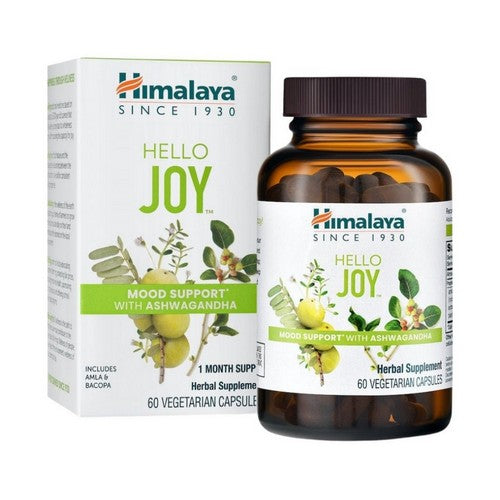
Hello Joy

At the recorded label maximum: 2 capsules per day

Add to my list
Per day$0.97

At the label maximum of 2 capsules a day.

Per pack$28.99

60 capsules · Green's Nutrition Affiliate Program · checked 17 Nov 2026. Delivery is not included.

Per capsule$0.48

Pack price divided by the number of capsules in the pack.

Composition

Amounts at the recorded label maximum. Directions may give a range.

Amounts not disclosed. The label gives only the total weight of this blend, not the amount of each ingredient in it. Without the individual amounts, we cannot compare these ingredients with upper limits.

Amla extract
Amount not disclosedpart of Proprietary Herbal Blend · not counted
No limit on file for the United StatesNone on file in any country
Ashwagandha extract
About this formextract (standardized withanolides). Reference level V0; no form is called “better” here.
Amount not disclosedpart of Proprietary Herbal Blend · not counted
No limit on file for the United StatesNone on file in any country
Amount not disclosedpart of Proprietary Herbal Blend · not counted
No limit on file for the United StatesNone on file in any country
Holy Basil extract
Amount not disclosedpart of Proprietary Herbal Blend · not counted
No limit on file for the United StatesNone on file in any country

Manufacturer's directions

Recommended Use: Adults take 1 capsule twice a day after food.

Other ingredients on the label

Tapioca Starch, plant-based Cellulose

Limits in other countries

No dose limits on file for the ingredients of this product.

About the ingredients

Ingredient information

Ingredient guideAshwagandhaAshwagandha is a plant, Withania somnifera: an evergreen shrub of the Solanaceae family. Its root has been used in the traditional medicine of India. Supplements contain extracts of the root or of root and leaf, or ground root. Extracts may be standardized to withanolides, a group of plant compounds.Read moreShow less
Terms and sources
Withania somnifera
The name ashwagandha is Sanskrit for the smell of a horse, after the smell of the root. The species name somnifera comes from a Latin word meaning sleep-inducing. NIH Office of Dietary Supplements.
Solanaceae family
The plant family is named in the Lopresti 2019 and Ziegenfuss 2018 trial reports. Evergreen shrub: NIH Office of Dietary Supplements.
traditional medicine of India
The Ayurvedic and Unani systems. NIH Office of Dietary Supplements.
withanolides
steroidal lactones. NIH Office of Dietary Supplements.

Ashwagandha in the body

Ashwagandha is not a nutrient, and the body has no daily requirement for it. Trials of its extracts measure things such as cortisol, a stress hormone, and self-rated sleep.

The plant is also called winter cherry or Indian ginseng, but it does not belong to the ginseng family. Most commercial supplements contain root extracts; some contain extracts of root and leaf. The chemical makeup of the root and the leaf differs.

Its compounds include withanolides and alkaloids. Extract makers measure withanolides to standardize their extracts. Laboratory studies suggest that compounds other than withanolides may also be active.

Terms and sources
standardize
To keep the amount of chosen compounds the same from batch to batch. Trial reports for KSM-66, Shoden and Witholytin state a withanolide share measured by HPLC.
Laboratory studies
Studies in cells and animals, summarized by the NIH Office of Dietary Supplements.

NIH notes that ashwagandha appears well tolerated for up to about 3 months. Its long-term safety is not known. NIH also notes a few reports of more serious side effects, including effects on the liver. Ashwagandha might also affect thyroid function and interact with some medicines. NIH notes that some experts advise against ashwagandha during pregnancy.

Terms and sources
about 3 months
Common side effects, such as loose stools, nausea and drowsiness, are usually mild. NIH Office of Dietary Supplements.

Information, not a prescription. Do not start, stop or combine supplements or medicines on your own.
Ingredient guideBacopaBacopa is a plant, Bacopa monnieri, also called brahmi or water hyssop. It is used in Ayurveda, the traditional medicine of India. Supplements contain extracts of the leaves, the aerial parts or the whole plant, or dried plant powder. Extracts are often standardized to bacosides, a group of plant saponins.Read moreShow less
Terms and sources
brahmi
A name also used for gotu kola. LiverTox.
water hyssop
The name used in the McPhee 2021 trial report. Kumar et al., 2016: the plant is also known as brahmi.
Ayurveda
In Ayurveda it is counted among the Medhya Rasayana herbs. Kumar et al., 2016.
the leaves, the aerial parts or the whole plant
LiverTox, an NIH database: leaves. Trial reports below: aerial parts. Aguiar 2013 review: whole-plant extracts in laboratory studies. US labels name all three; our count.
bacosides
Saponins are compounds that bind sugars to a fat-like core. Bacosides A and B and bacopasides are named in the Kumar 2016 trial report.

Bacopa in the body

Bacopa is not a nutrient, and the body has no daily requirement for it. Trials of its extracts measure memory and attention with word lists, reaction-time tasks and other computer tests.

Its compounds include saponins called bacosides and bacopasides, and alkaloids such as brahmine and herpestine. Extract makers measure bacosides or total saponins to standardize their extracts. The share depends on the test: one extract held 45% saponins by one method and 11.38% bacosides by another.

Terms and sources
brahmine and herpestine
Kumar et al., 2016, trial report introduction, from earlier plant chemistry studies.
standardize
To keep the amount of chosen compounds the same from batch to batch. The Kumar 2016 and Peth-Nui 2012 trial reports state the share and the test used.
one extract
Bacognize in the Kumar 2016 trial report: 45% saponins by UV spectrophotometry; 11.38% for four named bacosides by HPLC.

LiverTox, an NIH database, notes that bacopa has "only minor and usually short-lived side effects." Overall side-effect rates with bacopa have usually been similar to those with a dummy pill. Small clinical trials reported no serious or severe side effects. Bacopa has not been linked to rises in liver enzymes or to cases of liver injury. A 2013 review adds that long-term toxicity studies in people have yet to be done. In two trials below, side effects, mostly digestive, were more common with bacopa than with a dummy pill.

Terms and sources
usually short-lived side effects
LiverTox lists side effects "which may include abdominal pain, nausea, diarrhea, flatulence, dry mouth, headache, dizziness, insomnia, and rash."
liver injury
LiverTox likelihood score E: an unlikely cause of liver injury. Few trials reported liver blood tests.
A 2013 review
Aguiar and Borowski, Rejuvenation Research, 2013. The review also names nausea and stomach upset as the most common side effects.
two trials below
Morgan 2010: more frequent stools and nausea, among other digestive effects. Lopresti 2025: mostly digestive complaints and headaches; statistically significant. In Calabrese 2008, side effects possibly related to the product were 9 with bacopa and 10 with the dummy pill. With bacopa, flu-like symptoms and digestive problems were the most common.

Information, not a prescription. Do not start, stop or combine supplements or medicines on your own.

Services

Choose the option that suits you.

Quick selection

I know my goal

$5

1–2 minutes · a few questions with fixed answers

One goal. Up to three products. Set a budget per day if you like.

Product checks
form and amount on the label, plus shop prices
Daily schedule
what to take, when, how much
Totals and limits
next to the upper limit
Reasons & sources
for each product
Prices and shops
plus food and habits
Progress
what to track, when to see a doctor

Complete the questionnaire before you pay. If no product fits any of your goals, you won’t be charged.

Order · $5View example

Full selection

I have several goals

$15

5–7 minutes · questionnaire with fixed answers

Up to three goals in one set. Where two goals overlap, one product is used for both.

Product checks
form and amount on the label, plus shop prices
Daily schedule
what to take, when, how much
Totals and limits
next to the upper limit
Reasons & sources
for each product
Prices and shops
plus food and habits
Progress
what to track, when to see a doctor

Complete the questionnaire before you pay. If no product fits any of your goals, you won’t be charged.

Order · $15View example

Expert review

I want a person to look at my supplements

$50

Written review within 48 hours of your completed questionnaire

An expert reviews your supplement list and questionnaire.

Written review
duplicates, limits, forms
Detailed questionnaire
supplements, medicines, history
Optional uploads
supplement-label photos or documents relevant to your review
Your notes
your priorities and questions
Follow-up questions
in writing, when needed
Next steps
points to discuss with your doctor

Complete the questionnaire before you pay.

Order · $50View example
Sources, label & certificates

Label record

Copied from the NIH label database (DSLD 256062) · not yet compared with the label · checked 19 Oct 2026 · Report an error

The United States has no pre-market registration for supplements.
Label on file in the NIH Dietary Supplement Label Database
checked 19 Oct 2026source: NIH DSLDReport an error

Barcode 6 05069 06533 7

Third-party certificates

Label mentions: hello Joy Goodbye Blues Say 'hello energy' Because even if you have reasons to be sad, help is in your hands.. Not yet checked against the certifiers’ registries.

Information, not a prescription. Do not start, stop or combine supplements or medicines on your own. If you have a health condition, are pregnant or breastfeeding, take medicines, or are under 18, talk to a doctor or pharmacist first.

Photo credits

Image: © Himalaya. Shown to identify the product. Source:

Rights holders can ask us to remove an image or send official product photos: info@verateca.com.

Product photo

Himalaya Hello Joy — enlarged pack