Advanced Nutrition by Zahler · tablets

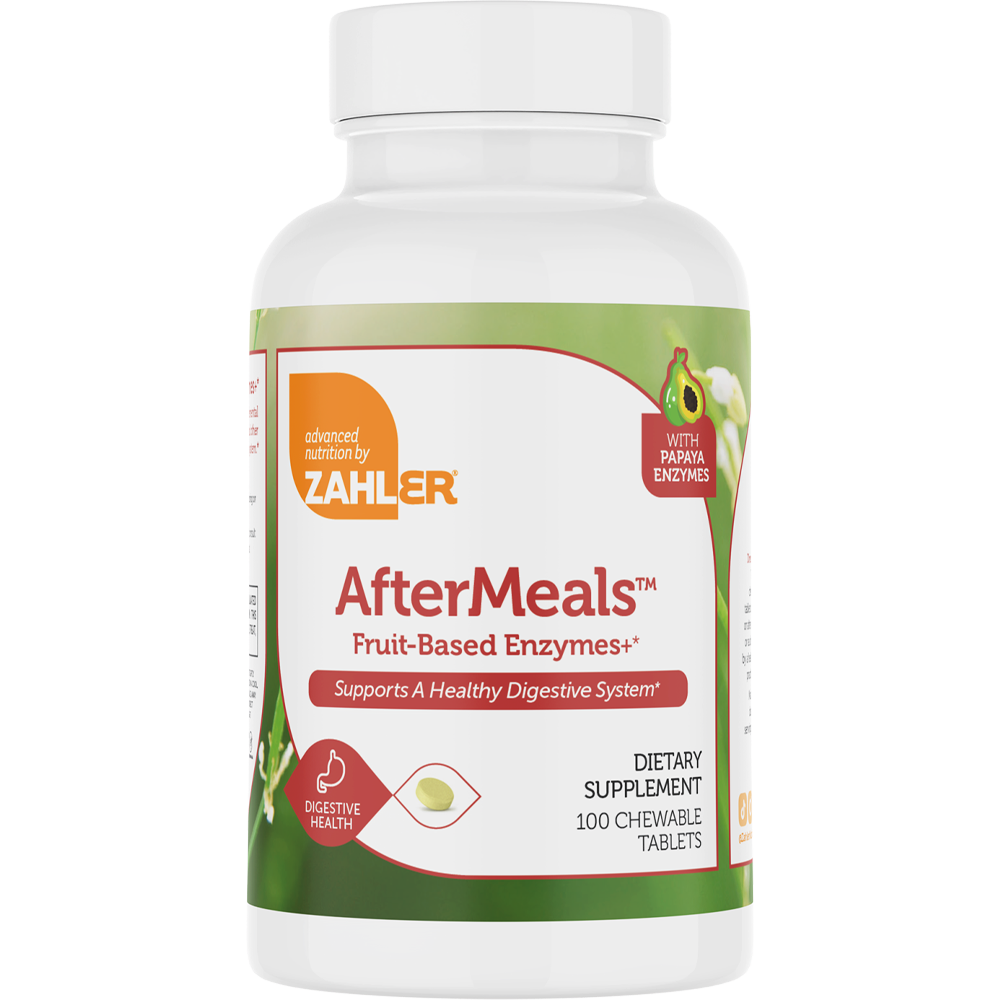
AfterMeals

2 tablets · how many a day not stated

Add to my list
Per day$0.25

Calculated at 1 serving a day (2 tablets). The label does not state how many to take daily.

Per pack$12.25

100 chewable tablets · Vitacost · checked 13 Nov 2026. Delivery is not included.

Per tablet$0.12

Pack price divided by the number of tablets in the pack.

Composition

Recorded amounts. How many servings a day is not stated.

Amounts not disclosed. The label gives only the total weight of this blend, not the amount of each ingredient in it. Without the individual amounts, we cannot compare these ingredients with upper limits.

Calciumas Calcium Carbonate
About this formcalcium carbonate — about 40% of the compound is calcium itself. Most calcium per gram; take with food. Reference level V0; no form is called “better” here.
220 mgrecorded amount; daily frequency not stated · as calcium itself110 mg per tablet · calculated from 220 mg per 2 tablets
11% of 2,000 mg — US upper limit for adults, National Academies2,500 mg (ages 19–50) · 2,000 mg (51 and older) · from food and supplements, adults · food is not counted here · a reference value, not a legal limit
Papaya powder
130 mgrecorded amount; daily frequency not stated65 mg per tablet · calculated from 130 mg per 2 tablets
No limit on file for the United StatesNone on file in any country
Bromelain Complex
80 mgrecorded amount; daily frequency not stated
No limit on file for the United StatesNone on file in any country
Bromelain
Amount not disclosedpart of Bromelain Complex · not counted
No limit on file for the United StatesNone on file in any country
Papain Complex
50 mgrecorded amount; daily frequency not stated
No limit on file for the United StatesNone on file in any country
Papain
Amount not disclosedpart of Papain Complex · not counted
No limit on file for the United StatesNone on file in any country
Licorice powder
5 mgrecorded amount; daily frequency not stated2.5 mg per tablet · calculated from 5 mg per 2 tablets
No limit on file for the United StatesNone on file in any country
4 mgrecorded amount; daily frequency not stated2 mg per tablet · calculated from 4 mg per 2 tablets
No limit on file for the United StatesNone on file in any country
1 mgrecorded amount; daily frequency not stated500 mcg per tablet · calculated from 1 mg per 2 tablets
No limit on file for the United StatesNone on file in any country

Where no limit is shown, none is set or on file for the United States. That is not the same as having no maximum.

Manufacturer's directions

Directions: Take 2 tablets during or after meals; or as directed by a healthcare practitioner.

Other ingredients on the label

Sorbitol, Stearic Acid, Magnesium Stearate, Natural Flavors, Silicon Dioxide (SiO2), Sucralose, Citric Acid

Limits in other countries
CountryCalcium
United States2,000 mgreference, not a law · 11%
Comparison note2,500 mg (ages 19–50) · 2,000 mg (51 and older)
Austria800 mgrecommendation · 28%
Belgium1,600 mglaw · 14%
Croatia1,500 mglaw · 15%
Cyprus1,500 mglaw · 15%
Denmark1,327 mgrecommendation · 17%
EAEU2,500 mglaw · 9%
Estonia2,500 mgrecommendation · 9%
Finland2,500 mgrecommendation · 9%
France800 mglaw · 28%
Germany500 mgrecommendation · 44%
Ireland2,500 mgrecommendation · 9%
Italy1,200 mgrecommendation · 18%
Luxembourg1,600 mglaw · 14%
Malta1,500 mgrecommendation · 15%
Norway705 mglaw · 31%
Poland1,500 mgrecommendation · 15%
Switzerland750 mglaw · 29%

Maximum amounts per daily dose of a food supplement, as each country sets them; the share is the daily amount on the label against that maximum. Law = legally binding; recommendation = an authority's recommended maximum, not binding; reference = the U.S. upper intake level for adults from all sources (National Academies), not a legal limit. Verification level V0 · Report an error

About the ingredients

Ingredient information

Ingredient guideCalciumCalcium is the most abundant mineral in the human body. An adult body holds about 1.2–1.4 kg of it, almost all in bones and teeth. Milk, yogurt and cheese are rich sources. Supplements contain calcium as part of a compound, most often calcium carbonate or calcium citrate.Read moreShow less
Terms and sources
1.2–1.4 kg
About 1,200 g in women and 1,400 g in men. NIH Office of Dietary Supplements.

Calcium in the body

About 99% of the body's calcium is in bones and teeth. The other 1% is in the blood and soft tissues. This small part is needed for normal muscle function, nerve signaling, blood clotting and hormone release. It also takes part as blood vessels tighten and relax.

Terms and sources
bones and teeth
There it sits in hydroxyapatite, a mineral of calcium and phosphate. Linus Pauling Institute; NIH Office of Dietary Supplements.

The body keeps blood calcium in a narrow range, about 8.8–10.4 mg/dL. When intake is low, it draws calcium from bone to hold that range. A blood test therefore does not show how much calcium a person gets. Bone is rebuilt all the time; teeth are not. Vitamin D is needed to absorb calcium in the gut.

Terms and sources
8.8–10.4 mg/dL
2.2–2.6 mmol/L, total calcium in serum in healthy people. NIH Office of Dietary Supplements.
absorb calcium in the gut
Vitamin D is needed for active transport, the main route when intake is low. NIH Office of Dietary Supplements.

Information, not a prescription. Do not start, stop or combine supplements or medicines on your own.
Ingredient guideFennelFennel is an aromatic plant, Foeniculum vulgare, of the Apiaceae family. It is grown for its leaves, stems and seeds. What is sold as fennel seed is the dried fruit of the plant. Supplements sell ground seed in capsules, seed extracts, liquid extracts, tea and fennel oil.Read moreShow less
Terms and sources
Apiaceae
Also called Umbelliferae. Badgujar et al., BioMed Research International, 2014.
dried fruit
The review notes that the dried fruit, called fennel, is a major item of commerce. Badgujar et al., BioMed Research International, 2014.

Fennel in the body

Fennel is not a nutrient, and the body has no daily requirement for it. Trials in adults without a diagnosis measure things such as sleep ratings and blood lipids.

The odor of fennel comes from its essential oil. In two studied cultivars, trans-anethole made up 59.8–90.4% of the oil. The same oils held 0.1–2.5% estragole; other analyses found 7.6% and 10.4%. Sweet fennel is the variety dulce of the same species.

Terms and sources
essential oil
The oil has been reported to hold more than 87 volatile compounds. Badgujar et al., BioMed Research International, 2014.
two studied cultivars
Aurelio and Sparta. Other compounds include limonene and fenchone. Badgujar et al., BioMed Research International, 2014. The review summarizes earlier analyses.
other analyses
Oil with 72.2% trans-anethole and 7.6% estragole. Another oil: 68.5% trans-anethole and 10.4% estragole. Badgujar et al., BioMed Research International, 2014.
variety dulce
Foeniculum vulgare Miller subsp. vulgare var. dulce. EU herbal monograph on sweet fennel fruit, European Medicines Agency.

The European Medicines Agency's EU herbal medicine monographs on fennel state: "Estragole is considered a genotoxic carcinogen in rodents." In a 2019 study, 12 healthy adults drank 500 mL of fennel tea holding 2.2 mg of estragole. A urine marker of the reactive form cleared almost fully within 8 hours. The total amount of the marker ranged from 93 to 1,076 ng between people. In an earlier study, estragole itself was not detected in blood after fennel tea. Under 0.41% of the estragole dose appeared in urine as bound (conjugated) 1'-hydroxyestragole; 17% became p-allylphenol.

Terms and sources
genotoxic carcinogen
Able to damage DNA and to cause tumors. The monographs cite liver tumors in mice and indirect evidence in rats. EU herbal monographs on bitter and sweet fennel fruit, Revision 1, European Medicines Agency.
12 healthy adults
Six women and six men. Monien et al., Chemical Research in Toxicology, 2019.
A urine marker
AMPAC, a breakdown product of the reactive form of estragole. Before the tea, it was below the detection limit. In one volunteer, it also formed from trans-anethole, to a much smaller extent. Monien et al., 2019.
93 to 1,076 ng
The authors link this spread to differences in the enzymes that break down estragole. Monien et al., 2019.
an earlier study
Not above the detection limit. Its breakdown products appeared in blood within 2.5 hours. Zeller et al., Chemical Research in Toxicology, 2009.
1'-hydroxyestragole
The first step toward the reactive form. It peaked in urine at 1.5 hours. Zeller et al., 2009.

The European Medicines Agency has EU monographs for bitter and sweet fennel fruit. They cover it as a traditional herbal medicine taken as tea. For adults, the monographs' tea dose is 1.5 g of fruit in 250 mL of boiling water. It is taken 3 times a day. They add: "Not to be taken for more than 2 weeks." For children 4 to 12 years old, they add: "For short-term use in mild transitory symptoms only (less than one week)." Under contraindications, they list: "Hypersensitivity to the active substance or to Apiaceae (Umbelliferae) family (aniseed, caraway, celery, coriander and dill) or to anethole." They add: "Hypersensitivity to mugwort pollen, due to cross-reactivity with fennel." As a side effect, they note: "Allergic reactions to fennel, affecting the skin or the respiratory system may occur." The monographs also state: "Safety during pregnancy and lactation has not been established." They add: "In the absence of sufficient data, the use during pregnancy and lactation is not recommended." They also note: "There is evidence that trans-anethole is excreted in human breast milk." They add: "No fertility data available." They report: "A fennel aqueous extract was tested in an Ames test on Salmonella typhimurium strains TA98, TA100 and turned out as negative." They also report: "Results from studies carried out in laboratory animals showed a weak mutagenic activity of anethole." The monographs also report: "An aqueous extract of fennel seeds given daily to 24 female BALB/c mice from day 6 to day 15 of pregnancy showed a dose-dependent teratogenic effect." They add: "The embryotoxic effect resulted in morphological changes, skeletal disorders, and cellular alterations." For children, they state: "The use is not recommended in children under 4 years of age due to lack of adequate data." For older children, they add: "The use in children between 4 and 12 years of age is not recommended if the daily intake of estragole exceeds the guidance value of 1.0 µg/kg bw, unless justified by a risk assessment based on adequate safety data." For these herbal medicines, they state: "In the general population exposure to estragole should be kept as low as practically achievable." They also set: "In pregnant and breast-feeding women, the daily intake of estragole has to be below 0.05 mg/person per day." And: "In children below 12 years of age, the daily intake of estragole has to be below 1.0 µg/kg bw." Under interactions with other medicines, the monographs state: "None reported."

Terms and sources
monographs
Foeniculi amari fructus and Foeniculi dulcis fructus. Their safety texts match apart from small wording differences; quotes here are from the bitter fennel monograph. EU herbal monographs on bitter and sweet fennel fruit, Revision 1, European Medicines Agency.
3 times a day
Steeped for 15 minutes; 4.5 g a day. For adults and adolescents. EU herbal monographs on bitter and sweet fennel fruit, Revision 1, European Medicines Agency.
contraindications
Reasons not to use the product, in medicine labeling terms. EU herbal monographs on bitter and sweet fennel fruit, Revision 1, European Medicines Agency.
a side effect
The monographs add that the frequency is not known.
Ames test
A laboratory test for DNA changes in bacteria.
teratogenic
Causing birth defects in the offspring. The monographs add that adequate tests on reproductive toxicity have not been performed. EU herbal monographs on bitter and sweet fennel fruit, Revision 1, European Medicines Agency.
1.0 µg/kg bw
Micrograms per kilogram of body weight, as a daily intake. This applies to the tea for digestive and cough uses. EU herbal monographs on bitter and sweet fennel fruit, Revision 1, European Medicines Agency.

In the 60-woman capsule trial below, 6 women reported side effects with fennel and 3 with a dummy capsule. In the 50-woman capsule trial below, no side effects were reported in either group.

Terms and sources
6 women reported side effects
With fennel: an allergic rash, weight gain and raised blood pressure in 1 woman each, and vaginal bleeding in 2. With the dummy capsule, the report describes one stomachache. Afiat et al., 2018. Another report of this trial says 5 women with fennel and 1 with the dummy capsule left it. 54 of 60 finished. Saghafi et al., Journal of Menopausal Medicine, 2017.

Information, not a prescription. Do not start, stop or combine supplements or medicines on your own.

Ingredient guideGingerGinger is the underground stem, or rhizome, of the plant Zingiber officinale. The plant is native to the warm parts of Asia. Its rhizome is used in food and in supplements. Supplements contain ginger as root powder in capsules, extracts, liquid extracts, tea, lozenges and chews.Read moreShow less
Terms and sources
rhizome
NCCIH calls the rhizome an underground stem. NCCIH, Ginger: Usefulness and Safety.
warm parts of Asia
NCCIH, Ginger: Usefulness and Safety.

Ginger in the body

Ginger is not a nutrient, and the body has no daily requirement for it. Trials in adults without a diagnosis measure things such as muscle soreness after exercise and stomach emptying.

Ginger root holds about 1–3% volatile oils and a group of pungent compounds. In fresh root, the most abundant pungent compounds are gingerols, mainly 6-gingerol. Shogaols, a dehydrated form of gingerols, are found mainly in dried and heat-treated root. Extract makers state gingerols, sometimes with shogaols, to standardize their extracts.

Terms and sources
pungent compounds
Mainly gingerols and shogaols. Zick et al., 2008.
a dehydrated form
Fresh root holds only small amounts of shogaols. Zick et al., 2008.
standardize
To keep the amount of chosen compounds the same from batch to batch. In one study, an extract standardized to 5% gingerols held 2.15% 6-gingerol by HPLC. Zick et al., 2008.

In 27 healthy adults, one dose of up to 2 g of extract left no free gingerols in blood. They appeared in blood in bound forms, mostly glucuronides, from 30 minutes after the dose. These bound forms could no longer be detected in blood by 4 hours in all but one person. Side effects in that study were all graded mild, mainly burping, a burning feeling in the chest and stomach upset.

Terms and sources
27 healthy adults
Single doses from 100 mg to 2 g of an extract with 5% gingerols. Each new group got a higher dose; there was no comparison group. Zick et al., 2008.
glucuronides
Gingerols and shogaols joined to glucuronic acid. A smaller part was bound to sulfate. Zick et al., 2008.
all but one person
One person on 2 g still had bound 6-gingerol at 8 hours. Zick et al., 2008.
graded mild
No side effect was above grade 1 on a standard toxicity scale. Zick et al., 2008.

NCCIH notes: “Ginger has been used safely in many research studies where it was taken orally (by mouth) as a dietary supplement.” It adds: “Ginger products may also be safe for topical use.” NCCIH lists side effects: “Ginger can have side effects such as abdominal discomfort, heartburn, diarrhea, and mouth and throat irritation when taken orally.” NCCIH advises: “If you take any type of medicine, talk with your health care provider before using ginger or any other herbal products; some herbs and medicines interact in harmful ways.” NCCIH also writes: “The use of ginger dietary supplements during pregnancy may be safe.” It continues: “As with all herbal supplements, if you’re considering using ginger while pregnant, consult your health care provider.” NCCIH adds: “Little is known about whether it’s safe to use ginger while breastfeeding.”

Terms and sources
NCCIH notes
NCCIH, Ginger: Usefulness and Safety.

In the cycling trial below, at most 2 of 30 cyclists reported gas, burping or fullness with either drink. In the 2-week powder trial below, no moderate or severe side effects were reported.

Terms and sources
at most 2 of 30 cyclists
Weekly 16-item questionnaire on stomach and gut symptoms. Kurtz et al., Sports, 2026.
no moderate or severe side effects
Crichton et al., Journal of Nutrition, 2023.

Information, not a prescription. Do not start, stop or combine supplements or medicines on your own.

Services

Choose the option that suits you.

Quick selection

I know my goal

$5

1–2 minutes · a few questions with fixed answers

One goal. Up to three products. Set a budget per day if you like.

Product checks
form and amount on the label, plus shop prices
Daily schedule
what to take, when, how much
Totals and limits
next to the upper limit
Reasons & sources
for each product
Prices and shops
plus food and habits
Progress
what to track, when to see a doctor

Complete the questionnaire before you pay. If no product fits any of your goals, you won’t be charged.

Order · $5View example

Full selection

I have several goals

$15

5–7 minutes · questionnaire with fixed answers

Up to three goals in one set. Where two goals overlap, one product is used for both.

Product checks
form and amount on the label, plus shop prices
Daily schedule
what to take, when, how much
Totals and limits
next to the upper limit
Reasons & sources
for each product
Prices and shops
plus food and habits
Progress
what to track, when to see a doctor

Complete the questionnaire before you pay. If no product fits any of your goals, you won’t be charged.

Order · $15View example

Expert review

I want a person to look at my supplements

$50

Written review within 48 hours of your completed questionnaire

An expert reviews your supplement list and questionnaire.

Written review
duplicates, limits, forms
Detailed questionnaire
supplements, medicines, history
Optional uploads
supplement-label photos or documents relevant to your review
Your notes
your priorities and questions
Follow-up questions
in writing, when needed
Next steps
points to discuss with your doctor

Complete the questionnaire before you pay.

Order · $50View example
Sources, label & certificates

Label record

Copied from the NIH label database (DSLD 259917) · not yet compared with the label · checked 19 Oct 2026 · Report an error

The United States has no pre-market registration for supplements.
Label on file in the NIH Dietary Supplement Label Database
checked 19 Oct 2026source: NIH DSLDReport an error

Barcode 8 48998 08053 2

Third-party certificates

Label mentions: You may need additional supplements to support a healthy diet; consult your nutritionist for a formula that is right for you or contact us at 877-ASK-ZAHLER (877-275-9245) or ask@zahlers.com.. Not yet checked against the certifiers’ registries.

Information, not a prescription. Do not start, stop or combine supplements or medicines on your own. If you have a health condition, are pregnant or breastfeeding, take medicines, or are under 18, talk to a doctor or pharmacist first.

Photo credits

Image: © Advanced Nutrition by Zahler. Shown to identify the product. Source:

Rights holders can ask us to remove an image or send official product photos: info@verateca.com.

Product photo

Advanced Nutrition by Zahler AfterMeals — enlarged pack