HealthForce SuperFoods · powder

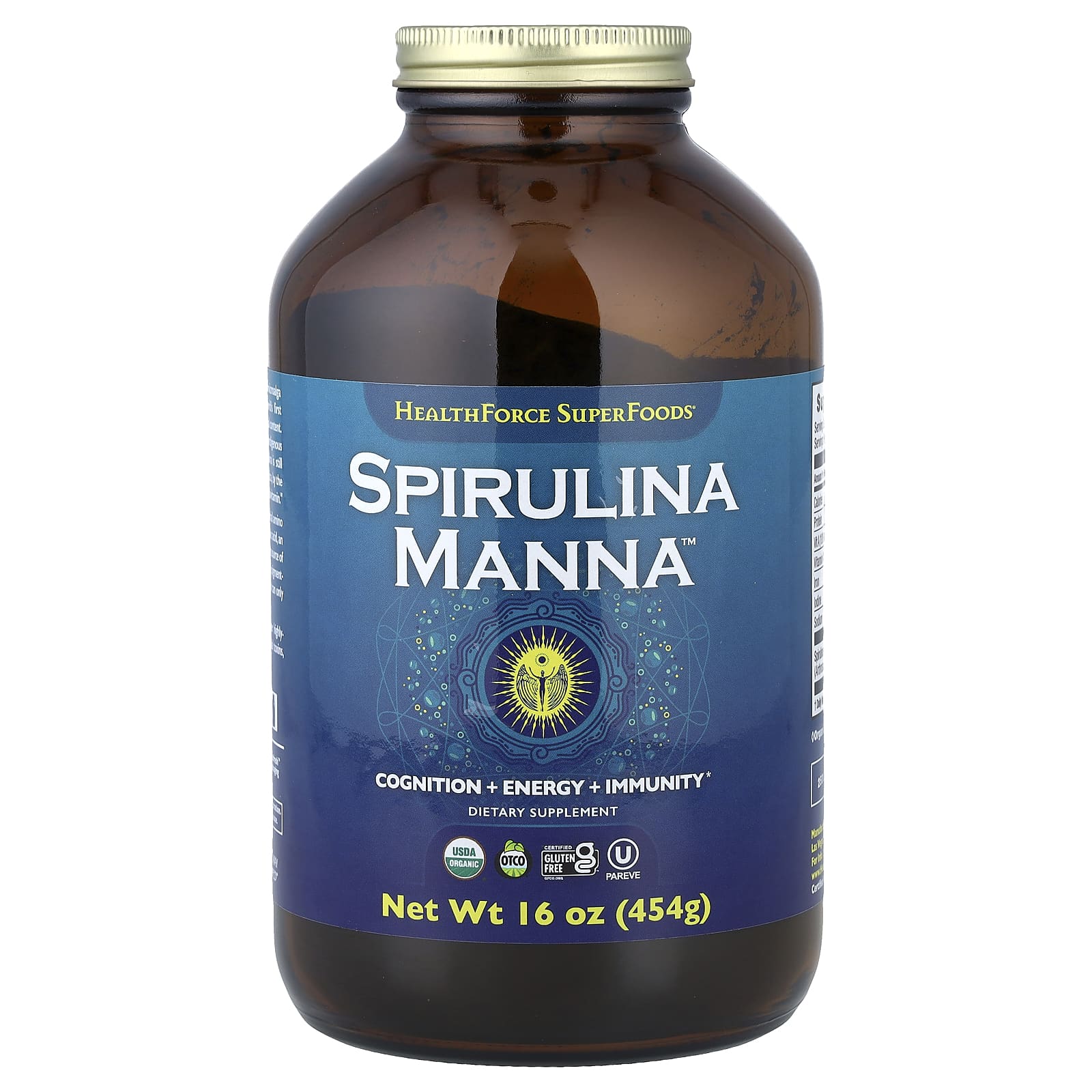
Spirulina Manna

At the recorded label maximum: 1 serving (2.4 Grams [1 teaspoon] each) per day

Add to my list
Per day$0.32

At the label maximum of 1 serving a day.

Per pack$59.95

16 ounces; 453.5 g · Vitacost · checked 13 Nov 2026. Delivery is not included.

Per serving$0.32

Pack price divided by the number of servings in the pack.

Composition

Amounts at the recorded label maximum. Directions may give a range.

1.7 mgat the recorded label maximum (1 serving × 1.7 mg; 2.4 Grams [1 teaspoon] per serving) · as iron itself
4% of 45 mg — US upper limit for adults, National Academiesfrom food and supplements, adults · food is not counted here · a reference value, not a legal limit
Vitamin Aas Beta-Carotene
About this formbeta-carotene (provitamin A). Converted to vitamin A only as needed; not comparable with retinol by dose. Reference level V0; no form is called “better” here.
1.12 mgat the recorded label maximum (1 serving × 1.12 mg; 2.4 Grams [1 teaspoon] per serving)
Not compared with 3 mg — US upper limit for adults, National Academiesthe limit counts retinol only · a reference value, not a legal limit
4 mgat the recorded label maximum (1 serving × 4 mg; 2.4 Grams [1 teaspoon] per serving)
<1% of 2,000 mg — US upper limit for adults, National Academiesfrom food and supplements, adults · food is not counted here · a reference value, not a legal limit

Manufacturer's directions

Suggested Use: 1 teaspoon per day; either all at once or divided. Spirulina is a food. It can be eaten directly or added to foods.

Other ingredients on the label

Spirulina

Limits in other countries
CountryIronVitamin AVitamin C
United States45 mgreference, not a law · 4%3,000 mcgreference, not a law · not compared2,000 mgreference, not a law · 0%
Austria10 mgrecommendation · 17%900 mcgrecommendation · 124% · above500 mgrecommendation · 1%
Belgium45 mglaw · 4%1,200 mcglaw · 93%1,000 mglaw · 0%
Croatia30 mglaw · 6%1,500 mcglaw · 75%800 mglaw · 1%
Cyprus15 mglaw · 11%2,300 mcglaw · 49%2,000 mglaw · 0%
Denmark27 mgrecommendation · 6%—not on file1,000 mgrecommendation · 0%
EAEU40 mglaw · 4%3,000 mcglaw · 37%900 mglaw · 0%
Estonia—not on file3,000 mcgrecommendation · 37%—not on file
Finland—not on file3,000 mcgrecommendation · 37%—not on file
France14 mglaw · 12%800 mcglaw · 140% · above180 mglaw · 2%
Germany6 mgrecommendation · 28%200 mcgrecommendation · 560% · above250 mgrecommendation · 2%
Ireland45 mgrecommendation · 4%3,000 mcgrecommendation · 37%2,000 mgrecommendation · 0%
Italy30 mgrecommendation · 6%1,200 mcgrecommendation · 93%1,000 mgrecommendation · 0%
Luxembourg28 mglaw · 6%1,200 mcglaw · 93%1,000 mglaw · 0%
Malta17 mgrecommendation · 10%1,500 mcgrecommendation · 75%1,000 mgrecommendation · 0%
Netherlands—not on file1,200 mcglaw · 93%—not on file
Norway21 mglaw · 8%—not on file1,000 mglaw · 0%
Poland20 mgrecommendation · 9%800 mcgrecommendation · 140% · above1,000 mgrecommendation · 0%
Switzerland21 mglaw · 8%1,360 mcglaw · 82%750 mglaw · 1%

Maximum amounts per daily dose of a food supplement, as each country sets them; the share is the daily amount on the label against that maximum. Law = legally binding; recommendation = an authority's recommended maximum, not binding; reference = the U.S. upper intake level for adults from all sources (National Academies), not a legal limit. Verification level V0 · Report an error

About the ingredients

Ingredient information

Ingredient guideIronIron is an essential mineral that the body uses to carry oxygen in the blood. An adult body holds about 3 to 4 g of iron, most of it in hemoglobin. Meat, seafood and grain foods made with fortified flour are major sources. Supplements contain iron as part of a compound, such as ferrous sulfate, ferrous fumarate or ferrous bisglycinate.Read moreShow less
Terms and sources
3 to 4 g
NIH Office of Dietary Supplements. The Linus Pauling Institute estimates 2.3 g in women and 3.8 g in men.

Iron in the body

Iron is part of hemoglobin, the red blood cell protein that carries oxygen from the lungs to the tissues. It is also part of myoglobin, a protein that carries and stores oxygen in muscle cells. Iron is needed for physical growth, the work of cells and making some hormones. Hundreds of proteins and enzymes contain iron, including those that make energy in cells.

Terms and sources
hemoglobin
NIH Office of Dietary Supplements.
myoglobin
Linus Pauling Institute. Its 2016 update was paid for in part by a grant from Bayer Consumer Care AG.
making some hormones
NIH Office of Dietary Supplements.
Hundreds of proteins
Including cytochromes, which carry electrons when cells make ATP, their main energy molecule. Linus Pauling Institute.

The body loses very little iron, so it reuses most of what it has. About 20 mg of iron a day is recovered from old red blood cells. To cover losses, the gut absorbs only 1–2 mg of iron a day. A hormone made in the liver, hepcidin, sets how much iron the gut takes up. Spare iron is stored as ferritin in the liver, spleen and bone marrow.

Terms and sources
loses very little iron
Small amounts leave in urine, stool, sweat and shed skin cells; more is lost with menstrual blood. NIH Office of Dietary Supplements.
About 20 mg
The same article gives about 35 mg a day for all iron recycling. Linus Pauling Institute. Its 2016 update was paid for in part by a grant from Bayer Consumer Care AG.
1–2 mg
Linus Pauling Institute.
hepcidin
When stores are full, hepcidin blocks iron uptake from food; when they are low, it is barely made. Linus Pauling Institute; NIH.
ferritin
A storage protein. Its level in blood is a common test of iron stores. NIH Office of Dietary Supplements.

NIH notes: "Adults with normal intestinal function have very little risk of iron overload from dietary sources of iron. However, supplements containing 25 mg iron or more can reduce zinc absorption and plasma zinc concentrations. High-dose iron supplements can also cause gastrointestinal effects, including gastric upset, constipation, nausea, abdominal pain, vomiting, and diarrhea. Taking iron supplements with food can help minimize these adverse effects. Case reports, some of which involved doses of 130 mg iron, suggest that some people develop even more serious gastrointestinal effects, including gastritis and gastric lesions (along with iron deposits in the gastric mucosa in some cases)." It goes on: "Acute intakes of more than 20 mg/kg iron (about 1,365 mg iron for a person weighing 150 pounds [lb]) from supplements or medicines can lead to corrosive necrosis of the intestine, which might lead to fluid and blood loss, shock, tissue damage, and organ failure, especially if food is not taken at the same time as the iron. In severe cases (e.g., one-time ingestions of 60 mg/kg, or about 4,090 mg iron for a 150-lb person), overdoses of iron can lead to multisystem organ failure, coma, convulsions, and even death." NIH continues: "Between 1983 and 2000, at least 43 U.S. children died from ingesting supplements containing high doses of iron (36–443 mg iron/kg body weight). Accidental ingestion of iron supplements caused about a third of poisoning deaths among children reported in the United States between 1983 and 1991." It adds: "In 1997, FDA began requiring oral supplements containing more than 30 mg elemental iron per dose to be sold in single-dose packaging with strong warning labels. At the same time, many manufacturers voluntarily replaced the sugar coating on iron tablets with film coatings. Between 1998 and 2002, only one child death due to ingesting an iron-containing tablet was reported. As a result of a court decision, FDA removed its single-dose packaging requirement for iron supplements in 2003. FDA currently requires that iron-containing dietary supplements sold in solid form (e.g., tablets or capsules but not powders) carry the following label statement: “WARNING: Accidental overdose of iron-containing products is a leading cause of fatal poisoning in children under 6. Keep this product out of reach of children. In case of accidental overdose, call a doctor or poison control center immediately”. In addition, since 1978, the Consumer Product Safety Commission has required manufacturers to package dietary supplements that contain 250 mg or more elemental iron per container in child-resistant bottles or packaging to prevent accidental poisoning." NIH adds: "Hemochromatosis, a disease caused by a mutation in the hemochromatosis (HFE) gene, is associated with an excessive buildup of iron in the body. About 1 in 10 Whites carry the most common HFE mutation (C282Y), but only 4.4 Whites per 1,000 are homozygous for the mutation and have hemochromatosis. The condition is much less common in other ethnic groups. Without treatment by periodic chelation or phlebotomy, people with hereditary hemochromatosis typically develop signs of iron toxicity by their 30s. These effects can include liver cirrhosis, hepatocellular carcinoma, heart disease, and impaired pancreatic function. The American Association for the Study of Liver Diseases recommends that treatment of hemochromatosis include the avoidance of iron and vitamin C supplements."

Terms and sources
NIH notes
NIH Office of Dietary Supplements, Iron fact sheet for health professionals, section on health risks from excessive iron. The next paragraphs follow in the order of that section.
It adds
Same NIH section, the paragraph on packaging and label rules. In the United States, 21 CFR 101.17(e) requires the same statement.
NIH adds
Same NIH section, next paragraph.

Information, not a prescription. Do not start, stop or combine supplements or medicines on your own.
Ingredient guideVitamin AVitamin A is the name for a group of fat-soluble compounds, mainly retinol and retinyl esters. Animal foods contain it as preformed vitamin A; plants contain carotenoids, some of which the body converts into it. Supplements contain retinyl acetate, retinyl palmitate, beta-carotene or a combination. Amounts are given in mcg RAE; older labels used IU.Read moreShow less
Terms and sources
fat-soluble
They dissolve in fat, not in water. NIH Office of Dietary Supplements.
carotenoids
Provitamin A carotenoids: beta-carotene, alpha-carotene and beta-cryptoxanthin. NIH Office of Dietary Supplements.
mcg RAE
Micrograms of retinol activity equivalents. The unit counts how much retinol each form gives the body.

Vitamin A in the body

Vitamin A is part of rhodopsin, the protein in the retina that responds to light. It is needed for normal vision. It is also involved in immune function, cell communication, growth and development, and reproduction.

Terms and sources
rhodopsin
The light-sensitive pigment of the eye's rod cells, which see in dim light. NIH Office of Dietary Supplements; Linus Pauling Institute.
normal vision
NIH Office of Dietary Supplements. It is also needed for the normal surface of the eye.
cell communication
NIH Office of Dietary Supplements. Vitamin A takes part in the growth and specialization of cells.

The body turns retinol into retinal and retinoic acid, the two main active forms. Most of the body's vitamin A is stored in the liver as retinyl esters. Blood retinol levels stay steady until the stores in the liver are almost used up.

Terms and sources
retinoic acid
It switches genes on and off; Linus Pauling Institute counts more than 500 genes that respond to it.
retinyl esters
Retinol joined to a fatty acid, such as retinyl palmitate. NIH Office of Dietary Supplements.
stay steady
NIH Office of Dietary Supplements. So a blood test is not always a reliable guide to the stores. See Green 2016 below: normal blood retinol with low stores.

Plants make hundreds of carotenoids; only about 10% of them can be converted to retinol. The body converts beta-carotene into vitamin A in the gut, through an enzyme. Lutein, zeaxanthin and lycopene are carotenoids that the body does not convert into vitamin A.

Terms and sources
about 10%
Linus Pauling Institute.
an enzyme
Beta-carotene monooxygenase type 1 (BCMO1). Conversion rates may vary with genes. NIH Office of Dietary Supplements.
does not convert
NIH Office of Dietary Supplements calls them non-provitamin A carotenoids.

Information, not a prescription. Do not start, stop or combine supplements or medicines on your own.

Ingredient guideVitamin CVitamin C, also called L-ascorbic acid, is a water-soluble vitamin. Most animals make vitamin C in the body; humans cannot and get it from food. Fruits and vegetables such as peppers, citrus fruits and kiwifruit are the main sources. Supplements contain it as ascorbic acid or as mineral salts such as sodium and calcium ascorbate.Read moreShow less
Terms and sources
water-soluble
It dissolves in water, not in fat. NIH Office of Dietary Supplements.

Vitamin C in the body

Vitamin C is needed to make collagen, carnitine and some neurotransmitters. It is also an antioxidant and can return used vitamin E to its active form. It is needed for normal immune function. It increases the absorption of iron from plant foods.

Terms and sources
collagen
A protein that holds together connective tissue, such as skin, tendons and blood vessels. NIH Office of Dietary Supplements.
carnitine
A substance cells need to get energy from fat. Linus Pauling Institute.
neurotransmitters
Chemical messengers between nerve cells.
antioxidant
A substance that limits damage from free radicals, reactive molecules made in cells.
iron from plant foods
Nonheme iron, the only form of iron in plant foods. NIH Office of Dietary Supplements.

An adult body holds from about 300 mg to about 2 g of vitamin C. White blood cells, the eyes, the adrenal and pituitary glands and the brain hold the most. Cells hold vitamin C in millimolar concentrations, blood plasma in micromolar concentrations. At 100 mg a day or more, cells appear to be saturated.

Terms and sources
about 300 mg
The lower figure is for very low intake. NIH Office of Dietary Supplements.
adrenal and pituitary glands
Small glands that make hormones: the adrenals sit above the kidneys, the pituitary below the brain.
millimolar
Thousandths of a mole per liter; micromolar means millionths. NIH Office of Dietary Supplements.
saturated
Holding as much as they take up. Above 200 mg a day, blood plasma levels rise little more.

The body absorbs about 70–90% of vitamin C at 30–180 mg a day. Above 1 g a day, less than 50% is absorbed, and unused vitamin C leaves in urine.

Terms and sources
less than 50%
Summary by the NIH Office of Dietary Supplements. Absorption in the gut runs through a dose-dependent transporter protein.

Information, not a prescription. Do not start, stop or combine supplements or medicines on your own.

Need help choosing?

Choose the option that suits you.

Quick selection

I know my goal

$5

1–2 minutes · a few questions with fixed answers

One goal. Up to three products. Set a budget per day if you like.

Product checks
form and amount on the label, plus shop prices
Daily schedule
what to take, when, how much
Totals and limits
next to the upper limit
Reasons & sources
for each product
Prices and shops
plus food and habits
Progress
what to track, when to see a doctor

Complete the questionnaire before you pay. If no product fits any of your goals, you won’t be charged.

Order · $5View example

Full selection

I have several goals

$15

5–7 minutes · questionnaire with fixed answers

Up to three goals in one set. Where two goals overlap, one product is used for both.

Product checks
form and amount on the label, plus shop prices
Daily schedule
what to take, when, how much
Totals and limits
next to the upper limit
Reasons & sources
for each product
Prices and shops
plus food and habits
Progress
what to track, when to see a doctor

Complete the questionnaire before you pay. If no product fits any of your goals, you won’t be charged.

Order · $15View example

Expert review

I want a person to look at my supplements

$50

Written review within 48 hours of your completed questionnaire

An expert reviews your supplement list and questionnaire.

Written review
duplicates, limits, forms
Detailed questionnaire
supplements, medicines, history
Optional uploads
supplement-label photos or documents relevant to your review
Your notes
your priorities and questions
Follow-up questions
in writing, when needed
Next steps
points to discuss with your doctor

Complete the questionnaire before you pay.

Order · $50View example
Sources, label & certificates

Label record

Copied from the NIH label database (DSLD 264301) · not yet compared with the label · checked 19 Oct 2026 · Report an error

The United States has no pre-market registration for supplements.
Label on file in the NIH Dietary Supplement Label Database
checked 19 Oct 2026source: NIH DSLDReport an error

Barcode 6 50786 00004 8

Third-party certificates

No third-party certificate on file for this product.

Information, not a prescription. Do not start, stop or combine supplements or medicines on your own. If you have a health condition, are pregnant or breastfeeding, take medicines, or are under 18, talk to a doctor or pharmacist first.

Photo credits

Image: © HealthForce SuperFoods. Shown to identify the product. Source: iherb.com

Rights holders can ask us to remove an image or send official product photos: info@verateca.com.

Product photo

HealthForce SuperFoods Spirulina Manna — enlarged pack