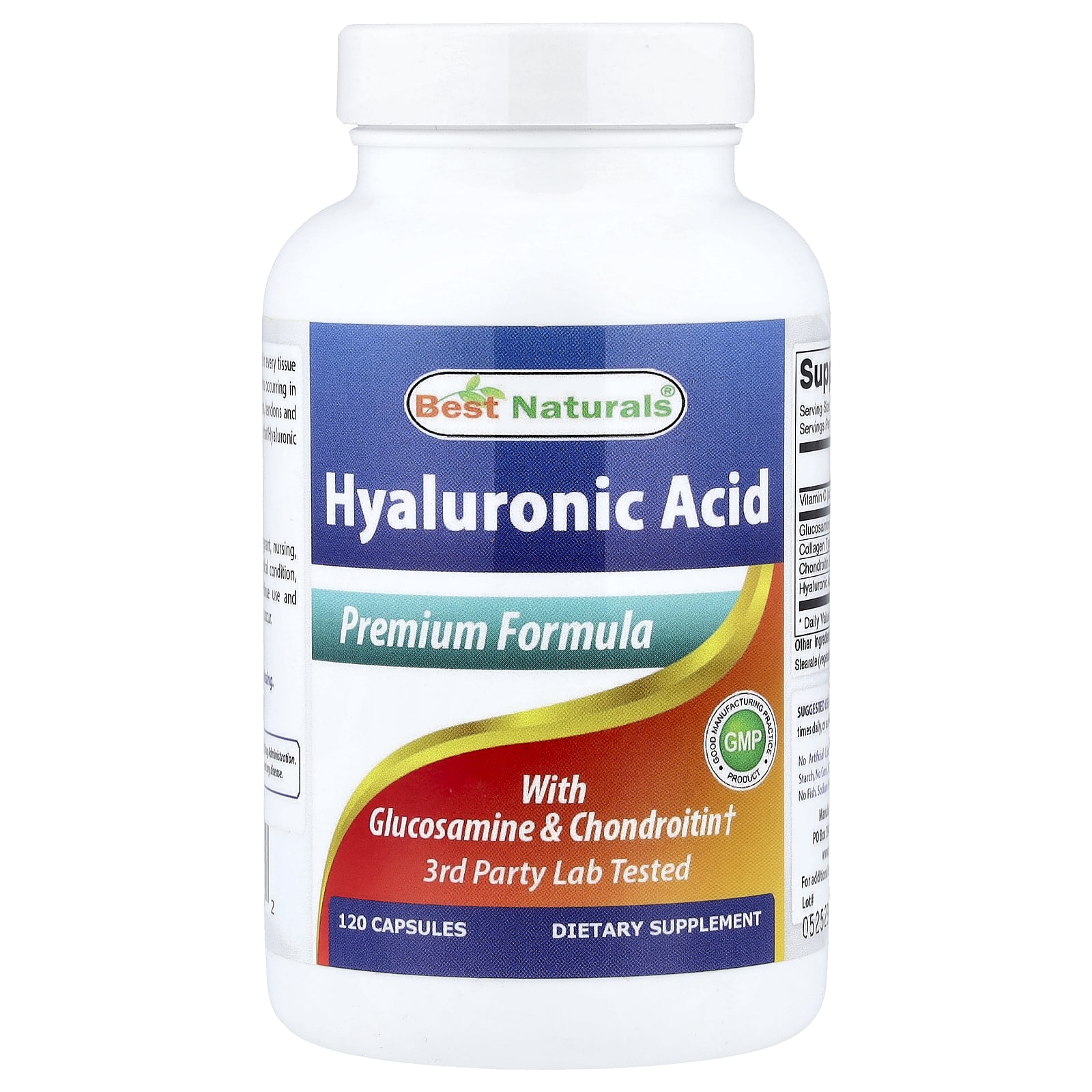
Best Naturals · capsules

Hyaluronic Acid

At the recorded label maximum: 4 capsules per day

Add to my list
Per day$0.60

At the label maximum of 4 capsules a day.

Per pack$18.06

120 capsules · Vitacost · checked 13 Nov 2026. Delivery is not included.

Per capsule$0.15

Pack price divided by the number of capsules in the pack.

Composition

Amounts at the recorded label maximum. Directions may give a range.

Vitamin Cas Ascorbic Acid
120 mgat the recorded label maximum (2 servings × 60 mg; 2 capsules per serving)30 mg per capsule · calculated from 60 mg per 2 capsules
6% of 2,000 mg — US upper limit for adults, National Academiesfrom food and supplements, adults · food is not counted here · a reference value, not a legal limit
Glucosamine Sulfate 2KCl
About this formglucosamine sulfate. Reference level V0; no form is called “better” here.
500 mgat the recorded label maximum (2 servings × 250 mg; 2 capsules per serving)125 mg per capsule · calculated from 250 mg per 2 capsules
No limit on file for the United States
Limits in other countries (2)Croatia, Switzerland
Collagen Type II
About this formhydrolyzed type II collagen (chicken sternum, BioCell). For joints; dose around one gram. Reference level V0; no form is called “better” here.
1,600 mgat the recorded label maximum (2 servings × 800 mg; 2 capsules per serving)400 mg per capsule · calculated from 800 mg per 2 capsules
No limit on file for the United StatesNone on file in any country
Chondroitin Sulfate
400 mgat the recorded label maximum (2 servings × 200 mg; 2 capsules per serving)100 mg per capsule · calculated from 200 mg per 2 capsules
No limit on file for the United States
Limits in other countries (1)Croatia
200 mgat the recorded label maximum (2 servings × 100 mg; 2 capsules per serving)50 mg per capsule · calculated from 100 mg per 2 capsules
No limit on file for the United StatesNone on file in any country

Where no limit is shown, none is set or on file for the United States. That is not the same as having no maximum.

Manufacturer's directions

Suggested Use: As a dietary supplement; take two (2) capsules one to two times daily; or as directed by your qualified healthcare professional.

Other ingredients on the label

Gelatin, Silica, Vegetable Magnesium Stearate

Limits in other countries
CountryVitamin CGlucosamine Sulfate 2KClChondroitin Sulfate
United States2,000 mgreference, not a law · 6%—not on file—not on file
Austria500 mgrecommendation · 24%—not on file—not on file
Belgium1,000 mglaw · 12%—not on file—not on file
Croatia800 mglaw · 15%2,000 mglaw · 25%1,200 mglaw · 33%
Cyprus2,000 mglaw · 6%—not on file—not on file
Denmark1,000 mgrecommendation · 12%—not on file—not on file
EAEU900 mglaw · 13%—not on file—not on file
Estonia—not on file—not on file—not on file
Finland—not on file—not on file—not on file
France180 mglaw · 67%—not on file—not on file
Germany250 mgrecommendation · 48%—not on file—not on file
Ireland2,000 mgrecommendation · 6%—not on file—not on file
Italy1,000 mgrecommendation · 12%—not on file—not on file
Luxembourg1,000 mglaw · 12%—not on file—not on file
Malta1,000 mgrecommendation · 12%—not on file—not on file
Norway1,000 mglaw · 12%—not on file—not on file
Poland1,000 mgrecommendation · 12%—not on file—not on file
Switzerland750 mglaw · 16%750 mglaw · 67%—not on file

Maximum amounts per daily dose of a food supplement, as each country sets them; the share is the daily amount on the label against that maximum. Law = legally binding; recommendation = an authority's recommended maximum, not binding; reference = the U.S. upper intake level for adults from all sources (National Academies), not a legal limit. Verification level V0 · Report an error

About the ingredients

Ingredient information

Ingredient guideVitamin CVitamin C, also called L-ascorbic acid, is a water-soluble vitamin. Most animals make vitamin C in the body; humans cannot and get it from food. Fruits and vegetables such as peppers, citrus fruits and kiwifruit are the main sources. Supplements contain it as ascorbic acid or as mineral salts such as sodium and calcium ascorbate.Read moreShow less
Terms and sources
water-soluble
It dissolves in water, not in fat. NIH Office of Dietary Supplements.

Vitamin C in the body

Vitamin C is needed to make collagen, carnitine and some neurotransmitters. It is also an antioxidant and can return used vitamin E to its active form. It is needed for normal immune function. It increases the absorption of iron from plant foods.

Terms and sources
collagen
A protein that holds together connective tissue, such as skin, tendons and blood vessels. NIH Office of Dietary Supplements.
carnitine
A substance cells need to get energy from fat. Linus Pauling Institute.
neurotransmitters
Chemical messengers between nerve cells.
antioxidant
A substance that limits damage from free radicals, reactive molecules made in cells.
iron from plant foods
Nonheme iron, the only form of iron in plant foods. NIH Office of Dietary Supplements.

An adult body holds from about 300 mg to about 2 g of vitamin C. White blood cells, the eyes, the adrenal and pituitary glands and the brain hold the most. Cells hold vitamin C in millimolar concentrations, blood plasma in micromolar concentrations. At 100 mg a day or more, cells appear to be saturated.

Terms and sources
about 300 mg
The lower figure is for very low intake. NIH Office of Dietary Supplements.
adrenal and pituitary glands
Small glands that make hormones: the adrenals sit above the kidneys, the pituitary below the brain.
millimolar
Thousandths of a mole per liter; micromolar means millionths. NIH Office of Dietary Supplements.
saturated
Holding as much as they take up. Above 200 mg a day, blood plasma levels rise little more.

The body absorbs about 70–90% of vitamin C at 30–180 mg a day. Above 1 g a day, less than 50% is absorbed, and unused vitamin C leaves in urine.

Terms and sources
less than 50%
Summary by the NIH Office of Dietary Supplements. Absorption in the gut runs through a dose-dependent transporter protein.

Information, not a prescription. Do not start, stop or combine supplements or medicines on your own.
Ingredient guideHyaluronic AcidHyaluronic acid is a long sugar chain found in skin, the eye and joint fluid. Supplements contain it as hyaluronic acid or its salt, sodium hyaluronate. It is made by bacterial fermentation or extracted from rooster combs. This page is about taking it by mouth; injections and skin creams are other topics.Read moreShow less

Hyaluronic acid in the body

Hyaluronic acid is a long chain of two sugars that repeat in turn. One chain can weigh up to 6 million daltons. That is about 16,000 repeats of the sugar pair, by our calculation. In the body it is present as a salt, hyaluronate. It is found in high amounts in skin, the umbilical cord and the clear gel inside the eye. It is also present in joint fluid, cartilage and blood vessels.

Terms and sources
two sugars
glucuronic acid and N-acetylglucosamine. Liu et al., Microbial Cell Factories, 2011.
daltons
a unit of molecular mass. Liu et al., Microbial Cell Factories, 2011.
16,000 repeats
6,000,000 divided by 379, the mass of one sugar pair in daltons.
clear gel inside the eye
the vitreous humor. The name joins hyaloid, meaning glassy, and uronic acid. Meyer and Palmer described it in 1934, from cattle eyes. Liu et al., Microbial Cell Factories, 2011.
joint fluid
Fraser et al., 1997, find it in all tissues and body fluids of vertebrates.

In rats, more than half of the body's hyaluronic acid is in the skin. About a quarter is in the skeleton and connective structures, and less than a tenth in muscle. In women's skin, it made up 0.030% of skin weight at ages 19–47. The share fell to 0.015% at age 60 and 0.007% at age 75.

Terms and sources
In rats
Rats of 250 g held 40–60 mg in total. Reed et al., Acta Physiologica Scandinavica, 1988.
women's skin
Skin samples from women aged about 19 to 75. Longas et al., Carbohydrate Research, 1987.

In tissues, the half-life of hyaluronic acid ranges from less than 1 day to several days. Hyaluronic acid that reaches the blood has a half-life of 2–5 minutes. Cells lining the small vessels of the liver remove most of it. At only 0.1% in water, the chains tangle and the solution becomes thick. Roles proposed for it include lubrication and control of water in tissues.

Terms and sources
half-life
the time it takes for half of it to be broken down. Fraser et al., Journal of Internal Medicine, 1997.
becomes thick
highly viscous. Liu et al., Microbial Cell Factories, 2011.
Roles proposed
Fraser et al., Journal of Internal Medicine, 1997.

What happens to swallowed hyaluronic acid has been studied mostly in rats. In a 2008 rat study, 87–96% of a radioactive label was recovered, almost all of it in feces. Some of the label still appeared in joints, bones and skin. A 2016 rat study found no hyaluronic acid in feces. Gut bacteria broke it into small pieces, which passed through rat large intestine tissue in lab tests.

Terms and sources
radioactive label
technetium-99m attached to hyaluronic acid. Dogs were also studied. Balogh et al., Journal of Agricultural and Food Chemistry, 2008.
2016 rat study
It measured hyaluronic acid itself, not a label. Kimura et al., Journal of Medicinal Food, 2016. Five of six authors work for Kewpie, a maker of hyaluronic acid.
small pieces
oligosaccharides, short chains of sugar pairs. Pieces of 1, 2 and more sugar pairs reached rat skin.

Information, not a prescription. Do not start, stop or combine supplements or medicines on your own.

Need help choosing?

Choose the option that suits you.

Quick selection

I know my goal

$5

1–2 minutes · a few questions with fixed answers

One goal. Up to three products. Set a budget per day if you like.

Product checks
form and amount on the label, plus shop prices
Daily schedule
what to take, when, how much
Totals and limits
next to the upper limit
Reasons & sources
for each product
Prices and shops
plus food and habits
Progress
what to track, when to see a doctor

Complete the questionnaire before you pay. If no product fits any of your goals, you won’t be charged.

Order · $5View example

Full selection

I have several goals

$15

5–7 minutes · questionnaire with fixed answers

Up to three goals in one set. Where two goals overlap, one product is used for both.

Product checks
form and amount on the label, plus shop prices
Daily schedule
what to take, when, how much
Totals and limits
next to the upper limit
Reasons & sources
for each product
Prices and shops
plus food and habits
Progress
what to track, when to see a doctor

Complete the questionnaire before you pay. If no product fits any of your goals, you won’t be charged.

Order · $15View example

Expert review

I want a person to look at my supplements

$50

Written review within 48 hours of your completed questionnaire

An expert reviews your supplement list and questionnaire.

Written review
duplicates, limits, forms
Detailed questionnaire
supplements, medicines, history
Optional uploads
supplement-label photos or documents relevant to your review
Your notes
your priorities and questions
Follow-up questions
in writing, when needed
Next steps
points to discuss with your doctor

Complete the questionnaire before you pay.

Order · $50View example
Sources, label & certificates

Label record

Copied from the NIH label database (DSLD 270584) · not yet compared with the label · checked 19 Oct 2026 · Report an error

The United States has no pre-market registration for supplements.
Label on file in the NIH Dietary Supplement Label Database
checked 19 Oct 2026source: NIH DSLDReport an error

Barcode 8 59375 00270 2

Third-party certificates

No third-party certificate on file for this product.

Information, not a prescription. Do not start, stop or combine supplements or medicines on your own. If you have a health condition, are pregnant or breastfeeding, take medicines, or are under 18, talk to a doctor or pharmacist first.

Photo credits

Image: © Best Naturals. Shown to identify the product. Source: iherb.com

Rights holders can ask us to remove an image or send official product photos: info@verateca.com.

Product photo

Best Naturals Hyaluronic Acid — enlarged pack