Source Naturals

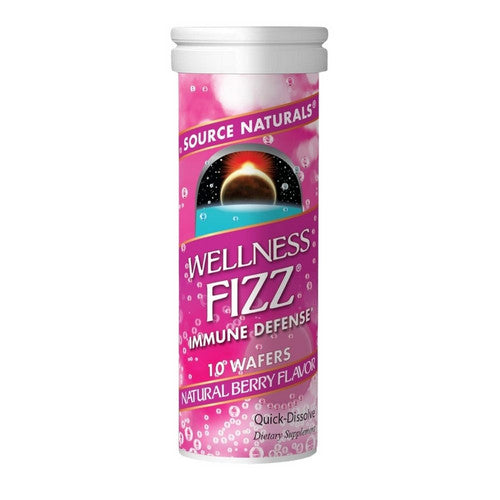
Wellness Fizz Natural Berry Flavor

At the recorded label maximum: 6 wafers per day

Add to my list
Per day$3.57

At the label maximum of 6 wafers a day.

Per pack$5.95

10 wafers · Vitacost · checked 13 Nov 2026. Delivery is not included.

Per wafer$0.60

Pack price divided by the number of wafers in the pack.

Composition

Amounts at the recorded label maximum. Directions may give a range.

Amounts not disclosed. The label gives only the total weight of this blend, not the amount of each ingredient in it. Without the individual amounts, we cannot compare these ingredients with upper limits.

At the recorded label maximum, the daily amount is 9 mg of vitamin A. This is above the US adult upper intake level of 3 mg a day for vitamin A from food and supplements. The National Academies set this scientific reference value.

At the recorded label maximum, the daily amount is 6,000 mg of vitamin C. This is above the US adult upper intake level of 2,000 mg a day for vitamin C from food and supplements. The National Academies set this scientific reference value.

At the recorded label maximum, the daily amount is 72 mg of zinc. This is above the US adult upper intake level of 40 mg a day for zinc from food and supplements. The National Academies set this scientific reference value.

Label source · Upper intake level source: vitamin A, vitamin C · Upper intake level source: zinc · Report an error

Vitamin Aas Vitamin A Palmitate
About this formretinol / retinyl esters. Reference level V0; no form is called “better” here.
9 mgat the recorded label maximum (6 wafers × 1.5 mg)1.5 mg per wafer · calculated from 1.5 mg per 1 wafer
300% ↑ of the upper intake level of 3 mg — US upper limit for adults, National Academiesfrom food and supplements, adults · food is not counted here · a reference value, not a legal limit
6,000 mgat the recorded label maximum (6 wafers × 1,000 mg)1,000 mg per wafer · calculated from 1,000 mg per 1 wafer
300% ↑ of the upper intake level of 2,000 mg — US upper limit for adults, National Academiesfrom food and supplements, adults · food is not counted here · a reference value, not a legal limit
Zincas Zinc Gluconate
About this formzinc gluconate — about 14% of the compound is zinc itself. Reference level V0; no form is called “better” here.
72 mgat the recorded label maximum (6 wafers × 12 mg) · as zinc itself12 mg per wafer · calculated from 12 mg per 1 wafer
180% ↑ of the upper intake level of 40 mg — US upper limit for adults, National Academiesfrom food and supplements, adults · food is not counted here · a reference value, not a legal limit
Vitamin Eas D-Alpha-Tocopheryl Succinate
About this formd-alpha-tocopherol (natural). 1 IU natural = 0.67 mg; synthetic 1 IU = 0.45 mg. Reference level V0; no form is called “better” here.
120 mgat the recorded label maximum (6 wafers × 20 mg)20 mg per wafer · calculated from 20 mg per 1 wafer
12% of 1,000 mg — US upper limit for adults, National Academiesvitamin E from supplements, adults · a reference value, not a legal limit
240 mcgat the recorded label maximum (6 wafers × 40 mcg)40 mcg per wafer · calculated from 40 mcg per 1 wafer
60% of 400 mcg — US upper limit for adults, National Academiesfrom food and supplements, adults · food is not counted here · a reference value, not a legal limit
1,200 mgat the recorded label maximum (6 wafers × 200 mg)200 mg per wafer · calculated from 200 mg per 1 wafer
No limit on file for the United StatesNone on file in any country
Chinese Licorice extract
Amount not disclosedpart of Yin Chiao Extract Complex · not counted
No limit on file for the United StatesNone on file in any country
Burdock extract
Amount not disclosedpart of Yin Chiao Extract Complex · not counted
No limit on file for the United StatesNone on file in any country
600 mgat the recorded label maximum (6 wafers × 100 mg)100 mg per wafer · calculated from 100 mg per 1 wafer
No limit on file for the United States
Limits in other countries (1)Czechia
Cinnamomum spp. bark ext.
90 mgat the recorded label maximum (6 wafers × 15 mg)15 mg per wafer · calculated from 15 mg per 1 wafer
No limit on file for the United StatesNone on file in any country

Where no limit is shown, none is set or on file for the United States. That is not the same as having no maximum.

Manufacturer's directions

Suggested Use: Dissolve 1 wafer in 8 ounces of warm water every 3 to 4 hours at the first sign of imbalance or before exposure to crowded environments such as offices; restaurants and airplanes. Do not exceed 4 wafers daily.

Other ingredients on the label

Sodium Bicarbonate, Sodium Carbonate, Tartaric Acid, Citric Acid, modified Cellulose Gum, Stevia leaf extract, Stearic Acid (C18:0), natural Black Cherry flavor, Black Currant, natural Raspberry flavor, natural Peach flavor, Silica

Limits in other countries
CountryVitamin AVitamin CZincVitamin E
United States3,000 mcgreference, not a law · 300% · above2,000 mgreference, not a law · 300% · above40 mgreference, not a law · 180% · above1,000 mgreference, not a law · 12%
Austria900 mcgrecommendation · 1000% · above500 mgrecommendation · 1200% · above15 mgrecommendation · 480% · above24 mgrecommendation · 500% · above
Belgium1,200 mcglaw · 750% · above1,000 mglaw · 600% · above22.5 mglaw · 320% · above39 mglaw · 308% · above
Croatia1,500 mcglaw · 600% · above800 mglaw · 750% · above15 mglaw · 480% · above200 mglaw · 60%
Cyprus2,300 mcglaw · 391% · above2,000 mglaw · 300% · above15 mglaw · 480% · above800 mglaw · 15%
Denmark—not on file1,000 mgrecommendation · 600% · above11 mgrecommendation · 655% · above291 mgrecommendation · 41%
EAEU3,000 mcglaw · 300% · above900 mglaw · 667% · above25 mglaw · 288% · above150 mglaw · 80%
Estonia3,000 mcgrecommendation · 300% · above—not on file25 mgrecommendation · 288% · above300 mgrecommendation · 40%
Finland3,000 mcgrecommendation · 300% · above—not on file25 mgrecommendation · 288% · above300 mgrecommendation · 40%
France800 mcglaw · 1125% · above180 mglaw · 3333% · above15 mglaw · 480% · above30 mglaw · 400% · above
Germany200 mcgrecommendation · 4500% · above250 mgrecommendation · 2400% · above6.5 mgrecommendation · 1108% · above30 mgrecommendation · 400% · above
Ireland3,000 mcgrecommendation · 300% · above2,000 mgrecommendation · 300% · above25 mgrecommendation · 288% · above300 mgrecommendation · 40%
Italy1,200 mcgrecommendation · 750% · above1,000 mgrecommendation · 600% · above15 mgrecommendation · 480% · above60 mgrecommendation · 200% · above
Luxembourg1,200 mcglaw · 750% · above1,000 mglaw · 600% · above15 mglaw · 480% · above18 mglaw · 667% · above
Malta1,500 mcgrecommendation · 600% · above1,000 mgrecommendation · 600% · above25 mgrecommendation · 288% · above800 IUlaw · not compared
Netherlands1,200 mcglaw · 750% · above—not on file—not on file—not on file
Norway—not on file1,000 mglaw · 600% · above14 mglaw · 514% · above250 mglaw · 48%
Poland800 mcgrecommendation · 1125% · above1,000 mgrecommendation · 600% · above15 mgrecommendation · 480% · above250 mgrecommendation · 48%
Switzerland1,360 mcglaw · 662% · above750 mglaw · 800% · above5.3 mglaw · 1358% · above205 mglaw · 59%

Maximum amounts per daily dose of a food supplement, as each country sets them; the share is the daily amount on the label against that maximum. Law = legally binding; recommendation = an authority's recommended maximum, not binding; reference = the U.S. upper intake level for adults from all sources (National Academies), not a legal limit. Verification level V0 · 2 more ingredients have limits on file · Report an error

About the ingredients

Ingredient information

Ingredient guideVitamin AVitamin A is the name for a group of fat-soluble compounds, mainly retinol and retinyl esters. Animal foods contain it as preformed vitamin A; plants contain carotenoids, some of which the body converts into it. Supplements contain retinyl acetate, retinyl palmitate, beta-carotene or a combination. Amounts are given in mcg RAE; older labels used IU.Read moreShow less
Terms and sources
fat-soluble
They dissolve in fat, not in water. NIH Office of Dietary Supplements.
carotenoids
Provitamin A carotenoids: beta-carotene, alpha-carotene and beta-cryptoxanthin. NIH Office of Dietary Supplements.
mcg RAE
Micrograms of retinol activity equivalents. The unit counts how much retinol each form gives the body.

Vitamin A in the body

Vitamin A is part of rhodopsin, the protein in the retina that responds to light. It is needed for normal vision. It is also involved in immune function, cell communication, growth and development, and reproduction.

Terms and sources
rhodopsin
The light-sensitive pigment of the eye's rod cells, which see in dim light. NIH Office of Dietary Supplements; Linus Pauling Institute.
normal vision
NIH Office of Dietary Supplements. It is also needed for the normal surface of the eye.
cell communication
NIH Office of Dietary Supplements. Vitamin A takes part in the growth and specialization of cells.

The body turns retinol into retinal and retinoic acid, the two main active forms. Most of the body's vitamin A is stored in the liver as retinyl esters. Blood retinol levels stay steady until the stores in the liver are almost used up.

Terms and sources
retinoic acid
It switches genes on and off; Linus Pauling Institute counts more than 500 genes that respond to it.
retinyl esters
Retinol joined to a fatty acid, such as retinyl palmitate. NIH Office of Dietary Supplements.
stay steady
NIH Office of Dietary Supplements. So a blood test is not always a reliable guide to the stores. See Green 2016 below: normal blood retinol with low stores.

Plants make hundreds of carotenoids; only about 10% of them can be converted to retinol. The body converts beta-carotene into vitamin A in the gut, through an enzyme. Lutein, zeaxanthin and lycopene are carotenoids that the body does not convert into vitamin A.

Terms and sources
about 10%
Linus Pauling Institute.
an enzyme
Beta-carotene monooxygenase type 1 (BCMO1). Conversion rates may vary with genes. NIH Office of Dietary Supplements.
does not convert
NIH Office of Dietary Supplements calls them non-provitamin A carotenoids.

Information, not a prescription. Do not start, stop or combine supplements or medicines on your own.

Ingredient guideVitamin CVitamin C, also called L-ascorbic acid, is a water-soluble vitamin. Most animals make vitamin C in the body; humans cannot and get it from food. Fruits and vegetables such as peppers, citrus fruits and kiwifruit are the main sources. Supplements contain it as ascorbic acid or as mineral salts such as sodium and calcium ascorbate.Read moreShow less
Terms and sources
water-soluble
It dissolves in water, not in fat. NIH Office of Dietary Supplements.

Vitamin C in the body

Vitamin C is needed to make collagen, carnitine and some neurotransmitters. It is also an antioxidant and can return used vitamin E to its active form. It is needed for normal immune function. It increases the absorption of iron from plant foods.

Terms and sources
collagen
A protein that holds together connective tissue, such as skin, tendons and blood vessels. NIH Office of Dietary Supplements.
carnitine
A substance cells need to get energy from fat. Linus Pauling Institute.
neurotransmitters
Chemical messengers between nerve cells.
antioxidant
A substance that limits damage from free radicals, reactive molecules made in cells.
iron from plant foods
Nonheme iron, the only form of iron in plant foods. NIH Office of Dietary Supplements.

An adult body holds from about 300 mg to about 2 g of vitamin C. White blood cells, the eyes, the adrenal and pituitary glands and the brain hold the most. Cells hold vitamin C in millimolar concentrations, blood plasma in micromolar concentrations. At 100 mg a day or more, cells appear to be saturated.

Terms and sources
about 300 mg
The lower figure is for very low intake. NIH Office of Dietary Supplements.
adrenal and pituitary glands
Small glands that make hormones: the adrenals sit above the kidneys, the pituitary below the brain.
millimolar
Thousandths of a mole per liter; micromolar means millionths. NIH Office of Dietary Supplements.
saturated
Holding as much as they take up. Above 200 mg a day, blood plasma levels rise little more.

The body absorbs about 70–90% of vitamin C at 30–180 mg a day. Above 1 g a day, less than 50% is absorbed, and unused vitamin C leaves in urine.

Terms and sources
less than 50%
Summary by the NIH Office of Dietary Supplements. Absorption in the gut runs through a dose-dependent transporter protein.

Information, not a prescription. Do not start, stop or combine supplements or medicines on your own.

Ingredient guideZincZinc is an essential mineral that the body needs for the work of hundreds of enzymes. An adult body holds about 1.5–2.5 g of it. Supplements contain zinc as part of a compound, such as zinc citrate, oxide or gluconate. Three things are easy to confuse: the label number, the recommended amounts, and what the forms do. This article sorts them out.Read moreShow less

What zinc does

Zinc-dependent enzymes are found in all six classes of enzymes, the proteins that speed up chemical reactions in cells. By one estimate, more than 3,000 human proteins have sites that bind zinc. In some of them, zinc holds a fold called a zinc finger in shape. Zinc fingers let some proteins bind DNA and switch genes on or off. Zinc also takes part in immune function, protein and DNA synthesis, cell division and the sense of taste.

Most of the body's zinc is in skeletal muscle and bone. As intake rises, the body absorbs more zinc, but a smaller share of it.

Information, not a prescription. Do not start, stop or combine supplements or medicines on your own.

Ingredient guideVitamin EVitamin E is the name for eight fat-soluble compounds: four tocopherols and four tocotrienols. Alpha-tocopherol is the only form recognized to meet human needs. Supplements contain natural (d-) or synthetic (dl-) alpha-tocopherol, often as an ester. Three things are easy to confuse: the two forms, label units and what the upper limit counts. This article sorts them out.Read moreShow less

What vitamin E does

Vitamin E is an antioxidant that works in cell membranes. There, free radicals damage fats, and each damaged fat can damage the next. Alpha-tocopherol stops this chain reaction. Vitamin C can return used vitamin E to its active form. Vitamin E is also involved in immune function; studies in cells show roles in cell signaling.

After absorption, the liver sends alpha-tocopherol back into the blood with the alpha-tocopherol transfer protein. The liver breaks down the other forms, so blood and cells hold less of them.

In one study with labeled vitamin E, healthy women absorbed about 55% of a dose taken with a liquid meal. Vitamin E takes 9–12 hours to pass from a meal into the blood, carried in fat particles. The liver replaces the whole pool of alpha-tocopherol in blood plasma every day.

Information, not a prescription. Do not start, stop or combine supplements or medicines on your own.

Ingredient guideSeleniumSelenium is an essential mineral that the body builds into about 25 proteins called selenoproteins. Brazil nuts, seafood, meat and poultry are rich food sources, and plant foods vary with the soil. Supplements contain it as selenomethionine, selenium yeast, sodium selenite, sodium selenate or other forms.Read moreShow less
Terms and sources
selenoproteins
In these proteins, selenium sits inside the amino acid selenocysteine. NIH Office of Dietary Supplements; Linus Pauling Institute.
selenium yeast
Yeast grown in a high-selenium medium; it holds selenium mainly as selenomethionine. NIH Office of Dietary Supplements.

Selenium in the body

Selenoproteins include glutathione peroxidases, thioredoxin reductases and selenoprotein P. Their roles include thyroid hormone metabolism, DNA synthesis, reproduction and protection from oxidative damage. The thyroid gland holds more selenium for its size than any other organ. Selenoprotein P, made mainly in the liver, carries selenium to other tissues.

Terms and sources
glutathione peroxidases
Enzymes that break down hydrogen peroxide and fat peroxides. Linus Pauling Institute.
thyroid hormone metabolism
NIH Office of Dietary Supplements.
more selenium for its size
NIH: "Selenium concentration is higher in the thyroid gland than in any other organ in the body…"
carries selenium
Linus Pauling Institute.

About 28% to 46% of the body's selenium is in skeletal muscle. The body keeps its selenium steady mainly through the urine. Selenomethionine can also be built into ordinary body proteins in place of the amino acid methionine. Blood selenium of 8 mcg/dL or more is usually considered sufficient in healthy people. Research suggests that selenoprotein P and glutathione peroxidase rise with supplements only when selenium status is low, NIH notes.

Terms and sources
28% to 46%
NIH Office of Dietary Supplements.
through the urine
At higher intakes, selenium also leaves through the lungs and in stool. NIH Office of Dietary Supplements.
in place of the amino acid methionine
Only proteins with selenocysteine count as selenoproteins. Linus Pauling Institute.
8 mcg/dL
Plasma or serum selenium. Hair and nail selenium show intake over months or years. NIH Office of Dietary Supplements.
NIH notes
NIH Office of Dietary Supplements.

NIH notes: "Selenosis is the result of chronically high intakes of selenium. It is most commonly characterized by hair loss and nail brittleness or loss, but other signs and symptoms can include a garlic odor in the breath, a metallic taste in the mouth, skin rash, nausea, diarrhea, fatigue, irritability, and nervous system abnormalities. The Tolerable Upper Intake Level for selenium is 400 mcg for adults, and it ranges from 45 mcg to 400 mcg for infants, children, and adolescents, depending on age."

Terms and sources
NIH notes
NIH Office of Dietary Supplements, Selenium fact sheet for health professionals, section on health risks from excessive selenium. The opening paragraph.

NIH continues: "Chronically high intakes of the organic and inorganic forms of selenium have similar effects. Early indicators of excess intake are a garlic odor in the breath and a metallic taste in the mouth. The most common clinical signs of chronically high selenium intakes, or selenosis, are hair loss and nail brittleness or loss. Other signs and symptoms include skin rash, nausea, diarrhea, fatigue, irritability, and nervous system abnormalities."

Terms and sources
NIH continues
The next paragraph of the same NIH section.

It continues: "As discussed earlier, Brazil nuts contain very high amounts of selenium (68–91 mcg per nut) and could cause selenium toxicity if consumed regularly. Acute selenium toxicity has resulted from the ingestion of misformulated over-the-counter products that contain very large amounts of selenium. In 2008, for example, 201 people experienced severe adverse reactions from taking a liquid dietary supplement that contained 200 times the labeled amount of selenium. Acute selenium toxicity can cause severe gastrointestinal and neurological symptoms; acute respiratory distress syndrome; myocardial infarction; hair loss; muscle tenderness; tremors; lightheadedness; facial flushing; kidney failure; cardiac failure; and, in rare cases, death."

Terms and sources
It continues
The next paragraph of the same NIH section.

NIH also describes a subgroup result from SELECT, a large trial of 200 mcg a day in men. NIH notes: "Further investigation in a case-cohort of 1,739 men with prostate cancer and 3,117 matched controls from the SELECT trial found that selenium supplementation did not affect prostate cancer risk in men with low baseline selenium status (based on toenail selenium levels). However, the researchers did find an increased risk of high-grade prostate cancer in men with higher baseline selenium status (≥60th percentile of toenail selenium) and recommended that men over age 55 avoid selenium supplementation at doses that exceed recommended dietary intakes."

Terms and sources
subgroup result from SELECT
NIH Office of Dietary Supplements, Selenium fact sheet for health professionals, section on selenium and health.

Information, not a prescription. Do not start, stop or combine supplements or medicines on your own.

Ingredient guideElderberryElderberry is the dark purple berry of the European or black elder tree, Sambucus nigra. The tree grows in Europe, North America, Western Asia and North Africa. Supplements contain the berry as juice concentrate, powder or extract. Some extracts are standardized to anthocyanins, the berry's purple pigments.Read moreShow less
Terms and sources
dark purple berry
NCCIH, Elderberry: Usefulness and Safety.
grows in Europe
NCCIH, Elderberry: Usefulness and Safety.
anthocyanins
Given as cyanidin glycosides in one trial report below. Curtis et al., 2009.

Elderberry in the body

Elderberry is not a nutrient, and the body has no daily requirement for it. Trials below in adults without a diagnosis measured blood fats, sugar and insulin.

In one 12-week trial, anthocyanins did not build up in blood with daily intake. Mela et al. write that gut enzymes, mainly lactase-phloridzin hydrolase, convert such pigments to their aglycone forms.

Terms and sources
In one 12-week trial
The abstract states: “We observed no plasma accumulation of anthocyanins.” Curtis et al., Journal of Nutrition, 2009, below.
lactase-phloridzin hydrolase
The enzyme that also digests milk sugar. Mela et al., Nutrition and Metabolism, 2020, a trial report below.

Information, not a prescription. Do not start, stop or combine supplements or medicines on your own.

Ingredient guideEchinaceaEchinacea is a group of flowering plants closely related to sunflowers, daisies and ragweed, also called purple coneflower. The plants are native to areas east of the Rocky Mountains in the United States. Supplements use three species: Echinacea purpurea, E. angustifolia and E. pallida. The parts used are the root, the flower and the herb.Read moreShow less
Terms and sources
closely related to sunflowers, daisies and ragweed
NCCIH, Echinacea: Usefulness and Safety.
purple coneflower
NCCIH lists the common names echinacea, purple coneflower, coneflower and American coneflower. NCCIH, Echinacea: Usefulness and Safety.
east of the Rocky Mountains
NCCIH, Echinacea: Usefulness and Safety.
three species
The Latin names NCCIH lists. NCCIH, Echinacea: Usefulness and Safety.
the root, the flower and the herb
flos, herba, radix: the parts Italy's plant list names for each species. Italian Ministry of Health, 2018.

Echinacea in the body

Echinacea is not a nutrient, and the body has no daily requirement for it. Trials below in adults without a diagnosis measured white blood cell activity and red blood cell markers.

Information, not a prescription. Do not start, stop or combine supplements or medicines on your own.

Services

Choose the option that suits you.

Quick selection

I know my goal

$5

1–2 minutes · a few questions with fixed answers

One goal. Up to three products. Set a budget per day if you like.

Product checks
form and amount on the label, plus shop prices
Daily schedule
what to take, when, how much
Totals and limits
next to the upper limit
Reasons & sources
for each product
Prices and shops
plus food and habits
Progress
what to track, when to see a doctor

Complete the questionnaire before you pay. If no product fits any of your goals, you won’t be charged.

Order · $5View example

Full selection

I have several goals

$15

5–7 minutes · questionnaire with fixed answers

Up to three goals in one set. Where two goals overlap, one product is used for both.

Product checks
form and amount on the label, plus shop prices
Daily schedule
what to take, when, how much
Totals and limits
next to the upper limit
Reasons & sources
for each product
Prices and shops
plus food and habits
Progress
what to track, when to see a doctor

Complete the questionnaire before you pay. If no product fits any of your goals, you won’t be charged.

Order · $15View example

Expert review

I want a person to look at my supplements

$50

Written review within 48 hours of your completed questionnaire

An expert reviews your supplement list and questionnaire.

Written review
duplicates, limits, forms
Detailed questionnaire
supplements, medicines, history
Optional uploads
supplement-label photos or documents relevant to your review
Your notes
your priorities and questions
Follow-up questions
in writing, when needed
Next steps
points to discuss with your doctor

Complete the questionnaire before you pay.

Order · $50View example
Sources, label & certificates

Label record

Copied from the NIH label database (DSLD 273815) · not yet compared with the label · checked 19 Oct 2026 · Report an error

The United States has no pre-market registration for supplements.
Label on file in the NIH Dietary Supplement Label Database
checked 19 Oct 2026source: NIH DSLDReport an error

Barcode 0 21078 02051 6

Third-party certificates

No third-party certificate on file for this product.

Information, not a prescription. Do not start, stop or combine supplements or medicines on your own. If you have a health condition, are pregnant or breastfeeding, take medicines, or are under 18, talk to a doctor or pharmacist first.

Photo credits

Image: © Source Naturals. Shown to identify the product. Source:

Rights holders can ask us to remove an image or send official product photos: info@verateca.com.

Product photo

Source Naturals Wellness Fizz Natural Berry Flavor — enlarged pack