Source Naturals Wellness · liquid

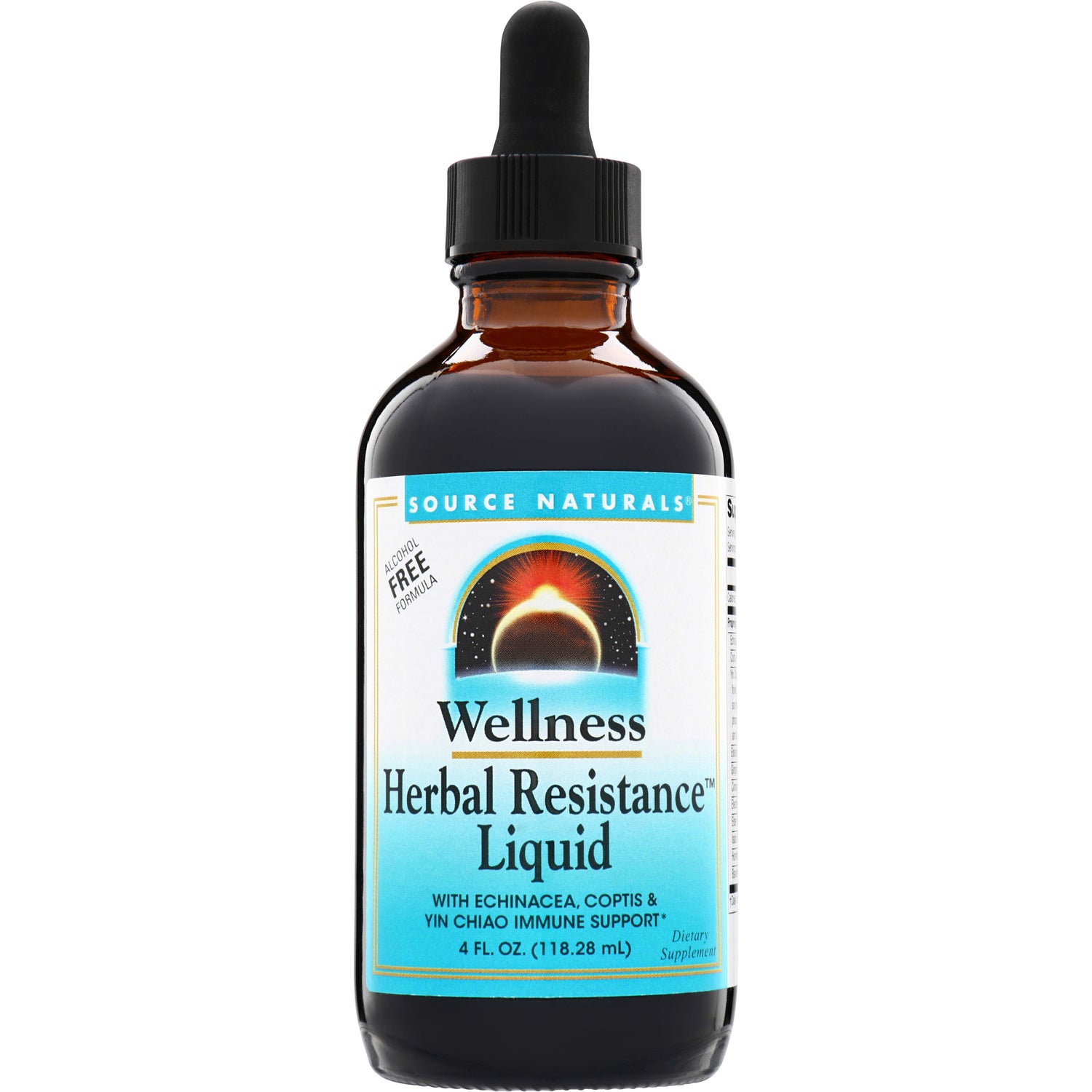
Wellness Herbal Resistance Liquid

At the recorded label maximum: 3 servings (2.5 mL [1/2 teaspoon] each) per day

Add to my list
Per day$1.24

At the label maximum of 3 servings a day.

Per pack$19.59

4 fl. oz.; 118.28 mL · Vitacost · checked 13 Nov 2026. Delivery is not included.

Per serving$0.41

Pack price divided by the number of servings in the pack.

Composition

Amounts at the recorded label maximum. Directions may give a range.

Amounts not disclosed. The label gives only the total weight of this blend, not the amount of each ingredient in it. Without the individual amounts, we cannot compare these ingredients with upper limits.

Amount not disclosedpart of Proprietary Extract Blend · not counted
No limit on file for the United States
Limits in other countries (1)Czechia
Peppermint
Amount not disclosedpart of Proprietary Extract Blend · not counted
No limit on file for the United StatesNone on file in any country
Licorice
Amount not disclosedpart of Proprietary Extract Blend · not counted
No limit on file for the United StatesNone on file in any country
Burdock
Amount not disclosedpart of Proprietary Extract Blend · not counted
No limit on file for the United StatesNone on file in any country
Bamboo
Amount not disclosedpart of Proprietary Extract Blend · not counted
No limit on file for the United StatesNone on file in any country
Amount not disclosedpart of Proprietary Extract Blend · not counted
No limit on file for the United StatesNone on file in any country
Amount not disclosedpart of Proprietary Extract Blend · not counted
No limit on file for the United StatesNone on file in any country
Cinnamomum spp.
Amount not disclosedpart of Proprietary Extract Blend · not counted
No limit on file for the United StatesNone on file in any country
Eleuthero
Amount not disclosedpart of Proprietary Extract Blend · not counted
No limit on file for the United StatesNone on file in any country

Manufacturer's directions

Suggested Use: 1/2 teaspoon three times daily (1/2 teaspoon is approximately 45 drops). Shake well before using.

Other ingredients on the label

Vegetable Glycerin, deionized Water, Honey, Peppermint essential Oil, Potassium Benzoate, Potassium Sorbate, Citric Acid

Limits in other countries
CountryEchinacea (E. purpurea and E. angustifolia) root
Czechia500 mglaw · not compared

Maximum amounts per daily dose of a food supplement, as each country sets them; the share is the daily amount on the label against that maximum. Law = legally binding; recommendation = an authority's recommended maximum, not binding; reference = the U.S. upper intake level for adults from all sources (National Academies), not a legal limit. Verification level V0 · Report an error

About the ingredients

Ingredient information

Ingredient guideEchinaceaEchinacea is a group of flowering plants closely related to sunflowers, daisies and ragweed, also called purple coneflower. The plants are native to areas east of the Rocky Mountains in the United States. Supplements use three species: Echinacea purpurea, E. angustifolia and E. pallida. The parts used are the root, the flower and the herb.Read moreShow less
Terms and sources
closely related to sunflowers, daisies and ragweed
NCCIH, Echinacea: Usefulness and Safety.
purple coneflower
NCCIH lists the common names echinacea, purple coneflower, coneflower and American coneflower. NCCIH, Echinacea: Usefulness and Safety.
east of the Rocky Mountains
NCCIH, Echinacea: Usefulness and Safety.
three species
The Latin names NCCIH lists. NCCIH, Echinacea: Usefulness and Safety.
the root, the flower and the herb
flos, herba, radix: the parts Italy's plant list names for each species. Italian Ministry of Health, 2018.

Echinacea in the body

Echinacea is not a nutrient, and the body has no daily requirement for it. Trials below in adults without a diagnosis measured white blood cell activity and red blood cell markers.

Information, not a prescription. Do not start, stop or combine supplements or medicines on your own.
Ingredient guideElderberryElderberry is the dark purple berry of the European or black elder tree, Sambucus nigra. The tree grows in Europe, North America, Western Asia and North Africa. Supplements contain the berry as juice concentrate, powder or extract. Some extracts are standardized to anthocyanins, the berry's purple pigments.Read moreShow less
Terms and sources
dark purple berry
NCCIH, Elderberry: Usefulness and Safety.
grows in Europe
NCCIH, Elderberry: Usefulness and Safety.
anthocyanins
Given as cyanidin glycosides in one trial report below. Curtis et al., 2009.

Elderberry in the body

Elderberry is not a nutrient, and the body has no daily requirement for it. Trials below in adults without a diagnosis measured blood fats, sugar and insulin.

In one 12-week trial, anthocyanins did not build up in blood with daily intake. Mela et al. write that gut enzymes, mainly lactase-phloridzin hydrolase, convert such pigments to their aglycone forms.

Terms and sources
In one 12-week trial
The abstract states: “We observed no plasma accumulation of anthocyanins.” Curtis et al., Journal of Nutrition, 2009, below.
lactase-phloridzin hydrolase
The enzyme that also digests milk sugar. Mela et al., Nutrition and Metabolism, 2020, a trial report below.

Information, not a prescription. Do not start, stop or combine supplements or medicines on your own.

Ingredient guideGingerGinger is the underground stem, or rhizome, of the plant Zingiber officinale. The plant is native to the warm parts of Asia. Its rhizome is used in food and in supplements. Supplements contain ginger as root powder in capsules, extracts, liquid extracts, tea, lozenges and chews.Read moreShow less
Terms and sources
rhizome
NCCIH calls the rhizome an underground stem. NCCIH, Ginger: Usefulness and Safety.
warm parts of Asia
NCCIH, Ginger: Usefulness and Safety.

Ginger in the body

Ginger is not a nutrient, and the body has no daily requirement for it. Trials in adults without a diagnosis measure things such as muscle soreness after exercise and stomach emptying.

Ginger root holds about 1–3% volatile oils and a group of pungent compounds. In fresh root, the most abundant pungent compounds are gingerols, mainly 6-gingerol. Shogaols, a dehydrated form of gingerols, are found mainly in dried and heat-treated root. Extract makers state gingerols, sometimes with shogaols, to standardize their extracts.

Terms and sources
pungent compounds
Mainly gingerols and shogaols. Zick et al., 2008.
a dehydrated form
Fresh root holds only small amounts of shogaols. Zick et al., 2008.
standardize
To keep the amount of chosen compounds the same from batch to batch. In one study, an extract standardized to 5% gingerols held 2.15% 6-gingerol by HPLC. Zick et al., 2008.

In 27 healthy adults, one dose of up to 2 g of extract left no free gingerols in blood. They appeared in blood in bound forms, mostly glucuronides, from 30 minutes after the dose. These bound forms could no longer be detected in blood by 4 hours in all but one person. Side effects in that study were all graded mild, mainly burping, a burning feeling in the chest and stomach upset.

Terms and sources
27 healthy adults
Single doses from 100 mg to 2 g of an extract with 5% gingerols. Each new group got a higher dose; there was no comparison group. Zick et al., 2008.
glucuronides
Gingerols and shogaols joined to glucuronic acid. A smaller part was bound to sulfate. Zick et al., 2008.
all but one person
One person on 2 g still had bound 6-gingerol at 8 hours. Zick et al., 2008.
graded mild
No side effect was above grade 1 on a standard toxicity scale. Zick et al., 2008.

NCCIH notes: “Ginger has been used safely in many research studies where it was taken orally (by mouth) as a dietary supplement.” It adds: “Ginger products may also be safe for topical use.” NCCIH lists side effects: “Ginger can have side effects such as abdominal discomfort, heartburn, diarrhea, and mouth and throat irritation when taken orally.” NCCIH advises: “If you take any type of medicine, talk with your health care provider before using ginger or any other herbal products; some herbs and medicines interact in harmful ways.” NCCIH also writes: “The use of ginger dietary supplements during pregnancy may be safe.” It continues: “As with all herbal supplements, if you’re considering using ginger while pregnant, consult your health care provider.” NCCIH adds: “Little is known about whether it’s safe to use ginger while breastfeeding.”

Terms and sources
NCCIH notes
NCCIH, Ginger: Usefulness and Safety.

In the cycling trial below, at most 2 of 30 cyclists reported gas, burping or fullness with either drink. In the 2-week powder trial below, no moderate or severe side effects were reported.

Terms and sources
at most 2 of 30 cyclists
Weekly 16-item questionnaire on stomach and gut symptoms. Kurtz et al., Sports, 2026.
no moderate or severe side effects
Crichton et al., Journal of Nutrition, 2023.

Information, not a prescription. Do not start, stop or combine supplements or medicines on your own.

Services

Choose the option that suits you.

Quick selection

I know my goal

$5

1–2 minutes · a few questions with fixed answers

One goal. Up to three products. Set a budget per day if you like.

Product checks
form and amount on the label, plus shop prices
Daily schedule
what to take, when, how much
Totals and limits
next to the upper limit
Reasons & sources
for each product
Prices and shops
plus food and habits
Progress
what to track, when to see a doctor

Complete the questionnaire before you pay. If no product fits any of your goals, you won’t be charged.

Order · $5View example

Full selection

I have several goals

$15

5–7 minutes · questionnaire with fixed answers

Up to three goals in one set. Where two goals overlap, one product is used for both.

Product checks
form and amount on the label, plus shop prices
Daily schedule
what to take, when, how much
Totals and limits
next to the upper limit
Reasons & sources
for each product
Prices and shops
plus food and habits
Progress
what to track, when to see a doctor

Complete the questionnaire before you pay. If no product fits any of your goals, you won’t be charged.

Order · $15View example

Expert review

I want a person to look at my supplements

$50

Written review within 48 hours of your completed questionnaire

An expert reviews your supplement list and questionnaire.

Written review
duplicates, limits, forms
Detailed questionnaire
supplements, medicines, history
Optional uploads
supplement-label photos or documents relevant to your review
Your notes
your priorities and questions
Follow-up questions
in writing, when needed
Next steps
points to discuss with your doctor

Complete the questionnaire before you pay.

Order · $50View example
Sources, label & certificates

Label record

Copied from the NIH label database (DSLD 274111) · not yet compared with the label · checked 19 Oct 2026 · Report an error

The United States has no pre-market registration for supplements.
Label on file in the NIH Dietary Supplement Label Database
checked 19 Oct 2026source: NIH DSLDReport an error

Barcode 0 21078 01162 0

Third-party certificates

No third-party certificate on file for this product.

Information, not a prescription. Do not start, stop or combine supplements or medicines on your own. If you have a health condition, are pregnant or breastfeeding, take medicines, or are under 18, talk to a doctor or pharmacist first.

Photo credits

Image: © Source Naturals Wellness. Shown to identify the product. Source:

Rights holders can ask us to remove an image or send official product photos: info@verateca.com.

Product photo

Source Naturals Wellness Wellness Herbal Resistance Liquid — enlarged pack