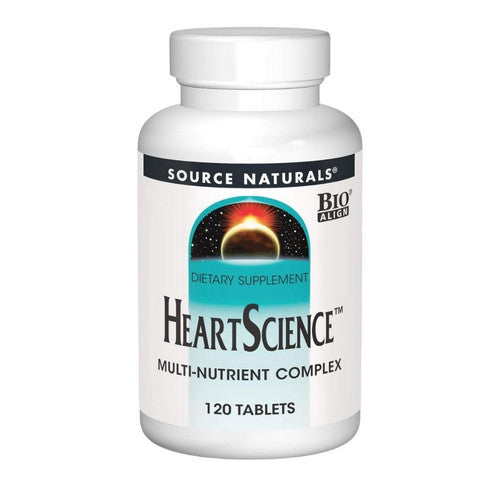
Source Naturals · tablets

Heart Science

At the recorded label maximum: 6 tablets per day

Add to my list
Per day$1.22 – $2.45

For 3 to 6 tablets a day as stated on the label.

Per pack$48.96

120 tablets · Vitacost · checked 13 Nov 2026. Delivery is not included.

Per tablet$0.41

Pack price divided by the number of tablets in the pack.

Composition

Amounts at the recorded label maximum. Directions may give a range.

At the recorded label maximum, the daily amount is 1,000 mg of nicotinic acid. This is above the US adult upper intake level of 35 mg a day for nicotinic acid from supplements. The National Academies set this scientific reference value.

At the recorded label maximum, the daily amount is 1.6 mg of folate. This is above the US adult upper intake level of 1 mg a day for folate from supplements. The National Academies set this scientific reference value.

At the recorded label maximum, the daily amount is 600 mg of magnesium. This is above the US adult upper intake level of 350 mg a day for magnesium from supplements and medicines. The National Academies set this scientific reference value.

The U.S. adult upper limit of 350 mg/day for magnesium from supplements and medications is based on studies of diarrhea.

Label source · Upper intake level source: nicotinic acid, folate · Upper intake level source: magnesium · Report an error

Vitamin Aas Beta-Carotene
About this formbeta-carotene (provitamin A). Converted to vitamin A only as needed; not comparable with retinol by dose. Reference level V0; no form is called “better” here.
15 mgat the recorded label maximum (2 servings × 7.5 mg; 3 tablets per serving)2.5 mg per tablet · calculated from 7.5 mg per 3 tablets
Not compared with 3 mg — US upper limit for adults, National Academiesthe limit counts retinol only · a reference value, not a legal limit
2,000 mgat the recorded label maximum (2 servings × 1,000 mg; 3 tablets per serving)333.333333333333 mg per tablet · calculated from 1,000 mg per 3 tablets
100% of 2,000 mg — US upper limit for adults, National Academiesfrom food and supplements, adults · food is not counted here · a reference value, not a legal limit
Vitamin Eas D-Alpha-Tocopheryl Succinate | Gamma-Vitamin E Complex
About this formd-alpha-tocopherol (natural). 1 IU natural = 0.67 mg; synthetic 1 IU = 0.45 mg. Reference level V0; no form is called “better” here.
536 mgat the recorded label maximum (2 servings × 268 mg; 3 tablets per serving)89.3333333333333 mg per tablet · calculated from 268 mg per 3 tablets
54% of 1,000 mg — US upper limit for adults, National Academiesvitamin E from supplements, adults · a reference value, not a legal limit
Thiamineas Vitamin B1
100 mgat the recorded label maximum (2 servings × 50 mg; 3 tablets per serving)16.6666666666667 mg per tablet · calculated from 50 mg per 3 tablets
No US upper limitNational Academies: not determined — too little data on harm
Limits in other countries (8)Austria, Croatia, Cyprus, Eurasian Economic Union (EAEU), France, Italy, Malta, Poland
1,000 mgat the recorded label maximum (2 servings × 500 mg; 3 tablets per serving)166.666666666667 mg per tablet · calculated from 500 mg per 3 tablets
2857% ↑ of the upper intake level of 35 mg — US upper limit for adults, National Academiesnicotinic acid from supplements, adults · a reference value, not a legal limit
100 mgat the recorded label maximum (2 servings × 50 mg; 3 tablets per serving)16.6666666666667 mg per tablet · calculated from 50 mg per 3 tablets
100% of 100 mg — US upper limit for adults, National Academiesfrom food and supplements, adults · food is not counted here · a reference value, not a legal limit
Folateas Folic Acid
About this formfolic acid. Reference level V0; no form is called “better” here.
1.6 mgat the recorded label maximum (2 servings × 800 mcg; 3 tablets per serving)266.666666666667 mcg per tablet · calculated from 800 mcg per 3 tablets
160% ↑ of the upper intake level of 1 mg — US upper limit for adults, National Academiesfolate from supplements, adults · a reference value, not a legal limit
1 mgat the recorded label maximum (2 servings × 500 mcg; 3 tablets per serving)166.666666666667 mcg per tablet · calculated from 500 mcg per 3 tablets
No US upper limitNational Academies: not determined — too little data on harm
Limits in other countries (9)Austria, Croatia, Cyprus, Eurasian Economic Union (EAEU), France, Germany, Italy, Malta, Poland
Magnesiumas Magnesium Oxide
About this formmagnesium oxide — about 60% of the compound is magnesium itself. Most magnesium per gram, cheapest, less well absorbed. Reference level V0; no form is called “better” here.
600 mgat the recorded label maximum (2 servings × 300 mg; 3 tablets per serving) · as magnesium itself100 mg per tablet · calculated from 300 mg per 3 tablets
171% ↑ of the upper intake level of 350 mg — US upper limit for adults, National Academiesmagnesium from supplements, adults · a reference value, not a legal limit
400 mcgat the recorded label maximum (2 servings × 200 mcg; 3 tablets per serving)66.6666666666667 mcg per tablet · calculated from 200 mcg per 3 tablets
100% of 400 mcg — US upper limit for adults, National Academiesfrom food and supplements, adults · food is not counted here · a reference value, not a legal limit
1.5 mgat the recorded label maximum (2 servings × 750 mcg; 3 tablets per serving)250 mcg per tablet · calculated from 750 mcg per 3 tablets
15% of 10 mg — US upper limit for adults, National Academiesfrom food and supplements, adults · food is not counted here · a reference value, not a legal limit
Chromium
600 mcgat the recorded label maximum (2 servings × 300 mcg; 3 tablets per serving)
No US upper limitNational Academies: not determined — too little data on harm
Limits in other countries (13)Austria, Belgium, Croatia, Cyprus, Denmark, Eurasian Economic Union (EAEU), France, Germany, Italy, Luxembourg, Malta, Poland, Switzerland
Chromium Picolinate
300 mcgat the recorded label maximum (2 servings × 150 mcg; 3 tablets per serving)
No US upper limitNational Academies: not determined — too little data on harm
Limits in other countries (13)Austria, Belgium, Croatia, Cyprus, Denmark, Eurasian Economic Union (EAEU), France, Germany, Italy, Luxembourg, Malta, Poland, Switzerland
Potassiumas Potassium Citrate
198 mgat the recorded label maximum (2 servings × 99 mg; 3 tablets per serving)33 mg per tablet · calculated from 99 mg per 3 tablets
No US upper limitNational Academies: not determined — too little data on harm
Limits in other countries (11)Austria, Belgium, Croatia, Denmark, Eurasian Economic Union (EAEU), France, Germany, Luxembourg, Malta, Poland, Switzerland
L-Arginine HCl
1,000 mgat the recorded label maximum (2 servings × 500 mg; 3 tablets per serving)166.666666666667 mg per tablet · calculated from 500 mg per 3 tablets
No limit on file for the United StatesNone on file in any country
Bromelain
1,000 mgat the recorded label maximum (2 servings × 500 mg; 3 tablets per serving)166.666666666667 mg per tablet · calculated from 500 mg per 3 tablets
No limit on file for the United StatesNone on file in any country
1,000 mgat the recorded label maximum (2 servings × 500 mg; 3 tablets per serving)166.666666666667 mg per tablet · calculated from 500 mg per 3 tablets
No limit on file for the United States
Limits in other countries (3)Croatia, Czechia, Switzerland
L-Carnitine Fumarate
800 mgat the recorded label maximum (2 servings × 400 mg; 3 tablets per serving)133.333333333333 mg per tablet · calculated from 400 mg per 3 tablets
No limit on file for the United StatesNone on file in any country
800 mgat the recorded label maximum (2 servings × 400 mg; 3 tablets per serving)133.333333333333 mg per tablet · calculated from 400 mg per 3 tablets
No limit on file for the United StatesNone on file in any country
L-Proline
800 mgat the recorded label maximum (2 servings × 400 mg; 3 tablets per serving)133.333333333333 mg per tablet · calculated from 400 mg per 3 tablets
No limit on file for the United StatesNone on file in any country
Hawthorn berry extract
400 mgat the recorded label maximum (2 servings × 200 mg; 3 tablets per serving)
No limit on file for the United StatesNone on file in any country
Hawthorn Extractas Hawthorn Flower Extract | Hawthorn leaf extract
400 mgat the recorded label maximum (2 servings × 200 mg; 3 tablets per serving)
No limit on file for the United StatesNone on file in any country
Inositolas Inositol Hexanicotinate
280 mgat the recorded label maximum (2 servings × 140 mg; 3 tablets per serving)46.6666666666667 mg per tablet · calculated from 140 mg per 3 tablets
No limit on file for the United States
Limits in other countries (3)Croatia, Eurasian Economic Union (EAEU), Switzerland
N-Acetyl Glucosamine
About this formN-acetyl glucosamine. Reference level V0; no form is called “better” here.
200 mgat the recorded label maximum (2 servings × 100 mg; 3 tablets per serving)33.3333333333333 mg per tablet · calculated from 100 mg per 3 tablets
No limit on file for the United States
Limits in other countries (2)Croatia, Switzerland
Turmeric Rhizome Extractas Curcuminoids
About this formturmeric extract standardized (curcuminoids). Reference level V0; no form is called “better” here.
200 mgat the recorded label maximum (2 servings × 100 mg; 3 tablets per serving)33.3333333333333 mg per tablet · calculated from 100 mg per 3 tablets
No limit on file for the United StatesNone on file in any country
Soybean Isoflavone Concentrate
200 mgat the recorded label maximum (2 servings × 100 mg; 3 tablets per serving)
No limit on file for the United StatesNone on file in any country
Total Isoflavones
80 mgat the recorded label maximum (2 servings × 40 mg; 3 tablets per serving)
No limit on file for the United StatesNone on file in any country
Trimethylglycine
200 mgat the recorded label maximum (2 servings × 100 mg; 3 tablets per serving)33.3333333333333 mg per tablet · calculated from 100 mg per 3 tablets
No limit on file for the United States
Limits in other countries (3)Croatia, France, Switzerland
Horsetail aerial parts extractas Silica
200 mgat the recorded label maximum (2 servings × 100 mg; 3 tablets per serving)33.3333333333333 mg per tablet · calculated from 100 mg per 3 tablets
No limit on file for the United StatesNone on file in any country
Coenzyme Q10
About this formubiquinone. Reference level V0; no form is called “better” here.
120 mgat the recorded label maximum (2 servings × 60 mg; 3 tablets per serving)20 mg per tablet · calculated from 60 mg per 3 tablets
No limit on file for the United States
Limits in other countries (1)Eurasian Economic Union (EAEU)
Garlicas Allicin
120 mgat the recorded label maximum (2 servings × 60 mg; 3 tablets per serving)20 mg per tablet · calculated from 60 mg per 3 tablets
No limit on file for the United StatesNone on file in any country
Ginkgo leaf extractas Flavone Glycosides | Terpene Lactones
120 mgat the recorded label maximum (2 servings × 60 mg; 3 tablets per serving)20 mg per tablet · calculated from 60 mg per 3 tablets
No limit on file for the United StatesNone on file in any country
Quercetin
100 mgat the recorded label maximum (2 servings × 50 mg; 3 tablets per serving)16.6666666666667 mg per tablet · calculated from 50 mg per 3 tablets
No limit on file for the United StatesNone on file in any country
Total Resveratrolas Polygonum cuspidatum Root Extract
80 mgat the recorded label maximum (2 servings × 40 mg; 3 tablets per serving)13.3333333333333 mg per tablet · calculated from 40 mg per 3 tablets
No limit on file for the United StatesNone on file in any country
Nattokinase
72 mgat the recorded label maximum (2 servings × 36 mg; 3 tablets per serving)12 mg per tablet · calculated from 36 mg per 3 tablets
No limit on file for the United StatesNone on file in any country

Where no limit is shown, none is set or on file for the United States. That is not the same as having no maximum.
Manufacturer's directions

Suggested Use: 3 to 6 tablets daily with a meal.

Other ingredients on the label

Stearic Acid, modified Cellulose Gum, Silica, Magnesium Stearate

Limits in other countries
CountryVitamin AVitamin CVitamin EThiamine
United States3,000 mcgreference, not a law · not compared2,000 mgreference, not a law · 100%1,000 mgreference, not a law · 54%—not on file
Austria900 mcgrecommendation · 1667% · above500 mgrecommendation · 400% · above24 mgrecommendation · 2233% · above4.4 mgrecommendation · 2273% · above
Belgium1,200 mcglaw · 1250% · above1,000 mglaw · 200% · above39 mglaw · 1374% · above—not on file
Croatia1,500 mcglaw · 1000% · above800 mglaw · 250% · above200 mglaw · 268% · above25 mglaw · 400% · above
Cyprus2,300 mcglaw · 652% · above2,000 mglaw · 100%800 mglaw · 67%50 mglaw · 200% · above
Denmark—not on file1,000 mgrecommendation · 200% · above291 mgrecommendation · 184% · above—not on file
EAEU3,000 mcglaw · 500% · above900 mglaw · 222% · above150 mglaw · 357% · above5 mglaw · 2000% · above
Estonia3,000 mcgrecommendation · 500% · above—not on file300 mgrecommendation · 179% · above—not on file
Finland3,000 mcgrecommendation · 500% · above—not on file300 mgrecommendation · 179% · above—not on file
France800 mcglaw · 1875% · above180 mglaw · 1111% · above30 mglaw · 1787% · above4.2 mglaw · 2381% · above
Germany200 mcgrecommendation · 7500% · above250 mgrecommendation · 800% · above30 mgrecommendation · 1787% · above—not on file
Ireland3,000 mcgrecommendation · 500% · above2,000 mgrecommendation · 100%300 mgrecommendation · 179% · above—not on file
Italy1,200 mcgrecommendation · 1250% · above1,000 mgrecommendation · 200% · above60 mgrecommendation · 893% · above25 mgrecommendation · 400% · above
Luxembourg1,200 mcglaw · 1250% · above1,000 mglaw · 200% · above18 mglaw · 2978% · above—not on file
Malta1,500 mcgrecommendation · 1000% · above1,000 mgrecommendation · 200% · above800 IUlaw · not compared100 mgrecommendation · 100%
Netherlands1,200 mcglaw · 1250% · above—not on file—not on file—not on file
Norway—not on file1,000 mglaw · 200% · above250 mglaw · 214% · above—not on file
Poland800 mcgrecommendation · 1875% · above1,000 mgrecommendation · 200% · above250 mgrecommendation · 214% · above100 mgrecommendation · 100%
Switzerland1,360 mcglaw · 1103% · above750 mglaw · 267% · above205 mglaw · 261% · above—not on file

Maximum amounts per daily dose of a food supplement, as each country sets them; the share is the daily amount on the label against that maximum. Law = legally binding; recommendation = an authority's recommended maximum, not binding; reference = the U.S. upper intake level for adults from all sources (National Academies), not a legal limit. Verification level V0 · 14 more ingredients have limits on file · Report an error

About the ingredients

Ingredient information

Ingredient guideVitamin AVitamin A is the name for a group of fat-soluble compounds, mainly retinol and retinyl esters. Animal foods contain it as preformed vitamin A; plants contain carotenoids, some of which the body converts into it. Supplements contain retinyl acetate, retinyl palmitate, beta-carotene or a combination. Amounts are given in mcg RAE; older labels used IU.Read moreShow less
Terms and sources
fat-soluble
They dissolve in fat, not in water. NIH Office of Dietary Supplements.
carotenoids
Provitamin A carotenoids: beta-carotene, alpha-carotene and beta-cryptoxanthin. NIH Office of Dietary Supplements.
mcg RAE
Micrograms of retinol activity equivalents. The unit counts how much retinol each form gives the body.

Vitamin A in the body

Vitamin A is part of rhodopsin, the protein in the retina that responds to light. It is needed for normal vision. It is also involved in immune function, cell communication, growth and development, and reproduction.

Terms and sources
rhodopsin
The light-sensitive pigment of the eye's rod cells, which see in dim light. NIH Office of Dietary Supplements; Linus Pauling Institute.
normal vision
NIH Office of Dietary Supplements. It is also needed for the normal surface of the eye.
cell communication
NIH Office of Dietary Supplements. Vitamin A takes part in the growth and specialization of cells.

The body turns retinol into retinal and retinoic acid, the two main active forms. Most of the body's vitamin A is stored in the liver as retinyl esters. Blood retinol levels stay steady until the stores in the liver are almost used up.

Terms and sources
retinoic acid
It switches genes on and off; Linus Pauling Institute counts more than 500 genes that respond to it.
retinyl esters
Retinol joined to a fatty acid, such as retinyl palmitate. NIH Office of Dietary Supplements.
stay steady
NIH Office of Dietary Supplements. So a blood test is not always a reliable guide to the stores. See Green 2016 below: normal blood retinol with low stores.

Plants make hundreds of carotenoids; only about 10% of them can be converted to retinol. The body converts beta-carotene into vitamin A in the gut, through an enzyme. Lutein, zeaxanthin and lycopene are carotenoids that the body does not convert into vitamin A.

Terms and sources
about 10%
Linus Pauling Institute.
an enzyme
Beta-carotene monooxygenase type 1 (BCMO1). Conversion rates may vary with genes. NIH Office of Dietary Supplements.
does not convert
NIH Office of Dietary Supplements calls them non-provitamin A carotenoids.

Information, not a prescription. Do not start, stop or combine supplements or medicines on your own.

Ingredient guideVitamin CVitamin C, also called L-ascorbic acid, is a water-soluble vitamin. Most animals make vitamin C in the body; humans cannot and get it from food. Fruits and vegetables such as peppers, citrus fruits and kiwifruit are the main sources. Supplements contain it as ascorbic acid or as mineral salts such as sodium and calcium ascorbate.Read moreShow less
Terms and sources
water-soluble
It dissolves in water, not in fat. NIH Office of Dietary Supplements.

Vitamin C in the body

Vitamin C is needed to make collagen, carnitine and some neurotransmitters. It is also an antioxidant and can return used vitamin E to its active form. It is needed for normal immune function. It increases the absorption of iron from plant foods.

Terms and sources
collagen
A protein that holds together connective tissue, such as skin, tendons and blood vessels. NIH Office of Dietary Supplements.
carnitine
A substance cells need to get energy from fat. Linus Pauling Institute.
neurotransmitters
Chemical messengers between nerve cells.
antioxidant
A substance that limits damage from free radicals, reactive molecules made in cells.
iron from plant foods
Nonheme iron, the only form of iron in plant foods. NIH Office of Dietary Supplements.

An adult body holds from about 300 mg to about 2 g of vitamin C. White blood cells, the eyes, the adrenal and pituitary glands and the brain hold the most. Cells hold vitamin C in millimolar concentrations, blood plasma in micromolar concentrations. At 100 mg a day or more, cells appear to be saturated.

Terms and sources
about 300 mg
The lower figure is for very low intake. NIH Office of Dietary Supplements.
adrenal and pituitary glands
Small glands that make hormones: the adrenals sit above the kidneys, the pituitary below the brain.
millimolar
Thousandths of a mole per liter; micromolar means millionths. NIH Office of Dietary Supplements.
saturated
Holding as much as they take up. Above 200 mg a day, blood plasma levels rise little more.

The body absorbs about 70–90% of vitamin C at 30–180 mg a day. Above 1 g a day, less than 50% is absorbed, and unused vitamin C leaves in urine.

Terms and sources
less than 50%
Summary by the NIH Office of Dietary Supplements. Absorption in the gut runs through a dose-dependent transporter protein.

Information, not a prescription. Do not start, stop or combine supplements or medicines on your own.

Ingredient guideVitamin EVitamin E is the name for eight fat-soluble compounds: four tocopherols and four tocotrienols. Alpha-tocopherol is the only form recognized to meet human needs. Supplements contain natural (d-) or synthetic (dl-) alpha-tocopherol, often as an ester. Three things are easy to confuse: the two forms, label units and what the upper limit counts. This article sorts them out.Read moreShow less

What vitamin E does

Vitamin E is an antioxidant that works in cell membranes. There, free radicals damage fats, and each damaged fat can damage the next. Alpha-tocopherol stops this chain reaction. Vitamin C can return used vitamin E to its active form. Vitamin E is also involved in immune function; studies in cells show roles in cell signaling.

After absorption, the liver sends alpha-tocopherol back into the blood with the alpha-tocopherol transfer protein. The liver breaks down the other forms, so blood and cells hold less of them.

In one study with labeled vitamin E, healthy women absorbed about 55% of a dose taken with a liquid meal. Vitamin E takes 9–12 hours to pass from a meal into the blood, carried in fat particles. The liver replaces the whole pool of alpha-tocopherol in blood plasma every day.

Information, not a prescription. Do not start, stop or combine supplements or medicines on your own.

Ingredient guideNiacin (vitamin B3)Niacin, also called vitamin B3, is a B vitamin that dissolves in water. The body turns it into NAD, a coenzyme that more than 400 enzymes need. Supplements contain nicotinic acid, niacinamide or inositol hexanicotinate, which is often sold as no-flush niacin. Amounts are counted in niacin equivalents, which include niacin the body makes from tryptophan.Read moreShow less
Terms and sources
vitamin B3
Niacin is the general name for nicotinic acid, nicotinamide and related compounds. NIH Office of Dietary Supplements.
coenzyme
A small molecule that an enzyme needs to run its reaction.
niacinamide
Another name for nicotinamide.
niacin equivalents
1 mg of niacin, or 60 mg of tryptophan, counts as 1 mg NE. NIH Office of Dietary Supplements.

Niacin in the body

All tissues in the body convert niacin into NAD, its main active form. More than 400 enzymes need NAD, more than for any other vitamin-derived coenzyme. NAD carries energy from carbohydrates, fats and proteins to ATP, the cell's energy currency. NADP, a second active form, is needed to make cholesterol and fatty acids.

Terms and sources
NAD
Nicotinamide adenine dinucleotide. NIH Office of Dietary Supplements.
400 enzymes
NIH Office of Dietary Supplements.
ATP
Adenosine triphosphate. NIH Office of Dietary Supplements.
NADP
Nicotinamide adenine dinucleotide phosphate. All tissues except skeletal muscle make it from NAD. NIH Office of Dietary Supplements.

Niacin is the general name for nicotinic acid, nicotinamide and related compounds. None of them is related to the nicotine in tobacco, despite the similar names. The body makes NAD from nicotinamide in two steps and from nicotinic acid in three.

Terms and sources
related compounds
Such as nicotinamide riboside. NIH Office of Dietary Supplements.
nicotine in tobacco
Linus Pauling Institute.
two steps
Two enzyme reactions; the route from nicotinic acid has three. Linus Pauling Institute.

The body absorbs almost all niacin, even from doses of 3–4 g. The liver changes the remaining excess into compounds that leave the body in urine. Blood niacin levels are not a reliable guide to how much niacin the body has. Researchers measure two niacin breakdown products in urine instead.

Terms and sources
almost all niacin
Mostly in the small intestine, some in the stomach. NIH Office of Dietary Supplements.
remaining excess
Red blood cells keep some excess as a reserve. NIH Office of Dietary Supplements.
compounds
Methylated products such as N1-methyl-nicotinamide. NIH Office of Dietary Supplements.
not a reliable guide
NIH Office of Dietary Supplements.
two niacin breakdown products
N1-methyl-nicotinamide and N1-methyl-2-pyridone-5-carboxamide. NIH calls it "the most sensitive and reliable measure of niacin status."

Information, not a prescription. Do not start, stop or combine supplements or medicines on your own.

Ingredient guideVitamin B6Vitamin B6 is the name for six related water-soluble compounds: pyridoxine, pyridoxal, pyridoxamine and their phosphate forms. Its main active form, pyridoxal 5'-phosphate (PLP), is a helper molecule for more than 100 enzymes. Supplements most often contain pyridoxine hydrochloride; some contain PLP, also called P5P. Vitamin B6 is also in multivitamins and B complex products.Read moreShow less
Terms and sources
water-soluble
They dissolve in water, not in fat. NIH Office of Dietary Supplements.
helper molecule
A coenzyme: a small molecule an enzyme needs to work. Linus Pauling Institute.
pyridoxine hydrochloride
NIH Office of Dietary Supplements names it the most common form in supplements.

Vitamin B6 in the body

Vitamin B6 takes part in more than 100 enzyme reactions, mostly in the metabolism of protein. It is involved in making neurotransmitters, the chemical messengers of the nervous system. It is also involved in immune function and in making hemoglobin, the oxygen carrier in red blood cells.

Terms and sources
more than 100 enzyme reactions
NIH Office of Dietary Supplements. It also works in the metabolism of carbohydrates and fats.
neurotransmitters
Serotonin, dopamine and GABA among them. Linus Pauling Institute.
immune function
NIH Office of Dietary Supplements.

The human body cannot make vitamin B6, so it must come from food. PLP is a helper in over 4% of all enzyme reactions. Much of the body's PLP sits in muscle, bound to the enzyme that releases glucose from stored glycogen.

Terms and sources
cannot make vitamin B6
Linus Pauling Institute.
over 4%
Linus Pauling Institute.
the enzyme
Glycogen phosphorylase. Linus Pauling Institute.

Blood PLP is the most common measure of vitamin B6 status. Levels above 30 nmol/L have been the traditional sign of enough vitamin B6 in adults.

Terms and sources
Blood PLP
Plasma pyridoxal 5'-phosphate. NIH Office of Dietary Supplements.
30 nmol/L
NIH Office of Dietary Supplements.

Information, not a prescription. Do not start, stop or combine supplements or medicines on your own.

Ingredient guideFolateFolate is a water-soluble B vitamin, also called vitamin B9. It occurs naturally in many foods. Folic acid is the synthetic form used in most supplements and in fortified foods. Some supplements contain L-methylfolate or folinic acid instead. Folate is also in multivitamins, prenatal vitamins and B complex products.Read moreShow less
Terms and sources
water-soluble
It dissolves in water, not in fat. NIH Office of Dietary Supplements.
synthetic form
NIH Office of Dietary Supplements: the fully oxidized form of the vitamin.
L-methylfolate
Also called 5-MTHF or L-5-methyltetrahydrofolate. NIH Office of Dietary Supplements.
prenatal vitamins
NIH Office of Dietary Supplements lists these product types.

Folate in the body

Folate is a helper molecule that moves single carbon units between other molecules. It is needed to make DNA and RNA and to process amino acids. Folate and vitamin B12 work in the same step that turns homocysteine into the amino acid methionine.

Terms and sources
helper molecule
A coenzyme. NIH Office of Dietary Supplements. The name comes from foliage: green leafy vegetables are rich in folate, Linus Pauling Institute.
DNA and RNA
NIH Office of Dietary Supplements: folate is required for proper cell division.
same step
Methionine synthase needs both folate, as 5-methyltetrahydrofolate, and vitamin B12. Linus Pauling Institute.

Folic acid is not active until the body converts it into natural folates. The main form of folate in blood plasma is L-methylfolate. When the converting enzyme is at capacity, unconverted folic acid appears in the blood. A US national survey found unconverted folic acid in 96% of blood samples.

Terms and sources
not active
Linus Pauling Institute: folic acid "has no biological activity unless converted into folates".
main form
NIH Office of Dietary Supplements.
converting enzyme
Dihydrofolate reductase. Its activity varies greatly between people. NIH Office of Dietary Supplements.
96% of blood samples
Serum samples, NHANES 2007–2008, people aged 1 year and older. Linus Pauling Institute.

The body holds about 15 to 30 mg of folate, about half of it in the liver. Gut bacteria also make folate; how much of it the body uses is unclear. Red blood cell folate reflects intake over the longer term; folate in the blood fluid reflects recent intake. Blood homocysteine is a common marker of folate status, though vitamin B12 and other factors also affect it.

Terms and sources
15 to 30 mg
NIH Office of Dietary Supplements.
Gut bacteria
NIH Office of Dietary Supplements: folate made in the colon can be absorbed there.
Red blood cell folate
NIH Office of Dietary Supplements: above 140 ng/mL indicates adequate status. For serum folate, the cutoff is 3 ng/mL.
common marker
NIH Office of Dietary Supplements calls it a functional indicator that is not highly specific.

A common gene variant, MTHFR 677C>T, makes the enzyme that forms L-methylfolate less active. Depending on the population, 3% to 32% of people carry two copies.

Terms and sources
MTHFR 677C>T
Linus Pauling Institute. With two copies of the variant, enzyme activity is about 65% lower; with one copy, about 30% lower.
3% to 32%
20% to 53% carry one copy. Linus Pauling Institute.

Information, not a prescription. Do not start, stop or combine supplements or medicines on your own.

Ingredient guideVitamin B12Vitamin B12 is a water-soluble vitamin that contains the mineral cobalt. Only certain bacteria and archaea can make it. People get it from foods of animal origin, fortified foods and supplements. Supplements use four forms: cyanocobalamin, methylcobalamin, adenosylcobalamin and hydroxocobalamin.Read moreShow less
Terms and sources
cobalt
Because of the cobalt, compounds with vitamin B12 activity are called cobalamins. NIH Office of Dietary Supplements.
archaea
A group of single-celled microbes. Linus Pauling Institute, Oregon State University.

Vitamin B12 in the body

Vitamin B12 has the largest and most complex chemical structure of all the vitamins. It is the only vitamin that contains a metal, cobalt. In the body, it works with two enzymes. One of them turns homocysteine into the amino acid methionine.

Terms and sources
two enzymes
Methionine synthase and L-methylmalonyl-CoA mutase. NIH Office of Dietary Supplements.
homocysteine
Blood homocysteine rises quickly as vitamin B12 status declines. NIH Office of Dietary Supplements.

Vitamin B12 is needed for the development and function of the nervous system, red blood cell formation and DNA synthesis. Methylcobalamin and adenosylcobalamin are the forms the body uses. The body stores about 1–5 mg, roughly 1,000 to 2,000 times the amount a person eats in a day. In people with enough vitamin B12, supplements do not appear to change athletic performance or endurance.

Terms and sources
forms the body uses
The metabolically active forms; adenosylcobalamin is also written 5-deoxyadenosylcobalamin. Cyanocobalamin and hydroxocobalamin become active after the body converts them.
athletic performance
Summary by the NIH Office of Dietary Supplements.

In food, vitamin B12 is bound to protein, and stomach acid and enzymes release it. It then binds to intrinsic factor, a protein made in the stomach. Vitamin B12 in supplements and fortified foods is already free and skips the release step.

Terms and sources
intrinsic factor
The pair is absorbed at the end of the small intestine. NIH Office of Dietary Supplements.

Information, not a prescription. Do not start, stop or combine supplements or medicines on your own.

Ingredient guideMagnesiumMagnesium is an essential mineral: the human body cannot make it and gets it from food and drinks. An adult body holds about 25 g, mostly in bone. Supplements add to it, in forms such as magnesium citrate, glycinate and oxide.Read moreShow less

Magnesium in the body

Inside cells, magnesium is the second most common positively charged mineral, after potassium. It takes part in more than 300 enzyme systems. It is needed for normal muscle and nerve function, energy metabolism, protein synthesis, and normal bones and teeth.

Terms and sources
positively charged mineral
a cation. de Baaij et al., Physiological Reviews, 2015 (PMID 25540137).
enzyme systems
Enzymes are proteins that run chemical reactions in cells. The 300 figure is from NIH ODS. A 2015 review puts the number of enzyme reactions at over 600.
energy metabolism
How cells turn food into usable energy.

About 50–60% of the body's magnesium sits in bone. Most of the rest is in muscle and other soft tissue. Less than 1% is in the blood. A blood test sees only this small part.

Terms and sources
in the blood
In serum. The usual range is 0.75–0.95 mmol/L.

Information, not a prescription. Do not start, stop or combine supplements or medicines on your own.

Ingredient guideSeleniumSelenium is an essential mineral that the body builds into about 25 proteins called selenoproteins. Brazil nuts, seafood, meat and poultry are rich food sources, and plant foods vary with the soil. Supplements contain it as selenomethionine, selenium yeast, sodium selenite, sodium selenate or other forms.Read moreShow less
Terms and sources
selenoproteins
In these proteins, selenium sits inside the amino acid selenocysteine. NIH Office of Dietary Supplements; Linus Pauling Institute.
selenium yeast
Yeast grown in a high-selenium medium; it holds selenium mainly as selenomethionine. NIH Office of Dietary Supplements.

Selenium in the body

Selenoproteins include glutathione peroxidases, thioredoxin reductases and selenoprotein P. Their roles include thyroid hormone metabolism, DNA synthesis, reproduction and protection from oxidative damage. The thyroid gland holds more selenium for its size than any other organ. Selenoprotein P, made mainly in the liver, carries selenium to other tissues.

Terms and sources
glutathione peroxidases
Enzymes that break down hydrogen peroxide and fat peroxides. Linus Pauling Institute.
thyroid hormone metabolism
NIH Office of Dietary Supplements.
more selenium for its size
NIH: "Selenium concentration is higher in the thyroid gland than in any other organ in the body…"
carries selenium
Linus Pauling Institute.

About 28% to 46% of the body's selenium is in skeletal muscle. The body keeps its selenium steady mainly through the urine. Selenomethionine can also be built into ordinary body proteins in place of the amino acid methionine. Blood selenium of 8 mcg/dL or more is usually considered sufficient in healthy people. Research suggests that selenoprotein P and glutathione peroxidase rise with supplements only when selenium status is low, NIH notes.

Terms and sources
28% to 46%
NIH Office of Dietary Supplements.
through the urine
At higher intakes, selenium also leaves through the lungs and in stool. NIH Office of Dietary Supplements.
in place of the amino acid methionine
Only proteins with selenocysteine count as selenoproteins. Linus Pauling Institute.
8 mcg/dL
Plasma or serum selenium. Hair and nail selenium show intake over months or years. NIH Office of Dietary Supplements.
NIH notes
NIH Office of Dietary Supplements.

NIH notes: "Selenosis is the result of chronically high intakes of selenium. It is most commonly characterized by hair loss and nail brittleness or loss, but other signs and symptoms can include a garlic odor in the breath, a metallic taste in the mouth, skin rash, nausea, diarrhea, fatigue, irritability, and nervous system abnormalities. The Tolerable Upper Intake Level for selenium is 400 mcg for adults, and it ranges from 45 mcg to 400 mcg for infants, children, and adolescents, depending on age."

Terms and sources
NIH notes
NIH Office of Dietary Supplements, Selenium fact sheet for health professionals, section on health risks from excessive selenium. The opening paragraph.

NIH continues: "Chronically high intakes of the organic and inorganic forms of selenium have similar effects. Early indicators of excess intake are a garlic odor in the breath and a metallic taste in the mouth. The most common clinical signs of chronically high selenium intakes, or selenosis, are hair loss and nail brittleness or loss. Other signs and symptoms include skin rash, nausea, diarrhea, fatigue, irritability, and nervous system abnormalities."

Terms and sources
NIH continues
The next paragraph of the same NIH section.

It continues: "As discussed earlier, Brazil nuts contain very high amounts of selenium (68–91 mcg per nut) and could cause selenium toxicity if consumed regularly. Acute selenium toxicity has resulted from the ingestion of misformulated over-the-counter products that contain very large amounts of selenium. In 2008, for example, 201 people experienced severe adverse reactions from taking a liquid dietary supplement that contained 200 times the labeled amount of selenium. Acute selenium toxicity can cause severe gastrointestinal and neurological symptoms; acute respiratory distress syndrome; myocardial infarction; hair loss; muscle tenderness; tremors; lightheadedness; facial flushing; kidney failure; cardiac failure; and, in rare cases, death."

Terms and sources
It continues
The next paragraph of the same NIH section.

NIH also describes a subgroup result from SELECT, a large trial of 200 mcg a day in men. NIH notes: "Further investigation in a case-cohort of 1,739 men with prostate cancer and 3,117 matched controls from the SELECT trial found that selenium supplementation did not affect prostate cancer risk in men with low baseline selenium status (based on toenail selenium levels). However, the researchers did find an increased risk of high-grade prostate cancer in men with higher baseline selenium status (≥60th percentile of toenail selenium) and recommended that men over age 55 avoid selenium supplementation at doses that exceed recommended dietary intakes."

Terms and sources
subgroup result from SELECT
NIH Office of Dietary Supplements, Selenium fact sheet for health professionals, section on selenium and health.

Information, not a prescription. Do not start, stop or combine supplements or medicines on your own.

Ingredient guideCopperCopper is an essential mineral that several enzymes need in order to work. An adult body holds about 50–120 mg of it, and only small amounts are stored. Supplements offer it in several forms. Three things are easy to confuse: the number on the label, the recommended amounts, and what the forms do. This article sorts them out.Read moreShow less

What copper does

Copper-dependent enzymes are called cuproenzymes. They take part in energy production, iron metabolism, building connective tissue and making brain signaling chemicals. One of them, ceruloplasmin, carries 60–95% of the copper in blood plasma, says the Linus Pauling Institute. Defense against oxidative damage depends mainly on copper-containing enzymes called superoxide dismutases.

Almost two-thirds of the body's copper is in the skeleton and muscle. Most copper leaves the body in bile, and a small amount in urine. The body keeps its copper level steady through absorption in the gut and release from the liver into bile.

Information, not a prescription. Do not start, stop or combine supplements or medicines on your own.

Ingredient guideTaurineTaurine is an amino acid that the body makes from cysteine and does not use to build proteins. Meat, seafood and milk contain it; 48 plant foods tested in one survey did not. Energy drinks add it, and supplements sell it as powder or capsules, as taurine or magnesium taurate.Read moreShow less
Terms and sources
Taurine
The name comes from the ox, Bos taurus: taurine was first isolated from ox bile. Ripps and Shen, 2012.
an amino acid
Strictly, an amino sulfonic acid: it has a sulfonate group in place of the usual carboxyl group. Ripps and Shen, 2012.

Taurine in the body

Taurine is one of the most abundant amino acids in the brain, retina, muscle and other organs. Taurine joins bile acids to form bile salts. Cells also use it to keep their volume steady and to handle calcium.

Terms and sources
most abundant
Ripps and Shen, 2012. In the rat eye, it is the most abundant amino acid in the retina, lens and cornea.
bile salts
Ripps and Shen, 2012.
keep their volume steady
It works as an osmolyte, a dissolved substance that holds water in cells. Ripps and Shen, 2012.

The body makes taurine from two amino acids, methionine and cysteine. Humans and other primates have little CSD, a key enzyme for making taurine. In one study, vegan men had blood taurine of 45 µmol/L, and meat eaters 58 µmol/L. The vegans passed about 33 mg of taurine a day in urine, and the meat eaters about 113 mg.

Terms and sources
methionine and cysteine
The last step turns hypotaurine into taurine. Ripps and Shen, 2012.
CSD
cysteine sulfinic acid decarboxylase. Cats also have little of it. Ripps and Shen, 2012.
vegan men
12 men on a vegan diet for about 4 years, and 14 men who ate meat. The vegans' food diaries showed almost no taurine. Laidlaw et al., 1988.
about 33 mg
266 and 903 µmol a day in the paper. We converted these to mg.

After a 4 g dose by mouth, blood taurine peaked in about 1.5 hours. Half of it left the blood in about 1 hour.

Terms and sources
a 4 g dose
8 healthy men, fasting, in the morning. The peak was 86 mg per liter. Ghandforoush-Sattari et al., 2010.
Half of it
elimination half-life: 1.0 hour on average.

A study in Science reported that mice given taurine from middle age lived longer. The same study found that blood taurine fell with age in mice, monkeys and people. Later studies in people found blood taurine stable or higher with age. The authors of the mouse study called for trials in people.

Terms and sources
A study in Science
Singh et al., 2023. Mice got 1,000 mg per kg of body weight a day from 14 months of age.
lived longer
Median lifespan was 10–12% longer than in untreated mice.
monkeys
Monkeys given taurine for 6 months gained less weight; the study did not measure their lifespan.
Later studies
Fernandez et al., Science, 2025: three geographically distinct groups of people, at the US National Institute on Aging. Also 137 men aged 20–93: no link with age (Marcangeli et al., Aging Cell, 2025).

Information, not a prescription. Do not start, stop or combine supplements or medicines on your own.

Ingredient guideLysineLysine is one of the nine amino acids that the body cannot make and must get from food. Animal proteins and pea and soy proteins contain more of it than grain proteins. In supplements it comes as L-lysine or as its salts, such as L-lysine hydrochloride.Read moreShow less
Terms and sources
nine amino acids
Histidine, isoleucine, leucine, lysine, methionine, phenylalanine, threonine, tryptophan and valine. NIH Office of Dietary Supplements.

Lysine in the body

Cells use lysine to build proteins; human muscle protein is 7.8% lysine. Most higher organisms cannot make lysine, so it is called indispensable.

Terms and sources
7.8% lysine
Share of total protein. Gorissen et al., 2018.
indispensable
Also called essential. Matthews, 2020.

In mammals, the liver appears to be the main site of lysine breakdown. The pathway passes through saccharopine and 2-aminoadipic acid and ends in acetyl-CoA.

Terms and sources
the liver appears
Matthews, 2020.
saccharopine
The first steps take place in mitochondria. Matthews, 2020.

In 16 healthy adults, 5 g of labeled lysine by mouth reached the blood within 30 minutes. Its level peaked at about 2 hours on average. Over several hours, some of it was turned into 2-aminoadipic acid.

Terms and sources
labeled lysine
Made with carbon-13 to tell it from the body's own lysine. The methods name the dihydrochloride salt. Dean et al., 2026; listed with the studies below.

Information, not a prescription. Do not start, stop or combine supplements or medicines on your own.

Services

Choose the option that suits you.

Quick selection

I know my goal

$5

1–2 minutes · a few questions with fixed answers

One goal. Up to three products. Set a budget per day if you like.

Product checks
form and amount on the label, plus shop prices
Daily schedule
what to take, when, how much
Totals and limits
next to the upper limit
Reasons & sources
for each product
Prices and shops
plus food and habits
Progress
what to track, when to see a doctor

Complete the questionnaire before you pay. If no product fits any of your goals, you won’t be charged.

Order · $5View example

Full selection

I have several goals

$15

5–7 minutes · questionnaire with fixed answers

Up to three goals in one set. Where two goals overlap, one product is used for both.

Product checks
form and amount on the label, plus shop prices
Daily schedule
what to take, when, how much
Totals and limits
next to the upper limit
Reasons & sources
for each product
Prices and shops
plus food and habits
Progress
what to track, when to see a doctor

Complete the questionnaire before you pay. If no product fits any of your goals, you won’t be charged.

Order · $15View example

Expert review

I want a person to look at my supplements

$50

Written review within 48 hours of your completed questionnaire

An expert reviews your supplement list and questionnaire.

Written review
duplicates, limits, forms
Detailed questionnaire
supplements, medicines, history
Optional uploads
supplement-label photos or documents relevant to your review
Your notes
your priorities and questions
Follow-up questions
in writing, when needed
Next steps
points to discuss with your doctor

Complete the questionnaire before you pay.

Order · $50View example
Sources, label & certificates

Label record

Copied from the NIH label database (DSLD 274660) · not yet compared with the label · checked 19 Oct 2026 · Report an error

The United States has no pre-market registration for supplements.
Label on file in the NIH Dietary Supplement Label Database
checked 19 Oct 2026source: NIH DSLDReport an error

Barcode 0 21078 00341 0

Third-party certificates

No third-party certificate on file for this product.

Information, not a prescription. Do not start, stop or combine supplements or medicines on your own. If you have a health condition, are pregnant or breastfeeding, take medicines, or are under 18, talk to a doctor or pharmacist first.

Photo credits

Image: © Source Naturals. Shown to identify the product. Source:

Rights holders can ask us to remove an image or send official product photos: info@verateca.com.

Product photo

Source Naturals Heart Science — enlarged pack