Triquetra · liquid

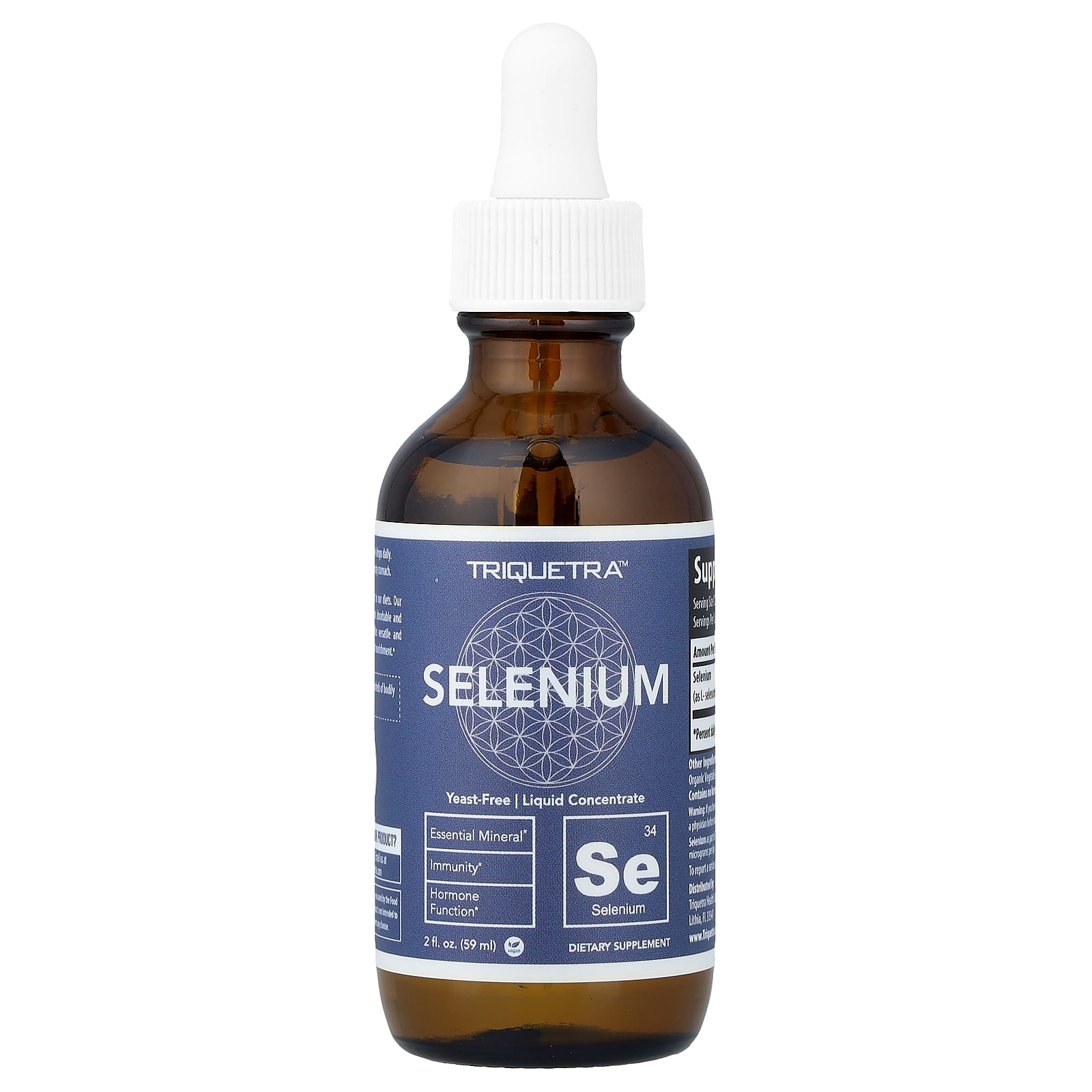
Selenium

At the recorded label maximum: 200 mcg per day (1 serving × 200 mcg; 0.2 mL [4 Drops] per serving)

Add to my list
Per day$0.07

At the label maximum of 1 serving a day.

Per pack$21.97

2 fluid ounces; 59 mL · Vitacost · checked 23 Oct 2026. Delivery is not included.

Per serving$0.07

Pack price divided by the number of servings in the pack.

Composition

Amounts at the recorded label maximum. Directions may give a range.

Seleniumas L-Selenomethionine
200 mcgat the recorded label maximum (1 serving × 200 mcg; 0.2 mL [4 Drops] per serving)
50% of 400 mcg — US upper limit for adults, National Academiesfrom food and supplements, adults · food is not counted here · a reference value, not a legal limit

Manufacturer's directions

Suggested Use: As a dietary supplement; shake before use. Take 4 drops daily. Add drops to water; juice; or food. Preferably do not take on an empty stomach.

Other ingredients on the label

reverse osmosis Water, organic Vegetable Glycerin

Limits in other countries
CountrySelenium
United States400 mcgreference, not a law · 50%
Austria100 mcgrecommendation · 200% · above
Belgium105 mcglaw · 190% · above
Croatia100 mcglaw · 200% · above
Cyprus200 mcglaw · 100%
Denmark197 mcgrecommendation · 102% · above
EAEU150 mcglaw · 133% · above
Estonia300 mcgrecommendation · 67%
Finland255 mcgrecommendation · 78%
France50 mcglaw · 400% · above
Germany40 mcgrecommendation · 500% · above
Ireland300 mcgrecommendation · 67%
Italy83 mcgrecommendation · 241% · above
Luxembourg82.5 mcglaw · 242% · above
Malta200 mcgrecommendation · 100%
Poland200 mcgrecommendation · 100%
Switzerland165 mcglaw · 121% · above

Maximum amounts per daily dose of a food supplement, as each country sets them; the share is the daily amount on the label against that maximum. Law = legally binding; recommendation = an authority's recommended maximum, not binding; reference = the U.S. upper intake level for adults from all sources (National Academies), not a legal limit. Verification level V0 · Report an error

About the ingredients

Ingredient information

Ingredient guideSeleniumSelenium is an essential mineral that the body builds into about 25 proteins called selenoproteins. Brazil nuts, seafood, meat and poultry are rich food sources, and plant foods vary with the soil. Supplements contain it as selenomethionine, selenium yeast, sodium selenite, sodium selenate or other forms.Read moreShow less
Terms and sources
selenoproteins
In these proteins, selenium sits inside the amino acid selenocysteine. NIH Office of Dietary Supplements; Linus Pauling Institute.
selenium yeast
Yeast grown in a high-selenium medium; it holds selenium mainly as selenomethionine. NIH Office of Dietary Supplements.

Selenium in the body

Selenoproteins include glutathione peroxidases, thioredoxin reductases and selenoprotein P. Their roles include thyroid hormone metabolism, DNA synthesis, reproduction and protection from oxidative damage. The thyroid gland holds more selenium for its size than any other organ. Selenoprotein P, made mainly in the liver, carries selenium to other tissues.

Terms and sources
glutathione peroxidases
Enzymes that break down hydrogen peroxide and fat peroxides. Linus Pauling Institute.
thyroid hormone metabolism
NIH Office of Dietary Supplements.
more selenium for its size
NIH: "Selenium concentration is higher in the thyroid gland than in any other organ in the body…"
carries selenium
Linus Pauling Institute.

About 28% to 46% of the body's selenium is in skeletal muscle. The body keeps its selenium steady mainly through the urine. Selenomethionine can also be built into ordinary body proteins in place of the amino acid methionine. Blood selenium of 8 mcg/dL or more is usually considered sufficient in healthy people. Research suggests that selenoprotein P and glutathione peroxidase rise with supplements only when selenium status is low, NIH notes.

Terms and sources
28% to 46%
NIH Office of Dietary Supplements.
through the urine
At higher intakes, selenium also leaves through the lungs and in stool. NIH Office of Dietary Supplements.
in place of the amino acid methionine
Only proteins with selenocysteine count as selenoproteins. Linus Pauling Institute.
8 mcg/dL
Plasma or serum selenium. Hair and nail selenium show intake over months or years. NIH Office of Dietary Supplements.
NIH notes
NIH Office of Dietary Supplements.

NIH notes: "Selenosis is the result of chronically high intakes of selenium. It is most commonly characterized by hair loss and nail brittleness or loss, but other signs and symptoms can include a garlic odor in the breath, a metallic taste in the mouth, skin rash, nausea, diarrhea, fatigue, irritability, and nervous system abnormalities. The Tolerable Upper Intake Level for selenium is 400 mcg for adults, and it ranges from 45 mcg to 400 mcg for infants, children, and adolescents, depending on age."

Terms and sources
NIH notes
NIH Office of Dietary Supplements, Selenium fact sheet for health professionals, section on health risks from excessive selenium. The opening paragraph.

NIH continues: "Chronically high intakes of the organic and inorganic forms of selenium have similar effects. Early indicators of excess intake are a garlic odor in the breath and a metallic taste in the mouth. The most common clinical signs of chronically high selenium intakes, or selenosis, are hair loss and nail brittleness or loss. Other signs and symptoms include skin rash, nausea, diarrhea, fatigue, irritability, and nervous system abnormalities."

Terms and sources
NIH continues
The next paragraph of the same NIH section.

It continues: "As discussed earlier, Brazil nuts contain very high amounts of selenium (68–91 mcg per nut) and could cause selenium toxicity if consumed regularly. Acute selenium toxicity has resulted from the ingestion of misformulated over-the-counter products that contain very large amounts of selenium. In 2008, for example, 201 people experienced severe adverse reactions from taking a liquid dietary supplement that contained 200 times the labeled amount of selenium. Acute selenium toxicity can cause severe gastrointestinal and neurological symptoms; acute respiratory distress syndrome; myocardial infarction; hair loss; muscle tenderness; tremors; lightheadedness; facial flushing; kidney failure; cardiac failure; and, in rare cases, death."

Terms and sources
It continues
The next paragraph of the same NIH section.

NIH also describes a subgroup result from SELECT, a large trial of 200 mcg a day in men. NIH notes: "Further investigation in a case-cohort of 1,739 men with prostate cancer and 3,117 matched controls from the SELECT trial found that selenium supplementation did not affect prostate cancer risk in men with low baseline selenium status (based on toenail selenium levels). However, the researchers did find an increased risk of high-grade prostate cancer in men with higher baseline selenium status (≥60th percentile of toenail selenium) and recommended that men over age 55 avoid selenium supplementation at doses that exceed recommended dietary intakes."

Terms and sources
subgroup result from SELECT
NIH Office of Dietary Supplements, Selenium fact sheet for health professionals, section on selenium and health.

Information, not a prescription. Do not start, stop or combine supplements or medicines on your own.
Need help choosing?

Choose the option that suits you.

Quick selection

I know my goal

$5

1–2 minutes · a few questions with fixed answers

One goal. Up to three products. Set a budget per day if you like.

Product checks
form and amount on the label, plus shop prices
Daily schedule
what to take, when, how much
Totals and limits
next to the upper limit
Reasons & sources
for each product
Prices and shops
plus food and habits
Progress
what to track, when to see a doctor

Complete the questionnaire before you pay. If no product fits any of your goals, you won’t be charged.

Order · $5View example

Full selection

I have several goals

$15

5–7 minutes · questionnaire with fixed answers

Up to three goals in one set. Where two goals overlap, one product is used for both.

Product checks
form and amount on the label, plus shop prices
Daily schedule
what to take, when, how much
Totals and limits
next to the upper limit
Reasons & sources
for each product
Prices and shops
plus food and habits
Progress
what to track, when to see a doctor

Complete the questionnaire before you pay. If no product fits any of your goals, you won’t be charged.

Order · $15View example

Expert review

I want a person to look at my supplements

$50

Written review within 48 hours of your completed questionnaire

An expert reviews your supplement list and questionnaire.

Written review
duplicates, limits, forms
Detailed questionnaire
supplements, medicines, history
Optional uploads
supplement-label photos or documents relevant to your review
Your notes
your priorities and questions
Follow-up questions
in writing, when needed
Next steps
points to discuss with your doctor

Complete the questionnaire before you pay.

Order · $50View example
Sources, label & certificates

Label record

Copied from the NIH label database (DSLD 276309) · not yet compared with the label · checked 19 Oct 2026 · Report an error

The United States has no pre-market registration for supplements.
Label on file in the NIH Dietary Supplement Label Database
checked 19 Oct 2026source: NIH DSLDReport an error

Barcode 8 54552 00746 4

Third-party certificates

No third-party certificate on file for this product.

Information, not a prescription. Do not start, stop or combine supplements or medicines on your own. If you have a health condition, are pregnant or breastfeeding, take medicines, or are under 18, talk to a doctor or pharmacist first.

Photo credits

Image: © Triquetra. Shown to identify the product. Source: iherb.com

Rights holders can ask us to remove an image or send official product photos: info@verateca.com.

Product photo

Triquetra Selenium — enlarged pack