Himalaya · capsules

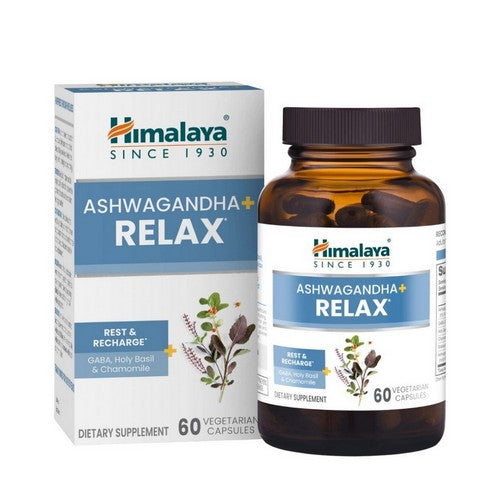
Ashwagandha+ Relax

At the recorded label maximum: 2 capsules per day

Add to my list
Per day$0.82

At the label maximum of 2 capsules a day.

Per pack$24.49

60 capsules · Vitacost · checked 13 Nov 2026. Delivery is not included.

Per capsule$0.41

Pack price divided by the number of capsules in the pack.

Composition

Amounts at the recorded label maximum. Directions may give a range.

Ashwagandha root extract
About this formextract (standardized withanolides). Reference level V0; no form is called “better” here.
280 mgat the recorded label maximum (1 serving × 280 mg; 2 capsules per serving)
No limit on file for the United StatesNone on file in any country
GABA
100 mgat the recorded label maximum (1 serving × 100 mg; 2 capsules per serving)50 mg per capsule · calculated from 100 mg per 2 capsules
No limit on file for the United StatesNone on file in any country
Holy Basil leaf extract
60 mgat the recorded label maximum (1 serving × 60 mg; 2 capsules per serving)30 mg per capsule · calculated from 60 mg per 2 capsules
No limit on file for the United StatesNone on file in any country
50 mgat the recorded label maximum (1 serving × 50 mg; 2 capsules per serving)25 mg per capsule · calculated from 50 mg per 2 capsules
No limit on file for the United StatesNone on file in any country
Ashwagandha Supercritical CO2 Extract
About this formextract (standardized withanolides). Reference level V0; no form is called “better” here.
10 mgat the recorded label maximum (1 serving × 10 mg; 2 capsules per serving)
No limit on file for the United StatesNone on file in any country

Where no limit is shown, none is set or on file for the United States. That is not the same as having no maximum.

Manufacturer's directions

Recommended Use: Adults take 2 capsules once daily.

Other ingredients on the label

Tapioca Starch, plant-based Cellulose

Limits in other countries

No dose limits on file for the ingredients of this product.

About the ingredients

Ingredient information

Ingredient guideAshwagandhaAshwagandha is a plant, Withania somnifera: an evergreen shrub of the Solanaceae family. Its root has been used in the traditional medicine of India. Supplements contain extracts of the root or of root and leaf, or ground root. Extracts may be standardized to withanolides, a group of plant compounds.Read moreShow less
Terms and sources
Withania somnifera
The name ashwagandha is Sanskrit for the smell of a horse, after the smell of the root. The species name somnifera comes from a Latin word meaning sleep-inducing. NIH Office of Dietary Supplements.
Solanaceae family
The plant family is named in the Lopresti 2019 and Ziegenfuss 2018 trial reports. Evergreen shrub: NIH Office of Dietary Supplements.
traditional medicine of India
The Ayurvedic and Unani systems. NIH Office of Dietary Supplements.
withanolides
steroidal lactones. NIH Office of Dietary Supplements.

Ashwagandha in the body

Ashwagandha is not a nutrient, and the body has no daily requirement for it. Trials of its extracts measure things such as cortisol, a stress hormone, and self-rated sleep.

The plant is also called winter cherry or Indian ginseng, but it does not belong to the ginseng family. Most commercial supplements contain root extracts; some contain extracts of root and leaf. The chemical makeup of the root and the leaf differs.

Its compounds include withanolides and alkaloids. Extract makers measure withanolides to standardize their extracts. Laboratory studies suggest that compounds other than withanolides may also be active.

Terms and sources
standardize
To keep the amount of chosen compounds the same from batch to batch. Trial reports for KSM-66, Shoden and Witholytin state a withanolide share measured by HPLC.
Laboratory studies
Studies in cells and animals, summarized by the NIH Office of Dietary Supplements.

NIH notes that ashwagandha appears well tolerated for up to about 3 months. Its long-term safety is not known. NIH also notes a few reports of more serious side effects, including effects on the liver. Ashwagandha might also affect thyroid function and interact with some medicines. NIH notes that some experts advise against ashwagandha during pregnancy.

Terms and sources
about 3 months
Common side effects, such as loose stools, nausea and drowsiness, are usually mild. NIH Office of Dietary Supplements.

Information, not a prescription. Do not start, stop or combine supplements or medicines on your own.
Ingredient guideChamomileChamomile is a plant whose dried flower heads are brewed as herbal tea and used in supplements. NCCIH describes two types, German and Roman chamomile, and its fact sheet focuses on German chamomile. Products contain dried flowers, flower extracts, liquid extracts or essential oil, alone or in blends.Read moreShow less
Terms and sources
dried flower heads
Chamomile tea is brewed from dried flower heads. McKay and Blumberg, Phytotherapy Research, 2006.
German chamomile
Matricaria recutita, also named Chamomilla recutita or Matricaria chamomilla. NCCIH, Chamomile: Usefulness and Safety.
NCCIH
NIH National Center for Complementary and Integrative Health.
flower extracts
EMA's public summary on matricaria flower names cut flowers and dry or liquid extracts, for herbal medicines. Some of these medicines combine it with other herbs. Essential oil: McKay and Blumberg, Phytotherapy Research, 2006.

Chamomile in the body

Chamomile is not a nutrient, and the body has no daily requirement for it. German chamomile is Matricaria recutita; Roman chamomile is a different plant, Chamaemelum nobile. Tea and supplements use the dried flower heads.

Terms and sources
Matricaria recutita
Also named Chamomilla recutita or Matricaria chamomilla. NCCIH, Chamomile: Usefulness and Safety.
Chamaemelum nobile
Carnat et al., Fitoterapia, 2004.
dried flower heads
McKay and Blumberg, Phytotherapy Research, 2006.

The flowers hold flavonoids, mainly apigenin, quercetin, patuletin and luteolin, and their glucosides. The essential oil of the flowers holds mainly alpha-bisabolol and its oxides, and azulenes such as chamazulene. In one analysis, apigenin and its glucosides were found in the ligulate florets, not in the tubular florets. Free apigenin does not occur in living flowers; it forms after harvest from apigenin 7-glycoside. In one study of healthy men, apigenin forms in urine equaled 34% of the apigenin in chamomile tea.

Terms and sources
flavonoids
Plant pigments of the polyphenol family. McKay and Blumberg, Phytotherapy Research, 2006.
azulenes
McKay and Blumberg, Phytotherapy Research, 2006.
ligulate florets
Ligulate means strap-shaped. Redaelli et al., Planta Medica, 1981. The first author's affiliation is the research laboratory of Bonomelli S.p.A.
forms after harvest
So its share in dried flowers depends on post-harvest conditions. Schreiber et al., Planta Medica, 1990.
one study of healthy men
Borges et al., Free Radical Biology and Medicine, 2022. The drinks were not given in random order. We could not read the full text.

NCCIH writes: “Chamomile is likely safe when used orally in amounts commonly found in teas and other foods.” It adds: “It is possibly safe when used by adults and children orally for medicinal purposes over the short term.” And: “Using chamomile on the skin in adults and children or as an oral rinse for medicinal purposes is possibly safe at certain doses and over the short term.” NCCIH notes: “Side effects are uncommon and may include nausea, dizziness, and allergic reactions, including severe hypersensitivity reactions and anaphylaxis, in some people.” It adds: “If used near the eyes, chamomile might cause eye irritation.” On allergy, NCCIH writes: “People are more likely to experience allergic reactions to chamomile if they’re allergic to related plants such as ragweed, chrysanthemums, marigolds, or daisies.” NCCIH also writes: “Chamomile might have some of the same effects as estrogen.” It adds: “Preliminary studies suggest that taking chamomile along with birth control pills might decrease the effects of birth control pills.” And: “In addition, chamomile might worsen any condition that is sensitive to exposure to estrogen, such as breast or uterine cancer.” On medicines, NCCIH writes: “Interactions between chamomile and some drugs metabolized by the liver and warfarin (a blood thinner) have been reported, and there are theoretical reasons to suspect that chamomile might interact with other drugs as well, such as sedatives.” NCCIH advises: “If you take any type of medicine, talk with your health care provider before using chamomile or other herbal products; some herbs and medicines interact in harmful ways.” It also writes: “Little is known about whether it’s safe to use chamomile during pregnancy or while breastfeeding.” This page is about chamomile taken by mouth.

Terms and sources
NCCIH writes
NIH National Center for Complementary and Integrative Health (NCCIH), Chamomile: Usefulness and Safety. Its section What Do We Know About Safety? is quoted here in full. The fact sheet focuses on German chamomile.

Information, not a prescription. Do not start, stop or combine supplements or medicines on your own.

Services

Choose the option that suits you.

Quick selection

I know my goal

$5

1–2 minutes · a few questions with fixed answers

One goal. Up to three products. Set a budget per day if you like.

Product checks
form and amount on the label, plus shop prices
Daily schedule
what to take, when, how much
Totals and limits
next to the upper limit
Reasons & sources
for each product
Prices and shops
plus food and habits
Progress
what to track, when to see a doctor

Complete the questionnaire before you pay. If no product fits any of your goals, you won’t be charged.

Order · $5View example

Full selection

I have several goals

$15

5–7 minutes · questionnaire with fixed answers

Up to three goals in one set. Where two goals overlap, one product is used for both.

Product checks
form and amount on the label, plus shop prices
Daily schedule
what to take, when, how much
Totals and limits
next to the upper limit
Reasons & sources
for each product
Prices and shops
plus food and habits
Progress
what to track, when to see a doctor

Complete the questionnaire before you pay. If no product fits any of your goals, you won’t be charged.

Order · $15View example

Expert review

I want a person to look at my supplements

$50

Written review within 48 hours of your completed questionnaire

An expert reviews your supplement list and questionnaire.

Written review
duplicates, limits, forms
Detailed questionnaire
supplements, medicines, history
Optional uploads
supplement-label photos or documents relevant to your review
Your notes
your priorities and questions
Follow-up questions
in writing, when needed
Next steps
points to discuss with your doctor

Complete the questionnaire before you pay.

Order · $50View example
Sources, label & certificates

Label record

Copied from the NIH label database (DSLD 282965) · not yet compared with the label · checked 19 Oct 2026 · Report an error

The United States has no pre-market registration for supplements.
Label on file in the NIH Dietary Supplement Label Database
checked 19 Oct 2026source: NIH DSLDReport an error

Barcode 6 05069 06818 5

Third-party certificates

No third-party certificate on file for this product.

Information, not a prescription. Do not start, stop or combine supplements or medicines on your own. If you have a health condition, are pregnant or breastfeeding, take medicines, or are under 18, talk to a doctor or pharmacist first.

Photo credits

Image: © Himalaya. Shown to identify the product. Source:

Rights holders can ask us to remove an image or send official product photos: info@verateca.com.

Product photo

Himalaya Ashwagandha+ Relax — enlarged pack