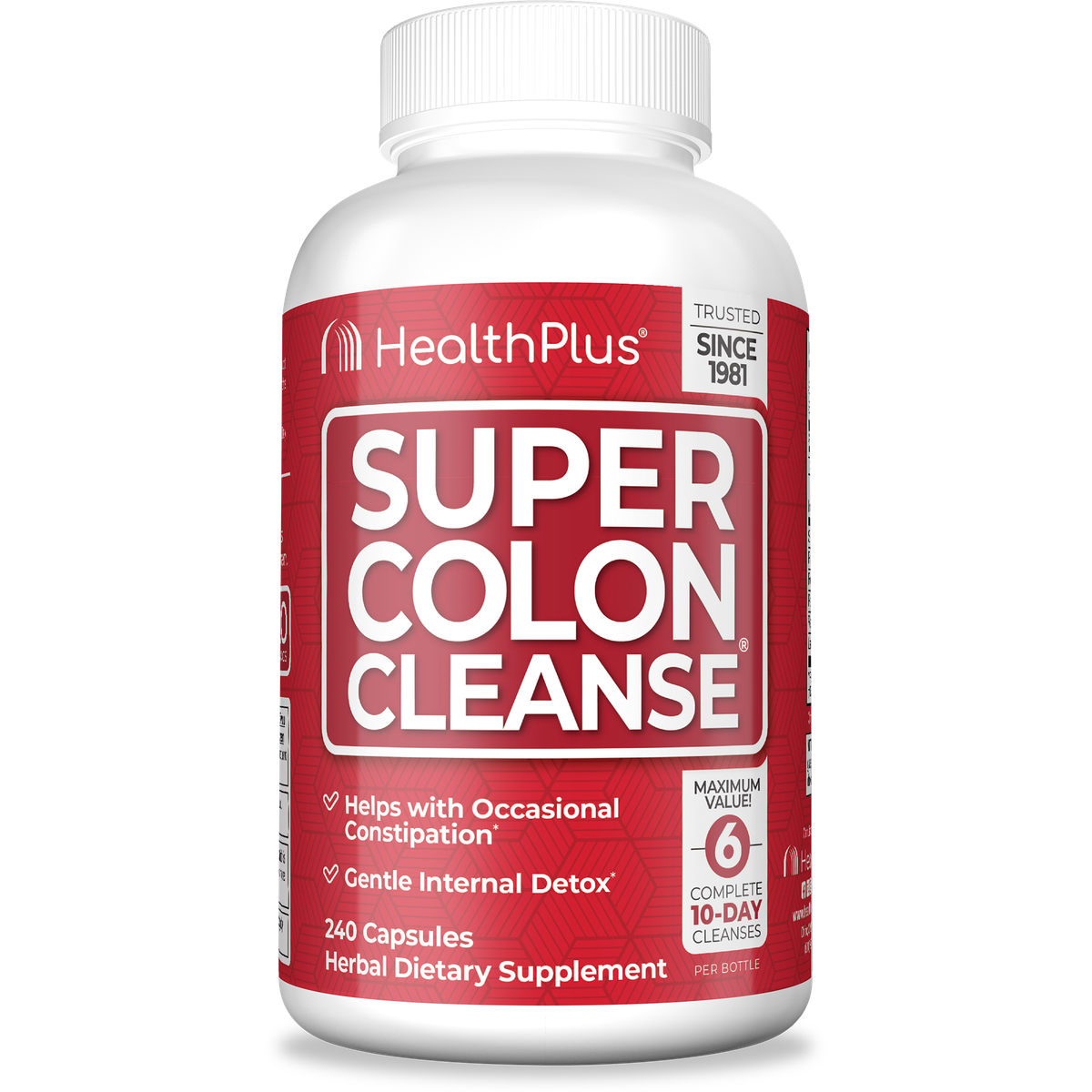
Health Plus · capsules

Super Colon Cleanse

At the recorded label maximum: 2 servings (2 Capsules; 1 Capsules each) per day

Add to my list
Per dayDaily cost unavailable

Daily cost unavailable

Per pack$26.78

240 capsules · Vitacost · checked 18 Nov 2026. Delivery is not included.

Per capsule$0.11

Pack price divided by the number of capsules in the pack.

Composition

Amounts at the recorded label maximum. Directions may give a range.

1.2 mgat the recorded label maximum (2 servings × 600 mcg; 2 Capsules; 1 Capsules per serving) · as iron itself
3% of 45 mg — US upper limit for adults, National Academiesfrom food and supplements, adults · food is not counted here · a reference value, not a legal limit
Senna leaf powder
1,330 mgat the recorded label maximum (2 servings × 665 mg; 2 Capsules; 1 Capsules per serving)
No limit on file for the United StatesNone on file in any country
642 mgat the recorded label maximum (2 servings × 321 mg; 2 Capsules; 1 Capsules per serving)
No limit on file for the United StatesNone on file in any country
42 mgat the recorded label maximum (2 servings × 21 mg; 2 Capsules; 1 Capsules per serving)
No limit on file for the United StatesNone on file in any country
Papaya leaf powder
42 mgat the recorded label maximum (2 servings × 21 mg; 2 Capsules; 1 Capsules per serving)
No limit on file for the United StatesNone on file in any country
Rose Hips fruit powder
42 mgat the recorded label maximum (2 servings × 21 mg; 2 Capsules; 1 Capsules per serving)
No limit on file for the United StatesNone on file in any country
L. acidophilus
22 mgat the recorded label maximum (2 servings × 11 mg; 2 Capsules; 1 Capsules per serving)
No limit on file for the United StatesNone on file in any country

Where no limit is shown, none is set or on file for the United States. That is not the same as having no maximum.

Manufacturer's directions

Suggested Use: Adults: Take 2 capsules 2 times daily with at least 10-12 oz. of water and drink immediately. If you feel stomach discomfort reduce the dosage by half. Taking this product without enough liquid may cause choking. Use Super Colon Cleanse about every 2 months and for no more than 10 days at a time. Children (6-12 years): Half the adult dosage.Suggested use for better results: Add fiber to your daily cleansing regime wit our Every Day Fiber or Original Colon Cleanse

Other ingredients on the label

Gelatin

Limits in other countries
CountryIron
United States45 mgreference, not a law · 3%
Austria10 mgrecommendation · 12%
Belgium45 mglaw · 3%
Croatia30 mglaw · 4%
Cyprus15 mglaw · 8%
Denmark27 mgrecommendation · 4%
EAEU40 mglaw · 3%
Estonia—not on file
Finland—not on file
France14 mglaw · 9%
Germany6 mgrecommendation · 20%
Ireland45 mgrecommendation · 3%
Italy30 mgrecommendation · 4%
Luxembourg28 mglaw · 4%
Malta17 mgrecommendation · 7%
Norway21 mglaw · 6%
Poland20 mgrecommendation · 6%
Switzerland21 mglaw · 6%

Maximum amounts per daily dose of a food supplement, as each country sets them; the share is the daily amount on the label against that maximum. Law = legally binding; recommendation = an authority's recommended maximum, not binding; reference = the U.S. upper intake level for adults from all sources (National Academies), not a legal limit. Verification level V0 · Report an error

About the ingredients

Ingredient information

Ingredient guideIronIron is an essential mineral that the body uses to carry oxygen in the blood. An adult body holds about 3 to 4 g of iron, most of it in hemoglobin. Meat, seafood and grain foods made with fortified flour are major sources. Supplements contain iron as part of a compound, such as ferrous sulfate, ferrous fumarate or ferrous bisglycinate.Read moreShow less
Terms and sources
3 to 4 g
NIH Office of Dietary Supplements. The Linus Pauling Institute estimates 2.3 g in women and 3.8 g in men.

Iron in the body

Iron is part of hemoglobin, the red blood cell protein that carries oxygen from the lungs to the tissues. It is also part of myoglobin, a protein that carries and stores oxygen in muscle cells. Iron is needed for physical growth, the work of cells and making some hormones. Hundreds of proteins and enzymes contain iron, including those that make energy in cells.

Terms and sources
hemoglobin
NIH Office of Dietary Supplements.
myoglobin
Linus Pauling Institute. Its 2016 update was paid for in part by a grant from Bayer Consumer Care AG.
making some hormones
NIH Office of Dietary Supplements.
Hundreds of proteins
Including cytochromes, which carry electrons when cells make ATP, their main energy molecule. Linus Pauling Institute.

The body loses very little iron, so it reuses most of what it has. About 20 mg of iron a day is recovered from old red blood cells. To cover losses, the gut absorbs only 1–2 mg of iron a day. A hormone made in the liver, hepcidin, sets how much iron the gut takes up. Spare iron is stored as ferritin in the liver, spleen and bone marrow.

Terms and sources
loses very little iron
Small amounts leave in urine, stool, sweat and shed skin cells; more is lost with menstrual blood. NIH Office of Dietary Supplements.
About 20 mg
The same article gives about 35 mg a day for all iron recycling. Linus Pauling Institute. Its 2016 update was paid for in part by a grant from Bayer Consumer Care AG.
1–2 mg
Linus Pauling Institute.
hepcidin
When stores are full, hepcidin blocks iron uptake from food; when they are low, it is barely made. Linus Pauling Institute; NIH.
ferritin
A storage protein. Its level in blood is a common test of iron stores. NIH Office of Dietary Supplements.

NIH notes: "Adults with normal intestinal function have very little risk of iron overload from dietary sources of iron. However, supplements containing 25 mg iron or more can reduce zinc absorption and plasma zinc concentrations. High-dose iron supplements can also cause gastrointestinal effects, including gastric upset, constipation, nausea, abdominal pain, vomiting, and diarrhea. Taking iron supplements with food can help minimize these adverse effects. Case reports, some of which involved doses of 130 mg iron, suggest that some people develop even more serious gastrointestinal effects, including gastritis and gastric lesions (along with iron deposits in the gastric mucosa in some cases)." It goes on: "Acute intakes of more than 20 mg/kg iron (about 1,365 mg iron for a person weighing 150 pounds [lb]) from supplements or medicines can lead to corrosive necrosis of the intestine, which might lead to fluid and blood loss, shock, tissue damage, and organ failure, especially if food is not taken at the same time as the iron. In severe cases (e.g., one-time ingestions of 60 mg/kg, or about 4,090 mg iron for a 150-lb person), overdoses of iron can lead to multisystem organ failure, coma, convulsions, and even death." NIH continues: "Between 1983 and 2000, at least 43 U.S. children died from ingesting supplements containing high doses of iron (36–443 mg iron/kg body weight). Accidental ingestion of iron supplements caused about a third of poisoning deaths among children reported in the United States between 1983 and 1991." It adds: "In 1997, FDA began requiring oral supplements containing more than 30 mg elemental iron per dose to be sold in single-dose packaging with strong warning labels. At the same time, many manufacturers voluntarily replaced the sugar coating on iron tablets with film coatings. Between 1998 and 2002, only one child death due to ingesting an iron-containing tablet was reported. As a result of a court decision, FDA removed its single-dose packaging requirement for iron supplements in 2003. FDA currently requires that iron-containing dietary supplements sold in solid form (e.g., tablets or capsules but not powders) carry the following label statement: “WARNING: Accidental overdose of iron-containing products is a leading cause of fatal poisoning in children under 6. Keep this product out of reach of children. In case of accidental overdose, call a doctor or poison control center immediately”. In addition, since 1978, the Consumer Product Safety Commission has required manufacturers to package dietary supplements that contain 250 mg or more elemental iron per container in child-resistant bottles or packaging to prevent accidental poisoning." NIH adds: "Hemochromatosis, a disease caused by a mutation in the hemochromatosis (HFE) gene, is associated with an excessive buildup of iron in the body. About 1 in 10 Whites carry the most common HFE mutation (C282Y), but only 4.4 Whites per 1,000 are homozygous for the mutation and have hemochromatosis. The condition is much less common in other ethnic groups. Without treatment by periodic chelation or phlebotomy, people with hereditary hemochromatosis typically develop signs of iron toxicity by their 30s. These effects can include liver cirrhosis, hepatocellular carcinoma, heart disease, and impaired pancreatic function. The American Association for the Study of Liver Diseases recommends that treatment of hemochromatosis include the avoidance of iron and vitamin C supplements."

Terms and sources
NIH notes
NIH Office of Dietary Supplements, Iron fact sheet for health professionals, section on health risks from excessive iron. The next paragraphs follow in the order of that section.
It adds
Same NIH section, the paragraph on packaging and label rules. In the United States, 21 CFR 101.17(e) requires the same statement.
NIH adds
Same NIH section, next paragraph.

Information, not a prescription. Do not start, stop or combine supplements or medicines on your own.
Ingredient guidePsylliumPsyllium is a soluble fiber from the husk of the seeds of Plantago ovata, a plant also called blond psyllium. In India, the husk is known as ispaghula. With water, the husk forms a gel. Supplements contain whole husk, husk powder for drinks, capsules of powder, or less often the seed.Read moreShow less
Terms and sources
soluble fiber
A fiber that dissolves in water. Psyllium is listed among fibers that form a thick gel. Linus Pauling Institute, Oregon State University.
ispaghula
Linus Pauling Institute, Oregon State University.
forms a gel
Linus Pauling Institute, Oregon State University.

Psyllium in the body

Psyllium is an isolated fiber, a carbohydrate that the body does not digest. With water, it forms a thick gel. Gut bacteria ferment only part of it, so the gel keeps holding water in the large intestine.

Terms and sources
isolated fiber
The Institute of Medicine lists psyllium among potential functional fibers: isolated, nondigestible carbohydrates. Linus Pauling Institute, Oregon State University.
ferment only part of it
LPI groups psyllium with soluble, gel-forming fibers that resist fermentation. Linus Pauling Institute, Oregon State University.

In 7 healthy adults, most of the psyllium reached the start of the large intestine intact within 4 hours. About 24% of its arabinose and 53% of its xylose were fermented; the rest left in the stool. In 9 healthy adults, 7 g three times a day enlarged the resting colon from 372 to 578 mL. These are measures of water and volume in the gut, not of symptoms.

Terms and sources
start of the large intestine
the cecum. Marteau et al., Gut, 1994.
arabinose
Arabinose and xylose are the two main sugars of the husk. Apparent digestibility, as reported by Marteau et al., Gut, 1994.
372 to 578 mL
Fasting colon volume on MRI, medians after 6 days: with a dummy powder and with psyllium. Major et al., Neurogastroenterology and Motility, 2018.

LPI lists psyllium among fibers found to cause "gastrointestinal distress, including abdominal cramping, bloating, gas, and diarrhea." It suggests starting a new fiber supplement at 3–4 g a day or less in the first week. LPI notes: "In subjects who are constipated, the initiation of a fiber supplement should start once the hard stool is cleared." LPI notes that several cases of a blocked gut have been reported with psyllium. They occurred when it was taken with too little fluid, or by people with impaired swallowing or slow gut movement. LPI notes that psyllium "may reduce the absorption of lithium, carbamazepine (Tegretol), digoxin (Lanoxin), and warfarin (Coumadin) when taken at the same time." LPI advises taking medicines at least 1 hour before or 2 hours after fiber supplements. LPI notes that "anaphylaxis has also been reported after the ingestion of cereal containing psyllium." It adds that "asthma has occasionally been reported in people with occupational exposure to psyllium powder." LPI notes that in one 3-year trial, psyllium "resulted in a significant increase in colorectal adenoma recurrence compared to placebo."

Terms and sources
LPI
Linus Pauling Institute, Oregon State University, fiber article.
anaphylaxis
A sudden, severe allergic reaction. Linus Pauling Institute, Oregon State University.

Information, not a prescription. Do not start, stop or combine supplements or medicines on your own.

Ingredient guideFennelFennel is an aromatic plant, Foeniculum vulgare, of the Apiaceae family. It is grown for its leaves, stems and seeds. What is sold as fennel seed is the dried fruit of the plant. Supplements sell ground seed in capsules, seed extracts, liquid extracts, tea and fennel oil.Read moreShow less
Terms and sources
Apiaceae
Also called Umbelliferae. Badgujar et al., BioMed Research International, 2014.
dried fruit
The review notes that the dried fruit, called fennel, is a major item of commerce. Badgujar et al., BioMed Research International, 2014.

Fennel in the body

Fennel is not a nutrient, and the body has no daily requirement for it. Trials in adults without a diagnosis measure things such as sleep ratings and blood lipids.

The odor of fennel comes from its essential oil. In two studied cultivars, trans-anethole made up 59.8–90.4% of the oil. The same oils held 0.1–2.5% estragole; other analyses found 7.6% and 10.4%. Sweet fennel is the variety dulce of the same species.

Terms and sources
essential oil
The oil has been reported to hold more than 87 volatile compounds. Badgujar et al., BioMed Research International, 2014.
two studied cultivars
Aurelio and Sparta. Other compounds include limonene and fenchone. Badgujar et al., BioMed Research International, 2014. The review summarizes earlier analyses.
other analyses
Oil with 72.2% trans-anethole and 7.6% estragole. Another oil: 68.5% trans-anethole and 10.4% estragole. Badgujar et al., BioMed Research International, 2014.
variety dulce
Foeniculum vulgare Miller subsp. vulgare var. dulce. EU herbal monograph on sweet fennel fruit, European Medicines Agency.

The European Medicines Agency's EU herbal medicine monographs on fennel state: "Estragole is considered a genotoxic carcinogen in rodents." In a 2019 study, 12 healthy adults drank 500 mL of fennel tea holding 2.2 mg of estragole. A urine marker of the reactive form cleared almost fully within 8 hours. The total amount of the marker ranged from 93 to 1,076 ng between people. In an earlier study, estragole itself was not detected in blood after fennel tea. Under 0.41% of the estragole dose appeared in urine as bound (conjugated) 1'-hydroxyestragole; 17% became p-allylphenol.

Terms and sources
genotoxic carcinogen
Able to damage DNA and to cause tumors. The monographs cite liver tumors in mice and indirect evidence in rats. EU herbal monographs on bitter and sweet fennel fruit, Revision 1, European Medicines Agency.
12 healthy adults
Six women and six men. Monien et al., Chemical Research in Toxicology, 2019.
A urine marker
AMPAC, a breakdown product of the reactive form of estragole. Before the tea, it was below the detection limit. In one volunteer, it also formed from trans-anethole, to a much smaller extent. Monien et al., 2019.
93 to 1,076 ng
The authors link this spread to differences in the enzymes that break down estragole. Monien et al., 2019.
an earlier study
Not above the detection limit. Its breakdown products appeared in blood within 2.5 hours. Zeller et al., Chemical Research in Toxicology, 2009.
1'-hydroxyestragole
The first step toward the reactive form. It peaked in urine at 1.5 hours. Zeller et al., 2009.

The European Medicines Agency has EU monographs for bitter and sweet fennel fruit. They cover it as a traditional herbal medicine taken as tea. For adults, the monographs' tea dose is 1.5 g of fruit in 250 mL of boiling water. It is taken 3 times a day. They add: "Not to be taken for more than 2 weeks." For children 4 to 12 years old, they add: "For short-term use in mild transitory symptoms only (less than one week)." Under contraindications, they list: "Hypersensitivity to the active substance or to Apiaceae (Umbelliferae) family (aniseed, caraway, celery, coriander and dill) or to anethole." They add: "Hypersensitivity to mugwort pollen, due to cross-reactivity with fennel." As a side effect, they note: "Allergic reactions to fennel, affecting the skin or the respiratory system may occur." The monographs also state: "Safety during pregnancy and lactation has not been established." They add: "In the absence of sufficient data, the use during pregnancy and lactation is not recommended." They also note: "There is evidence that trans-anethole is excreted in human breast milk." They add: "No fertility data available." They report: "A fennel aqueous extract was tested in an Ames test on Salmonella typhimurium strains TA98, TA100 and turned out as negative." They also report: "Results from studies carried out in laboratory animals showed a weak mutagenic activity of anethole." The monographs also report: "An aqueous extract of fennel seeds given daily to 24 female BALB/c mice from day 6 to day 15 of pregnancy showed a dose-dependent teratogenic effect." They add: "The embryotoxic effect resulted in morphological changes, skeletal disorders, and cellular alterations." For children, they state: "The use is not recommended in children under 4 years of age due to lack of adequate data." For older children, they add: "The use in children between 4 and 12 years of age is not recommended if the daily intake of estragole exceeds the guidance value of 1.0 µg/kg bw, unless justified by a risk assessment based on adequate safety data." For these herbal medicines, they state: "In the general population exposure to estragole should be kept as low as practically achievable." They also set: "In pregnant and breast-feeding women, the daily intake of estragole has to be below 0.05 mg/person per day." And: "In children below 12 years of age, the daily intake of estragole has to be below 1.0 µg/kg bw." Under interactions with other medicines, the monographs state: "None reported."

Terms and sources
monographs
Foeniculi amari fructus and Foeniculi dulcis fructus. Their safety texts match apart from small wording differences; quotes here are from the bitter fennel monograph. EU herbal monographs on bitter and sweet fennel fruit, Revision 1, European Medicines Agency.
3 times a day
Steeped for 15 minutes; 4.5 g a day. For adults and adolescents. EU herbal monographs on bitter and sweet fennel fruit, Revision 1, European Medicines Agency.
contraindications
Reasons not to use the product, in medicine labeling terms. EU herbal monographs on bitter and sweet fennel fruit, Revision 1, European Medicines Agency.
a side effect
The monographs add that the frequency is not known.
Ames test
A laboratory test for DNA changes in bacteria.
teratogenic
Causing birth defects in the offspring. The monographs add that adequate tests on reproductive toxicity have not been performed. EU herbal monographs on bitter and sweet fennel fruit, Revision 1, European Medicines Agency.
1.0 µg/kg bw
Micrograms per kilogram of body weight, as a daily intake. This applies to the tea for digestive and cough uses. EU herbal monographs on bitter and sweet fennel fruit, Revision 1, European Medicines Agency.

In the 60-woman capsule trial below, 6 women reported side effects with fennel and 3 with a dummy capsule. In the 50-woman capsule trial below, no side effects were reported in either group.

Terms and sources
6 women reported side effects
With fennel: an allergic rash, weight gain and raised blood pressure in 1 woman each, and vaginal bleeding in 2. With the dummy capsule, the report describes one stomachache. Afiat et al., 2018. Another report of this trial says 5 women with fennel and 1 with the dummy capsule left it. 54 of 60 finished. Saghafi et al., Journal of Menopausal Medicine, 2017.

Information, not a prescription. Do not start, stop or combine supplements or medicines on your own.

Services

Choose the option that suits you.

Quick selection

I know my goal

$5

1–2 minutes · a few questions with fixed answers

One goal. Up to three products. Set a budget per day if you like.

Product checks
form and amount on the label, plus shop prices
Daily schedule
what to take, when, how much
Totals and limits
next to the upper limit
Reasons & sources
for each product
Prices and shops
plus food and habits
Progress
what to track, when to see a doctor

Complete the questionnaire before you pay. If no product fits any of your goals, you won’t be charged.

Order · $5View example

Full selection

I have several goals

$15

5–7 minutes · questionnaire with fixed answers

Up to three goals in one set. Where two goals overlap, one product is used for both.

Product checks
form and amount on the label, plus shop prices
Daily schedule
what to take, when, how much
Totals and limits
next to the upper limit
Reasons & sources
for each product
Prices and shops
plus food and habits
Progress
what to track, when to see a doctor

Complete the questionnaire before you pay. If no product fits any of your goals, you won’t be charged.

Order · $15View example

Expert review

I want a person to look at my supplements

$50

Written review within 48 hours of your completed questionnaire

An expert reviews your supplement list and questionnaire.

Written review
duplicates, limits, forms
Detailed questionnaire
supplements, medicines, history
Optional uploads
supplement-label photos or documents relevant to your review
Your notes
your priorities and questions
Follow-up questions
in writing, when needed
Next steps
points to discuss with your doctor

Complete the questionnaire before you pay.

Order · $50View example
Sources, label & certificates

Label record

Copied from the NIH label database (DSLD 285763) · not yet compared with the label · checked 19 Oct 2026 · Report an error

The United States has no pre-market registration for supplements.
Label on file in the NIH Dietary Supplement Label Database
checked 19 Oct 2026source: NIH DSLDReport an error

Barcode 0 83502 08765 6

Third-party certificates

No third-party certificate on file for this product.

Information, not a prescription. Do not start, stop or combine supplements or medicines on your own. If you have a health condition, are pregnant or breastfeeding, take medicines, or are under 18, talk to a doctor or pharmacist first.

Photo credits

Image: © Health Plus. Shown to identify the product. Source:

Rights holders can ask us to remove an image or send official product photos: info@verateca.com.

Product photo

Health Plus Super Colon Cleanse — enlarged pack