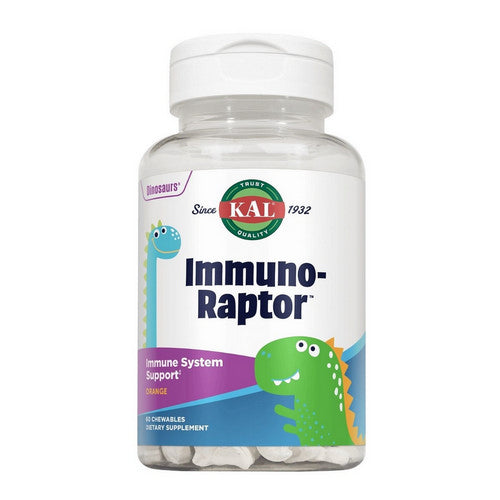
KAL Dinosaurs · tablets

Immuno-Raptor Orange

At the recorded label maximum: 1 serving (1 Chewables each) per day

Add to my list
Per day$0.19

At the label maximum of 1 chew a day.

Per pack$11.53

60 chews · Vitacost · checked 13 Nov 2026. Delivery is not included.

Per chew$0.19

Pack price divided by the number of chews in the pack.

Composition

Amounts at the recorded label maximum. Directions may give a range.

Amounts not disclosed. The label gives only the total weight of this blend, not the amount of each ingredient in it. Without the individual amounts, we cannot compare these ingredients with upper limits.

300 mcgat the recorded label maximum (1 serving × 300 mcg; 1 Chewables per serving)
Not compared with 3,000 mcg — US upper limit for adults, National Academiesthe limit counts retinol only · a reference value, not a legal limit
50 mgat the recorded label maximum (1 serving × 50 mg; 1 Chewables per serving)
3% of 2,000 mg — US upper limit for adults, National Academiesfrom food and supplements, adults · food is not counted here · a reference value, not a legal limit
Zincas Zinc Citrate
About this formzinc citrate — about 31% of the compound is zinc itself. Reference level V0; no form is called “better” here.
25 mgat the recorded label maximum (1 serving × 25 mg; 1 Chewables per serving) · as zinc itself
63% of 40 mg — US upper limit for adults, National Academiesfrom food and supplements, adults · food is not counted here · a reference value, not a legal limit
Bioflavonoid Complex
25 mgat the recorded label maximum (1 serving × 25 mg; 1 Chewables per serving)
No limit on file for the United StatesNone on file in any country
Bioflavonoid Concentrateas Lemon
Amount not disclosedpart of Bioflavonoid Complex · not counted
No limit on file for the United StatesNone on file in any country
Rose Hip
Amount not disclosedpart of Bioflavonoid Complex · not counted
No limit on file for the United StatesNone on file in any country
Rutin concentrate
Amount not disclosedpart of Bioflavonoid Complex · not counted
No limit on file for the United StatesNone on file in any country
Acerola Cherry juice powder
Amount not disclosedpart of Bioflavonoid Complex · not counted
No limit on file for the United StatesNone on file in any country
Carrot juice powder
Amount not disclosedpart of Bioflavonoid Complex · not counted
No limit on file for the United StatesNone on file in any country

Where no limit is shown, none is set or on file for the United States. That is not the same as having no maximum.

Manufacturer's directions

Directions: Take 1 chewable daily. Use only as directed.

Other ingredients on the label

Sorbitol, Xylitol, Stearic Acid (C18:0), Magnesium Stearate, Silica, Natural flavor (with other Natural flavors, Orange)

Limits in other countries
CountryVitamin AVitamin CZinc
United States3,000 mcgreference, not a law · not compared2,000 mgreference, not a law · 3%40 mgreference, not a law · 63%
Austria900 mcgrecommendation · 33%500 mgrecommendation · 10%15 mgrecommendation · 167% · above
Belgium1,200 mcglaw · 25%1,000 mglaw · 5%22.5 mglaw · 111% · above
Croatia1,500 mcglaw · 20%800 mglaw · 6%15 mglaw · 167% · above
Cyprus2,300 mcglaw · 13%2,000 mglaw · 3%15 mglaw · 167% · above
Denmark—not on file1,000 mgrecommendation · 5%11 mgrecommendation · 227% · above
EAEU3,000 mcglaw · 10%900 mglaw · 6%25 mglaw · 100%
Estonia3,000 mcgrecommendation · 10%—not on file25 mgrecommendation · 100%
Finland3,000 mcgrecommendation · 10%—not on file25 mgrecommendation · 100%
France800 mcglaw · 37%180 mglaw · 28%15 mglaw · 167% · above
Germany200 mcgrecommendation · 150% · above250 mgrecommendation · 20%6.5 mgrecommendation · 385% · above
Ireland3,000 mcgrecommendation · 10%2,000 mgrecommendation · 3%25 mgrecommendation · 100%
Italy1,200 mcgrecommendation · 25%1,000 mgrecommendation · 5%15 mgrecommendation · 167% · above
Luxembourg1,200 mcglaw · 25%1,000 mglaw · 5%15 mglaw · 167% · above
Malta1,500 mcgrecommendation · 20%1,000 mgrecommendation · 5%25 mgrecommendation · 100%
Netherlands1,200 mcglaw · 25%—not on file—not on file
Norway—not on file1,000 mglaw · 5%14 mglaw · 179% · above
Poland800 mcgrecommendation · 37%1,000 mgrecommendation · 5%15 mgrecommendation · 167% · above
Switzerland1,360 mcglaw · 22%750 mglaw · 7%5.3 mglaw · 472% · above

Maximum amounts per daily dose of a food supplement, as each country sets them; the share is the daily amount on the label against that maximum. Law = legally binding; recommendation = an authority's recommended maximum, not binding; reference = the U.S. upper intake level for adults from all sources (National Academies), not a legal limit. Verification level V0 · Report an error

About the ingredients

Ingredient information

Ingredient guideVitamin AVitamin A is the name for a group of fat-soluble compounds, mainly retinol and retinyl esters. Animal foods contain it as preformed vitamin A; plants contain carotenoids, some of which the body converts into it. Supplements contain retinyl acetate, retinyl palmitate, beta-carotene or a combination. Amounts are given in mcg RAE; older labels used IU.Read moreShow less
Terms and sources
fat-soluble
They dissolve in fat, not in water. NIH Office of Dietary Supplements.
carotenoids
Provitamin A carotenoids: beta-carotene, alpha-carotene and beta-cryptoxanthin. NIH Office of Dietary Supplements.
mcg RAE
Micrograms of retinol activity equivalents. The unit counts how much retinol each form gives the body.

Vitamin A in the body

Vitamin A is part of rhodopsin, the protein in the retina that responds to light. It is needed for normal vision. It is also involved in immune function, cell communication, growth and development, and reproduction.

Terms and sources
rhodopsin
The light-sensitive pigment of the eye's rod cells, which see in dim light. NIH Office of Dietary Supplements; Linus Pauling Institute.
normal vision
NIH Office of Dietary Supplements. It is also needed for the normal surface of the eye.
cell communication
NIH Office of Dietary Supplements. Vitamin A takes part in the growth and specialization of cells.

The body turns retinol into retinal and retinoic acid, the two main active forms. Most of the body's vitamin A is stored in the liver as retinyl esters. Blood retinol levels stay steady until the stores in the liver are almost used up.

Terms and sources
retinoic acid
It switches genes on and off; Linus Pauling Institute counts more than 500 genes that respond to it.
retinyl esters
Retinol joined to a fatty acid, such as retinyl palmitate. NIH Office of Dietary Supplements.
stay steady
NIH Office of Dietary Supplements. So a blood test is not always a reliable guide to the stores. See Green 2016 below: normal blood retinol with low stores.

Plants make hundreds of carotenoids; only about 10% of them can be converted to retinol. The body converts beta-carotene into vitamin A in the gut, through an enzyme. Lutein, zeaxanthin and lycopene are carotenoids that the body does not convert into vitamin A.

Terms and sources
about 10%
Linus Pauling Institute.
an enzyme
Beta-carotene monooxygenase type 1 (BCMO1). Conversion rates may vary with genes. NIH Office of Dietary Supplements.
does not convert
NIH Office of Dietary Supplements calls them non-provitamin A carotenoids.

Information, not a prescription. Do not start, stop or combine supplements or medicines on your own.

Ingredient guideVitamin CVitamin C, also called L-ascorbic acid, is a water-soluble vitamin. Most animals make vitamin C in the body; humans cannot and get it from food. Fruits and vegetables such as peppers, citrus fruits and kiwifruit are the main sources. Supplements contain it as ascorbic acid or as mineral salts such as sodium and calcium ascorbate.Read moreShow less
Terms and sources
water-soluble
It dissolves in water, not in fat. NIH Office of Dietary Supplements.

Vitamin C in the body

Vitamin C is needed to make collagen, carnitine and some neurotransmitters. It is also an antioxidant and can return used vitamin E to its active form. It is needed for normal immune function. It increases the absorption of iron from plant foods.

Terms and sources
collagen
A protein that holds together connective tissue, such as skin, tendons and blood vessels. NIH Office of Dietary Supplements.
carnitine
A substance cells need to get energy from fat. Linus Pauling Institute.
neurotransmitters
Chemical messengers between nerve cells.
antioxidant
A substance that limits damage from free radicals, reactive molecules made in cells.
iron from plant foods
Nonheme iron, the only form of iron in plant foods. NIH Office of Dietary Supplements.

An adult body holds from about 300 mg to about 2 g of vitamin C. White blood cells, the eyes, the adrenal and pituitary glands and the brain hold the most. Cells hold vitamin C in millimolar concentrations, blood plasma in micromolar concentrations. At 100 mg a day or more, cells appear to be saturated.

Terms and sources
about 300 mg
The lower figure is for very low intake. NIH Office of Dietary Supplements.
adrenal and pituitary glands
Small glands that make hormones: the adrenals sit above the kidneys, the pituitary below the brain.
millimolar
Thousandths of a mole per liter; micromolar means millionths. NIH Office of Dietary Supplements.
saturated
Holding as much as they take up. Above 200 mg a day, blood plasma levels rise little more.

The body absorbs about 70–90% of vitamin C at 30–180 mg a day. Above 1 g a day, less than 50% is absorbed, and unused vitamin C leaves in urine.

Terms and sources
less than 50%
Summary by the NIH Office of Dietary Supplements. Absorption in the gut runs through a dose-dependent transporter protein.

Information, not a prescription. Do not start, stop or combine supplements or medicines on your own.

Ingredient guideZincZinc is an essential mineral that the body needs for the work of hundreds of enzymes. An adult body holds about 1.5–2.5 g of it. Supplements contain zinc as part of a compound, such as zinc citrate, oxide or gluconate. Three things are easy to confuse: the label number, the recommended amounts, and what the forms do. This article sorts them out.Read moreShow less

What zinc does

Zinc-dependent enzymes are found in all six classes of enzymes, the proteins that speed up chemical reactions in cells. By one estimate, more than 3,000 human proteins have sites that bind zinc. In some of them, zinc holds a fold called a zinc finger in shape. Zinc fingers let some proteins bind DNA and switch genes on or off. Zinc also takes part in immune function, protein and DNA synthesis, cell division and the sense of taste.

Most of the body's zinc is in skeletal muscle and bone. As intake rises, the body absorbs more zinc, but a smaller share of it.

Information, not a prescription. Do not start, stop or combine supplements or medicines on your own.

Services

Choose the option that suits you.

Quick selection

I know my goal

$5

1–2 minutes · a few questions with fixed answers

One goal. Up to three products. Set a budget per day if you like.

Product checks
form and amount on the label, plus shop prices
Daily schedule
what to take, when, how much
Totals and limits
next to the upper limit
Reasons & sources
for each product
Prices and shops
plus food and habits
Progress
what to track, when to see a doctor

Complete the questionnaire before you pay. If no product fits any of your goals, you won’t be charged.

Order · $5View example

Full selection

I have several goals

$15

5–7 minutes · questionnaire with fixed answers

Up to three goals in one set. Where two goals overlap, one product is used for both.

Product checks
form and amount on the label, plus shop prices
Daily schedule
what to take, when, how much
Totals and limits
next to the upper limit
Reasons & sources
for each product
Prices and shops
plus food and habits
Progress
what to track, when to see a doctor

Complete the questionnaire before you pay. If no product fits any of your goals, you won’t be charged.

Order · $15View example

Expert review

I want a person to look at my supplements

$50

Written review within 48 hours of your completed questionnaire

An expert reviews your supplement list and questionnaire.

Written review
duplicates, limits, forms
Detailed questionnaire
supplements, medicines, history
Optional uploads
supplement-label photos or documents relevant to your review
Your notes
your priorities and questions
Follow-up questions
in writing, when needed
Next steps
points to discuss with your doctor

Complete the questionnaire before you pay.

Order · $50View example
Sources, label & certificates

Label record

Copied from the NIH label database (DSLD 286781) · not yet compared with the label · checked 19 Oct 2026 · Report an error

The United States has no pre-market registration for supplements.
Label on file in the NIH Dietary Supplement Label Database
checked 19 Oct 2026source: NIH DSLDReport an error

Barcode 0 21245 80824 4

Third-party certificates

No third-party certificate on file for this product.

Information, not a prescription. Do not start, stop or combine supplements or medicines on your own. If you have a health condition, are pregnant or breastfeeding, take medicines, or are under 18, talk to a doctor or pharmacist first.

Photo credits

Image: © KAL Dinosaurs. Shown to identify the product. Source:

Rights holders can ask us to remove an image or send official product photos: info@verateca.com.

Product photo

KAL Dinosaurs Immuno-Raptor Orange — enlarged pack