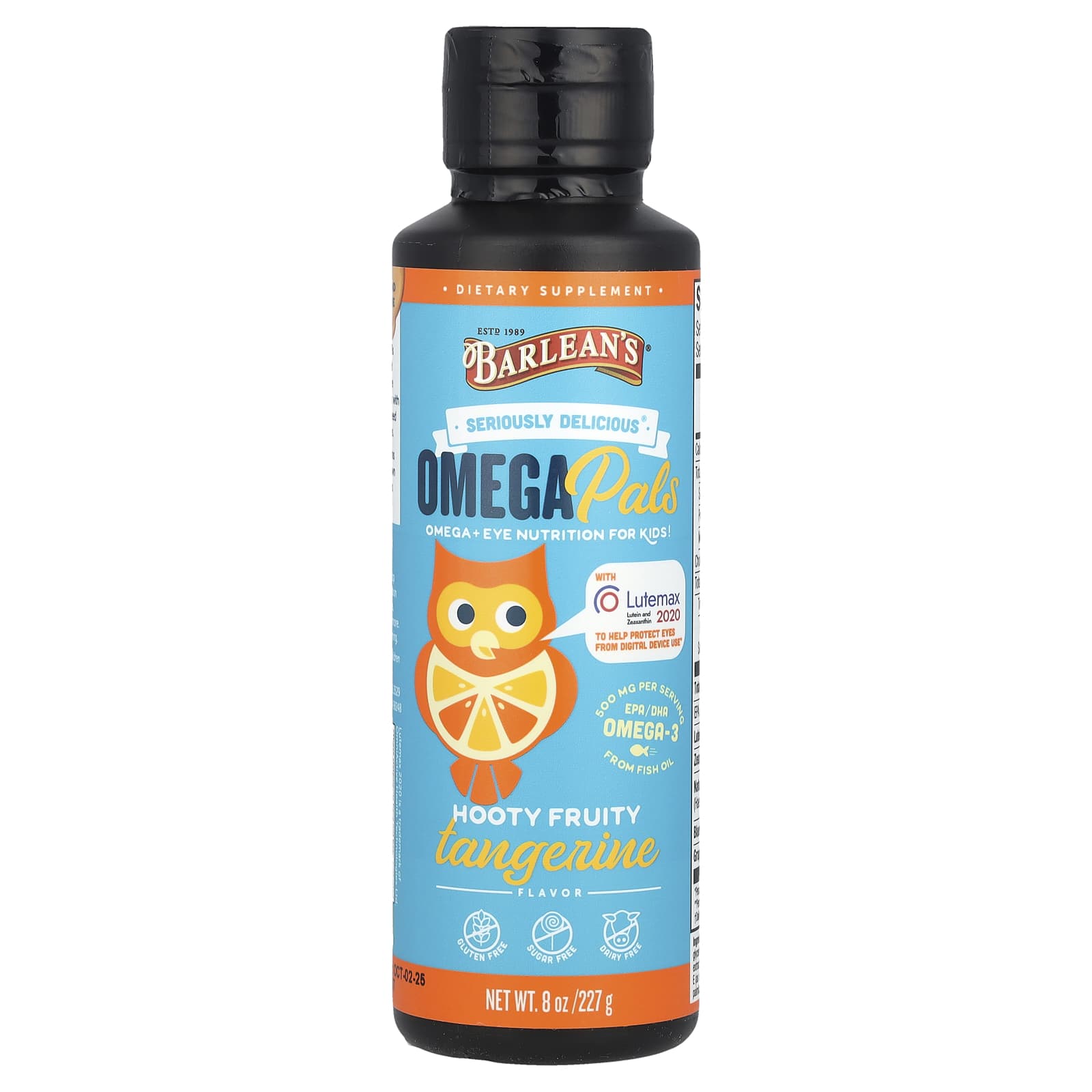
Barlean's Seriously Delicious · liquid

Omega Pals Hooty Fuity Tangerine Flavor

At the recorded label maximum: 1.33 servings (7.95 mL [1.5 Tsp] each) per day

Add to my list
Per dayDaily cost unavailable

Daily cost unavailable

Per pack$22.99

8 ounces; 227 g · Barlean's · checked 15 Nov 2026. Delivery is not included.

Per 100 g$10.13

Pack price divided by the pack size, shown per 100 g.

Composition

Amounts at the recorded label maximum. Directions may give a range.

Omega-3 Polyunsaturated Fat
831.25 mgat the recorded label maximum (1.33 servings × 625 mg; 7.95 mL [1.5 Tsp] per serving)
No limit on file for the United StatesNone on file in any country
Eicosapentaenoic Acid
404.32 mgat the recorded label maximum (1.33 servings × 304 mg; 7.95 mL [1.5 Tsp] per serving)
No limit on file for the United StatesNone on file in any country
Eicosapentaenoic Acid
404.32 mgat the recorded label maximum (1.33 servings × 304 mg; 7.95 mL [1.5 Tsp] per serving)
No limit on file for the United StatesNone on file in any country
260.68 mgat the recorded label maximum (1.33 servings × 196 mg; 7.95 mL [1.5 Tsp] per serving)
No limit on file for the United States
Limits in other countries (1)Switzerland
260.68 mgat the recorded label maximum (1.33 servings × 196 mg; 7.95 mL [1.5 Tsp] per serving)
No limit on file for the United States
Limits in other countries (1)Switzerland
Other Omega-3 Fatty Acids
166.25 mgat the recorded label maximum (1.33 servings × 125 mg; 7.95 mL [1.5 Tsp] per serving)
No limit on file for the United StatesNone on file in any country
Other Omega-3 Fatty Acids
166.25 mgat the recorded label maximum (1.33 servings × 125 mg; 7.95 mL [1.5 Tsp] per serving)
No limit on file for the United StatesNone on file in any country
Luteinas Marigold
7.98 mgat the recorded label maximum (1.33 servings × 6 mg; 7.95 mL [1.5 Tsp] per serving)
No limit on file for the United States
Limits in other countries (3)Croatia, Eurasian Economic Union (EAEU), Switzerland
Luteinas Marigold
7.98 mgat the recorded label maximum (1.33 servings × 6 mg; 7.95 mL [1.5 Tsp] per serving)
No limit on file for the United States
Limits in other countries (3)Croatia, Eurasian Economic Union (EAEU), Switzerland
1.33 mgat the recorded label maximum (1.33 servings × 1 mg; 7.95 mL [1.5 Tsp] per serving)
No limit on file for the United States
Limits in other countries (2)Eurasian Economic Union (EAEU), Switzerland
1.33 mgat the recorded label maximum (1.33 servings × 1 mg; 7.95 mL [1.5 Tsp] per serving)
No limit on file for the United States
Limits in other countries (2)Eurasian Economic Union (EAEU), Switzerland
natural Astaxanthinas Haematococcus pluvialis
1.33 mgat the recorded label maximum (1.33 servings × 1 mg; 7.95 mL [1.5 Tsp] per serving)
No limit on file for the United States
Limits in other countries (1)Eurasian Economic Union (EAEU)
natural Astaxanthinas Haematococcus pluvialis
1.33 mgat the recorded label maximum (1.33 servings × 1 mg; 7.95 mL [1.5 Tsp] per serving)
No limit on file for the United States
Limits in other countries (1)Eurasian Economic Union (EAEU)
Blueberry extract
49.21 mgat the recorded label maximum (1.33 servings × 37 mg; 7.95 mL [1.5 Tsp] per serving)
No limit on file for the United StatesNone on file in any country
Blueberry extract
49.21 mgat the recorded label maximum (1.33 servings × 37 mg; 7.95 mL [1.5 Tsp] per serving)
No limit on file for the United StatesNone on file in any country
Grape seed extract
17.29 mgat the recorded label maximum (1.33 servings × 13 mg; 7.95 mL [1.5 Tsp] per serving)
No limit on file for the United StatesNone on file in any country
Grape seed extract
17.29 mgat the recorded label maximum (1.33 servings × 13 mg; 7.95 mL [1.5 Tsp] per serving)
No limit on file for the United StatesNone on file in any country

Where no limit is shown, none is set or on file for the United States. That is not the same as having no maximum.

Manufacturer's directions

Suggested use: 1 1/2 tsp daily. Slurp from a spoon or mix into smoothies; yogurt; oatmeal and more. Shake well

Other ingredients on the label

Water, Fish Oil (Anchovy, and/or Mackerel, Sardine), Xylitol, Glycerine, Gum Arabic, Natural flavors, Lutemax 2020 (Marigold flower extract), Citric Acid, Xanthan Gum, Antioxidant Blend (and Ascorbyl Palmitate, Rosemary extract, Vitamin E), natural Astaxanthin, Guar Gum, Sorbic Acid
Limits in other countries
CountryDocosahexaenoic AcidLuteinZeaxanthin Isomersnatural Astaxanthin
Croatia—not on file20 mglaw · 80%—not on file—not on file
EAEU—not on file10 mglaw · 160% · above3 mglaw · 89%6 mglaw · 44%
Switzerland1,000 mglaw · 52%20 mglaw · 80%2 mglaw · 133% · above—not on file

Maximum amounts per daily dose of a food supplement, as each country sets them; the share is the daily amount on the label against that maximum. Law = legally binding; recommendation = an authority's recommended maximum, not binding; reference = the U.S. upper intake level for adults from all sources (National Academies), not a legal limit. Verification level V0 · Report an error

About the ingredients

Ingredient information

Ingredient guideDHA (docosahexaenoic acid)DHA, or docosahexaenoic acid, is an omega-3 fatty acid with 22 carbon atoms. Microalgae make it, and fish take it up through the food chain. Supplements contain DHA from fish oil or from algal oil, alone or together with EPA, another omega-3.Read moreShow less
Terms and sources
omega-3 fatty acid
A polyunsaturated fat with its first double bond three carbons from the end of the chain. NIH Office of Dietary Supplements.

DHA in the body

DHA is written C22:6n-3: 22 carbon atoms and 6 double bonds. It is especially high in the retina, the brain and sperm, NIH notes. LPI calls DHA the predominant polyunsaturated fat in the retina and in nerve cells. The retina conserves and recycles DHA even when omega-3 intake is low, LPI notes. NIH names DHA and arachidonic acid, an omega-6, as the two most prevalent long-chain polyunsaturated fats in the brain.

Terms and sources
C22:6n-3
The n-3 means the first double bond is three carbons from the methyl end. NIH Office of Dietary Supplements.
retina
The light-sensing layer at the back of the eye.
LPI
Linus Pauling Institute, page on essential fatty acids.

NIH notes that DHA accumulates most rapidly during the third trimester of pregnancy. The body makes only small amounts of DHA from ALA, the plant omega-3. DHA can also be turned back into EPA. The page Omega-3 fatty acids covers the whole family, EPA and the forms of fish oil.

Terms and sources
third trimester
NIH adds that DHA in the retina is complete by birth. The brain keeps adding DHA for the first 2 years.
small amounts
In separate studies, young men converted 0–4% of ALA to DHA, and young women about 9%. Linus Pauling Institute.
turned back into EPA
Six weeks of 1.62 g of DHA a day: an estimated 7.4–11.4% by serum fats. By platelet fats, 12.3–13.8%. Linus Pauling Institute.

Information, not a prescription. Do not start, stop or combine supplements or medicines on your own.

Ingredient guideLuteinLutein is a yellow carotenoid, a pigment that plants make. Dark green leafy vegetables such as spinach and kale are rich food sources. In the eye, lutein and its close relative zeaxanthin collect in the macula, the center of the retina. Supplements contain it as free lutein or as lutein esters, often together with zeaxanthin.Read moreShow less
Terms and sources
carotenoid
One of a family of more than 750 yellow, orange and red pigments. Linus Pauling Institute.

Lutein in the body

Lutein belongs to the xanthophylls, carotenoids that contain oxygen. The body cannot turn lutein into vitamin A. Lutein and zeaxanthin are isomers: the same atoms in a slightly different arrangement.

Terms and sources
xanthophylls
Zeaxanthin is also a xanthophyll. Linus Pauling Institute.
vitamin A
Lutein, zeaxanthin and lycopene have no vitamin A activity; beta-carotene has. Linus Pauling Institute.
isomers
Some food analyses do not separate the two and report them as lutein + zeaxanthin.

In the macula, lutein, zeaxanthin and meso-zeaxanthin form the macular pigment. Depending on its density, the macular pigment absorbs up to 90% of blue light. Lutein and zeaxanthin in the eye come only from the diet. Lutein and zeaxanthin are also the only carotenoids in the lens of the eye.

Terms and sources
meso-zeaxanthin
Made in the body from lutein. Linus Pauling Institute.
up to 90%
Linus Pauling Institute.
lens
The clear part of the eye that focuses light on the retina.

Lutein also collects in the brain. Studies measure the macular pigment as optical density, on a scale from 0 to 1.

Terms and sources
in the brain
Linus Pauling Institute. Levels in the macula and in the brain are correlated in some studies.
optical density
Macular pigment optical density, MPOD. It reflects the lutein and zeaxanthin in the macula. Wilson et al., 2021.

Information, not a prescription. Do not start, stop or combine supplements or medicines on your own.

Ingredient guideZeaxanthinZeaxanthin is a yellow carotenoid, a pigment that plants make. Yellow corn, bell peppers and egg yolk are sources of it. In the eye, zeaxanthin and its close relative lutein collect in the macula, the center of the retina. Many supplements pair it with a larger amount of lutein; some contain zeaxanthin alone.Read moreShow less
Terms and sources
carotenoid
One of a family of more than 750 yellow, orange and red pigments. Linus Pauling Institute.
sources of it
Linus Pauling Institute. Dark green leafy vegetables are rich in lutein but low in zeaxanthin.
some contain zeaxanthin alone
Linus Pauling Institute.

Zeaxanthin in the body

Zeaxanthin belongs to the xanthophylls, carotenoids that contain oxygen. The body cannot turn zeaxanthin into vitamin A. Zeaxanthin and lutein are isomers: the same atoms in a slightly different arrangement.

Terms and sources
xanthophylls
Lutein is also a xanthophyll. Linus Pauling Institute.
vitamin A
Lutein, zeaxanthin and lycopene have no vitamin A activity; beta-carotene has. Linus Pauling Institute.
isomers
Some food analyses do not separate the two and report them as lutein + zeaxanthin. Linus Pauling Institute.

In the macula, zeaxanthin, lutein and meso-zeaxanthin form the macular pigment. Depending on its density, the macular pigment absorbs up to 90% of blue light. Zeaxanthin and lutein in the eye come only from the diet. Zeaxanthin and lutein are also the only carotenoids in the lens of the eye.

Terms and sources
meso-zeaxanthin
Made in the body from lutein. Linus Pauling Institute.
up to 90%
Linus Pauling Institute.
lens
The clear part of the eye that focuses light on the retina.

Studies measure the macular pigment as optical density, on a scale from 0 to 1.

Terms and sources
optical density
Macular pigment optical density, MPOD. It reflects the lutein and zeaxanthin in the macula. Wilson et al., 2021.

Information, not a prescription. Do not start, stop or combine supplements or medicines on your own.

Ingredient guideAstaxanthinAstaxanthin is a red carotenoid, a fat-soluble pigment made by some algae and yeasts. It is found in the flesh of salmon and trout and in the shells of shrimp and other crustaceans. Astaxanthin can come from the alga Haematococcus pluvialis, from yeast or from chemical synthesis. It comes free or as esters, bound to fatty acids.Read moreShow less
Terms and sources
carotenoid
One of a family of more than 750 pigments. Linus Pauling Institute.
in the shells
Park et al., 2010.
chemical synthesis
Ambati et al., 2014. The synthetic form differs chemically from algae astaxanthin (Brendler and Williamson, 2019).
esters
See the forms below. Ambati et al., 2014.

Astaxanthin in the body

Astaxanthin belongs to the xanthophylls, carotenoids that contain oxygen. Its molecule has two rings, each with a hydroxyl and a keto group, joined by a long chain. The body cannot turn astaxanthin into vitamin A.

Terms and sources
xanthophylls
Ambati et al., 2014.
keto group
Its chemical name is 3,3'-dihydroxy-β,β-carotene-4,4'-dione. Molar mass 596.84 g/mol. Ambati et al., 2014.
vitamin A
It has no provitamin A activity in people, unlike beta-carotene. Ambati et al., 2014.

After a dose with a meal, astaxanthin travels in the blood with fat-carrying particles. In a study of 3 men given 100 mg, levels peaked at about 7 hours and halved in 21 hours. Astaxanthin esters are split during absorption; only free astaxanthin was found in the blood.

Terms and sources
fat-carrying particles
In 3 men given 100 mg: 36–64% in VLDL and chylomicrons, 29% in LDL, 24% in HDL. Østerlie et al., 2000.
halved in 21 hours
Østerlie et al., 2000: elimination half-life 21 ± 11 hours. It was about 16 hours in 32 men (Mercke Odeberg et al., 2003). In 3 other men given esters, it was about 52 hours (Coral-Hinostroza et al., 2004).
only free astaxanthin
3 men given astaxanthin diesters; no esters were detected in plasma. Coral-Hinostroza et al., 2004.

Information, not a prescription. Do not start, stop or combine supplements or medicines on your own.

Need help choosing?

Choose the option that suits you.

Quick selection

I know my goal

$5

1–2 minutes · a few questions with fixed answers

One goal. Up to three products. Set a budget per day if you like.

Product checks
form and amount on the label, plus shop prices
Daily schedule
what to take, when, how much
Totals and limits
next to the upper limit
Reasons & sources
for each product
Prices and shops
plus food and habits
Progress
what to track, when to see a doctor

Complete the questionnaire before you pay. If no product fits any of your goals, you won’t be charged.

Order · $5View example

Full selection

I have several goals

$15

5–7 minutes · questionnaire with fixed answers

Up to three goals in one set. Where two goals overlap, one product is used for both.

Product checks
form and amount on the label, plus shop prices
Daily schedule
what to take, when, how much
Totals and limits
next to the upper limit
Reasons & sources
for each product
Prices and shops
plus food and habits
Progress
what to track, when to see a doctor

Complete the questionnaire before you pay. If no product fits any of your goals, you won’t be charged.

Order · $15View example

Expert review

I want a person to look at my supplements

$50

Written review within 48 hours of your completed questionnaire

An expert reviews your supplement list and questionnaire.

Written review
duplicates, limits, forms
Detailed questionnaire
supplements, medicines, history
Optional uploads
supplement-label photos or documents relevant to your review
Your notes
your priorities and questions
Follow-up questions
in writing, when needed
Next steps
points to discuss with your doctor

Complete the questionnaire before you pay.

Order · $50View example
Sources, label & certificates

Label record

Copied from the NIH label database (DSLD 291843) · not yet compared with the label · checked 2 Nov 2026 · Report an error

The United States has no pre-market registration for supplements.
Label on file in the NIH Dietary Supplement Label Database
checked 2 Nov 2026source: NIH DSLDReport an error

Barcode 7 05875 80105 8

Third-party certificates

No third-party certificate on file for this product.

Information, not a prescription. Do not start, stop or combine supplements or medicines on your own. If you have a health condition, are pregnant or breastfeeding, take medicines, or are under 18, talk to a doctor or pharmacist first.

Photo credits

Image: © Barlean's Seriously Delicious. Shown to identify the product. Source: iherb.com

Rights holders can ask us to remove an image or send official product photos: info@verateca.com.

Product photo

Barlean's Seriously Delicious Omega Pals Hooty Fuity Tangerine Flavor — enlarged pack