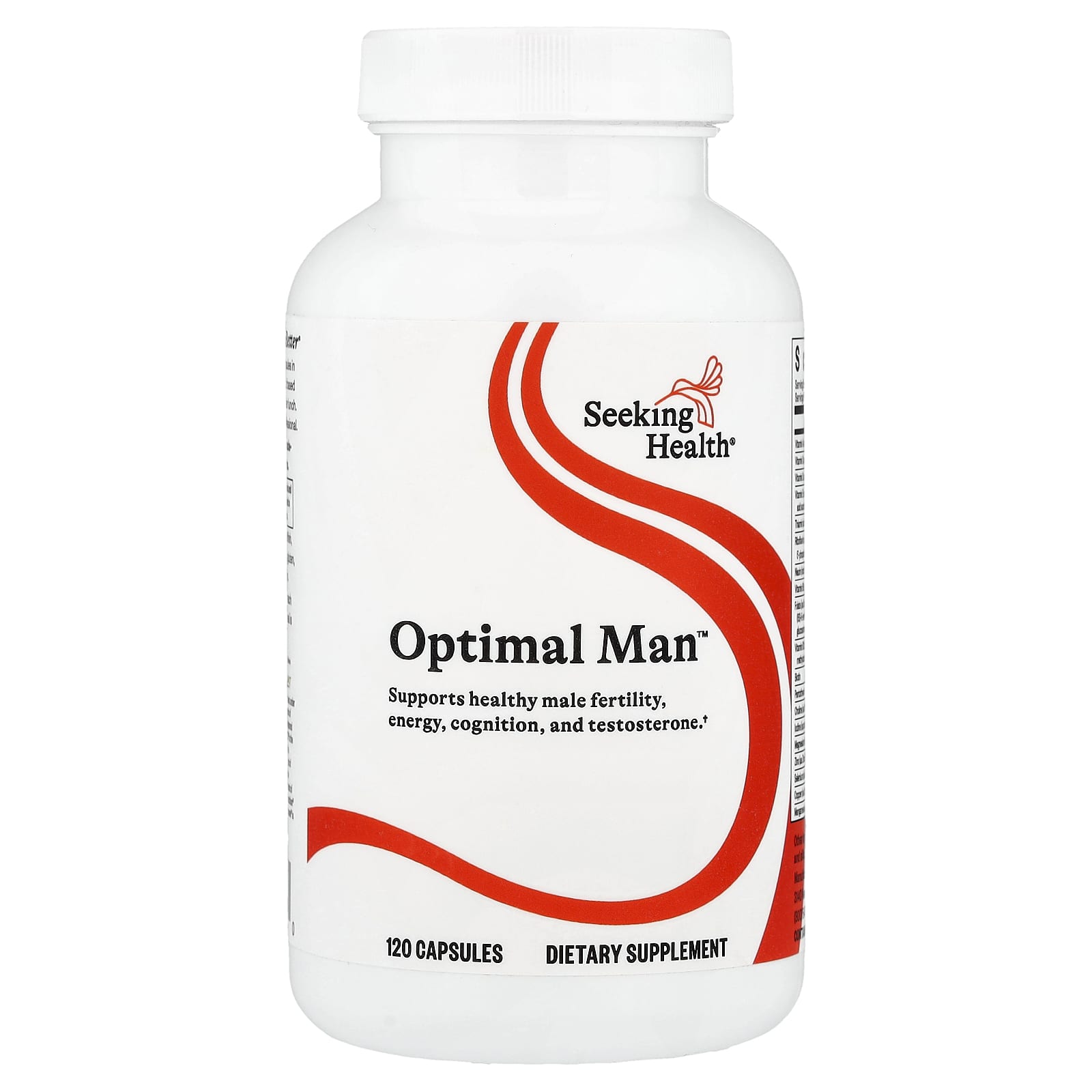
Seeking Health · capsules

Optimal Man

At the recorded label maximum: 4 capsules per day

Add to my list
Per day$2.33

At the label maximum of 4 capsules a day.

Per pack$70.00

120 capsules · Vitacost · checked 22 Oct 2026. Delivery is not included.

Per capsule$0.58

Pack price divided by the number of capsules in the pack.

Composition

Amounts at the recorded label maximum. Directions may give a range.

Vitamin Aas Beta-Carotene | Retinyl Palmitate
1.5 mgat the recorded label maximum (1 serving × 1.5 mg; 4 capsules per serving)375 mcg per capsule · calculated from 1.5 mg per 4 capsules
Not compared with 3 mg — US upper limit for adults, National Academiesthe limit counts retinol only · a reference value, not a legal limit
Vitamin Cas Ascorbic Acid
100 mgat the recorded label maximum (1 serving × 100 mg; 4 capsules per serving)25 mg per capsule · calculated from 100 mg per 4 capsules
5% of 2,000 mg — US upper limit for adults, National Academiesfrom food and supplements, adults · food is not counted here · a reference value, not a legal limit
Vitamin D3as Cholecalciferol
About this formvitamin D3 (cholecalciferol). Raises vitamin D levels more than D2. Reference level V0; no form is called “better” here.
25 mcgat the recorded label maximum (1 serving × 25 mcg; 4 capsules per serving)6.25 mcg per capsule · calculated from 25 mcg per 4 capsules
25% of 100 mcg — US upper limit for adults, National Academiesfrom food and supplements, adults · food is not counted here · a reference value, not a legal limit
Vitamin Eas Novatol
45 mgat the recorded label maximum (1 serving × 45 mg; 4 capsules per serving)
5% of 1,000 mg — US upper limit for adults, National Academiesvitamin E from supplements, adults · a reference value, not a legal limit
Thiamineas Thiamine Hydrochloride
50 mgat the recorded label maximum (1 serving × 50 mg; 4 capsules per serving)12.5 mg per capsule · calculated from 50 mg per 4 capsules
No US upper limitNational Academies: not determined — too little data on harm
Limits in other countries (8)Austria, Croatia, Cyprus, Eurasian Economic Union (EAEU), France, Italy, Malta, Poland
Riboflavinas Riboflavin 5-Phosphate Sodium
5 mgat the recorded label maximum (1 serving × 5 mg; 4 capsules per serving)1.25 mg per capsule · calculated from 5 mg per 4 capsules
No US upper limitNational Academies: not determined — too little data on harm
Limits in other countries (8)Austria, Croatia, Cyprus, Eurasian Economic Union (EAEU), France, Italy, Malta, Poland
35 mgat the recorded label maximum (1 serving × 35 mg; 4 capsules per serving)8.75 mg per capsule · calculated from 35 mg per 4 capsules
100% of 35 mg — US upper limit for adults, National Academiesniacin from supplements, adults · a reference value, not a legal limit
Vitamin B6as Pyridoxal 5-Phosphate
15 mgat the recorded label maximum (1 serving × 15 mg; 4 capsules per serving)3.75 mg per capsule · calculated from 15 mg per 4 capsules
15% of 100 mg — US upper limit for adults, National Academiesfrom food and supplements, adults · food is not counted here · a reference value, not a legal limit
Folateas Calcium Folinate | Quatrefolic (6S)-5-Methyltetrahydrofolate, Glucosamine Salt
About this formL-5-methyltetrahydrofolate. Active form, used directly by the body. Reference level V0; no form is called “better” here.
680 mcgat the recorded label maximum (1 serving × 680 mcg; 4 capsules per serving)170 mcg per capsule · calculated from 680 mcg per 4 capsules
Not compared with 1,000 mcg — US upper limit for adults, National Academiesthe limit counts folic acid only · a reference value, not a legal limit
Vitamin B12as Adenosylcobalamin | Mecobalactive
About this formadenosylcobalamin. Reference level V0; no form is called “better” here.
100 mcgat the recorded label maximum (1 serving × 100 mcg; 4 capsules per serving)25 mcg per capsule · calculated from 100 mcg per 4 capsules
No US upper limitNational Academies: not determined — too little data on harm
Limits in other countries (9)Austria, Croatia, Cyprus, Eurasian Economic Union (EAEU), France, Germany, Italy, Malta, Poland
Cholineas Choline Bitartrate
150 mgat the recorded label maximum (1 serving × 150 mg; 4 capsules per serving)37.5 mg per capsule · calculated from 150 mg per 4 capsules
4% of 3,500 mg — US upper limit for adults, National Academiesfrom food and supplements, adults · food is not counted here · a reference value, not a legal limit
Iodineas Potassium Iodide
200 mcgat the recorded label maximum (1 serving × 200 mcg; 4 capsules per serving)50 mcg per capsule · calculated from 200 mcg per 4 capsules
18% of 1,100 mcg — US upper limit for adults, National Academiesfrom food and supplements, adults · food is not counted here · a reference value, not a legal limit
Magnesiumas Dimagnesium Malate
About this formmagnesium malate — about 16% of the compound is magnesium itself. Reference level V0; no form is called “better” here.
150 mgat the recorded label maximum (1 serving × 150 mg; 4 capsules per serving) · as magnesium itself37.5 mg per capsule · calculated from 150 mg per 4 capsules
43% of 350 mg — US upper limit for adults, National Academiesmagnesium from supplements, adults · a reference value, not a legal limit
Zincas Zinc Bisglycinate Chelate
About this formzinc bisglycinate — about 30% of the compound is zinc itself. Reference level V0; no form is called “better” here.
25 mgat the recorded label maximum (1 serving × 25 mg; 4 capsules per serving) · as zinc itself6.25 mg per capsule · calculated from 25 mg per 4 capsules
63% of 40 mg — US upper limit for adults, National Academiesfrom food and supplements, adults · food is not counted here · a reference value, not a legal limit
Seleniumas SelenoExcell High Selenium Yeast
100 mcgat the recorded label maximum (1 serving × 100 mcg; 4 capsules per serving)25 mcg per capsule · calculated from 100 mcg per 4 capsules
25% of 400 mcg — US upper limit for adults, National Academiesfrom food and supplements, adults · food is not counted here · a reference value, not a legal limit
Copperas Copper Bisglycinate Chelate
1.5 mgat the recorded label maximum (1 serving × 1.5 mg; 4 capsules per serving)375 mcg per capsule · calculated from 1.5 mg per 4 capsules
15% of 10 mg — US upper limit for adults, National Academiesfrom food and supplements, adults · food is not counted here · a reference value, not a legal limit
Manganeseas Manganese Bisglycinate Chelate
2 mgat the recorded label maximum (1 serving × 2 mg; 4 capsules per serving)500 mcg per capsule · calculated from 2 mg per 4 capsules
18% of 11 mg — US upper limit for adults, National Academiesfrom food and supplements, adults · food is not counted here · a reference value, not a legal limit
Chromiumas Chromium Picolinate
150 mcgat the recorded label maximum (1 serving × 150 mcg; 4 capsules per serving)37.5 mcg per capsule · calculated from 150 mcg per 4 capsules
No US upper limitNational Academies: not determined — too little data on harm
Limits in other countries (13)Austria, Belgium, Croatia, Cyprus, Denmark, Eurasian Economic Union (EAEU), France, Germany, Italy, Luxembourg, Malta, Poland, Switzerland
Acetyl L-Carnitine hydrochloride
250 mgat the recorded label maximum (1 serving × 250 mg; 4 capsules per serving)62.5 mg per capsule · calculated from 250 mg per 4 capsules
No limit on file for the United StatesNone on file in any country
Betaine Anhydrous
150 mgat the recorded label maximum (1 serving × 150 mg; 4 capsules per serving)37.5 mg per capsule · calculated from 150 mg per 4 capsules
No limit on file for the United States
Limits in other countries (3)Croatia, France, Switzerland
Ashwagandha Root Extract
About this formextract (standardized withanolides). Reference level V0; no form is called “better” here.
150 mgat the recorded label maximum (1 serving × 150 mg; 4 capsules per serving)37.5 mg per capsule · calculated from 150 mg per 4 capsules
No limit on file for the United StatesNone on file in any country
Maca; Powder
150 mgat the recorded label maximum (1 serving × 150 mg; 4 capsules per serving)37.5 mg per capsule · calculated from 150 mg per 4 capsules
No limit on file for the United StatesNone on file in any country
100 mgat the recorded label maximum (1 serving × 100 mg; 4 capsules per serving)25 mg per capsule · calculated from 100 mg per 4 capsules
No limit on file for the United StatesNone on file in any country
Alpha Lipoic Acid
50 mgat the recorded label maximum (1 serving × 50 mg; 4 capsules per serving)12.5 mg per capsule · calculated from 50 mg per 4 capsules
No limit on file for the United States
Limits in other countries (1)Eurasian Economic Union (EAEU)
25 mgat the recorded label maximum (1 serving × 25 mg; 4 capsules per serving)6.25 mg per capsule · calculated from 25 mg per 4 capsules
No limit on file for the United StatesNone on file in any country
Boronas Bororganic Glycine
5 mgat the recorded label maximum (1 serving × 5 mg; 4 capsules per serving)1.25 mg per capsule · calculated from 5 mg per 4 capsules
25% of 20 mg — US upper limit for adults, National Academiesfrom food and supplements, adults · food is not counted here · a reference value, not a legal limit
Mixed Tocopherols
About this formd-alpha-tocopherol (natural). 1 IU natural = 0.67 mg; synthetic 1 IU = 0.45 mg. Reference level V0; no form is called “better” here.
5 mgat the recorded label maximum (1 serving × 5 mg; 4 capsules per serving)
<1% of 1,000 mg — US upper limit for adults, National Academiesmixed tocopherols from supplements, adults · a reference value, not a legal limit
Luteinas Marigold flower extract
5 mgat the recorded label maximum (1 serving × 5 mg; 4 capsules per serving)1.25 mg per capsule · calculated from 5 mg per 4 capsules
No limit on file for the United States
Limits in other countries (3)Croatia, Eurasian Economic Union (EAEU), Switzerland
Zeaxanthinas Marigold flower extract
5 mgat the recorded label maximum (1 serving × 5 mg; 4 capsules per serving)1.25 mg per capsule · calculated from 5 mg per 4 capsules
No limit on file for the United States
Limits in other countries (2)Eurasian Economic Union (EAEU), Switzerland
Vitamin K2as Menaquinone-7
About this formvitamin K2 MK-7. Long-acting; dosed in micrograms. Reference level V0; no form is called “better” here.
100 mcgat the recorded label maximum (1 serving × 100 mcg; 4 capsules per serving)25 mcg per capsule · calculated from 100 mcg per 4 capsules
No US upper limitNational Academies: not determined — too little data on harm
Limits in other countries (12)Austria, Belgium, Croatia, Denmark, Eurasian Economic Union (EAEU), France, Germany, Italy, Luxembourg, Malta, Poland, Switzerland

Where no limit is shown, none is set or on file for the United States. That is not the same as having no maximum.
Manufacturer's directions

Suggested use: Take 4 capsules daily; with a meal; in divided doses; or use as directed by your healthcare professional. Do not take within 5 hours of bedtime as it may interfere with sleep.

Other ingredients on the label

Hypromellose, Water, Ascorbyl Palmitate

Limits in other countries
CountryVitamin AVitamin CVitamin D3Mixed Tocopherols
United States3,000 mcgreference, not a law · not compared2,000 mgreference, not a law · 5%100 mcgreference, not a law · 25%1,000 mgreference, not a law · 5%
Austria900 mcgrecommendation · 167% · above500 mgrecommendation · 20%20 mcgrecommendation · 125% · above24 mgrecommendation · 208% · above
Belgium1,200 mcglaw · 125% · above1,000 mglaw · 10%75 mcglaw · 33%39 mglaw · 128% · above
Croatia1,500 mcglaw · 100%800 mglaw · 13%10 mcglaw · 250% · above200 mglaw · 25%
Cyprus2,300 mcglaw · 65%2,000 mglaw · 5%10 mcglaw · 250% · above800 mglaw · 6%
Denmark—not on file1,000 mgrecommendation · 10%95 mcgrecommendation · 26%291 mgrecommendation · 17%
EAEU3,000 mcglaw · 50%900 mglaw · 11%15 mcglaw · 167% · above150 mglaw · 33%
Estonia3,000 mcgrecommendation · 50%—not on file100 mcgrecommendation · 25%300 mgrecommendation · 17%
Finland3,000 mcgrecommendation · 50%—not on file100 mcgrecommendation · 25%300 mgrecommendation · 17%
France800 mcglaw · 188% · above180 mglaw · 56%5 mcglaw · 500% · above30 mglaw · 167% · above
Germany200 mcgrecommendation · 750% · above250 mgrecommendation · 40%20 mcgrecommendation · 125% · above30 mgrecommendation · 167% · above
Ireland3,000 mcgrecommendation · 50%2,000 mgrecommendation · 5%100 mcgrecommendation · 25%300 mgrecommendation · 17%
Italy1,200 mcgrecommendation · 125% · above1,000 mgrecommendation · 10%50 mcgrecommendation · 50%60 mgrecommendation · 83%
Luxembourg1,200 mcglaw · 125% · above1,000 mglaw · 10%50 mcglaw · 50%18 mglaw · 278% · above
Malta1,500 mcgrecommendation · 100%1,000 mgrecommendation · 10%25 mcgrecommendation · 100%800 IUlaw · not compared
Netherlands1,200 mcglaw · 125% · above—not on file75 mcglaw · 33%—not on file
Norway—not on file1,000 mglaw · 10%80 mcglaw · 31%250 mglaw · 20%
Poland800 mcgrecommendation · 188% · above1,000 mgrecommendation · 10%50 mcgrecommendation · 50%250 mgrecommendation · 20%
Switzerland1,360 mcglaw · 110% · above750 mglaw · 13%70 mcglaw · 36%205 mglaw · 24%

Maximum amounts per daily dose of a food supplement, as each country sets them; the share is the daily amount on the label against that maximum. Law = legally binding; recommendation = an authority's recommended maximum, not binding; reference = the U.S. upper intake level for adults from all sources (National Academies), not a legal limit. Verification level V0 · 20 more ingredients have limits on file · Report an error

About the ingredients

Ingredient information

Ingredient guideVitamin AVitamin A is the name for a group of fat-soluble compounds, mainly retinol and retinyl esters. Animal foods contain it as preformed vitamin A; plants contain carotenoids, some of which the body converts into it. Supplements contain retinyl acetate, retinyl palmitate, beta-carotene or a combination. Amounts are given in mcg RAE; older labels used IU.Read moreShow less
Terms and sources
fat-soluble
They dissolve in fat, not in water. NIH Office of Dietary Supplements.
carotenoids
Provitamin A carotenoids: beta-carotene, alpha-carotene and beta-cryptoxanthin. NIH Office of Dietary Supplements.
mcg RAE
Micrograms of retinol activity equivalents. The unit counts how much retinol each form gives the body.

Vitamin A in the body

Vitamin A is part of rhodopsin, the protein in the retina that responds to light. It is needed for normal vision. It is also involved in immune function, cell communication, growth and development, and reproduction.

Terms and sources
rhodopsin
The light-sensitive pigment of the eye's rod cells, which see in dim light. NIH Office of Dietary Supplements; Linus Pauling Institute.
normal vision
NIH Office of Dietary Supplements. It is also needed for the normal surface of the eye.
cell communication
NIH Office of Dietary Supplements. Vitamin A takes part in the growth and specialization of cells.

The body turns retinol into retinal and retinoic acid, the two main active forms. Most of the body's vitamin A is stored in the liver as retinyl esters. Blood retinol levels stay steady until the stores in the liver are almost used up.

Terms and sources
retinoic acid
It switches genes on and off; Linus Pauling Institute counts more than 500 genes that respond to it.
retinyl esters
Retinol joined to a fatty acid, such as retinyl palmitate. NIH Office of Dietary Supplements.
stay steady
NIH Office of Dietary Supplements. So a blood test is not always a reliable guide to the stores. See Green 2016 below: normal blood retinol with low stores.

Plants make hundreds of carotenoids; only about 10% of them can be converted to retinol. The body converts beta-carotene into vitamin A in the gut, through an enzyme. Lutein, zeaxanthin and lycopene are carotenoids that the body does not convert into vitamin A.

Terms and sources
about 10%
Linus Pauling Institute.
an enzyme
Beta-carotene monooxygenase type 1 (BCMO1). Conversion rates may vary with genes. NIH Office of Dietary Supplements.
does not convert
NIH Office of Dietary Supplements calls them non-provitamin A carotenoids.

Information, not a prescription. Do not start, stop or combine supplements or medicines on your own.

Ingredient guideVitamin CVitamin C, also called L-ascorbic acid, is a water-soluble vitamin. Most animals make vitamin C in the body; humans cannot and get it from food. Fruits and vegetables such as peppers, citrus fruits and kiwifruit are the main sources. Supplements contain it as ascorbic acid or as mineral salts such as sodium and calcium ascorbate.Read moreShow less
Terms and sources
water-soluble
It dissolves in water, not in fat. NIH Office of Dietary Supplements.

Vitamin C in the body

Vitamin C is needed to make collagen, carnitine and some neurotransmitters. It is also an antioxidant and can return used vitamin E to its active form. It is needed for normal immune function. It increases the absorption of iron from plant foods.

Terms and sources
collagen
A protein that holds together connective tissue, such as skin, tendons and blood vessels. NIH Office of Dietary Supplements.
carnitine
A substance cells need to get energy from fat. Linus Pauling Institute.
neurotransmitters
Chemical messengers between nerve cells.
antioxidant
A substance that limits damage from free radicals, reactive molecules made in cells.
iron from plant foods
Nonheme iron, the only form of iron in plant foods. NIH Office of Dietary Supplements.

An adult body holds from about 300 mg to about 2 g of vitamin C. White blood cells, the eyes, the adrenal and pituitary glands and the brain hold the most. Cells hold vitamin C in millimolar concentrations, blood plasma in micromolar concentrations. At 100 mg a day or more, cells appear to be saturated.

Terms and sources
about 300 mg
The lower figure is for very low intake. NIH Office of Dietary Supplements.
adrenal and pituitary glands
Small glands that make hormones: the adrenals sit above the kidneys, the pituitary below the brain.
millimolar
Thousandths of a mole per liter; micromolar means millionths. NIH Office of Dietary Supplements.
saturated
Holding as much as they take up. Above 200 mg a day, blood plasma levels rise little more.

The body absorbs about 70–90% of vitamin C at 30–180 mg a day. Above 1 g a day, less than 50% is absorbed, and unused vitamin C leaves in urine.

Terms and sources
less than 50%
Summary by the NIH Office of Dietary Supplements. Absorption in the gut runs through a dose-dependent transporter protein.

Information, not a prescription. Do not start, stop or combine supplements or medicines on your own.

Ingredient guideVitamin DVitamin D is a fat-soluble vitamin. The skin makes it when ultraviolet light from the sun reaches it, and a few foods contain it. Supplements contain one or both of its two main forms: vitamin D3 and vitamin D2. Labels state the amount in micrograms (mcg), international units (IU) or both.Read moreShow less
Terms and sources
fat-soluble
It dissolves in fat, not in water. NIH Office of Dietary Supplements.

Vitamin D in the body

Vitamin D from the sun, food and supplements is inactive at first. The liver turns it into 25-hydroxyvitamin D, the form a blood test measures. Mainly the kidneys then make the active form.

Terms and sources
25-hydroxyvitamin D
Also called calcidiol or 25(OH)D. Results come in nmol/L or ng/mL; 50 nmol/L equals 20 ng/mL.
active form
1,25-dihydroxyvitamin D, also called calcitriol.

Vitamin D is needed for normal absorption of calcium from the gut and for normal bones. It is also needed for normal muscle and immune function. Many tissues in the body carry vitamin D receptors.

Terms and sources
vitamin D receptors
Proteins in cells that respond to the active form of vitamin D. NIH Office of Dietary Supplements.

Information, not a prescription. Do not start, stop or combine supplements or medicines on your own.

Ingredient guideVitamin EVitamin E is the name for eight fat-soluble compounds: four tocopherols and four tocotrienols. Alpha-tocopherol is the only form recognized to meet human needs for vitamin E. Nuts, seeds and vegetable oils are rich food sources. Supplements contain natural (d-) or synthetic (dl-) alpha-tocopherol, often as an acetate or succinate.Read moreShow less
Terms and sources
fat-soluble
They dissolve in fat, not in water. NIH Office of Dietary Supplements.
acetate or succinate
Esters: alpha-tocopherol joined to acetic or succinic acid, which keeps it longer in storage.

Vitamin E in the body

Vitamin E is an antioxidant that stops a chain reaction of fat oxidation in cell membranes. Vitamin C can return used vitamin E to its active form. Vitamin E is also involved in immune function; studies in cells show roles in cell signaling.

Terms and sources
chain reaction of fat oxidation
Free radicals damage fats in cell membranes, and each damaged fat can damage the next. Alpha-tocopherol stops this chain. Linus Pauling Institute.
Vitamin C
Linus Pauling Institute.
studies in cells
Mainly test-tube studies of cells. NIH Office of Dietary Supplements.

After absorption, the liver sends alpha-tocopherol back into the blood and breaks down the other forms. So blood and cells hold less of the other forms than of alpha-tocopherol.

Terms and sources
sends alpha-tocopherol back
Through the alpha-tocopherol transfer protein in the liver. NIH Office of Dietary Supplements.

In one study with labeled vitamin E, healthy women absorbed about 55% of a dose. Vitamin E takes 9–12 hours to pass from a meal into the blood. The liver replaces the whole pool of alpha-tocopherol in blood plasma every day.

Terms and sources
about 55%
Linus Pauling Institute, citing Traber 2019. The dose was taken with a liquid meal. The rest left in the stool. A published correction to that article added missing supplementary files only.
9–12 hours
It travels from the gut in fat particles called chylomicrons; a later meal speeds this up. Linus Pauling Institute.
every day
Linus Pauling Institute.

Information, not a prescription. Do not start, stop or combine supplements or medicines on your own.

Ingredient guideRiboflavin (Vitamin B2)Riboflavin, also called vitamin B2, is a water-soluble B vitamin. The body turns it into two coenzymes, FMN and FAD, which take part in energy production. It is found in eggs, organ meats, milk and fortified grains. Supplements contain riboflavin or riboflavin 5'-phosphate sodium.Read moreShow less
Terms and sources
water-soluble
It dissolves in water, not in fat. NIH Office of Dietary Supplements.
FMN and FAD
Flavin mononucleotide, also called riboflavin 5'-phosphate, and flavin adenine dinucleotide. NIH Office of Dietary Supplements.

Riboflavin in the body

Riboflavin is part of two coenzymes, FMN and FAD. They play major roles in energy production; cell function, growth and development; and the metabolism of fats, drugs and steroids. The body needs FAD to make niacin from the amino acid tryptophan. It needs FMN to turn vitamin B6 into its active form.

Terms and sources
two coenzymes
More than 90% of riboflavin in the diet is already in these two forms. NIH Office of Dietary Supplements.
energy production
NIH Office of Dietary Supplements.
niacin
Vitamin B3. NIH Office of Dietary Supplements.
active form
Pyridoxal 5'-phosphate. NIH Office of Dietary Supplements.

Riboflavin is yellow and glows under ultraviolet light. Light also breaks it down quickly. Milk in a clear glass bottle can lose up to 50% of its riboflavin in two hours of bright sunlight.

Terms and sources
glows
It is naturally fluorescent. NIH Office of Dietary Supplements.
breaks it down
Both ultraviolet and visible light. NIH Office of Dietary Supplements.
clear glass bottle
Linus Pauling Institute, Oregon State University. NIH notes that this is why milk is not usually stored in glass.

Most riboflavin is absorbed in the upper small intestine. The body stores only small amounts. When a person takes in more, the excess is not absorbed or leaves in the urine. Bacteria in the large intestine also make riboflavin, more after plant-based meals than after meat-based ones.

Terms and sources
upper small intestine
The proximal small intestine. NIH Office of Dietary Supplements.
leaves in the urine
NIH Office of Dietary Supplements.
Bacteria in the large intestine
They make free riboflavin, and the large intestine can absorb some of it. NIH Office of Dietary Supplements.

Riboflavin status is not routinely measured in healthy people. The usual blood test, EGRAC, shows how much a red blood cell enzyme speeds up when FAD is added. Healthy adults with enough riboflavin pass at least 120 mcg of it a day in the urine. LPI notes that, in people with enough riboflavin, supplements have not generally been found to increase exercise tolerance or performance.

Terms and sources
not routinely measured
NIH Office of Dietary Supplements.
EGRAC
Erythrocyte glutathione reductase activity coefficient. A value of 1.2 or less usually indicates adequate riboflavin status. NIH Office of Dietary Supplements; LPI notes that the test is commonly used.
120 mcg
NIH Office of Dietary Supplements.
LPI notes
Linus Pauling Institute, Oregon State University.

Information, not a prescription. Do not start, stop or combine supplements or medicines on your own.

Ingredient guideNiacin (vitamin B3)Niacin, also called vitamin B3, is a B vitamin that dissolves in water. The body turns it into NAD, a coenzyme that more than 400 enzymes need. Supplements contain nicotinic acid, niacinamide or inositol hexanicotinate, which is often sold as no-flush niacin. Amounts are counted in niacin equivalents, which include niacin the body makes from tryptophan.Read moreShow less
Terms and sources
vitamin B3
Niacin is the general name for nicotinic acid, nicotinamide and related compounds. NIH Office of Dietary Supplements.
coenzyme
A small molecule that an enzyme needs to run its reaction.
niacinamide
Another name for nicotinamide.
niacin equivalents
1 mg of niacin, or 60 mg of tryptophan, counts as 1 mg NE. NIH Office of Dietary Supplements.

Niacin in the body

All tissues in the body convert niacin into NAD, its main active form. More than 400 enzymes need NAD, more than for any other vitamin-derived coenzyme. NAD carries energy from carbohydrates, fats and proteins to ATP, the cell's energy currency. NADP, a second active form, is needed to make cholesterol and fatty acids.

Terms and sources
NAD
Nicotinamide adenine dinucleotide. NIH Office of Dietary Supplements.
400 enzymes
NIH Office of Dietary Supplements.
ATP
Adenosine triphosphate. NIH Office of Dietary Supplements.
NADP
Nicotinamide adenine dinucleotide phosphate. All tissues except skeletal muscle make it from NAD. NIH Office of Dietary Supplements.

Niacin is the general name for nicotinic acid, nicotinamide and related compounds. None of them is related to the nicotine in tobacco, despite the similar names. The body makes NAD from nicotinamide in two steps and from nicotinic acid in three.

Terms and sources
related compounds
Such as nicotinamide riboside. NIH Office of Dietary Supplements.
nicotine in tobacco
Linus Pauling Institute.
two steps
Two enzyme reactions; the route from nicotinic acid has three. Linus Pauling Institute.

The body absorbs almost all niacin, even from doses of 3–4 g. The liver changes the remaining excess into compounds that leave the body in urine. Blood niacin levels are not a reliable guide to how much niacin the body has. Researchers measure two niacin breakdown products in urine instead.

Terms and sources
almost all niacin
Mostly in the small intestine, some in the stomach. NIH Office of Dietary Supplements.
remaining excess
Red blood cells keep some excess as a reserve. NIH Office of Dietary Supplements.
compounds
Methylated products such as N1-methyl-nicotinamide. NIH Office of Dietary Supplements.
not a reliable guide
NIH Office of Dietary Supplements.
two niacin breakdown products
N1-methyl-nicotinamide and N1-methyl-2-pyridone-5-carboxamide. NIH calls it "the most sensitive and reliable measure of niacin status."

Information, not a prescription. Do not start, stop or combine supplements or medicines on your own.

Ingredient guideVitamin B6Vitamin B6 is the name for six related water-soluble compounds: pyridoxine, pyridoxal, pyridoxamine and their phosphate forms. Its main active form, pyridoxal 5'-phosphate (PLP), is a helper molecule for more than 100 enzymes. Supplements most often contain pyridoxine hydrochloride; some contain PLP, also called P5P. Vitamin B6 is also in multivitamins and B complex products.Read moreShow less
Terms and sources
water-soluble
They dissolve in water, not in fat. NIH Office of Dietary Supplements.
helper molecule
A coenzyme: a small molecule an enzyme needs to work. Linus Pauling Institute.
pyridoxine hydrochloride
NIH Office of Dietary Supplements names it the most common form in supplements.

Vitamin B6 in the body

Vitamin B6 takes part in more than 100 enzyme reactions, mostly in the metabolism of protein. It is involved in making neurotransmitters, the chemical messengers of the nervous system. It is also involved in immune function and in making hemoglobin, the oxygen carrier in red blood cells.

Terms and sources
more than 100 enzyme reactions
NIH Office of Dietary Supplements. It also works in the metabolism of carbohydrates and fats.
neurotransmitters
Serotonin, dopamine and GABA among them. Linus Pauling Institute.
immune function
NIH Office of Dietary Supplements.

The human body cannot make vitamin B6, so it must come from food. PLP is a helper in over 4% of all enzyme reactions. Much of the body's PLP sits in muscle, bound to the enzyme that releases glucose from stored glycogen.

Terms and sources
cannot make vitamin B6
Linus Pauling Institute.
over 4%
Linus Pauling Institute.
the enzyme
Glycogen phosphorylase. Linus Pauling Institute.

Blood PLP is the most common measure of vitamin B6 status. Levels above 30 nmol/L have been the traditional sign of enough vitamin B6 in adults.

Terms and sources
Blood PLP
Plasma pyridoxal 5'-phosphate. NIH Office of Dietary Supplements.
30 nmol/L
NIH Office of Dietary Supplements.

Information, not a prescription. Do not start, stop or combine supplements or medicines on your own.

Ingredient guideFolateFolate is a water-soluble B vitamin, also called vitamin B9. It occurs naturally in many foods. Folic acid is the synthetic form used in most supplements and in fortified foods. Some supplements contain L-methylfolate or folinic acid instead. Folate is also in multivitamins, prenatal vitamins and B complex products.Read moreShow less
Terms and sources
water-soluble
It dissolves in water, not in fat. NIH Office of Dietary Supplements.
synthetic form
NIH Office of Dietary Supplements: the fully oxidized form of the vitamin.
L-methylfolate
Also called 5-MTHF or L-5-methyltetrahydrofolate. NIH Office of Dietary Supplements.
prenatal vitamins
NIH Office of Dietary Supplements lists these product types.

Folate in the body

Folate is a helper molecule that moves single carbon units between other molecules. It is needed to make DNA and RNA and to process amino acids. Folate and vitamin B12 work in the same step that turns homocysteine into the amino acid methionine.

Terms and sources
helper molecule
A coenzyme. NIH Office of Dietary Supplements. The name comes from foliage: green leafy vegetables are rich in folate, Linus Pauling Institute.
DNA and RNA
NIH Office of Dietary Supplements: folate is required for proper cell division.
same step
Methionine synthase needs both folate, as 5-methyltetrahydrofolate, and vitamin B12. Linus Pauling Institute.

Folic acid is not active until the body converts it into natural folates. The main form of folate in blood plasma is L-methylfolate. When the converting enzyme is at capacity, unconverted folic acid appears in the blood. A US national survey found unconverted folic acid in 96% of blood samples.

Terms and sources
not active
Linus Pauling Institute: folic acid "has no biological activity unless converted into folates".
main form
NIH Office of Dietary Supplements.
converting enzyme
Dihydrofolate reductase. Its activity varies greatly between people. NIH Office of Dietary Supplements.
96% of blood samples
Serum samples, NHANES 2007–2008, people aged 1 year and older. Linus Pauling Institute.

The body holds about 15 to 30 mg of folate, about half of it in the liver. Gut bacteria also make folate; how much of it the body uses is unclear. Red blood cell folate reflects intake over the longer term; folate in the blood fluid reflects recent intake. Blood homocysteine is a common marker of folate status, though vitamin B12 and other factors also affect it.

Terms and sources
15 to 30 mg
NIH Office of Dietary Supplements.
Gut bacteria
NIH Office of Dietary Supplements: folate made in the colon can be absorbed there.
Red blood cell folate
NIH Office of Dietary Supplements: above 140 ng/mL indicates adequate status. For serum folate, the cutoff is 3 ng/mL.
common marker
NIH Office of Dietary Supplements calls it a functional indicator that is not highly specific.

A common gene variant, MTHFR 677C>T, makes the enzyme that forms L-methylfolate less active. Depending on the population, 3% to 32% of people carry two copies.

Terms and sources
MTHFR 677C>T
Linus Pauling Institute. With two copies of the variant, enzyme activity is about 65% lower; with one copy, about 30% lower.
3% to 32%
20% to 53% carry one copy. Linus Pauling Institute.

Information, not a prescription. Do not start, stop or combine supplements or medicines on your own.

Ingredient guideVitamin B12Vitamin B12 is a water-soluble vitamin that contains the mineral cobalt. Only certain bacteria and archaea can make it. People get it from foods of animal origin, fortified foods and supplements. Supplements use four forms: cyanocobalamin, methylcobalamin, adenosylcobalamin and hydroxocobalamin.Read moreShow less
Terms and sources
cobalt
Because of the cobalt, compounds with vitamin B12 activity are called cobalamins. NIH Office of Dietary Supplements.
archaea
A group of single-celled microbes. Linus Pauling Institute, Oregon State University.

Vitamin B12 in the body

Vitamin B12 has the largest and most complex chemical structure of all the vitamins. It is the only vitamin that contains a metal, cobalt. In the body, it works with two enzymes. One of them turns homocysteine into the amino acid methionine.

Terms and sources
two enzymes
Methionine synthase and L-methylmalonyl-CoA mutase. NIH Office of Dietary Supplements.
homocysteine
Blood homocysteine rises quickly as vitamin B12 status declines. NIH Office of Dietary Supplements.

Vitamin B12 is needed for the development and function of the nervous system, red blood cell formation and DNA synthesis. Methylcobalamin and adenosylcobalamin are the forms the body uses. The body stores about 1–5 mg, roughly 1,000 to 2,000 times the amount a person eats in a day. In people with enough vitamin B12, supplements do not appear to change athletic performance or endurance.

Terms and sources
forms the body uses
The metabolically active forms; adenosylcobalamin is also written 5-deoxyadenosylcobalamin. Cyanocobalamin and hydroxocobalamin become active after the body converts them.
athletic performance
Summary by the NIH Office of Dietary Supplements.

In food, vitamin B12 is bound to protein, and stomach acid and enzymes release it. It then binds to intrinsic factor, a protein made in the stomach. Vitamin B12 in supplements and fortified foods is already free and skips the release step.

Terms and sources
intrinsic factor
The pair is absorbed at the end of the small intestine. NIH Office of Dietary Supplements.

Information, not a prescription. Do not start, stop or combine supplements or medicines on your own.

Ingredient guideCholineCholine is an essential nutrient found in eggs, meat, fish, milk and some beans and vegetables. It is needed for the normal function of cell membranes and to make the messenger acetylcholine. Supplements contain choline bitartrate, choline chloride, alpha-GPC, phosphatidylcholine or lecithin. Citicoline, also called CDP-choline, is a related compound and is not covered here.Read moreShow less
Terms and sources
essential nutrient
The liver makes some choline, mostly as phosphatidylcholine, but not enough to meet human needs. NIH Office of Dietary Supplements.
acetylcholine
A chemical messenger of the nervous system. NIH Office of Dietary Supplements.
choline chloride
NIH lists choline bitartrate, phosphatidylcholine and lecithin as supplement forms. The Linus Pauling Institute adds choline chloride.
alpha-GPC
Short for alpha-glycerophosphocholine. NIH lists glycerophosphocholine among the forms of choline in food.
Citicoline
Cytidine diphosphocholine. The Linus Pauling Institute lists it with the choline salts sold as supplements.

Choline in the body

The body needs choline to make two fats that cell membranes are built from. Choline is also needed to make acetylcholine, a messenger between nerve cells.

Terms and sources
two fats
Phosphatidylcholine and sphingomyelin, two major phospholipids of cell membranes. NIH Office of Dietary Supplements.
acetylcholine
NIH describes it as a neurotransmitter for memory, mood, muscle control and other brain and nerve functions.

Choline is a source of methyl groups, which many steps in metabolism use. The liver makes some choline, but not enough, so some must come from food.

Terms and sources
methyl groups
NIH Office of Dietary Supplements. When a diet is low in folate, the need for dietary choline rises, because choline becomes the main methyl donor.
not enough
NIH Office of Dietary Supplements. NIH adds that women before menopause might need less choline from the diet. Estrogen switches on the gene for making it.

Free choline and other water-soluble forms are absorbed in the small intestine and go to the liver. The rest of phosphatidylcholine is absorbed intact and carried in the lymph to body tissues.

Terms and sources
small intestine
Enzymes free choline from about half of the fat-soluble forms and some water-soluble forms. NIH Office of Dietary Supplements.
absorbed intact
Together with sphingomyelin, packed into chylomicrons. NIH Office of Dietary Supplements.

Choline in blood is not routinely measured in healthy people. Blood levels do not fall below half of normal even after a week without food.

Terms and sources
not routinely measured
In healthy adults, plasma choline is 7 to 20 micromol per liter. NIH Office of Dietary Supplements.
half of normal
Possibly because membrane phospholipids are broken down to release choline, or because the body makes it. NIH Office of Dietary Supplements.

Information, not a prescription. Do not start, stop or combine supplements or medicines on your own.

Ingredient guideIodineIodine is an essential trace element that the thyroid gland builds into the hormones thyroxine (T4) and triiodothyronine (T3). Seaweed, fish and other seafood, dairy products, eggs and iodized salt are the main food sources. Supplements contain it as potassium iodide, sodium iodide or potassium iodate, or as kelp and other seaweed.Read moreShow less
Terms and sources
thyroid gland
NIH Office of Dietary Supplements; Linus Pauling Institute.
iodized salt
Salt with added iodine. NIH Office of Dietary Supplements.
kelp
A brown seaweed. Its iodine content varies widely. NIH Office of Dietary Supplements.

Iodine in the body

Thyroid hormones regulate many biochemical reactions, including protein synthesis and enzyme activity, NIH notes. They are also needed for normal bone and nervous system development before birth and in infancy. The pituitary hormone TSH controls how much iodine the thyroid takes up and how much hormone it releases. Selenium-containing enzymes turn T4 into the active hormone T3 in the liver, brain and other tissues.

Terms and sources
NIH notes
NIH Office of Dietary Supplements.
before birth and in infancy
NIH Office of Dietary Supplements.
TSH
Thyroid-stimulating hormone, also called thyrotropin. NIH Office of Dietary Supplements.
Selenium-containing enzymes
Iodothyronine deiodinases. Linus Pauling Institute.

A healthy adult holds 15 to 20 mg of iodine; 70% to 80% of it is in the thyroid. The thyroid uses about 80 mcg of iodine a day to make its hormones. More than 90% of the iodine people eat leaves in the urine. So urinary iodine is the usual measure of iodine status. A median urinary iodine of 100–199 mcg/L shows adequate intake in a group of adults, NIH notes. TSH can stay normal when intake is low, so it is not a sensitive marker of intake, NIH notes.

Terms and sources
15 to 20 mg
NIH Office of Dietary Supplements; Linus Pauling Institute.
about 80 mcg
Linus Pauling Institute.
More than 90%
Within 24 to 48 hours, LPI notes. NIH Office of Dietary Supplements; Linus Pauling Institute.
urinary iodine
One spot sample does not show one person's status; repeated 24-hour or spot samples are more accurate for individuals. NIH Office of Dietary Supplements.
100–199 mcg/L
Median of many people's urine samples. NIH Office of Dietary Supplements.
not a sensitive marker
NIH Office of Dietary Supplements.

NIH notes: "High intakes of iodine can cause some of the same symptoms as iodine deficiency—including goiter, elevated TSH levels, and hypothyroidism—because excess iodine in susceptible individuals inhibits thyroid hormone synthesis and thereby increases TSH stimulation, which can produce goiter. Iodine-induced hyperthyroidism can also result from high iodine intakes, including when iodine is administered to treat iodine deficiency. Studies have also shown that excessive iodine intakes cause thyroiditis and thyroid papillary cancer. Cases of acute iodine poisoning are rare and are usually caused by doses of many grams. Acute poisoning symptoms include burning of the mouth, throat, and stomach; fever; abdominal pain; nausea; vomiting; diarrhea; weak pulse; and coma."

Terms and sources
NIH notes
NIH Office of Dietary Supplements, Iodine fact sheet for health professionals, section on health risks from excessive iodine. Citation numbers are left out.

It continues: "Responses to excess iodine and the doses required to cause adverse effects vary. Some people, such as those with autoimmune thyroid disease and iodine deficiency, may experience adverse effects with iodine intakes considered safe for the general population."

Terms and sources
It continues
The next paragraph of the same NIH section.

It ends: "The FNB has established iodine ULs for food and supplement intakes (Table 3). In most people, iodine intakes from foods and supplements are unlikely to exceed the UL. Long-term intakes above the UL increase the risk of adverse health effects. The ULs do not apply to individuals receiving iodine for medical treatment, but such individuals should be under the care of a physician."

Terms and sources
It ends
The last paragraph of the same NIH section. Table 3 is the NIH table of upper limits by age. FNB is the Food and Nutrition Board of the US National Academies.

NIH adds: "Results from a 2010 study, however, raise some questions as to the safety of widespread iodine supplementation in areas of relative iodine sufficiency. In this cross-sectional study, pregnant women living in Spain had a significantly increased risk of hyperthyrotropinemia (TSH >3 microU/mL) if they consumed iodine supplements in doses ≥200 mcg/day compared with those who consumed doses <100 mcg/day. These findings suggest that taking higher doses of supplemental iodine during pregnancy could induce thyroid dysfunction in some women and underscore the need for additional research into the effects on maternal thyroid function of iodine supplementation during pregnancy."

Terms and sources
NIH adds
NIH Office of Dietary Supplements, section on development before birth and in infancy. Citation numbers are left out. In the NIH text, it follows recommendations of 150 mcg a day in pregnancy and breastfeeding. They come from the American Thyroid Association and the American Academy of Pediatrics.

LPI adds: "The American Thyroid Association advises against consuming iodine (or kelp) supplements containing 500 μg/day or more of iodine."

Terms and sources
LPI adds
Linus Pauling Institute, section on safety. It cites American Thyroid Association statements. The association is a medical society, not a regulator.

Information, not a prescription. Do not start, stop or combine supplements or medicines on your own.

Ingredient guideMagnesiumMagnesium is an essential mineral: the human body cannot make it and gets it from food and drinks. An adult body holds about 25 g, mostly in bone. Supplements add to it, in forms such as magnesium citrate, glycinate and oxide.Read moreShow less

Magnesium in the body

Inside cells, magnesium is the second most common positively charged mineral, after potassium. It takes part in more than 300 enzyme systems. It is needed for normal muscle and nerve function, energy metabolism, protein synthesis, and normal bones and teeth.

Terms and sources
positively charged mineral
a cation. de Baaij et al., Physiological Reviews, 2015 (PMID 25540137).
enzyme systems
Enzymes are proteins that run chemical reactions in cells. The 300 figure is from NIH ODS. A 2015 review puts the number of enzyme reactions at over 600.
energy metabolism
How cells turn food into usable energy.

About 50–60% of the body's magnesium sits in bone. Most of the rest is in muscle and other soft tissue. Less than 1% is in the blood. A blood test sees only this small part.

Terms and sources
in the blood
In serum. The usual range is 0.75–0.95 mmol/L.

Information, not a prescription. Do not start, stop or combine supplements or medicines on your own.

Ingredient guideZincZinc is an essential mineral that the body needs for the work of hundreds of enzymes. An adult body holds about 1.5–2.5 g of it. Oysters, meat and other seafood are rich sources. Supplements contain zinc as part of a compound, such as zinc citrate, zinc oxide or zinc gluconate.Read moreShow less
Terms and sources
1.5–2.5 g
About 1.5 g in women and 2.5 g in men. NIH Office of Dietary Supplements.

Zinc in the body

Zinc-dependent enzymes are found in all six classes of enzymes. More than 3,000 human proteins have sites that bind zinc. In some proteins, zinc holds a fold called a zinc finger in shape. Zinc also takes part in immune function, protein and DNA synthesis, cell division and the sense of taste.

Terms and sources
all six classes of enzymes
Enzymes are proteins that speed up chemical reactions in cells. The classes are those of the International Union of Biochemistry and Molecular Biology. Linus Pauling Institute.
More than 3,000
An estimate from searches of protein data. Linus Pauling Institute.
zinc finger
Zinc fingers let some proteins bind DNA and switch genes on or off. Linus Pauling Institute.
sense of taste
NIH Office of Dietary Supplements.

Most of the body's zinc is in skeletal muscle and bone. In healthy people, blood zinc is usually 80–120 mcg/dL. These blood values do not always follow how much zinc a person gets from food or supplements. As intake rises, the body absorbs more zinc, but a smaller share of it.

Terms and sources
80–120 mcg/dL
Serum or plasma zinc, 12–18 micromoles per liter. NIH Office of Dietary Supplements.
do not always follow
They also vary with age, sex and the time of the blood draw. NIH Office of Dietary Supplements.
a smaller share
Fractional absorption drops as intake rises. NIH Office of Dietary Supplements.

NIH notes: "High zinc intakes can cause nausea, dizziness, headaches, gastric distress, vomiting, and loss of appetite. If used for weeks, doses of 50 mg zinc or more—typically from supplements or excessive use of denture adhesive creams that contain zinc—can interfere with copper absorption (which can cause low copper status), reduce immune function, and lower HDL cholesterol levels. The amount of zinc obtained from food is rarely as high as 50 mg, so the zinc in foods is unlikely to cause zinc toxicity. Very high doses of zinc from supplements (142 mg/day) might also interfere with magnesium absorption and disrupt magnesium balance."

Terms and sources
NIH notes
NIH Office of Dietary Supplements, Zinc fact sheet for health professionals, section on health risks from excessive zinc.

Information, not a prescription. Do not start, stop or combine supplements or medicines on your own.

Ingredient guideSeleniumSelenium is an essential mineral that the body builds into about 25 proteins called selenoproteins. Brazil nuts, seafood, meat and poultry are rich food sources, and plant foods vary with the soil. Supplements contain it as selenomethionine, selenium yeast, sodium selenite, sodium selenate or other forms.Read moreShow less
Terms and sources
selenoproteins
In these proteins, selenium sits inside the amino acid selenocysteine. NIH Office of Dietary Supplements; Linus Pauling Institute.
selenium yeast
Yeast grown in a high-selenium medium; it holds selenium mainly as selenomethionine. NIH Office of Dietary Supplements.

Selenium in the body

Selenoproteins include glutathione peroxidases, thioredoxin reductases and selenoprotein P. Their roles include thyroid hormone metabolism, DNA synthesis, reproduction and protection from oxidative damage. The thyroid gland holds more selenium for its size than any other organ. Selenoprotein P, made mainly in the liver, carries selenium to other tissues.

Terms and sources
glutathione peroxidases
Enzymes that break down hydrogen peroxide and fat peroxides. Linus Pauling Institute.
thyroid hormone metabolism
NIH Office of Dietary Supplements.
more selenium for its size
NIH: "Selenium concentration is higher in the thyroid gland than in any other organ in the body…"
carries selenium
Linus Pauling Institute.

About 28% to 46% of the body's selenium is in skeletal muscle. The body keeps its selenium steady mainly through the urine. Selenomethionine can also be built into ordinary body proteins in place of the amino acid methionine. Blood selenium of 8 mcg/dL or more is usually considered sufficient in healthy people. Research suggests that selenoprotein P and glutathione peroxidase rise with supplements only when selenium status is low, NIH notes.

Terms and sources
28% to 46%
NIH Office of Dietary Supplements.
through the urine
At higher intakes, selenium also leaves through the lungs and in stool. NIH Office of Dietary Supplements.
in place of the amino acid methionine
Only proteins with selenocysteine count as selenoproteins. Linus Pauling Institute.
8 mcg/dL
Plasma or serum selenium. Hair and nail selenium show intake over months or years. NIH Office of Dietary Supplements.
NIH notes
NIH Office of Dietary Supplements.

NIH notes: "Selenosis is the result of chronically high intakes of selenium. It is most commonly characterized by hair loss and nail brittleness or loss, but other signs and symptoms can include a garlic odor in the breath, a metallic taste in the mouth, skin rash, nausea, diarrhea, fatigue, irritability, and nervous system abnormalities. The Tolerable Upper Intake Level for selenium is 400 mcg for adults, and it ranges from 45 mcg to 400 mcg for infants, children, and adolescents, depending on age."

Terms and sources
NIH notes
NIH Office of Dietary Supplements, Selenium fact sheet for health professionals, section on health risks from excessive selenium. The opening paragraph.

NIH continues: "Chronically high intakes of the organic and inorganic forms of selenium have similar effects. Early indicators of excess intake are a garlic odor in the breath and a metallic taste in the mouth. The most common clinical signs of chronically high selenium intakes, or selenosis, are hair loss and nail brittleness or loss. Other signs and symptoms include skin rash, nausea, diarrhea, fatigue, irritability, and nervous system abnormalities."

Terms and sources
NIH continues
The next paragraph of the same NIH section.

It continues: "As discussed earlier, Brazil nuts contain very high amounts of selenium (68–91 mcg per nut) and could cause selenium toxicity if consumed regularly. Acute selenium toxicity has resulted from the ingestion of misformulated over-the-counter products that contain very large amounts of selenium. In 2008, for example, 201 people experienced severe adverse reactions from taking a liquid dietary supplement that contained 200 times the labeled amount of selenium. Acute selenium toxicity can cause severe gastrointestinal and neurological symptoms; acute respiratory distress syndrome; myocardial infarction; hair loss; muscle tenderness; tremors; lightheadedness; facial flushing; kidney failure; cardiac failure; and, in rare cases, death."

Terms and sources
It continues
The next paragraph of the same NIH section.

NIH also describes a subgroup result from SELECT, a large trial of 200 mcg a day in men. NIH notes: "Further investigation in a case-cohort of 1,739 men with prostate cancer and 3,117 matched controls from the SELECT trial found that selenium supplementation did not affect prostate cancer risk in men with low baseline selenium status (based on toenail selenium levels). However, the researchers did find an increased risk of high-grade prostate cancer in men with higher baseline selenium status (≥60th percentile of toenail selenium) and recommended that men over age 55 avoid selenium supplementation at doses that exceed recommended dietary intakes."

Terms and sources
subgroup result from SELECT
NIH Office of Dietary Supplements, Selenium fact sheet for health professionals, section on selenium and health.

Information, not a prescription. Do not start, stop or combine supplements or medicines on your own.

Ingredient guideCopperCopper is an essential mineral that several enzymes need in order to work. An adult body holds about 50–120 mg of it. Shellfish, seeds and nuts, organ meats and whole grains are rich sources. Supplements contain copper as part of a compound, such as copper gluconate, copper bisglycinate or cupric oxide.Read moreShow less
Terms and sources
several enzymes
They are called cuproenzymes. They take part in energy production, iron metabolism, connective tissue synthesis and the making of brain signaling chemicals. NIH Office of Dietary Supplements.
50–120 mg
Only small amounts of copper are stored in the body. NIH Office of Dietary Supplements.

Copper in the body

One copper enzyme, ceruloplasmin, carries more than 95% of the copper in the blood plasma of healthy people. Copper-containing superoxide dismutases are the main defense of cells against oxidative damage, NIH notes. Almost two-thirds of the body's copper is in the skeleton and muscle.

Terms and sources
ceruloplasmin
Ceruloplasmin also takes part in iron metabolism. NIH Office of Dietary Supplements.
superoxide dismutases
Enzymes that break down reactive forms of oxygen. NIH Office of Dietary Supplements.

Most copper leaves the body in bile, and a small amount in urine. The body keeps its copper level steady through absorption in the gut and release from the liver into bile. No blood test reliably shows how much copper a person has, NIH notes. High intakes of zinc can interfere with copper absorption.

Terms and sources
keeps its copper level steady
NIH Office of Dietary Supplements.
No blood test
Normal serum copper is 10–25 micromoles per liter (63.5–158.9 mcg/dL). Blood copper and ceruloplasmin also change with estrogen status and inflammation. NIH Office of Dietary Supplements.
High intakes of zinc
NIH notes: "High dietary intakes of zinc can interfere with copper absorption, and excessive use of zinc supplements can lead to copper deficiency." NIH notes this is one reason the US zinc upper limit for adults is 40 mg a day.

NIH notes: "Chronic exposure to high levels of copper can result in liver damage and gastrointestinal symptoms (e.g., abdominal pain, cramps, nausea, diarrhea, and vomiting). Copper toxicity is rare in healthy individuals who do not have a hereditary copper homeostasis defect. However, copper toxicity has been reported in people who consume water containing high levels of copper as a result of stagnant water in copper-containing pipes and fixtures as well as copper alloys in water distribution systems and household plumbing that allow copper to leach into water. The Environmental Protection Agency has established a recommended upper limit for copper in public water systems of 1.3 mg/L."

Terms and sources
NIH notes
NIH Office of Dietary Supplements, Copper fact sheet for health professionals, section on health risks from excessive copper.

NIH notes: "People with Wilson’s disease, a rare, autosomal recessive disease, have a high risk of copper toxicity. Wilson’s disease, which is caused by a mutation in ATP7B, leads to abnormally high tissue levels of copper as a result of defective copper clearance. People with this disease can develop neurologic and liver damage that can result in cirrhosis. Patients can also develop acute hepatitis, hemolytic crisis, and liver failure. Lifelong copper chelation therapy or high doses of zinc can prevent permanent organ damage in these patients."

Terms and sources
NIH notes
NIH Office of Dietary Supplements, Copper fact sheet for health professionals, section on health risks from excessive copper.

NIH notes: "The FNB has established ULs for copper from food and supplements for healthy individuals based on levels associated with liver damage. The ULs do not apply to individuals who are receiving supplemental copper under medical supervision."

Terms and sources
NIH notes
NIH Office of Dietary Supplements, Copper fact sheet for health professionals, section on health risks from excessive copper. The section ends with a table of upper limits by age.

Information, not a prescription. Do not start, stop or combine supplements or medicines on your own.

Ingredient guideAshwagandhaAshwagandha is a plant, Withania somnifera: an evergreen shrub of the Solanaceae family. Its root has been used in the traditional medicine of India. Supplements contain extracts of the root or of root and leaf, or ground root. Extracts may be standardized to withanolides, a group of plant compounds.Read moreShow less
Terms and sources
Withania somnifera
The name ashwagandha is Sanskrit for the smell of a horse, after the smell of the root. The species name somnifera comes from a Latin word meaning sleep-inducing. NIH Office of Dietary Supplements.
Solanaceae family
The plant family is named in the Lopresti 2019 and Ziegenfuss 2018 trial reports. Evergreen shrub: NIH Office of Dietary Supplements.
traditional medicine of India
The Ayurvedic and Unani systems. NIH Office of Dietary Supplements.
withanolides
steroidal lactones. NIH Office of Dietary Supplements.

Ashwagandha in the body

Ashwagandha is not a nutrient, and the body has no daily requirement for it. Trials of its extracts measure things such as cortisol, a stress hormone, and self-rated sleep.

The plant is also called winter cherry or Indian ginseng, but it does not belong to the ginseng family. Most commercial supplements contain root extracts; some contain extracts of root and leaf. The chemical makeup of the root and the leaf differs.

Its compounds include withanolides and alkaloids. Extract makers measure withanolides to standardize their extracts. Laboratory studies suggest that compounds other than withanolides may also be active.

Terms and sources
standardize
To keep the amount of chosen compounds the same from batch to batch. Trial reports for KSM-66, Shoden and Witholytin state a withanolide share measured by HPLC.
Laboratory studies
Studies in cells and animals, summarized by the NIH Office of Dietary Supplements.

NIH notes that ashwagandha appears well tolerated for up to about 3 months. Its long-term safety is not known. NIH also notes a few reports of more serious side effects, including effects on the liver. Ashwagandha might also affect thyroid function and interact with some medicines. NIH notes that some experts advise against ashwagandha during pregnancy.

Terms and sources
about 3 months
Common side effects, such as loose stools, nausea and drowsiness, are usually mild. NIH Office of Dietary Supplements.

Information, not a prescription. Do not start, stop or combine supplements or medicines on your own.

Ingredient guidePanax ginsengPanax ginseng is a plant whose root is sold as Asian, Korean or Chinese ginseng. It is native to Korea, northeastern China and far-eastern Siberia. Supplements contain dried or steamed root as powder, or root extracts. Extracts are often standardized to ginsenosides, a group of plant compounds.Read moreShow less
Terms and sources
Panax ginseng
Also called red ginseng or white ginseng, after how the root is prepared. NCCIH lists these common names.
ginsenosides
Also called panaxosides. Triterpene saponins, by Lee et al., 2016.

Panax ginseng in the body

Panax ginseng is not a nutrient, and the body has no daily requirement for it. Trials of it measure things such as memory tests, self-rated tiredness and mood.

Its root contains many compounds. Ginsenosides are thought to be the most important of them. Standardized root extracts have known amounts of ginsenosides.

Terms and sources
many compounds
NIH National Center for Complementary and Integrative Health (NCCIH).
the most important
NCCIH: those thought to be most important are called ginsenosides, or panaxosides. They are also found in leaves, stems and berries, by the HRG80 trial report.
Standardized
Root extracts with known and reproducible amounts of ginsenosides. Lee et al., 2016.

Several different plants are sold as ginseng. American ginseng is a related species, Panax quinquefolius, from North America. Siberian ginseng is Eleutherococcus senticosus, a plant of another genus. Ashwagandha, sometimes called Indian ginseng, does not belong to the ginseng family.

Terms and sources
Panax quinquefolius
Lee et al., 2016. The Geng 2010 review counted any Panax species as ginseng.
another genus
Its rhizomes and bark are used; its compounds include eleutherosides. Kos et al., Molecules, 2025.
Indian ginseng
NIH Office of Dietary Supplements, ashwagandha fact sheet.

NCCIH says that taking Asian ginseng by mouth, for up to 6 months, in recommended amounts "appears to be safe for most people." NCCIH notes that questions have been raised about its long-term safety. NCCIH also notes that "some experts recommend against its use for infants, children, and women who are pregnant or breastfeeding." Little is known about using it on the skin, where it might cause irritation and burning. Trouble sleeping is its most common side effect. NCCIH lists uncommon reported side effects: severe rash, liver damage and severe allergic reactions. In the words of NCCIH, Asian ginseng "may worsen autoimmune disorders and interfere with blood clotting." It might lower blood sugar; NCCIH advises: "If you have diabetes, consult your health care provider before using Asian ginseng." It might interact with some medicines. NCCIH notes that some studies suggest it "may be unsafe when taken orally during pregnancy." One of its compounds has been found to cause birth defects in animals. NCCIH advises: "If you're considering using Asian ginseng while pregnant, consult your health care provider." NCCIH adds: "Little is known about whether it's safe to use Asian ginseng while breastfeeding." For people who take any medicine, NCCIH advises talking with a health care provider first: "some herbs and medicines interact in harmful ways."

Terms and sources
up to 6 months
Short-term use, in the words of NCCIH, Asian ginseng page.

Information, not a prescription. Do not start, stop or combine supplements or medicines on your own.

Ingredient guideGingerGinger is the underground stem, or rhizome, of the plant Zingiber officinale. The plant is native to the warm parts of Asia. Its rhizome is used in food and in supplements. Supplements contain ginger as root powder in capsules, extracts, liquid extracts, tea, lozenges and chews.Read moreShow less
Terms and sources
rhizome
NCCIH calls the rhizome an underground stem. NCCIH, Ginger: Usefulness and Safety.
warm parts of Asia
NCCIH, Ginger: Usefulness and Safety.

Ginger in the body

Ginger is not a nutrient, and the body has no daily requirement for it. Trials in adults without a diagnosis measure things such as muscle soreness after exercise and stomach emptying.

Ginger root holds about 1–3% volatile oils and a group of pungent compounds. In fresh root, the most abundant pungent compounds are gingerols, mainly 6-gingerol. Shogaols, a dehydrated form of gingerols, are found mainly in dried and heat-treated root. Extract makers state gingerols, sometimes with shogaols, to standardize their extracts.

Terms and sources
pungent compounds
Mainly gingerols and shogaols. Zick et al., 2008.
a dehydrated form
Fresh root holds only small amounts of shogaols. Zick et al., 2008.
standardize
To keep the amount of chosen compounds the same from batch to batch. In one study, an extract standardized to 5% gingerols held 2.15% 6-gingerol by HPLC. Zick et al., 2008.

In 27 healthy adults, one dose of up to 2 g of extract left no free gingerols in blood. They appeared in blood in bound forms, mostly glucuronides, from 30 minutes after the dose. These bound forms could no longer be detected in blood by 4 hours in all but one person. Side effects in that study were all graded mild, mainly burping, a burning feeling in the chest and stomach upset.

Terms and sources
27 healthy adults
Single doses from 100 mg to 2 g of an extract with 5% gingerols. Each new group got a higher dose; there was no comparison group. Zick et al., 2008.
glucuronides
Gingerols and shogaols joined to glucuronic acid. A smaller part was bound to sulfate. Zick et al., 2008.
all but one person
One person on 2 g still had bound 6-gingerol at 8 hours. Zick et al., 2008.
graded mild
No side effect was above grade 1 on a standard toxicity scale. Zick et al., 2008.

NCCIH notes: “Ginger has been used safely in many research studies where it was taken orally (by mouth) as a dietary supplement.” It adds: “Ginger products may also be safe for topical use.” NCCIH lists side effects: “Ginger can have side effects such as abdominal discomfort, heartburn, diarrhea, and mouth and throat irritation when taken orally.” NCCIH advises: “If you take any type of medicine, talk with your health care provider before using ginger or any other herbal products; some herbs and medicines interact in harmful ways.” NCCIH also writes: “The use of ginger dietary supplements during pregnancy may be safe.” It continues: “As with all herbal supplements, if you’re considering using ginger while pregnant, consult your health care provider.” NCCIH adds: “Little is known about whether it’s safe to use ginger while breastfeeding.”

Terms and sources
NCCIH notes
NCCIH, Ginger: Usefulness and Safety.

In the cycling trial below, at most 2 of 30 cyclists reported gas, burping or fullness with either drink. In the 2-week powder trial below, no moderate or severe side effects were reported.

Terms and sources
at most 2 of 30 cyclists
Weekly 16-item questionnaire on stomach and gut symptoms. Kurtz et al., Sports, 2026.
no moderate or severe side effects
Crichton et al., Journal of Nutrition, 2023.

Information, not a prescription. Do not start, stop or combine supplements or medicines on your own.

Ingredient guideLuteinLutein is a yellow carotenoid, a pigment that plants make. Dark green leafy vegetables such as spinach and kale are rich food sources. In the eye, lutein and its close relative zeaxanthin collect in the macula, the center of the retina. Supplements contain it as free lutein or as lutein esters, often together with zeaxanthin.Read moreShow less
Terms and sources
carotenoid
One of a family of more than 750 yellow, orange and red pigments. Linus Pauling Institute.

Lutein in the body

Lutein belongs to the xanthophylls, carotenoids that contain oxygen. The body cannot turn lutein into vitamin A. Lutein and zeaxanthin are isomers: the same atoms in a slightly different arrangement.

Terms and sources
xanthophylls
Zeaxanthin is also a xanthophyll. Linus Pauling Institute.
vitamin A
Lutein, zeaxanthin and lycopene have no vitamin A activity; beta-carotene has. Linus Pauling Institute.
isomers
Some food analyses do not separate the two and report them as lutein + zeaxanthin.

In the macula, lutein, zeaxanthin and meso-zeaxanthin form the macular pigment. Depending on its density, the macular pigment absorbs up to 90% of blue light. Lutein and zeaxanthin in the eye come only from the diet. Lutein and zeaxanthin are also the only carotenoids in the lens of the eye.

Terms and sources
meso-zeaxanthin
Made in the body from lutein. Linus Pauling Institute.
up to 90%
Linus Pauling Institute.
lens
The clear part of the eye that focuses light on the retina.

Lutein also collects in the brain. Studies measure the macular pigment as optical density, on a scale from 0 to 1.

Terms and sources
in the brain
Linus Pauling Institute. Levels in the macula and in the brain are correlated in some studies.
optical density
Macular pigment optical density, MPOD. It reflects the lutein and zeaxanthin in the macula. Wilson et al., 2021.

Information, not a prescription. Do not start, stop or combine supplements or medicines on your own.

Ingredient guideZeaxanthinZeaxanthin is a yellow carotenoid, a pigment that plants make. Yellow corn, bell peppers and egg yolk are sources of it. In the eye, zeaxanthin and its close relative lutein collect in the macula, the center of the retina. Many supplements pair it with a larger amount of lutein; some contain zeaxanthin alone.Read moreShow less
Terms and sources
carotenoid
One of a family of more than 750 yellow, orange and red pigments. Linus Pauling Institute.
sources of it
Linus Pauling Institute. Dark green leafy vegetables are rich in lutein but low in zeaxanthin.
some contain zeaxanthin alone
Linus Pauling Institute.

Zeaxanthin in the body

Zeaxanthin belongs to the xanthophylls, carotenoids that contain oxygen. The body cannot turn zeaxanthin into vitamin A. Zeaxanthin and lutein are isomers: the same atoms in a slightly different arrangement.

Terms and sources
xanthophylls
Lutein is also a xanthophyll. Linus Pauling Institute.
vitamin A
Lutein, zeaxanthin and lycopene have no vitamin A activity; beta-carotene has. Linus Pauling Institute.
isomers
Some food analyses do not separate the two and report them as lutein + zeaxanthin. Linus Pauling Institute.

In the macula, zeaxanthin, lutein and meso-zeaxanthin form the macular pigment. Depending on its density, the macular pigment absorbs up to 90% of blue light. Zeaxanthin and lutein in the eye come only from the diet. Zeaxanthin and lutein are also the only carotenoids in the lens of the eye.

Terms and sources
meso-zeaxanthin
Made in the body from lutein. Linus Pauling Institute.
up to 90%
Linus Pauling Institute.
lens
The clear part of the eye that focuses light on the retina.

Studies measure the macular pigment as optical density, on a scale from 0 to 1.

Terms and sources
optical density
Macular pigment optical density, MPOD. It reflects the lutein and zeaxanthin in the macula. Wilson et al., 2021.

Information, not a prescription. Do not start, stop or combine supplements or medicines on your own.

Need help choosing?

Choose the option that suits you.

Quick selection

I know my goal

$5

1–2 minutes · a few questions with fixed answers

One goal. Up to three products. Set a budget per day if you like.

Product checks
form and amount on the label, plus shop prices
Daily schedule
what to take, when, how much
Totals and limits
next to the upper limit
Reasons & sources
for each product
Prices and shops
plus food and habits
Progress
what to track, when to see a doctor

Complete the questionnaire before you pay. If no product fits any of your goals, you won’t be charged.

Order · $5View example

Full selection

I have several goals

$15

5–7 minutes · questionnaire with fixed answers

Up to three goals in one set. Where two goals overlap, one product is used for both.

Product checks
form and amount on the label, plus shop prices
Daily schedule
what to take, when, how much
Totals and limits
next to the upper limit
Reasons & sources
for each product
Prices and shops
plus food and habits
Progress
what to track, when to see a doctor

Complete the questionnaire before you pay. If no product fits any of your goals, you won’t be charged.

Order · $15View example

Expert review

I want a person to look at my supplements

$50

Written review within 48 hours of your completed questionnaire

An expert reviews your supplement list and questionnaire.

Written review
duplicates, limits, forms
Detailed questionnaire
supplements, medicines, history
Optional uploads
supplement-label photos or documents relevant to your review
Your notes
your priorities and questions
Follow-up questions
in writing, when needed
Next steps
points to discuss with your doctor

Complete the questionnaire before you pay.

Order · $50View example
Sources, label & certificates

Label record

Copied from the NIH label database (DSLD 292554) · not yet compared with the label · checked 2 Nov 2026 · Report an error

The United States has no pre-market registration for supplements.
Label on file in the NIH Dietary Supplement Label Database
checked 2 Nov 2026source: NIH DSLDReport an error

Barcode 8 10007 52164 0

Third-party certificates

Label mentions: Tip: Enhance Optimal Man with Seeking Health's Optimal Electrolyte and Optimal DHA.. Not yet checked against the certifiers’ registries.

Information, not a prescription. Do not start, stop or combine supplements or medicines on your own. If you have a health condition, are pregnant or breastfeeding, take medicines, or are under 18, talk to a doctor or pharmacist first.

Photo credits

Image: © Seeking Health. Shown to identify the product. Source: iherb.com

Rights holders can ask us to remove an image or send official product photos: info@verateca.com.

Product photo

Seeking Health Optimal Man — enlarged pack