PS ProSupps · powder

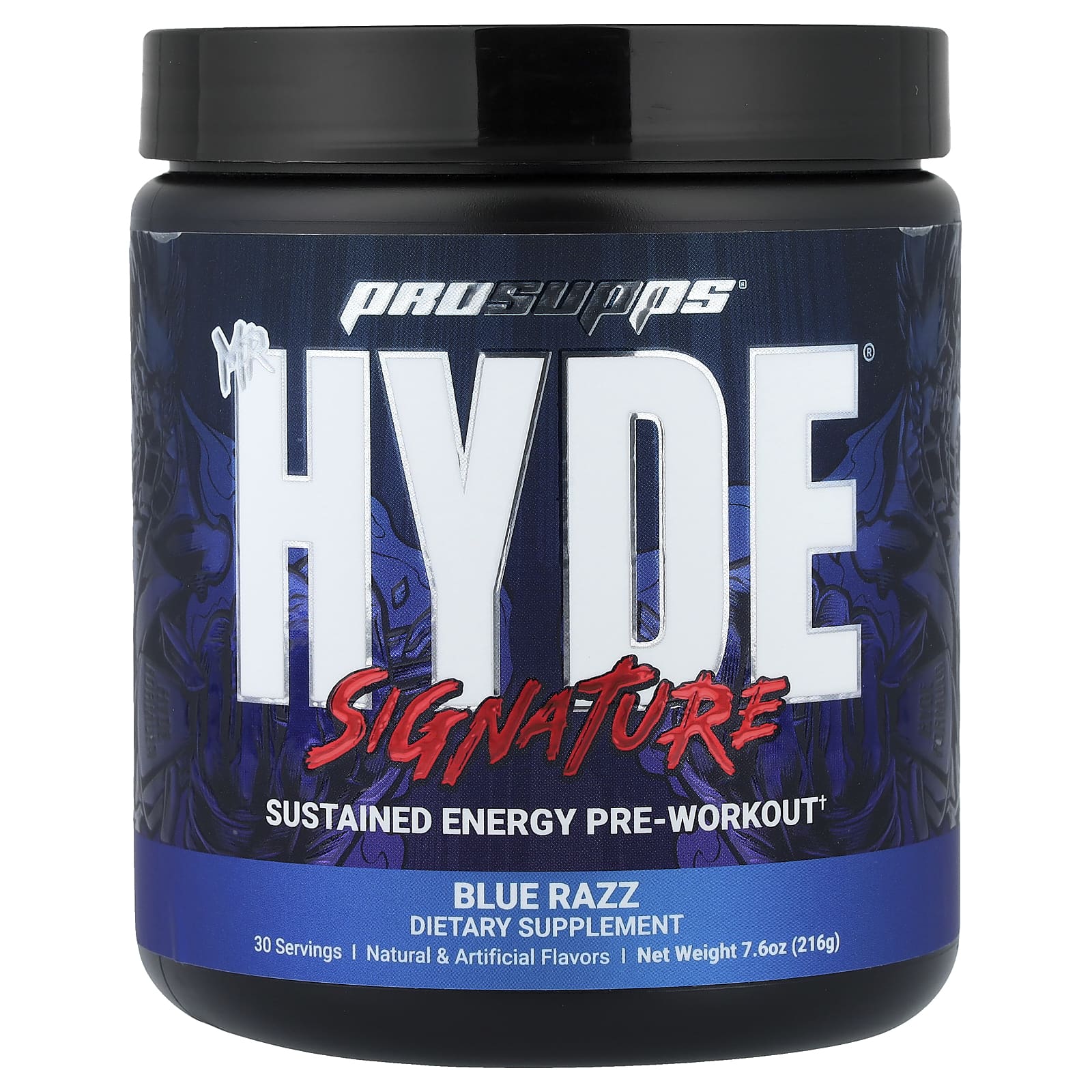
Mr Hyde Signature Pre-Workout Blue Razz Popsicle

7.2 Grams [1 Scoop] · how many a day not stated

Add to my list
Per day$0.83

Calculated at 1 serving a day. The label does not state how many to take daily.

Per pack$24.99

7.6 ounces; 216 g · Vitacost · checked 23 Oct 2026. Delivery is not included.

Per serving$0.83

Pack price divided by the number of servings in the pack.

Composition

Recorded amounts. How many servings a day is not stated.

14 mgrecorded amount; daily frequency not stated
40% of 35 mg — US upper limit for adults, National Academiesniacin from supplements, adults · a reference value, not a legal limit
25 mgrecorded amount; daily frequency not stated · as calcium itself
1% of 2,000 mg — US upper limit for adults, National Academies2,500 mg (ages 19–50) · 2,000 mg (51 and older) · from food and supplements, adults · food is not counted here · a reference value, not a legal limit
2,500 mgrecorded amount; daily frequency not stated
No limit on file for the United States
Limits in other countries (3)Croatia, France, Switzerland
L-Citrulline L-Aspartic Acid
250 mgrecorded amount; daily frequency not stated
No limit on file for the United StatesNone on file in any country
250 mgrecorded amount; daily frequency not stated
7% of 3,500 mg — US upper limit for adults, National Academiesfrom food and supplements, adults · food is not counted here · a reference value, not a legal limit
26 mgrecorded amount; daily frequency not stated
No limit on file for the United StatesNone on file in any country
26 mgrecorded amount; daily frequency not stated
No limit on file for the United StatesNone on file in any country
Gamma-Aminobutyric Acid
13 mgrecorded amount; daily frequency not stated
No limit on file for the United StatesNone on file in any country
169 mgrecorded amount; daily frequency not stated
No limit on file for the United States
Limits in other countries (4)Croatia, Norway, Poland, Switzerland
37 mgrecorded amount; daily frequency not stated
No limit on file for the United States
Limits in other countries (4)Croatia, Norway, Poland, Switzerland

Where no limit is shown, none is set or on file for the United States. That is not the same as having no maximum.

Manufacturer's directions

Suggested use: Mix 1 scoop of Mr. Hyde with 8oz of cold water and consume 15-30 minutes before exercise. Do not consume Mr. Hyde within 4 hours prior to bedtime. Do not take any other products that contain caffeine or any other stimulants while taking Mr. Hyde.Shake container well before use.

Other ingredients on the label

Natural & Artificial Flavors, Soluble Dietary Fiber, Citric Acid, Malic Acid, Sucralose, Calcium Silicate (Ca Silicate), Silicon Dioxide (SiO2), Acesulfame Potassium, FD&C Blue Lake #1

Limits in other countries
CountryNiacinCalciumCreatine MonohydrateCholine Bitartrate
United States35 mgreference, not a law · 40%2,000 mgreference, not a law · 1%
Comparison note2,500 mg (ages 19–50) · 2,000 mg (51 and older)
—not on file3,500 mgreference, not a law · 7%
Austria32 mgrecommendation · 44%800 mgrecommendation · 3%—not on file—not on file
Belgium54 mglaw · 26%1,600 mglaw · 2%—not on file—not on file
Croatia35 mglaw · 40%1,500 mglaw · 2%3,000 mglaw · 83%1,000 mglaw · 25%
Cyprus150 mglaw · 9%1,500 mglaw · 2%—not on file—not on file
Denmark891 mgrecommendation · 2%1,327 mgrecommendation · 2%—not on file—not on file
EAEU60 mglaw · 23%2,500 mglaw · 1%—not on file1,000 mglaw · 25%
Estonia10 mgrecommendation · 140% · above2,500 mgrecommendation · 1%—not on file—not on file
Finland—not on file2,500 mgrecommendation · 1%—not on file—not on file
France54 mglaw · 26%800 mglaw · 3%3,000 mglaw · 83%—not on file
Germany160 mgrecommendation · 9%500 mgrecommendation · 5%—not on file—not on file
Ireland900 mgrecommendation · 2%2,500 mgrecommendation · 1%—not on file—not on file
Italy54 mgrecommendation · 26%1,200 mgrecommendation · 2%—not on file—not on file
Luxembourg48 mglaw · 29%1,600 mglaw · 2%—not on file—not on file
Malta—not on file1,500 mgrecommendation · 2%—not on file—not on file
Norway—not on file705 mglaw · 4%—not on file—not on file
Poland830 mgrecommendation · 2%1,500 mgrecommendation · 2%—not on file—not on file
Switzerland600 mglaw · 2%750 mglaw · 3%3,000 mglaw · 83%550 mglaw · 45%

Maximum amounts per daily dose of a food supplement, as each country sets them; the share is the daily amount on the label against that maximum. Law = legally binding; recommendation = an authority's recommended maximum, not binding; reference = the U.S. upper intake level for adults from all sources (National Academies), not a legal limit. Verification level V0 · 1 more ingredients have limits on file · Report an error

About the ingredients

Ingredient information

Ingredient guideNiacin (vitamin B3)Niacin, also called vitamin B3, is a B vitamin that dissolves in water. The body turns it into NAD, a coenzyme that more than 400 enzymes need. Supplements contain nicotinic acid, niacinamide or inositol hexanicotinate, which is often sold as no-flush niacin. Amounts are counted in niacin equivalents, which include niacin the body makes from tryptophan.Read moreShow less
Terms and sources
vitamin B3
Niacin is the general name for nicotinic acid, nicotinamide and related compounds. NIH Office of Dietary Supplements.
coenzyme
A small molecule that an enzyme needs to run its reaction.
niacinamide
Another name for nicotinamide.
niacin equivalents
1 mg of niacin, or 60 mg of tryptophan, counts as 1 mg NE. NIH Office of Dietary Supplements.

Niacin in the body

All tissues in the body convert niacin into NAD, its main active form. More than 400 enzymes need NAD, more than for any other vitamin-derived coenzyme. NAD carries energy from carbohydrates, fats and proteins to ATP, the cell's energy currency. NADP, a second active form, is needed to make cholesterol and fatty acids.

Terms and sources
NAD
Nicotinamide adenine dinucleotide. NIH Office of Dietary Supplements.
400 enzymes
NIH Office of Dietary Supplements.
ATP
Adenosine triphosphate. NIH Office of Dietary Supplements.
NADP
Nicotinamide adenine dinucleotide phosphate. All tissues except skeletal muscle make it from NAD. NIH Office of Dietary Supplements.

Niacin is the general name for nicotinic acid, nicotinamide and related compounds. None of them is related to the nicotine in tobacco, despite the similar names. The body makes NAD from nicotinamide in two steps and from nicotinic acid in three.

Terms and sources
related compounds
Such as nicotinamide riboside. NIH Office of Dietary Supplements.
nicotine in tobacco
Linus Pauling Institute.
two steps
Two enzyme reactions; the route from nicotinic acid has three. Linus Pauling Institute.

The body absorbs almost all niacin, even from doses of 3–4 g. The liver changes the remaining excess into compounds that leave the body in urine. Blood niacin levels are not a reliable guide to how much niacin the body has. Researchers measure two niacin breakdown products in urine instead.

Terms and sources
almost all niacin
Mostly in the small intestine, some in the stomach. NIH Office of Dietary Supplements.
remaining excess
Red blood cells keep some excess as a reserve. NIH Office of Dietary Supplements.
compounds
Methylated products such as N1-methyl-nicotinamide. NIH Office of Dietary Supplements.
not a reliable guide
NIH Office of Dietary Supplements.
two niacin breakdown products
N1-methyl-nicotinamide and N1-methyl-2-pyridone-5-carboxamide. NIH calls it "the most sensitive and reliable measure of niacin status."

Information, not a prescription. Do not start, stop or combine supplements or medicines on your own.
Ingredient guideCalciumCalcium is the most abundant mineral in the human body. An adult body holds about 1.2–1.4 kg of it, almost all in bones and teeth. Milk, yogurt and cheese are rich sources. Supplements contain calcium as part of a compound, most often calcium carbonate or calcium citrate.Read moreShow less
Terms and sources
1.2–1.4 kg
About 1,200 g in women and 1,400 g in men. NIH Office of Dietary Supplements.

Calcium in the body

About 99% of the body's calcium is in bones and teeth. The other 1% is in the blood and soft tissues. This small part is needed for normal muscle function, nerve signaling, blood clotting and hormone release. It also takes part as blood vessels tighten and relax.

Terms and sources
bones and teeth
There it sits in hydroxyapatite, a mineral of calcium and phosphate. Linus Pauling Institute; NIH Office of Dietary Supplements.

The body keeps blood calcium in a narrow range, about 8.8–10.4 mg/dL. When intake is low, it draws calcium from bone to hold that range. A blood test therefore does not show how much calcium a person gets. Bone is rebuilt all the time; teeth are not. Vitamin D is needed to absorb calcium in the gut.

Terms and sources
8.8–10.4 mg/dL
2.2–2.6 mmol/L, total calcium in serum in healthy people. NIH Office of Dietary Supplements.
absorb calcium in the gut
Vitamin D is needed for active transport, the main route when intake is low. NIH Office of Dietary Supplements.

Information, not a prescription. Do not start, stop or combine supplements or medicines on your own.

Ingredient guideCreatineCreatine is a compound that the body makes from amino acids and stores mostly in muscle. Meat and fish also contain it. In supplements it comes as a powder or capsules, in forms such as creatine monohydrate, creatine HCl and buffered creatine.Read moreShow less

Creatine in the body

The body makes creatine from three amino acids: glycine, arginine and methionine. The kidneys carry out the first step and the liver the next ones. Together they make about 1 g of creatine a day.

Terms and sources
amino acids
the building blocks of protein. NIH Office of Dietary Supplements.
the first step
Chilibeck et al., 2017. NIH names the liver and kidneys together.
about 1 g
NIH Office of Dietary Supplements.

About 95% of the body's creatine is in skeletal muscle, with small amounts in the brain. About two thirds of muscle creatine is bound to phosphate, as phosphocreatine. Muscle cells use phosphocreatine to remake ATP, the energy carrier of cells, during short, intense efforts. An adult weighing 70 kg (154 lb) holds about 120 g of creatine and phosphocreatine.

Terms and sources
About 95%
International Society of Sports Nutrition, 2017.
ATP
adenosine triphosphate. NIH Office of Dietary Supplements.
about 120 g
NIH Office of Dietary Supplements.

Each day, about 1–2% of muscle creatine turns into creatinine, which leaves the body in urine. To keep stores steady, the body replaces about 1–3 g a day; about half comes from food. On a usual diet with 1–2 g of creatine a day, muscle stores are about 60–80% full.

Terms and sources
creatinine
a breakdown product of creatine. International Society of Sports Nutrition, 2017.
60–80% full
saturated. In studies, supplements raised muscle creatine and phosphocreatine by 20–40%. International Society of Sports Nutrition, 2017.

Information, not a prescription. Do not start, stop or combine supplements or medicines on your own.

Ingredient guideCholineCholine is an essential nutrient found in eggs, meat, fish, milk and some beans and vegetables. It is needed for the normal function of cell membranes and to make the messenger acetylcholine. Supplements contain choline bitartrate, choline chloride, alpha-GPC, phosphatidylcholine or lecithin. Citicoline, also called CDP-choline, is a related compound and is not covered here.Read moreShow less
Terms and sources
essential nutrient
The liver makes some choline, mostly as phosphatidylcholine, but not enough to meet human needs. NIH Office of Dietary Supplements.
acetylcholine
A chemical messenger of the nervous system. NIH Office of Dietary Supplements.
choline chloride
NIH lists choline bitartrate, phosphatidylcholine and lecithin as supplement forms. The Linus Pauling Institute adds choline chloride.
alpha-GPC
Short for alpha-glycerophosphocholine. NIH lists glycerophosphocholine among the forms of choline in food.
Citicoline
Cytidine diphosphocholine. The Linus Pauling Institute lists it with the choline salts sold as supplements.

Choline in the body

The body needs choline to make two fats that cell membranes are built from. Choline is also needed to make acetylcholine, a messenger between nerve cells.

Terms and sources
two fats
Phosphatidylcholine and sphingomyelin, two major phospholipids of cell membranes. NIH Office of Dietary Supplements.
acetylcholine
NIH describes it as a neurotransmitter for memory, mood, muscle control and other brain and nerve functions.

Choline is a source of methyl groups, which many steps in metabolism use. The liver makes some choline, but not enough, so some must come from food.

Terms and sources
methyl groups
NIH Office of Dietary Supplements. When a diet is low in folate, the need for dietary choline rises, because choline becomes the main methyl donor.
not enough
NIH Office of Dietary Supplements. NIH adds that women before menopause might need less choline from the diet. Estrogen switches on the gene for making it.

Free choline and other water-soluble forms are absorbed in the small intestine and go to the liver. The rest of phosphatidylcholine is absorbed intact and carried in the lymph to body tissues.

Terms and sources
small intestine
Enzymes free choline from about half of the fat-soluble forms and some water-soluble forms. NIH Office of Dietary Supplements.
absorbed intact
Together with sphingomyelin, packed into chylomicrons. NIH Office of Dietary Supplements.

Choline in blood is not routinely measured in healthy people. Blood levels do not fall below half of normal even after a week without food.

Terms and sources
not routinely measured
In healthy adults, plasma choline is 7 to 20 micromol per liter. NIH Office of Dietary Supplements.
half of normal
Possibly because membrane phospholipids are broken down to release choline, or because the body makes it. NIH Office of Dietary Supplements.

Information, not a prescription. Do not start, stop or combine supplements or medicines on your own.

Ingredient guideL-TheanineL-theanine is an amino acid found mainly in the leaves of the tea plant, Camellia sinensis. The body does not use it to build proteins. A cup of green tea holds roughly 8–30 mg. Supplements contain L-theanine made with microbes, with enzymes or by chemical synthesis, or extracted from tea leaves.Read moreShow less
Terms and sources
build proteins
It is a non-protein amino acid. Mátyus et al., Journal of Clinical Medicine, 2025.

L-theanine in the body

L-theanine is close in structure to glutamic acid, another amino acid. In a study of 12 adults, blood L-theanine peaked about 0.8 hours after a 100 mg dose. The body appears to split it into ethylamine and glutamic acid. L-theanine, ethylamine and glutamic acid all appear in urine.

Terms and sources
glutamic acid
Its chemical name is γ-glutamylethylamide. Hidese et al., Nutrients, 2019.
0.8 hours
About 48 minutes, after capsules and green tea alike. Scheid et al., Journal of Nutrition, 2012.

L-theanine passes from the blood into the brain. It is gone from blood plasma within 24 hours.

Terms and sources
into the brain
Through a carrier that also moves the amino acid leucine. Summary in Mátyus et al., 2025.
24 hours
Mátyus et al., 2025. The same review gives half-lives of about 15 to 65 minutes.

Information, not a prescription. Do not start, stop or combine supplements or medicines on your own.

Ingredient guideL-TyrosineL-tyrosine is an amino acid found in protein foods such as dairy, meat, fish, eggs, nuts and beans. The body also makes it from phenylalanine, another amino acid. The body uses tyrosine to make dopamine and noradrenaline, two chemical messengers of the brain. Supplements sell it as L-tyrosine or as N-acetyl-L-tyrosine.Read moreShow less

L-tyrosine in the body

Tyrosine is an aromatic amino acid, like phenylalanine and tryptophan. It is classed as conditionally essential: the body can make it from phenylalanine. Tyrosine is the starting material for dopamine and noradrenaline. It is also the starting material for melanin, the main pigment of skin.

Terms and sources
aromatic amino acid
Its structure contains a benzene ring. Shen et al., Frontiers in Bioengineering and Biotechnology, 2025.
conditionally essential
Made in the body when enough phenylalanine is available. van de Rest et al., Nutrients, 2017.
dopamine and noradrenaline
Catecholamines, chemical messengers of the brain and nerves. van de Rest et al., 2017.
melanin
The enzyme tyrosinase turns tyrosine into melanin step by step. Shen et al., 2025.

To enter the brain, tyrosine competes with other large amino acids for the same carrier. In one trial, blood tyrosine peaked 90 minutes after 100 or 150 mg per kg of body weight. Four hours after the dose, blood levels had not returned to their starting values.

Terms and sources
the same carrier
Transport across the blood-brain barrier. van de Rest et al., 2017.
In one trial
17 healthy adults aged 60–75. After 200 mg per kg, the peak came at 120 minutes. van de Rest et al., 2017.

Information, not a prescription. Do not start, stop or combine supplements or medicines on your own.

Ingredient guideCaffeineCaffeine is a compound found in coffee beans, tea leaves, cacao, guarana, kola nut and yerba mate. It belongs to a group of compounds called methylxanthines. Supplements contain anhydrous caffeine, compounds such as dicaffeine malate and caffeine citrate, or plant extracts such as guarana.Read moreShow less
Terms and sources
methylxanthines
Caffeine is a methylated xanthine. NIH Office of Dietary Supplements.

Caffeine in the body

Caffeine blocks receptors for adenosine, a messenger molecule in the body with sedative-like effects. NIH links this to higher arousal and vigor and lower fatigue. Caffeine also appears to lower perceived pain and effort during exercise.

Terms and sources
messenger molecule
a neuromodulator. NIH Office of Dietary Supplements.

Caffeine is absorbed quickly, even through the lining of the mouth. Blood levels peak within 45 minutes, and half of it is cleared in about 4–5 hours. More than 95% of caffeine is broken down in the liver by a single enzyme. Most of it becomes paraxanthine, a related compound.

Terms and sources
lining of the mouth
buccal membranes. NIH Office of Dietary Supplements.
4–5 hours
In adults the half-life varies from 1.5 to 10 hours between people. International Society of Sports Nutrition, 2021.
a single enzyme
CYP1A2. How fast it works differs between people, partly because of their genes. International Society of Sports Nutrition, 2021.
paraxanthine
About 84% becomes paraxanthine, 12% theobromine and 4% theophylline. Only 3–5% leaves in urine as caffeine. International Society of Sports Nutrition, 2021.

During exercise, caffeine does not raise urine output or sweat loss, according to NIH.

Terms and sources
sweat loss
In one trial in 35 °C heat, sweat rate was 21% higher with caffeine. John et al., 2024.

Information, not a prescription. Do not start, stop or combine supplements or medicines on your own.

Need help choosing?

Choose the option that suits you.

Quick selection

I know my goal

$5

1–2 minutes · a few questions with fixed answers

One goal. Up to three products. Set a budget per day if you like.

Product checks
form and amount on the label, plus shop prices
Daily schedule
what to take, when, how much
Totals and limits
next to the upper limit
Reasons & sources
for each product
Prices and shops
plus food and habits
Progress
what to track, when to see a doctor

Complete the questionnaire before you pay. If no product fits any of your goals, you won’t be charged.

Order · $5View example

Full selection

I have several goals

$15

5–7 minutes · questionnaire with fixed answers

Up to three goals in one set. Where two goals overlap, one product is used for both.

Product checks
form and amount on the label, plus shop prices
Daily schedule
what to take, when, how much
Totals and limits
next to the upper limit
Reasons & sources
for each product
Prices and shops
plus food and habits
Progress
what to track, when to see a doctor

Complete the questionnaire before you pay. If no product fits any of your goals, you won’t be charged.

Order · $15View example

Expert review

I want a person to look at my supplements

$50

Written review within 48 hours of your completed questionnaire

An expert reviews your supplement list and questionnaire.

Written review
duplicates, limits, forms
Detailed questionnaire
supplements, medicines, history
Optional uploads
supplement-label photos or documents relevant to your review
Your notes
your priorities and questions
Follow-up questions
in writing, when needed
Next steps
points to discuss with your doctor

Complete the questionnaire before you pay.

Order · $50View example
Sources, label & certificates

Label record

Copied from the NIH label database (DSLD 295400) · not yet compared with the label · checked 2 Nov 2026 · Report an error

The United States has no pre-market registration for supplements.
Label on file in the NIH Dietary Supplement Label Database
checked 2 Nov 2026source: NIH DSLDReport an error

Barcode 8 18253 02806 7

Third-party certificates

No third-party certificate on file for this product.

Information, not a prescription. Do not start, stop or combine supplements or medicines on your own. If you have a health condition, are pregnant or breastfeeding, take medicines, or are under 18, talk to a doctor or pharmacist first.

Photo credits

Image: © PS ProSupps. Shown to identify the product. Source: iherb.com

Rights holders can ask us to remove an image or send official product photos: info@verateca.com.

Product photo

PS ProSupps Mr Hyde Signature Pre-Workout Blue Razz Popsicle — enlarged pack