Advanced Nutrition by Zahler · capsules

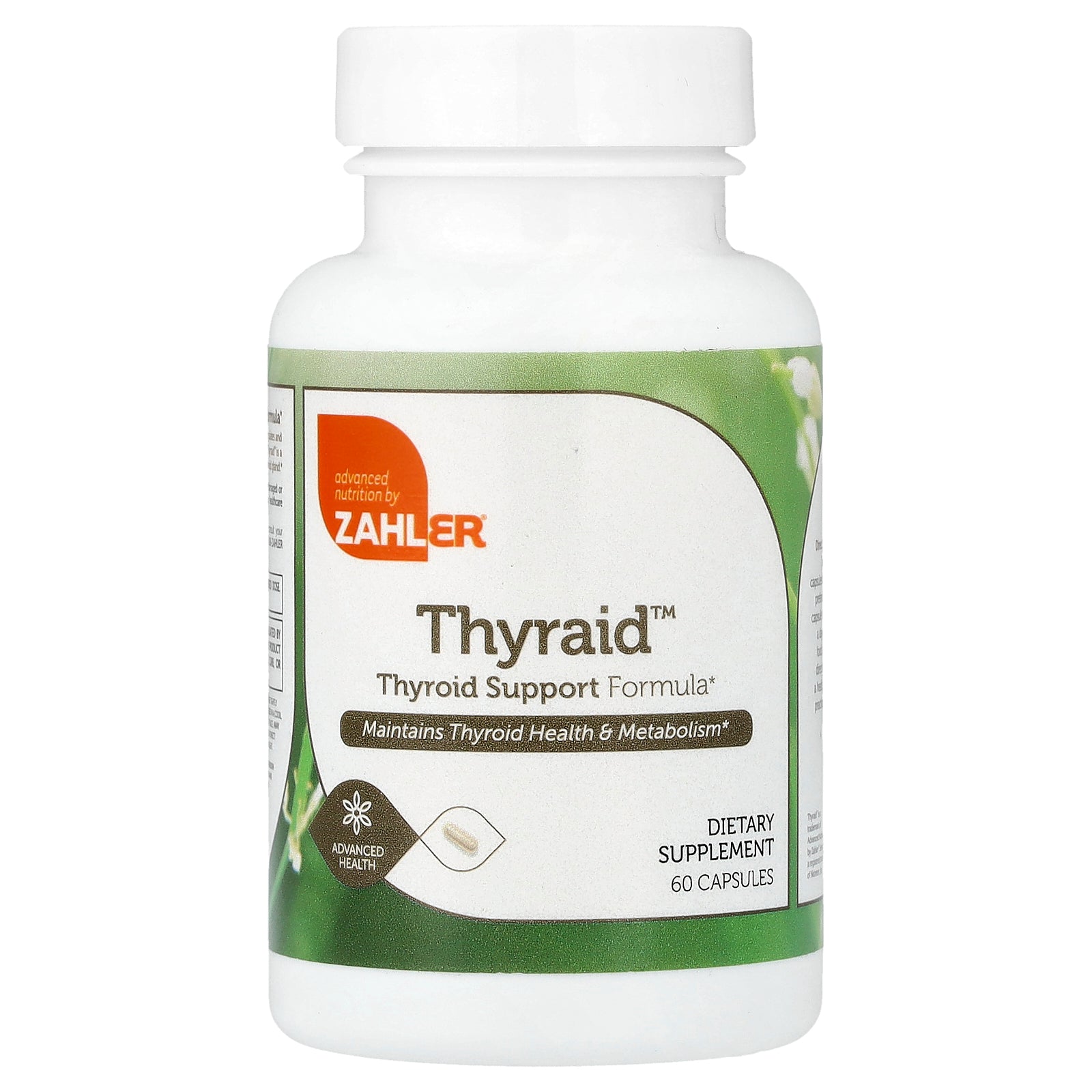
Thyraid

At the recorded label maximum: 4 capsules per day

Add to my list
Per day$1.32

At the label maximum of 4 capsules a day.

Per pack$19.76

60 capsules · Vitacost · checked 13 Nov 2026. Delivery is not included.

Per capsule$0.33

Pack price divided by the number of capsules in the pack.

Composition

Amounts at the recorded label maximum. Directions may give a range.

400 mcgat the recorded label maximum (4 capsules × 100 mcg)100 mcg per capsule · calculated from 100 mcg per 1 capsule
36% of 1,100 mcg — US upper limit for adults, National Academiesfrom food and supplements, adults · food is not counted here · a reference value, not a legal limit
Zincas Zinc Gluconate
About this formzinc gluconate — about 14% of the compound is zinc itself. Reference level V0; no form is called “better” here.
40 mgat the recorded label maximum (4 capsules × 10 mg) · as zinc itself10 mg per capsule · calculated from 10 mg per 1 capsule
100% of 40 mg — US upper limit for adults, National Academiesfrom food and supplements, adults · food is not counted here · a reference value, not a legal limit
400 mcgat the recorded label maximum (4 capsules × 100 mcg)100 mcg per capsule · calculated from 100 mcg per 1 capsule
4% of 10 mg — US upper limit for adults, National Academiesfrom food and supplements, adults · food is not counted here · a reference value, not a legal limit
Manganeseas Manganese Citrate
1 mgat the recorded label maximum (4 capsules × 250 mcg)250 mcg per capsule · calculated from 250 mcg per 1 capsule
9% of 11 mg — US upper limit for adults, National Academiesfrom food and supplements, adults · food is not counted here · a reference value, not a legal limit
2,000 mgat the recorded label maximum (4 capsules × 500 mg)500 mg per capsule · calculated from 500 mg per 1 capsule
No limit on file for the United StatesNone on file in any country

Where no limit is shown, none is set or on file for the United States. That is not the same as having no maximum.

Manufacturer's directions

Directions: Take 2 capsules daily; preferably 1 capsule twice a day with food; or as directed by a healthcare practitioner.

Other ingredients on the label

Hypromellose, Rice Hull Concentrate

Limits in other countries
CountryIodineZincCopperManganese
United States1,100 mcgreference, not a law · 36%40 mgreference, not a law · 100%10,000 mcgreference, not a law · 4%11 mgreference, not a law · 9%
Austria180 mcgrecommendation · 222% · above15 mgrecommendation · 267% · above1 mgrecommendation · 40%2 mgrecommendation · 50%
Belgium225 mcglaw · 178% · above22.5 mglaw · 178% · above2 mglaw · 20%1 mglaw · 100%
Croatia225 mcglaw · 178% · above15 mglaw · 267% · above3 mglaw · 13%4 mglaw · 25%
Cyprus500 mcglaw · 80%15 mglaw · 267% · above5 mglaw · 8%15 mglaw · 7%
Denmark134 mcgrecommendation · 299% · above11 mgrecommendation · 364% · above0.4 mgrecommendation · 100%3.4 mgrecommendation · 29%
EAEU300 mcglaw · 133% · above25 mglaw · 160% · above3 mglaw · 13%5 mglaw · 20%
Estonia600 mcgrecommendation · 67%25 mgrecommendation · 160% · above5 mgrecommendation · 8%—not on file
Finland600 mcgrecommendation · 67%25 mgrecommendation · 160% · above5 mgrecommendation · 8%—not on file
France150 mcglaw · 267% · above15 mglaw · 267% · above2,000 mcglaw · 20%3.5 mglaw · 29%
Germany100 mcgrecommendation · 400% · above6.5 mgrecommendation · 615% · above1 mgrecommendation · 40%0.5 mgrecommendation · 200% · above
Ireland600 mcgrecommendation · 67%25 mgrecommendation · 160% · above5 mgrecommendation · 8%11 mgrecommendation · 9%
Italy225 mcgrecommendation · 178% · above15 mgrecommendation · 267% · above2 mgrecommendation · 20%10 mgrecommendation · 10%
Luxembourg225 mcglaw · 178% · above15 mglaw · 267% · above2 mglaw · 20%3 mglaw · 33%
Malta200 mcgrecommendation · 200% · above25 mgrecommendation · 160% · above2 mgrecommendation · 20%4 mgrecommendation · 25%
Norway—not on file14 mglaw · 286% · above—not on file—not on file
Poland150 mcgrecommendation · 267% · above15 mgrecommendation · 267% · above2 mgrecommendation · 20%1.8 mgrecommendation · 56%
Switzerland200 mcglaw · 200% · above5.3 mglaw · 755% · above1.6 mglaw · 25%3 mglaw · 33%

Maximum amounts per daily dose of a food supplement, as each country sets them; the share is the daily amount on the label against that maximum. Law = legally binding; recommendation = an authority's recommended maximum, not binding; reference = the U.S. upper intake level for adults from all sources (National Academies), not a legal limit. Verification level V0 · Report an error

About the ingredients

Ingredient information

Ingredient guideIodineIodine is an essential trace element that the thyroid gland builds into the hormones thyroxine (T4) and triiodothyronine (T3). Seaweed, fish and other seafood, dairy products, eggs and iodized salt are the main food sources. Supplements contain it as potassium iodide, sodium iodide or potassium iodate, or as kelp and other seaweed.Read moreShow less
Terms and sources
thyroid gland
NIH Office of Dietary Supplements; Linus Pauling Institute.
iodized salt
Salt with added iodine. NIH Office of Dietary Supplements.
kelp
A brown seaweed. Its iodine content varies widely. NIH Office of Dietary Supplements.

Iodine in the body

Thyroid hormones regulate many biochemical reactions, including protein synthesis and enzyme activity, NIH notes. They are also needed for normal bone and nervous system development before birth and in infancy. The pituitary hormone TSH controls how much iodine the thyroid takes up and how much hormone it releases. Selenium-containing enzymes turn T4 into the active hormone T3 in the liver, brain and other tissues.

Terms and sources
NIH notes
NIH Office of Dietary Supplements.
before birth and in infancy
NIH Office of Dietary Supplements.
TSH
Thyroid-stimulating hormone, also called thyrotropin. NIH Office of Dietary Supplements.
Selenium-containing enzymes
Iodothyronine deiodinases. Linus Pauling Institute.

A healthy adult holds 15 to 20 mg of iodine; 70% to 80% of it is in the thyroid. The thyroid uses about 80 mcg of iodine a day to make its hormones. More than 90% of the iodine people eat leaves in the urine. So urinary iodine is the usual measure of iodine status. A median urinary iodine of 100–199 mcg/L shows adequate intake in a group of adults, NIH notes. TSH can stay normal when intake is low, so it is not a sensitive marker of intake, NIH notes.

Terms and sources
15 to 20 mg
NIH Office of Dietary Supplements; Linus Pauling Institute.
about 80 mcg
Linus Pauling Institute.
More than 90%
Within 24 to 48 hours, LPI notes. NIH Office of Dietary Supplements; Linus Pauling Institute.
urinary iodine
One spot sample does not show one person's status; repeated 24-hour or spot samples are more accurate for individuals. NIH Office of Dietary Supplements.
100–199 mcg/L
Median of many people's urine samples. NIH Office of Dietary Supplements.
not a sensitive marker
NIH Office of Dietary Supplements.

NIH notes: "High intakes of iodine can cause some of the same symptoms as iodine deficiency—including goiter, elevated TSH levels, and hypothyroidism—because excess iodine in susceptible individuals inhibits thyroid hormone synthesis and thereby increases TSH stimulation, which can produce goiter. Iodine-induced hyperthyroidism can also result from high iodine intakes, including when iodine is administered to treat iodine deficiency. Studies have also shown that excessive iodine intakes cause thyroiditis and thyroid papillary cancer. Cases of acute iodine poisoning are rare and are usually caused by doses of many grams. Acute poisoning symptoms include burning of the mouth, throat, and stomach; fever; abdominal pain; nausea; vomiting; diarrhea; weak pulse; and coma."

Terms and sources
NIH notes
NIH Office of Dietary Supplements, Iodine fact sheet for health professionals, section on health risks from excessive iodine. Citation numbers are left out.

It continues: "Responses to excess iodine and the doses required to cause adverse effects vary. Some people, such as those with autoimmune thyroid disease and iodine deficiency, may experience adverse effects with iodine intakes considered safe for the general population."

Terms and sources
It continues
The next paragraph of the same NIH section.

It ends: "The FNB has established iodine ULs for food and supplement intakes (Table 3). In most people, iodine intakes from foods and supplements are unlikely to exceed the UL. Long-term intakes above the UL increase the risk of adverse health effects. The ULs do not apply to individuals receiving iodine for medical treatment, but such individuals should be under the care of a physician."

Terms and sources
It ends
The last paragraph of the same NIH section. Table 3 is the NIH table of upper limits by age. FNB is the Food and Nutrition Board of the US National Academies.

NIH adds: "Results from a 2010 study, however, raise some questions as to the safety of widespread iodine supplementation in areas of relative iodine sufficiency. In this cross-sectional study, pregnant women living in Spain had a significantly increased risk of hyperthyrotropinemia (TSH >3 microU/mL) if they consumed iodine supplements in doses ≥200 mcg/day compared with those who consumed doses <100 mcg/day. These findings suggest that taking higher doses of supplemental iodine during pregnancy could induce thyroid dysfunction in some women and underscore the need for additional research into the effects on maternal thyroid function of iodine supplementation during pregnancy."

Terms and sources
NIH adds
NIH Office of Dietary Supplements, section on development before birth and in infancy. Citation numbers are left out. In the NIH text, it follows recommendations of 150 mcg a day in pregnancy and breastfeeding. They come from the American Thyroid Association and the American Academy of Pediatrics.

LPI adds: "The American Thyroid Association advises against consuming iodine (or kelp) supplements containing 500 μg/day or more of iodine."

Terms and sources
LPI adds
Linus Pauling Institute, section on safety. It cites American Thyroid Association statements. The association is a medical society, not a regulator.

Information, not a prescription. Do not start, stop or combine supplements or medicines on your own.
Ingredient guideZincZinc is an essential mineral that the body needs for the work of hundreds of enzymes. An adult body holds about 1.5–2.5 g of it. Supplements contain zinc as part of a compound, such as zinc citrate, oxide or gluconate. Three things are easy to confuse: the label number, the recommended amounts, and what the forms do. This article sorts them out.Read moreShow less

What zinc does

Zinc-dependent enzymes are found in all six classes of enzymes, the proteins that speed up chemical reactions in cells. By one estimate, more than 3,000 human proteins have sites that bind zinc. In some of them, zinc holds a fold called a zinc finger in shape. Zinc fingers let some proteins bind DNA and switch genes on or off. Zinc also takes part in immune function, protein and DNA synthesis, cell division and the sense of taste.

Most of the body's zinc is in skeletal muscle and bone. As intake rises, the body absorbs more zinc, but a smaller share of it.

Information, not a prescription. Do not start, stop or combine supplements or medicines on your own.

Ingredient guideCopperCopper is an essential mineral that several enzymes need in order to work. An adult body holds about 50–120 mg of it, and only small amounts are stored. Supplements offer it in several forms. Three things are easy to confuse: the number on the label, the recommended amounts, and what the forms do. This article sorts them out.Read moreShow less

What copper does

Copper-dependent enzymes are called cuproenzymes. They take part in energy production, iron metabolism, building connective tissue and making brain signaling chemicals. One of them, ceruloplasmin, carries 60–95% of the copper in blood plasma, says the Linus Pauling Institute. Defense against oxidative damage depends mainly on copper-containing enzymes called superoxide dismutases.

Almost two-thirds of the body's copper is in the skeleton and muscle. Most copper leaves the body in bile, and a small amount in urine. The body keeps its copper level steady through absorption in the gut and release from the liver into bile.

Information, not a prescription. Do not start, stop or combine supplements or medicines on your own.

Ingredient guideL-TyrosineL-tyrosine is an amino acid found in protein foods such as dairy, meat, fish, eggs, nuts and beans. The body also makes it from phenylalanine, another amino acid. The body uses tyrosine to make dopamine and noradrenaline, two chemical messengers of the brain. Supplements sell it as L-tyrosine or as N-acetyl-L-tyrosine.Read moreShow less

L-tyrosine in the body

Tyrosine is an aromatic amino acid, like phenylalanine and tryptophan. It is classed as conditionally essential: the body can make it from phenylalanine. Tyrosine is the starting material for dopamine and noradrenaline. It is also the starting material for melanin, the main pigment of skin.

Terms and sources
aromatic amino acid
Its structure contains a benzene ring. Shen et al., Frontiers in Bioengineering and Biotechnology, 2025.
conditionally essential
Made in the body when enough phenylalanine is available. van de Rest et al., Nutrients, 2017.
dopamine and noradrenaline
Catecholamines, chemical messengers of the brain and nerves. van de Rest et al., 2017.
melanin
The enzyme tyrosinase turns tyrosine into melanin step by step. Shen et al., 2025.

To enter the brain, tyrosine competes with other large amino acids for the same carrier. In one trial, blood tyrosine peaked 90 minutes after 100 or 150 mg per kg of body weight. Four hours after the dose, blood levels had not returned to their starting values.

Terms and sources
the same carrier
Transport across the blood-brain barrier. van de Rest et al., 2017.
In one trial
17 healthy adults aged 60–75. After 200 mg per kg, the peak came at 120 minutes. van de Rest et al., 2017.

Information, not a prescription. Do not start, stop or combine supplements or medicines on your own.

Services

Choose the option that suits you.

Quick selection

I know my goal

$5

1–2 minutes · a few questions with fixed answers

One goal. Up to three products. Set a budget per day if you like.

Product checks
form and amount on the label, plus shop prices
Daily schedule
what to take, when, how much
Totals and limits
next to the upper limit
Reasons & sources
for each product
Prices and shops
plus food and habits
Progress
what to track, when to see a doctor

Complete the questionnaire before you pay. If no product fits any of your goals, you won’t be charged.

Order · $5View example

Full selection

I have several goals

$15

5–7 minutes · questionnaire with fixed answers

Up to three goals in one set. Where two goals overlap, one product is used for both.

Product checks
form and amount on the label, plus shop prices
Daily schedule
what to take, when, how much
Totals and limits
next to the upper limit
Reasons & sources
for each product
Prices and shops
plus food and habits
Progress
what to track, when to see a doctor

Complete the questionnaire before you pay. If no product fits any of your goals, you won’t be charged.

Order · $15View example

Expert review

I want a person to look at my supplements

$50

Written review within 48 hours of your completed questionnaire

An expert reviews your supplement list and questionnaire.

Written review
duplicates, limits, forms
Detailed questionnaire
supplements, medicines, history
Optional uploads
supplement-label photos or documents relevant to your review
Your notes
your priorities and questions
Follow-up questions
in writing, when needed
Next steps
points to discuss with your doctor

Complete the questionnaire before you pay.

Order · $50View example
Sources, label & certificates

Label record

Copied from the NIH label database (DSLD 301149) · not yet compared with the label · checked 19 Oct 2026 · Report an error

The United States has no pre-market registration for supplements.
Label on file in the NIH Dietary Supplement Label Database
checked 19 Oct 2026source: NIH DSLDReport an error

Barcode 8 48998 08170 6

Third-party certificates

Label mentions: You may need additional supplements to support a healthy diet; consult your nutritionist for a formula that is right for you or contact us at 877-ASK-ZAHLER (877-275-9245) or ask@zahlers.com.. Not yet checked against the certifiers’ registries.

Information, not a prescription. Do not start, stop or combine supplements or medicines on your own. If you have a health condition, are pregnant or breastfeeding, take medicines, or are under 18, talk to a doctor or pharmacist first.

Photo credits

Image: © Advanced Nutrition by Zahler. Shown to identify the product. Source:

Rights holders can ask us to remove an image or send official product photos: info@verateca.com.

Product photo

Advanced Nutrition by Zahler Thyraid — enlarged pack