Nature's Way · tablets

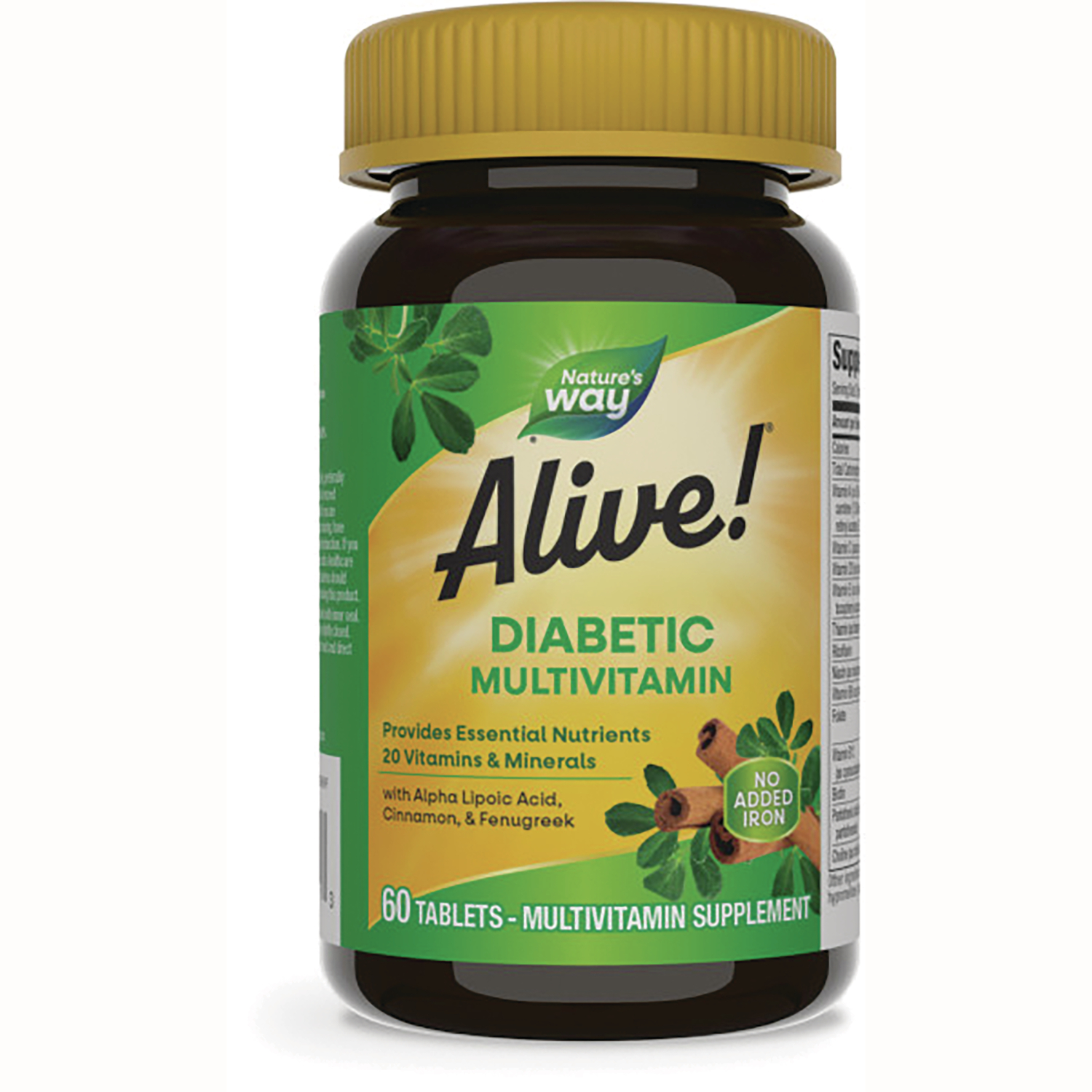
Alive! Diabetic Multivitamin

At the recorded label maximum: 2 tablets per day

Add to my list
Per day$0.50

At the label maximum of 2 tablets a day.

Per pack$14.99

60 tablets · Swanson · checked 20 Nov 2026. Delivery is not included.

Per tablet$0.25

Pack price divided by the number of tablets in the pack.

Composition

Amounts at the recorded label maximum. Directions may give a range.

Amounts not disclosed. The label gives only the total weight of this blend, not the amount of each ingredient in it. Without the individual amounts, we cannot compare these ingredients with upper limits.

The label’s daily amount is 40 mg of niacin (2 tablets). This is above the US adult upper intake level of 35 mg a day for niacin from supplements. The National Academies set this scientific reference value.

The label’s daily amount is 420 mg of magnesium (2 tablets). This is above the US adult upper intake level of 350 mg a day for magnesium from supplements and medicines. The National Academies set this scientific reference value.

The U.S. adult upper limit of 350 mg/day for magnesium from supplements and medications is based on studies of diarrhea.

Label source · Upper intake level source: niacin · Upper intake level source: magnesium · Report an error

3 mgat the recorded label maximum (1 serving × 3 mg; 2 tablets per serving)
Not compared with 3 mg — US upper limit for adults, National Academiesthe limit counts retinol only · a reference value, not a legal limit
Beta-Carotene
1.5 mgat the recorded label maximum (1 serving × 1.5 mg; 2 tablets per serving)750 mcg per tablet · calculated from 1.5 mg per 2 tablets
No US upper limitNational Academies: not determined — too little data on harm
Limits in other countries (9)Cyprus, Denmark, Eurasian Economic Union (EAEU), France, Germany, Italy, Malta, Poland, Switzerland
Retinyl Acetate
About this formretinol / retinyl esters. Reference level V0; no form is called “better” here.
1.5 mgat the recorded label maximum (1 serving × 1.5 mg; 2 tablets per serving)
50% of 3 mg — US upper limit for adults, National Academiesfrom food and supplements, adults · food is not counted here · a reference value, not a legal limit
250 mgat the recorded label maximum (1 serving × 250 mg; 2 tablets per serving)125 mg per tablet · calculated from 250 mg per 2 tablets
13% of 2,000 mg — US upper limit for adults, National Academiesfrom food and supplements, adults · food is not counted here · a reference value, not a legal limit
Vitamin D3as Cholecalciferol
About this formvitamin D3 (cholecalciferol). Raises vitamin D levels more than D2. Reference level V0; no form is called “better” here.
20 mcgat the recorded label maximum (1 serving × 20 mcg; 2 tablets per serving)10 mcg per tablet · calculated from 20 mcg per 2 tablets
20% of 100 mcg — US upper limit for adults, National Academiesfrom food and supplements, adults · food is not counted here · a reference value, not a legal limit
Vitamin Eas D-Alpha-Tocopheryl Succinate
About this formd-alpha-tocopherol (natural). 1 IU natural = 0.67 mg; synthetic 1 IU = 0.45 mg. Reference level V0; no form is called “better” here.
100 mgat the recorded label maximum (1 serving × 100 mg; 2 tablets per serving)50 mg per tablet · calculated from 100 mg per 2 tablets
10% of 1,000 mg — US upper limit for adults, National Academiesvitamin E from supplements, adults · a reference value, not a legal limit
Thiamineas Thiamine Mononitrate
80 mgat the recorded label maximum (1 serving × 80 mg; 2 tablets per serving)40 mg per tablet · calculated from 80 mg per 2 tablets
No US upper limitNational Academies: not determined — too little data on harm
Limits in other countries (8)Austria, Croatia, Cyprus, Eurasian Economic Union (EAEU), France, Italy, Malta, Poland
40 mg a day20 mg per tablet · 2 tablets a day per label
114% ↑ of the upper intake level of 35 mg — US upper limit for adults, National Academiesniacin from supplements, adults · a reference value, not a legal limit
20 mgat the recorded label maximum (1 serving × 20 mg; 2 tablets per serving)10 mg per tablet · calculated from 20 mg per 2 tablets
20% of 100 mg — US upper limit for adults, National Academiesfrom food and supplements, adults · food is not counted here · a reference value, not a legal limit
Folateas folic acid 240 mcg · 400 mcg DFE
About this formfolic acid. Reference level V0; no form is called “better” here.
What is DFE?DFE — dietary folate equivalents: one scale for folic acid and food folate. The body absorbs more folic acid, so it counts for more.
240 mcgat the recorded label maximum (1 serving × 240 mcg; 2 tablets per serving)
24% of 1,000 mcg — US upper limit for adults, National Academiesfolate from supplements, adults · a reference value, not a legal limit
Vitamin B12as Cyanocobalamin
About this formcyanocobalamin. Most studied and cheapest form. Reference level V0; no form is called “better” here.
40 mcgat the recorded label maximum (1 serving × 40 mcg; 2 tablets per serving)20 mcg per tablet · calculated from 40 mcg per 2 tablets
No US upper limitNational Academies: not determined — too little data on harm
Limits in other countries (9)Austria, Croatia, Cyprus, Eurasian Economic Union (EAEU), France, Germany, Italy, Malta, Poland
30 mcgat the recorded label maximum (1 serving × 30 mcg; 2 tablets per serving)15 mcg per tablet · calculated from 30 mcg per 2 tablets
No US upper limitNational Academies: not determined — too little data on harm
Limits in other countries (7)Austria, Croatia, Cyprus, Eurasian Economic Union (EAEU), France, Italy, Malta
Pantothenic Acidas D-Calcium Pantothenate
50 mgat the recorded label maximum (1 serving × 50 mg; 2 tablets per serving)25 mg per tablet · calculated from 50 mg per 2 tablets
No US upper limitNational Academies: not determined — too little data on harm
Limits in other countries (8)Austria, Croatia, Cyprus, Eurasian Economic Union (EAEU), France, Italy, Malta, Poland
50 mgat the recorded label maximum (1 serving × 50 mg; 2 tablets per serving)25 mg per tablet · calculated from 50 mg per 2 tablets
1% of 3,500 mg — US upper limit for adults, National Academiesfrom food and supplements, adults · food is not counted here · a reference value, not a legal limit
150 mcgat the recorded label maximum (1 serving × 150 mcg; 2 tablets per serving)75 mcg per tablet · calculated from 150 mcg per 2 tablets
14% of 1,100 mcg — US upper limit for adults, National Academiesfrom food and supplements, adults · food is not counted here · a reference value, not a legal limit
420 mg a day210 mg per tablet · 2 tablets a day per label · as magnesium itself
120% ↑ of the upper intake level of 350 mg — US upper limit for adults, National Academiesmagnesium from supplements, adults · a reference value, not a legal limit
Zincas Zinc Bisglycinate
About this formzinc bisglycinate — about 30% of the compound is zinc itself. Reference level V0; no form is called “better” here.
15 mgat the recorded label maximum (1 serving × 15 mg; 2 tablets per serving) · as zinc itself7.5 mg per tablet · calculated from 15 mg per 2 tablets
38% of 40 mg — US upper limit for adults, National Academiesfrom food and supplements, adults · food is not counted here · a reference value, not a legal limit
200 mcgat the recorded label maximum (1 serving × 200 mcg; 2 tablets per serving)100 mcg per tablet · calculated from 200 mcg per 2 tablets
50% of 400 mcg — US upper limit for adults, National Academiesfrom food and supplements, adults · food is not counted here · a reference value, not a legal limit
1 mgat the recorded label maximum (1 serving × 1 mg; 2 tablets per serving)500 mcg per tablet · calculated from 1 mg per 2 tablets
10% of 10 mg — US upper limit for adults, National Academiesfrom food and supplements, adults · food is not counted here · a reference value, not a legal limit
Manganeseas Manganese Bisglycinate
5 mgat the recorded label maximum (1 serving × 5 mg; 2 tablets per serving)2.5 mg per tablet · calculated from 5 mg per 2 tablets
45% of 11 mg — US upper limit for adults, National Academiesfrom food and supplements, adults · food is not counted here · a reference value, not a legal limit
Molybdenumas Sodium Molybdate
50 mcgat the recorded label maximum (1 serving × 50 mcg; 2 tablets per serving)25 mcg per tablet · calculated from 50 mcg per 2 tablets
3% of 2,000 mcg — US upper limit for adults, National Academiesfrom food and supplements, adults · food is not counted here · a reference value, not a legal limit
Inositol
Amount not disclosedpart of Antioxidant Activity Blend · not counted
No limit on file for the United States
Limits in other countries (3)Croatia, Eurasian Economic Union (EAEU), Switzerland
Amount not disclosedpart of Antioxidant Activity Blend · not counted
No limit on file for the United States
Limits in other countries (3)Croatia, Czechia, Switzerland
Alpha-Lipoic Acid
Amount not disclosedpart of Antioxidant Activity Blend · not counted
No limit on file for the United States
Limits in other countries (1)Eurasian Economic Union (EAEU)
Quercetin
Amount not disclosedpart of Antioxidant Activity Blend · not counted
No limit on file for the United StatesNone on file in any country
Betaine Hydrochloride
Amount not disclosedpart of Antioxidant Activity Blend · not counted
No limit on file for the United States
Limits in other countries (3)Croatia, France, Switzerland
Citrus Bioflavonoid Complexas Grapefruit | Lemon | Lime | Orange | Tangerine
Amount not disclosedpart of Antioxidant Activity Blend · not counted
No limit on file for the United StatesNone on file in any country
Rutinas Sophora japonica flower bud extract
Amount not disclosedpart of Antioxidant Activity Blend · not counted
No limit on file for the United StatesNone on file in any country
L-Carnitine
Amount not disclosedpart of Antioxidant Activity Blend · not counted
No limit on file for the United StatesNone on file in any country
Cinnamonas Cinnamomum spp.
Amount not disclosedpart of Plant-Powered Herbal Blend · not counted
No limit on file for the United StatesNone on file in any country
Fenugreek
Amount not disclosedpart of Plant-Powered Herbal Blend · not counted
No limit on file for the United StatesNone on file in any country
200 mcgat the recorded label maximum (1 serving × 200 mcg; 2 tablets per serving)100 mcg per tablet · calculated from 200 mcg per 2 tablets
No limit on file for the United States
Limits in other countries (3)Croatia, Eurasian Economic Union (EAEU), Switzerland

Where no limit is shown, none is set or on file for the United States. That is not the same as having no maximum.
Manufacturer's directions

Recommendation: Adults take 2 tablets daily; preferably with food.

Other ingredients on the label

Cellulose, Stearic Acid, Hydroxypropyl Cellulose, Sodium Croscarmellose, Hypromellose, Magnesium Stearate (Mg Stearate), Silica, Glycerin, Gelatin

Limits in other countries
CountryRetinyl AcetateBeta-CaroteneVitamin CVitamin D3
United States3,000 mcgreference, not a law · 50%—not on file2,000 mgreference, not a law · 13%100 mcgreference, not a law · 20%
Austria900 mcgrecommendation · 500% · above—not on file500 mgrecommendation · 50%20 mcgrecommendation · 100%
Belgium1,200 mcglaw · 375% · above—not on file1,000 mglaw · 25%75 mcglaw · 27%
Croatia1,500 mcglaw · 300% · above—not on file800 mglaw · 31%10 mcglaw · 200% · above
Cyprus2,300 mcglaw · 196% · above20 mglaw · 8%2,000 mglaw · 13%10 mcglaw · 200% · above
Denmark—not on file4.5 mgrecommendation · 33%1,000 mgrecommendation · 25%95 mcgrecommendation · 21%
EAEU3,000 mcglaw · 150% · above10 mglaw · 15%900 mglaw · 28%15 mcglaw · 133% · above
Estonia3,000 mcgrecommendation · 150% · above—not on file—not on file100 mcgrecommendation · 20%
Finland3,000 mcgrecommendation · 150% · above—not on file—not on file100 mcgrecommendation · 20%
France800 mcglaw · 563% · above7 mgrecommendation · 21%180 mglaw · 139% · above5 mcglaw · 400% · above
Germany200 mcgrecommendation · 2250% · above3.5 mgrecommendation · 43%250 mgrecommendation · 100%20 mcgrecommendation · 100%
Ireland3,000 mcgrecommendation · 150% · above—not on file2,000 mgrecommendation · 13%100 mcgrecommendation · 20%
Italy1,200 mcgrecommendation · 375% · above7.5 mgrecommendation · 20%1,000 mgrecommendation · 25%50 mcgrecommendation · 40%
Luxembourg1,200 mcglaw · 375% · above—not on file1,000 mglaw · 25%50 mcglaw · 40%
Malta1,500 mcgrecommendation · 300% · above7 mglaw · 21%1,000 mgrecommendation · 25%25 mcgrecommendation · 80%
Netherlands1,200 mcglaw · 375% · above—not on file—not on file75 mcglaw · 27%
Norway—not on file—not on file1,000 mglaw · 25%80 mcglaw · 25%
Poland800 mcgrecommendation · 563% · above7 mgrecommendation · 21%1,000 mgrecommendation · 25%50 mcgrecommendation · 40%
Switzerland1,360 mcglaw · 331% · above8.2 mglaw · 18%750 mglaw · 33%70 mcglaw · 29%

Maximum amounts per daily dose of a food supplement, as each country sets them; the share is the daily amount on the label against that maximum. Law = legally binding; recommendation = an authority's recommended maximum, not binding; reference = the U.S. upper intake level for adults from all sources (National Academies), not a legal limit. Verification level V0 · 22 more ingredients have limits on file · Report an error

About the ingredients

Ingredient information

Ingredient guideVitamin AVitamin A is the name for a group of fat-soluble compounds, mainly retinol and retinyl esters. Animal foods contain it as preformed vitamin A; plants contain carotenoids, some of which the body converts into it. Supplements contain retinyl acetate, retinyl palmitate, beta-carotene or a combination. Amounts are given in mcg RAE; older labels used IU.Read moreShow less
Terms and sources
fat-soluble
They dissolve in fat, not in water. NIH Office of Dietary Supplements.
carotenoids
Provitamin A carotenoids: beta-carotene, alpha-carotene and beta-cryptoxanthin. NIH Office of Dietary Supplements.
mcg RAE
Micrograms of retinol activity equivalents. The unit counts how much retinol each form gives the body.

Vitamin A in the body

Vitamin A is part of rhodopsin, the protein in the retina that responds to light. It is needed for normal vision. It is also involved in immune function, cell communication, growth and development, and reproduction.

Terms and sources
rhodopsin
The light-sensitive pigment of the eye's rod cells, which see in dim light. NIH Office of Dietary Supplements; Linus Pauling Institute.
normal vision
NIH Office of Dietary Supplements. It is also needed for the normal surface of the eye.
cell communication
NIH Office of Dietary Supplements. Vitamin A takes part in the growth and specialization of cells.

The body turns retinol into retinal and retinoic acid, the two main active forms. Most of the body's vitamin A is stored in the liver as retinyl esters. Blood retinol levels stay steady until the stores in the liver are almost used up.

Terms and sources
retinoic acid
It switches genes on and off; Linus Pauling Institute counts more than 500 genes that respond to it.
retinyl esters
Retinol joined to a fatty acid, such as retinyl palmitate. NIH Office of Dietary Supplements.
stay steady
NIH Office of Dietary Supplements. So a blood test is not always a reliable guide to the stores. See Green 2016 below: normal blood retinol with low stores.

Plants make hundreds of carotenoids; only about 10% of them can be converted to retinol. The body converts beta-carotene into vitamin A in the gut, through an enzyme. Lutein, zeaxanthin and lycopene are carotenoids that the body does not convert into vitamin A.

Terms and sources
about 10%
Linus Pauling Institute.
an enzyme
Beta-carotene monooxygenase type 1 (BCMO1). Conversion rates may vary with genes. NIH Office of Dietary Supplements.
does not convert
NIH Office of Dietary Supplements calls them non-provitamin A carotenoids.

Information, not a prescription. Do not start, stop or combine supplements or medicines on your own.

Ingredient guideVitamin CVitamin C, also called L-ascorbic acid, is a water-soluble vitamin. Most animals make vitamin C in the body; humans cannot and get it from food. Fruits and vegetables such as peppers, citrus fruits and kiwifruit are the main sources. Supplements contain it as ascorbic acid or as mineral salts such as sodium and calcium ascorbate.Read moreShow less
Terms and sources
water-soluble
It dissolves in water, not in fat. NIH Office of Dietary Supplements.

Vitamin C in the body

Vitamin C is needed to make collagen, carnitine and some neurotransmitters. It is also an antioxidant and can return used vitamin E to its active form. It is needed for normal immune function. It increases the absorption of iron from plant foods.

Terms and sources
collagen
A protein that holds together connective tissue, such as skin, tendons and blood vessels. NIH Office of Dietary Supplements.
carnitine
A substance cells need to get energy from fat. Linus Pauling Institute.
neurotransmitters
Chemical messengers between nerve cells.
antioxidant
A substance that limits damage from free radicals, reactive molecules made in cells.
iron from plant foods
Nonheme iron, the only form of iron in plant foods. NIH Office of Dietary Supplements.

An adult body holds from about 300 mg to about 2 g of vitamin C. White blood cells, the eyes, the adrenal and pituitary glands and the brain hold the most. Cells hold vitamin C in millimolar concentrations, blood plasma in micromolar concentrations. At 100 mg a day or more, cells appear to be saturated.

Terms and sources
about 300 mg
The lower figure is for very low intake. NIH Office of Dietary Supplements.
adrenal and pituitary glands
Small glands that make hormones: the adrenals sit above the kidneys, the pituitary below the brain.
millimolar
Thousandths of a mole per liter; micromolar means millionths. NIH Office of Dietary Supplements.
saturated
Holding as much as they take up. Above 200 mg a day, blood plasma levels rise little more.

The body absorbs about 70–90% of vitamin C at 30–180 mg a day. Above 1 g a day, less than 50% is absorbed, and unused vitamin C leaves in urine.

Terms and sources
less than 50%
Summary by the NIH Office of Dietary Supplements. Absorption in the gut runs through a dose-dependent transporter protein.

Information, not a prescription. Do not start, stop or combine supplements or medicines on your own.

Ingredient guideVitamin DVitamin D is a fat-soluble vitamin. The skin makes it when ultraviolet light from the sun reaches it, and a few foods contain it. Supplements contain one or both of its two main forms: vitamin D3 and vitamin D2. Labels state the amount in micrograms (mcg), international units (IU) or both.Read moreShow less
Terms and sources
fat-soluble
It dissolves in fat, not in water. NIH Office of Dietary Supplements.

Vitamin D in the body

Vitamin D from the sun, food and supplements is inactive at first. The liver turns it into 25-hydroxyvitamin D, the form a blood test measures. Mainly the kidneys then make the active form.

Terms and sources
25-hydroxyvitamin D
Also called calcidiol or 25(OH)D. Results come in nmol/L or ng/mL; 50 nmol/L equals 20 ng/mL.
active form
1,25-dihydroxyvitamin D, also called calcitriol.

Vitamin D is needed for normal absorption of calcium from the gut and for normal bones. It is also needed for normal muscle and immune function. Many tissues in the body carry vitamin D receptors.

Terms and sources
vitamin D receptors
Proteins in cells that respond to the active form of vitamin D. NIH Office of Dietary Supplements.

Information, not a prescription. Do not start, stop or combine supplements or medicines on your own.

Ingredient guideVitamin EVitamin E is the name for eight fat-soluble compounds: four tocopherols and four tocotrienols. Alpha-tocopherol is the only form recognized to meet human needs. Supplements contain natural (d-) or synthetic (dl-) alpha-tocopherol, often as an ester. Three things are easy to confuse: the two forms, label units and what the upper limit counts. This article sorts them out.Read moreShow less

What vitamin E does

Vitamin E is an antioxidant that works in cell membranes. There, free radicals damage fats, and each damaged fat can damage the next. Alpha-tocopherol stops this chain reaction. Vitamin C can return used vitamin E to its active form. Vitamin E is also involved in immune function; studies in cells show roles in cell signaling.

After absorption, the liver sends alpha-tocopherol back into the blood with the alpha-tocopherol transfer protein. The liver breaks down the other forms, so blood and cells hold less of them.

In one study with labeled vitamin E, healthy women absorbed about 55% of a dose taken with a liquid meal. Vitamin E takes 9–12 hours to pass from a meal into the blood, carried in fat particles. The liver replaces the whole pool of alpha-tocopherol in blood plasma every day.

Information, not a prescription. Do not start, stop or combine supplements or medicines on your own.

Ingredient guideRiboflavin (Vitamin B2)Riboflavin, also called vitamin B2, is a water-soluble B vitamin. The body turns it into two coenzymes, FMN and FAD, which take part in energy production. Eggs, organ meats, milk and fortified grains are among its food sources. Three things are easy to confuse: the number on the label, the recommended amounts, and what the forms do. This article sorts them out.Read moreShow less

What riboflavin does

Riboflavin is part of two coenzymes: flavin mononucleotide (FMN) and flavin adenine dinucleotide (FAD). They play major roles in energy production; cell function, growth and development; and the metabolism of fats, drugs and steroids. The body needs FAD to make niacin (vitamin B3) from the amino acid tryptophan. It needs FMN to turn vitamin B6 into its active form.

Most riboflavin is absorbed in the upper small intestine. The body stores only small amounts. When a person takes in more, the excess is either not absorbed or leaves in the urine. Bacteria in the large intestine also make riboflavin, more after plant-based meals than after meat-based ones.

Riboflavin is yellow and glows under ultraviolet light. Ultraviolet and visible light also break it down quickly. Milk in a clear glass bottle can lose up to 50% of its riboflavin in two hours of bright sunlight.

Information, not a prescription. Do not start, stop or combine supplements or medicines on your own.

Ingredient guideNiacin (vitamin B3)Niacin, also called vitamin B3, is a B vitamin that dissolves in water. The body turns it into NAD, a coenzyme that more than 400 enzymes need. Supplements contain nicotinic acid, niacinamide or inositol hexanicotinate, which is often sold as no-flush niacin. Amounts are counted in niacin equivalents, which include niacin the body makes from tryptophan.Read moreShow less
Terms and sources
vitamin B3
Niacin is the general name for nicotinic acid, nicotinamide and related compounds. NIH Office of Dietary Supplements.
coenzyme
A small molecule that an enzyme needs to run its reaction.
niacinamide
Another name for nicotinamide.
niacin equivalents
1 mg of niacin, or 60 mg of tryptophan, counts as 1 mg NE. NIH Office of Dietary Supplements.

Niacin in the body

All tissues in the body convert niacin into NAD, its main active form. More than 400 enzymes need NAD, more than for any other vitamin-derived coenzyme. NAD carries energy from carbohydrates, fats and proteins to ATP, the cell's energy currency. NADP, a second active form, is needed to make cholesterol and fatty acids.

Terms and sources
NAD
Nicotinamide adenine dinucleotide. NIH Office of Dietary Supplements.
400 enzymes
NIH Office of Dietary Supplements.
ATP
Adenosine triphosphate. NIH Office of Dietary Supplements.
NADP
Nicotinamide adenine dinucleotide phosphate. All tissues except skeletal muscle make it from NAD. NIH Office of Dietary Supplements.

Niacin is the general name for nicotinic acid, nicotinamide and related compounds. None of them is related to the nicotine in tobacco, despite the similar names. The body makes NAD from nicotinamide in two steps and from nicotinic acid in three.

Terms and sources
related compounds
Such as nicotinamide riboside. NIH Office of Dietary Supplements.
nicotine in tobacco
Linus Pauling Institute.
two steps
Two enzyme reactions; the route from nicotinic acid has three. Linus Pauling Institute.

The body absorbs almost all niacin, even from doses of 3–4 g. The liver changes the remaining excess into compounds that leave the body in urine. Blood niacin levels are not a reliable guide to how much niacin the body has. Researchers measure two niacin breakdown products in urine instead.

Terms and sources
almost all niacin
Mostly in the small intestine, some in the stomach. NIH Office of Dietary Supplements.
remaining excess
Red blood cells keep some excess as a reserve. NIH Office of Dietary Supplements.
compounds
Methylated products such as N1-methyl-nicotinamide. NIH Office of Dietary Supplements.
not a reliable guide
NIH Office of Dietary Supplements.
two niacin breakdown products
N1-methyl-nicotinamide and N1-methyl-2-pyridone-5-carboxamide. NIH calls it "the most sensitive and reliable measure of niacin status."

Information, not a prescription. Do not start, stop or combine supplements or medicines on your own.

Ingredient guideVitamin B6Vitamin B6 is the name for six related water-soluble compounds: pyridoxine, pyridoxal, pyridoxamine and their phosphate forms. Its main active form, pyridoxal 5'-phosphate (PLP), is a helper molecule for more than 100 enzymes. Supplements most often contain pyridoxine hydrochloride; some contain PLP, also called P5P. Vitamin B6 is also in multivitamins and B complex products.Read moreShow less
Terms and sources
water-soluble
They dissolve in water, not in fat. NIH Office of Dietary Supplements.
helper molecule
A coenzyme: a small molecule an enzyme needs to work. Linus Pauling Institute.
pyridoxine hydrochloride
NIH Office of Dietary Supplements names it the most common form in supplements.

Vitamin B6 in the body

Vitamin B6 takes part in more than 100 enzyme reactions, mostly in the metabolism of protein. It is involved in making neurotransmitters, the chemical messengers of the nervous system. It is also involved in immune function and in making hemoglobin, the oxygen carrier in red blood cells.

Terms and sources
more than 100 enzyme reactions
NIH Office of Dietary Supplements. It also works in the metabolism of carbohydrates and fats.
neurotransmitters
Serotonin, dopamine and GABA among them. Linus Pauling Institute.
immune function
NIH Office of Dietary Supplements.

The human body cannot make vitamin B6, so it must come from food. PLP is a helper in over 4% of all enzyme reactions. Much of the body's PLP sits in muscle, bound to the enzyme that releases glucose from stored glycogen.

Terms and sources
cannot make vitamin B6
Linus Pauling Institute.
over 4%
Linus Pauling Institute.
the enzyme
Glycogen phosphorylase. Linus Pauling Institute.

Blood PLP is the most common measure of vitamin B6 status. Levels above 30 nmol/L have been the traditional sign of enough vitamin B6 in adults.

Terms and sources
Blood PLP
Plasma pyridoxal 5'-phosphate. NIH Office of Dietary Supplements.
30 nmol/L
NIH Office of Dietary Supplements.

Information, not a prescription. Do not start, stop or combine supplements or medicines on your own.

Ingredient guideFolateFolate is a water-soluble B vitamin, also called vitamin B9. It occurs naturally in many foods. Folic acid is the synthetic form used in most supplements and in fortified foods. Some supplements contain L-methylfolate or folinic acid instead. Folate is also in multivitamins, prenatal vitamins and B complex products.Read moreShow less
Terms and sources
water-soluble
It dissolves in water, not in fat. NIH Office of Dietary Supplements.
synthetic form
NIH Office of Dietary Supplements: the fully oxidized form of the vitamin.
L-methylfolate
Also called 5-MTHF or L-5-methyltetrahydrofolate. NIH Office of Dietary Supplements.
prenatal vitamins
NIH Office of Dietary Supplements lists these product types.

Folate in the body

Folate is a helper molecule that moves single carbon units between other molecules. It is needed to make DNA and RNA and to process amino acids. Folate and vitamin B12 work in the same step that turns homocysteine into the amino acid methionine.

Terms and sources
helper molecule
A coenzyme. NIH Office of Dietary Supplements. The name comes from foliage: green leafy vegetables are rich in folate, Linus Pauling Institute.
DNA and RNA
NIH Office of Dietary Supplements: folate is required for proper cell division.
same step
Methionine synthase needs both folate, as 5-methyltetrahydrofolate, and vitamin B12. Linus Pauling Institute.

Folic acid is not active until the body converts it into natural folates. The main form of folate in blood plasma is L-methylfolate. When the converting enzyme is at capacity, unconverted folic acid appears in the blood. A US national survey found unconverted folic acid in 96% of blood samples.

Terms and sources
not active
Linus Pauling Institute: folic acid "has no biological activity unless converted into folates".
main form
NIH Office of Dietary Supplements.
converting enzyme
Dihydrofolate reductase. Its activity varies greatly between people. NIH Office of Dietary Supplements.
96% of blood samples
Serum samples, NHANES 2007–2008, people aged 1 year and older. Linus Pauling Institute.

The body holds about 15 to 30 mg of folate, about half of it in the liver. Gut bacteria also make folate; how much of it the body uses is unclear. Red blood cell folate reflects intake over the longer term; folate in the blood fluid reflects recent intake. Blood homocysteine is a common marker of folate status, though vitamin B12 and other factors also affect it.

Terms and sources
15 to 30 mg
NIH Office of Dietary Supplements.
Gut bacteria
NIH Office of Dietary Supplements: folate made in the colon can be absorbed there.
Red blood cell folate
NIH Office of Dietary Supplements: above 140 ng/mL indicates adequate status. For serum folate, the cutoff is 3 ng/mL.
common marker
NIH Office of Dietary Supplements calls it a functional indicator that is not highly specific.

A common gene variant, MTHFR 677C>T, makes the enzyme that forms L-methylfolate less active. Depending on the population, 3% to 32% of people carry two copies.

Terms and sources
MTHFR 677C>T
Linus Pauling Institute. With two copies of the variant, enzyme activity is about 65% lower; with one copy, about 30% lower.
3% to 32%
20% to 53% carry one copy. Linus Pauling Institute.

Information, not a prescription. Do not start, stop or combine supplements or medicines on your own.

Ingredient guideVitamin B12Vitamin B12 is a water-soluble vitamin that contains the mineral cobalt. Only certain bacteria and archaea can make it. People get it from foods of animal origin, fortified foods and supplements. Supplements use four forms: cyanocobalamin, methylcobalamin, adenosylcobalamin and hydroxocobalamin.Read moreShow less
Terms and sources
cobalt
Because of the cobalt, compounds with vitamin B12 activity are called cobalamins. NIH Office of Dietary Supplements.
archaea
A group of single-celled microbes. Linus Pauling Institute, Oregon State University.

Vitamin B12 in the body

Vitamin B12 has the largest and most complex chemical structure of all the vitamins. It is the only vitamin that contains a metal, cobalt. In the body, it works with two enzymes. One of them turns homocysteine into the amino acid methionine.

Terms and sources
two enzymes
Methionine synthase and L-methylmalonyl-CoA mutase. NIH Office of Dietary Supplements.
homocysteine
Blood homocysteine rises quickly as vitamin B12 status declines. NIH Office of Dietary Supplements.

Vitamin B12 is needed for the development and function of the nervous system, red blood cell formation and DNA synthesis. Methylcobalamin and adenosylcobalamin are the forms the body uses. The body stores about 1–5 mg, roughly 1,000 to 2,000 times the amount a person eats in a day. In people with enough vitamin B12, supplements do not appear to change athletic performance or endurance.

Terms and sources
forms the body uses
The metabolically active forms; adenosylcobalamin is also written 5-deoxyadenosylcobalamin. Cyanocobalamin and hydroxocobalamin become active after the body converts them.
athletic performance
Summary by the NIH Office of Dietary Supplements.

In food, vitamin B12 is bound to protein, and stomach acid and enzymes release it. It then binds to intrinsic factor, a protein made in the stomach. Vitamin B12 in supplements and fortified foods is already free and skips the release step.

Terms and sources
intrinsic factor
The pair is absorbed at the end of the small intestine. NIH Office of Dietary Supplements.

Information, not a prescription. Do not start, stop or combine supplements or medicines on your own.

Ingredient guideBiotinBiotin is a water-soluble B vitamin; labels also call it vitamin B7. Many foods contain it, mostly bound to protein. Mammals cannot make biotin, but some bacteria, yeasts, molds, algae and plants can. Supplements sell it alone, in B-complex products and in some multivitamins.Read moreShow less
Terms and sources
vitamin B7
Or D-biotin or vitamin H. Names as written on labels in the NIH Dietary Supplement Label Database.
some bacteria, yeasts, molds, algae and plants
Linus Pauling Institute, Oregon State University.

Biotin in the body

Biotin works with five enzymes called carboxylases. They carry out key steps in the metabolism of fatty acids, glucose and amino acids. Biotin also has roles in gene regulation and cell signaling. It was discovered in 1927, and 40 more years of research were needed to establish it as a vitamin.

Terms and sources
five enzymes
Propionyl-CoA carboxylase, pyruvate carboxylase, methylcrotonyl-CoA carboxylase and acetyl-CoA carboxylases 1 and 2. NIH Office of Dietary Supplements.
1927
Linus Pauling Institute, Oregon State University.

In food, most biotin is bound to protein. Gut enzymes, including one called biotinidase, release free biotin, which the small intestine absorbs. Most biotin in the body is stored in the liver. Most bacteria in the gut make biotin; whether people absorb meaningful amounts of it is unknown. In healthy adults, blood biotin is 133–329 pmol/L. Blood biotin rises with large doses taken by mouth.

Terms and sources
biotinidase
The enzyme that frees biotin from its protein-bound forms. NIH Office of Dietary Supplements.
Most bacteria in the gut
Linus Pauling Institute, Oregon State University.
blood biotin
Serum biotin. In urine: 18–127 nmol per 24 hours. NIH Office of Dietary Supplements.

NIH notes that biotin supplements “are often promoted for hair, skin, and nail health.” It adds: “However, these claims are supported, at best, by only a few case reports and small studies.” It also notes: “Future studies are needed to determine whether biotin supplements might improve hair, nail, and skin health, especially among healthy individuals.”

Terms and sources
NIH notes
NIH Office of Dietary Supplements, Biotin fact sheet for health professionals, section on hair, nail and skin health.

Information, not a prescription. Do not start, stop or combine supplements or medicines on your own.

Ingredient guideCholineCholine is an essential nutrient found in eggs, meat, fish, milk and some beans and vegetables. Supplements contain it as choline bitartrate, choline chloride, alpha-GPC, phosphatidylcholine or lecithin. Three things are easy to confuse: the number on the label, the recommended amounts, and what the forms do. This article sorts them out.Read moreShow less

What choline does

The body needs choline to make phosphatidylcholine and sphingomyelin, two fats that cell membranes are built from. Choline is also needed to make acetylcholine, a messenger between nerve cells. NIH describes acetylcholine as a messenger for memory, mood, muscle control and other brain and nerve functions.

Choline is a source of methyl groups, which many steps in metabolism use. The liver makes some choline, mostly as phosphatidylcholine, but not enough for the body's needs. Women before menopause might need less choline from food, because estrogen switches on the gene for making it.

Free choline and other water-soluble forms are absorbed in the small intestine and go to the liver. Enzymes free choline from about half of the fat-soluble forms. The rest of the phosphatidylcholine is absorbed intact and carried in the lymph to body tissues.

Information, not a prescription. Do not start, stop or combine supplements or medicines on your own.

Ingredient guideIodineIodine is an essential trace element that the thyroid gland builds into the hormones thyroxine (T4) and triiodothyronine (T3). Seaweed, fish and other seafood, dairy products, eggs and iodized salt are the main food sources. Supplements contain it as potassium iodide, sodium iodide or potassium iodate, or as kelp and other seaweed.Read moreShow less
Terms and sources
thyroid gland
NIH Office of Dietary Supplements; Linus Pauling Institute.
iodized salt
Salt with added iodine. NIH Office of Dietary Supplements.
kelp
A brown seaweed. Its iodine content varies widely. NIH Office of Dietary Supplements.

Iodine in the body

Thyroid hormones regulate many biochemical reactions, including protein synthesis and enzyme activity, NIH notes. They are also needed for normal bone and nervous system development before birth and in infancy. The pituitary hormone TSH controls how much iodine the thyroid takes up and how much hormone it releases. Selenium-containing enzymes turn T4 into the active hormone T3 in the liver, brain and other tissues.

Terms and sources
NIH notes
NIH Office of Dietary Supplements.
before birth and in infancy
NIH Office of Dietary Supplements.
TSH
Thyroid-stimulating hormone, also called thyrotropin. NIH Office of Dietary Supplements.
Selenium-containing enzymes
Iodothyronine deiodinases. Linus Pauling Institute.

A healthy adult holds 15 to 20 mg of iodine; 70% to 80% of it is in the thyroid. The thyroid uses about 80 mcg of iodine a day to make its hormones. More than 90% of the iodine people eat leaves in the urine. So urinary iodine is the usual measure of iodine status. A median urinary iodine of 100–199 mcg/L shows adequate intake in a group of adults, NIH notes. TSH can stay normal when intake is low, so it is not a sensitive marker of intake, NIH notes.

Terms and sources
15 to 20 mg
NIH Office of Dietary Supplements; Linus Pauling Institute.
about 80 mcg
Linus Pauling Institute.
More than 90%
Within 24 to 48 hours, LPI notes. NIH Office of Dietary Supplements; Linus Pauling Institute.
urinary iodine
One spot sample does not show one person's status; repeated 24-hour or spot samples are more accurate for individuals. NIH Office of Dietary Supplements.
100–199 mcg/L
Median of many people's urine samples. NIH Office of Dietary Supplements.
not a sensitive marker
NIH Office of Dietary Supplements.

NIH notes: "High intakes of iodine can cause some of the same symptoms as iodine deficiency—including goiter, elevated TSH levels, and hypothyroidism—because excess iodine in susceptible individuals inhibits thyroid hormone synthesis and thereby increases TSH stimulation, which can produce goiter. Iodine-induced hyperthyroidism can also result from high iodine intakes, including when iodine is administered to treat iodine deficiency. Studies have also shown that excessive iodine intakes cause thyroiditis and thyroid papillary cancer. Cases of acute iodine poisoning are rare and are usually caused by doses of many grams. Acute poisoning symptoms include burning of the mouth, throat, and stomach; fever; abdominal pain; nausea; vomiting; diarrhea; weak pulse; and coma."

Terms and sources
NIH notes
NIH Office of Dietary Supplements, Iodine fact sheet for health professionals, section on health risks from excessive iodine. Citation numbers are left out.

It continues: "Responses to excess iodine and the doses required to cause adverse effects vary. Some people, such as those with autoimmune thyroid disease and iodine deficiency, may experience adverse effects with iodine intakes considered safe for the general population."

Terms and sources
It continues
The next paragraph of the same NIH section.

It ends: "The FNB has established iodine ULs for food and supplement intakes (Table 3). In most people, iodine intakes from foods and supplements are unlikely to exceed the UL. Long-term intakes above the UL increase the risk of adverse health effects. The ULs do not apply to individuals receiving iodine for medical treatment, but such individuals should be under the care of a physician."

Terms and sources
It ends
The last paragraph of the same NIH section. Table 3 is the NIH table of upper limits by age. FNB is the Food and Nutrition Board of the US National Academies.

NIH adds: "Results from a 2010 study, however, raise some questions as to the safety of widespread iodine supplementation in areas of relative iodine sufficiency. In this cross-sectional study, pregnant women living in Spain had a significantly increased risk of hyperthyrotropinemia (TSH >3 microU/mL) if they consumed iodine supplements in doses ≥200 mcg/day compared with those who consumed doses <100 mcg/day. These findings suggest that taking higher doses of supplemental iodine during pregnancy could induce thyroid dysfunction in some women and underscore the need for additional research into the effects on maternal thyroid function of iodine supplementation during pregnancy."

Terms and sources
NIH adds
NIH Office of Dietary Supplements, section on development before birth and in infancy. Citation numbers are left out. In the NIH text, it follows recommendations of 150 mcg a day in pregnancy and breastfeeding. They come from the American Thyroid Association and the American Academy of Pediatrics.

LPI adds: "The American Thyroid Association advises against consuming iodine (or kelp) supplements containing 500 μg/day or more of iodine."

Terms and sources
LPI adds
Linus Pauling Institute, section on safety. It cites American Thyroid Association statements. The association is a medical society, not a regulator.

Information, not a prescription. Do not start, stop or combine supplements or medicines on your own.

Ingredient guideMagnesiumMagnesium is an essential mineral: the human body cannot make it and gets it from food and drinks. An adult body holds about 25 g, mostly in bone. Supplements add to it, in forms such as magnesium citrate, glycinate and oxide.Read moreShow less

Magnesium in the body

Inside cells, magnesium is the second most common positively charged mineral, after potassium. It takes part in more than 300 enzyme systems. It is needed for normal muscle and nerve function, energy metabolism, protein synthesis, and normal bones and teeth.

Terms and sources
positively charged mineral
a cation. de Baaij et al., Physiological Reviews, 2015 (PMID 25540137).
enzyme systems
Enzymes are proteins that run chemical reactions in cells. The 300 figure is from NIH ODS. A 2015 review puts the number of enzyme reactions at over 600.
energy metabolism
How cells turn food into usable energy.

About 50–60% of the body's magnesium sits in bone. Most of the rest is in muscle and other soft tissue. Less than 1% is in the blood. A blood test sees only this small part.

Terms and sources
in the blood
In serum. The usual range is 0.75–0.95 mmol/L.

Information, not a prescription. Do not start, stop or combine supplements or medicines on your own.

Ingredient guideZincZinc is an essential mineral that the body needs for the work of hundreds of enzymes. An adult body holds about 1.5–2.5 g of it. Supplements contain zinc as part of a compound, such as zinc citrate, oxide or gluconate. Three things are easy to confuse: the label number, the recommended amounts, and what the forms do. This article sorts them out.Read moreShow less

What zinc does

Zinc-dependent enzymes are found in all six classes of enzymes, the proteins that speed up chemical reactions in cells. By one estimate, more than 3,000 human proteins have sites that bind zinc. In some of them, zinc holds a fold called a zinc finger in shape. Zinc fingers let some proteins bind DNA and switch genes on or off. Zinc also takes part in immune function, protein and DNA synthesis, cell division and the sense of taste.

Most of the body's zinc is in skeletal muscle and bone. As intake rises, the body absorbs more zinc, but a smaller share of it.

Information, not a prescription. Do not start, stop or combine supplements or medicines on your own.

Ingredient guideSeleniumSelenium is an essential mineral that the body builds into about 25 proteins called selenoproteins. Brazil nuts, seafood, meat and poultry are rich food sources, and plant foods vary with the soil. Supplements contain it as selenomethionine, selenium yeast, sodium selenite, sodium selenate or other forms.Read moreShow less
Terms and sources
selenoproteins
In these proteins, selenium sits inside the amino acid selenocysteine. NIH Office of Dietary Supplements; Linus Pauling Institute.
selenium yeast
Yeast grown in a high-selenium medium; it holds selenium mainly as selenomethionine. NIH Office of Dietary Supplements.

Selenium in the body

Selenoproteins include glutathione peroxidases, thioredoxin reductases and selenoprotein P. Their roles include thyroid hormone metabolism, DNA synthesis, reproduction and protection from oxidative damage. The thyroid gland holds more selenium for its size than any other organ. Selenoprotein P, made mainly in the liver, carries selenium to other tissues.

Terms and sources
glutathione peroxidases
Enzymes that break down hydrogen peroxide and fat peroxides. Linus Pauling Institute.
thyroid hormone metabolism
NIH Office of Dietary Supplements.
more selenium for its size
NIH: "Selenium concentration is higher in the thyroid gland than in any other organ in the body…"
carries selenium
Linus Pauling Institute.

About 28% to 46% of the body's selenium is in skeletal muscle. The body keeps its selenium steady mainly through the urine. Selenomethionine can also be built into ordinary body proteins in place of the amino acid methionine. Blood selenium of 8 mcg/dL or more is usually considered sufficient in healthy people. Research suggests that selenoprotein P and glutathione peroxidase rise with supplements only when selenium status is low, NIH notes.

Terms and sources
28% to 46%
NIH Office of Dietary Supplements.
through the urine
At higher intakes, selenium also leaves through the lungs and in stool. NIH Office of Dietary Supplements.
in place of the amino acid methionine
Only proteins with selenocysteine count as selenoproteins. Linus Pauling Institute.
8 mcg/dL
Plasma or serum selenium. Hair and nail selenium show intake over months or years. NIH Office of Dietary Supplements.
NIH notes
NIH Office of Dietary Supplements.

NIH notes: "Selenosis is the result of chronically high intakes of selenium. It is most commonly characterized by hair loss and nail brittleness or loss, but other signs and symptoms can include a garlic odor in the breath, a metallic taste in the mouth, skin rash, nausea, diarrhea, fatigue, irritability, and nervous system abnormalities. The Tolerable Upper Intake Level for selenium is 400 mcg for adults, and it ranges from 45 mcg to 400 mcg for infants, children, and adolescents, depending on age."

Terms and sources
NIH notes
NIH Office of Dietary Supplements, Selenium fact sheet for health professionals, section on health risks from excessive selenium. The opening paragraph.

NIH continues: "Chronically high intakes of the organic and inorganic forms of selenium have similar effects. Early indicators of excess intake are a garlic odor in the breath and a metallic taste in the mouth. The most common clinical signs of chronically high selenium intakes, or selenosis, are hair loss and nail brittleness or loss. Other signs and symptoms include skin rash, nausea, diarrhea, fatigue, irritability, and nervous system abnormalities."

Terms and sources
NIH continues
The next paragraph of the same NIH section.

It continues: "As discussed earlier, Brazil nuts contain very high amounts of selenium (68–91 mcg per nut) and could cause selenium toxicity if consumed regularly. Acute selenium toxicity has resulted from the ingestion of misformulated over-the-counter products that contain very large amounts of selenium. In 2008, for example, 201 people experienced severe adverse reactions from taking a liquid dietary supplement that contained 200 times the labeled amount of selenium. Acute selenium toxicity can cause severe gastrointestinal and neurological symptoms; acute respiratory distress syndrome; myocardial infarction; hair loss; muscle tenderness; tremors; lightheadedness; facial flushing; kidney failure; cardiac failure; and, in rare cases, death."

Terms and sources
It continues
The next paragraph of the same NIH section.

NIH also describes a subgroup result from SELECT, a large trial of 200 mcg a day in men. NIH notes: "Further investigation in a case-cohort of 1,739 men with prostate cancer and 3,117 matched controls from the SELECT trial found that selenium supplementation did not affect prostate cancer risk in men with low baseline selenium status (based on toenail selenium levels). However, the researchers did find an increased risk of high-grade prostate cancer in men with higher baseline selenium status (≥60th percentile of toenail selenium) and recommended that men over age 55 avoid selenium supplementation at doses that exceed recommended dietary intakes."

Terms and sources
subgroup result from SELECT
NIH Office of Dietary Supplements, Selenium fact sheet for health professionals, section on selenium and health.

Information, not a prescription. Do not start, stop or combine supplements or medicines on your own.

Ingredient guideCopperCopper is an essential mineral that several enzymes need in order to work. An adult body holds about 50–120 mg of it, and only small amounts are stored. Supplements offer it in several forms. Three things are easy to confuse: the number on the label, the recommended amounts, and what the forms do. This article sorts them out.Read moreShow less

What copper does

Copper-dependent enzymes are called cuproenzymes. They take part in energy production, iron metabolism, building connective tissue and making brain signaling chemicals. One of them, ceruloplasmin, carries 60–95% of the copper in blood plasma, says the Linus Pauling Institute. Defense against oxidative damage depends mainly on copper-containing enzymes called superoxide dismutases.

Almost two-thirds of the body's copper is in the skeleton and muscle. Most copper leaves the body in bile, and a small amount in urine. The body keeps its copper level steady through absorption in the gut and release from the liver into bile.

Information, not a prescription. Do not start, stop or combine supplements or medicines on your own.

Ingredient guideTaurineTaurine is an amino acid that the body makes from cysteine and does not use to build proteins. Meat, seafood and milk contain it; 48 plant foods tested in one survey did not. Energy drinks add it, and supplements sell it as powder or capsules, as taurine or magnesium taurate.Read moreShow less
Terms and sources
Taurine
The name comes from the ox, Bos taurus: taurine was first isolated from ox bile. Ripps and Shen, 2012.
an amino acid
Strictly, an amino sulfonic acid: it has a sulfonate group in place of the usual carboxyl group. Ripps and Shen, 2012.

Taurine in the body

Taurine is one of the most abundant amino acids in the brain, retina, muscle and other organs. Taurine joins bile acids to form bile salts. Cells also use it to keep their volume steady and to handle calcium.

Terms and sources
most abundant
Ripps and Shen, 2012. In the rat eye, it is the most abundant amino acid in the retina, lens and cornea.
bile salts
Ripps and Shen, 2012.
keep their volume steady
It works as an osmolyte, a dissolved substance that holds water in cells. Ripps and Shen, 2012.

The body makes taurine from two amino acids, methionine and cysteine. Humans and other primates have little CSD, a key enzyme for making taurine. In one study, vegan men had blood taurine of 45 µmol/L, and meat eaters 58 µmol/L. The vegans passed about 33 mg of taurine a day in urine, and the meat eaters about 113 mg.

Terms and sources
methionine and cysteine
The last step turns hypotaurine into taurine. Ripps and Shen, 2012.
CSD
cysteine sulfinic acid decarboxylase. Cats also have little of it. Ripps and Shen, 2012.
vegan men
12 men on a vegan diet for about 4 years, and 14 men who ate meat. The vegans' food diaries showed almost no taurine. Laidlaw et al., 1988.
about 33 mg
266 and 903 µmol a day in the paper. We converted these to mg.

After a 4 g dose by mouth, blood taurine peaked in about 1.5 hours. Half of it left the blood in about 1 hour.

Terms and sources
a 4 g dose
8 healthy men, fasting, in the morning. The peak was 86 mg per liter. Ghandforoush-Sattari et al., 2010.
Half of it
elimination half-life: 1.0 hour on average.

A study in Science reported that mice given taurine from middle age lived longer. The same study found that blood taurine fell with age in mice, monkeys and people. Later studies in people found blood taurine stable or higher with age. The authors of the mouse study called for trials in people.

Terms and sources
A study in Science
Singh et al., 2023. Mice got 1,000 mg per kg of body weight a day from 14 months of age.
lived longer
Median lifespan was 10–12% longer than in untreated mice.
monkeys
Monkeys given taurine for 6 months gained less weight; the study did not measure their lifespan.
Later studies
Fernandez et al., Science, 2025: three geographically distinct groups of people, at the US National Institute on Aging. Also 137 men aged 20–93: no link with age (Marcangeli et al., Aging Cell, 2025).

Information, not a prescription. Do not start, stop or combine supplements or medicines on your own.

Ingredient guideLuteinLutein is a yellow carotenoid, a pigment that plants make. Dark green leafy vegetables such as spinach and kale are rich food sources. In the eye, lutein and its close relative zeaxanthin collect in the macula, the center of the retina. Supplements contain it as free lutein or as lutein esters, often together with zeaxanthin.Read moreShow less
Terms and sources
carotenoid
One of a family of more than 750 yellow, orange and red pigments. Linus Pauling Institute.

Lutein in the body

Lutein belongs to the xanthophylls, carotenoids that contain oxygen. The body cannot turn lutein into vitamin A. Lutein and zeaxanthin are isomers: the same atoms in a slightly different arrangement.

Terms and sources
xanthophylls
Zeaxanthin is also a xanthophyll. Linus Pauling Institute.
vitamin A
Lutein, zeaxanthin and lycopene have no vitamin A activity; beta-carotene has. Linus Pauling Institute.
isomers
Some food analyses do not separate the two and report them as lutein + zeaxanthin.

In the macula, lutein, zeaxanthin and meso-zeaxanthin form the macular pigment. Depending on its density, the macular pigment absorbs up to 90% of blue light. Lutein and zeaxanthin in the eye come only from the diet. Lutein and zeaxanthin are also the only carotenoids in the lens of the eye.

Terms and sources
meso-zeaxanthin
Made in the body from lutein. Linus Pauling Institute.
up to 90%
Linus Pauling Institute.
lens
The clear part of the eye that focuses light on the retina.

Lutein also collects in the brain. Studies measure the macular pigment as optical density, on a scale from 0 to 1.

Terms and sources
in the brain
Linus Pauling Institute. Levels in the macula and in the brain are correlated in some studies.
optical density
Macular pigment optical density, MPOD. It reflects the lutein and zeaxanthin in the macula. Wilson et al., 2021.

Information, not a prescription. Do not start, stop or combine supplements or medicines on your own.

Services

Choose the option that suits you.

Quick selection

I know my goal

$5

1–2 minutes · a few questions with fixed answers

One goal. Up to three products. Set a budget per day if you like.

Product checks
form and amount on the label, plus shop prices
Daily schedule
what to take, when, how much
Totals and limits
next to the upper limit
Reasons & sources
for each product
Prices and shops
plus food and habits
Progress
what to track, when to see a doctor

Complete the questionnaire before you pay. If no product fits any of your goals, you won’t be charged.

Order · $5View example

Full selection

I have several goals

$15

5–7 minutes · questionnaire with fixed answers

Up to three goals in one set. Where two goals overlap, one product is used for both.

Product checks
form and amount on the label, plus shop prices
Daily schedule
what to take, when, how much
Totals and limits
next to the upper limit
Reasons & sources
for each product
Prices and shops
plus food and habits
Progress
what to track, when to see a doctor

Complete the questionnaire before you pay. If no product fits any of your goals, you won’t be charged.

Order · $15View example

Expert review

I want a person to look at my supplements

$50

Written review within 48 hours of your completed questionnaire

An expert reviews your supplement list and questionnaire.

Written review
duplicates, limits, forms
Detailed questionnaire
supplements, medicines, history
Optional uploads
supplement-label photos or documents relevant to your review
Your notes
your priorities and questions
Follow-up questions
in writing, when needed
Next steps
points to discuss with your doctor

Complete the questionnaire before you pay.

Order · $50View example
Sources, label & certificates

Label record

Copied from the NIH label database (DSLD 304621) · not yet compared with the label · checked 19 Oct 2026 · Report an error

The United States has no pre-market registration for supplements.
Label on file in the NIH Dietary Supplement Label Database
checked 19 Oct 2026source: NIH DSLDReport an error

Barcode 0 33674 12371 3

Third-party certificates

No third-party certificate on file for this product.

Information, not a prescription. Do not start, stop or combine supplements or medicines on your own. If you have a health condition, are pregnant or breastfeeding, take medicines, or are under 18, talk to a doctor or pharmacist first.

Photo credits

Image: © Nature's Way. Shown to identify the product. Source:

Rights holders can ask us to remove an image or send official product photos: info@verateca.com.

Product photo

Nature's Way Alive! Diabetic Multivitamin — enlarged pack