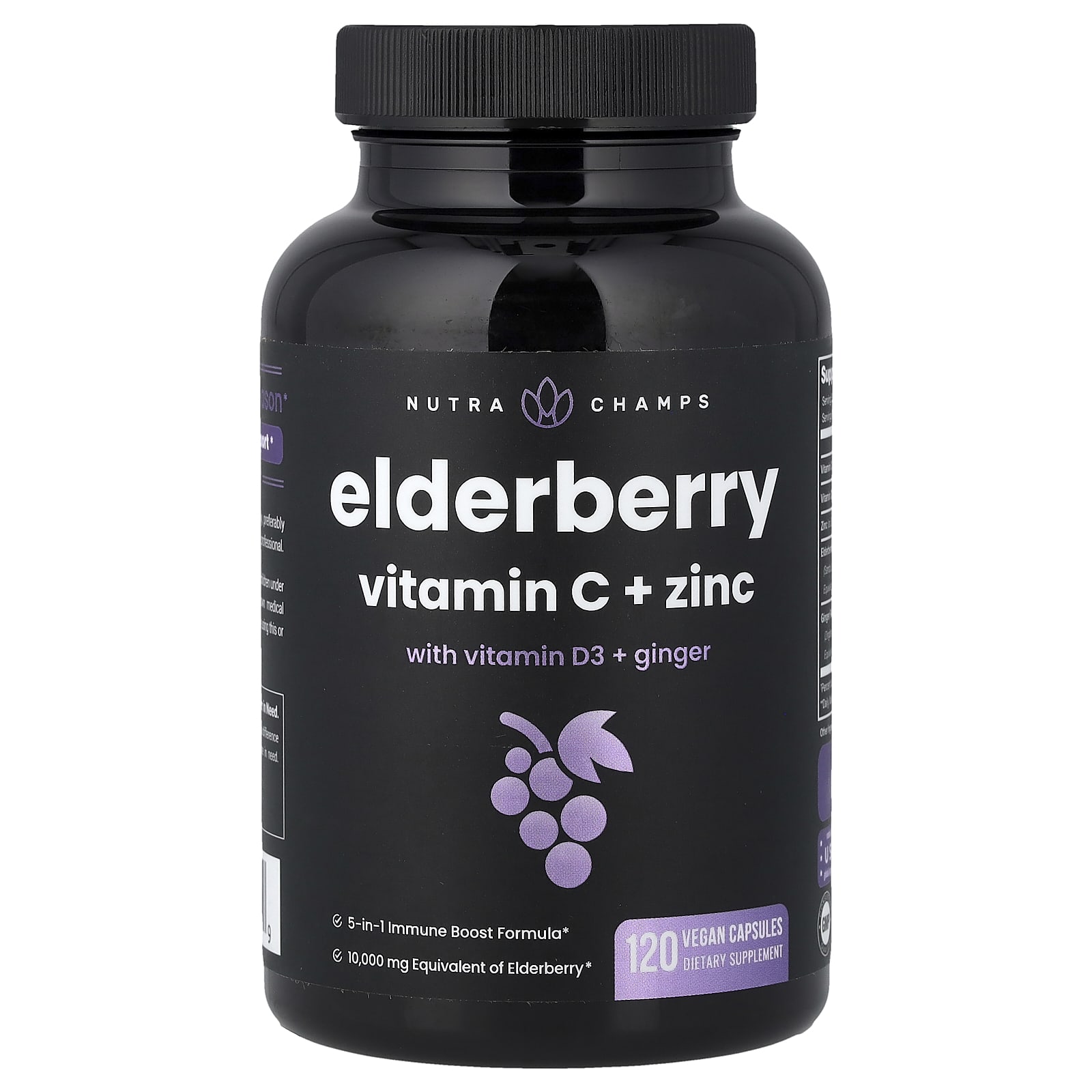
NutraChamps · capsules

Elderberry Vitamin C + Zinc

At the recorded label maximum: 2 capsules per day

Add to my list
Per day$0.38

At the label maximum of 2 capsules a day.

Per pack$23.05

120 capsules · Vitacost · checked 22 Oct 2026. Delivery is not included.

Per capsule$0.19

Pack price divided by the number of capsules in the pack.

Composition

Amounts at the recorded label maximum. Directions may give a range.

At the recorded label maximum, one ingredient is above the limit that applies in the United States: Vitamin D3 125 mcg (US upper limit for adults, National Academies: 100 mcg).

Talk to a doctor or pharmacist.

Vitamin Cas L-Ascorbic Acid
90 mgat the recorded label maximum (1 serving × 90 mg; 2 capsules per serving)45 mg per capsule · calculated from 90 mg per 2 capsules
5% of 2,000 mg — US upper limit for adults, National Academiesfrom food and supplements, adults · food is not counted here · a reference value, not a legal limit
Vitamin D3as Cholecalciferol
About this formvitamin D3 (cholecalciferol). Raises vitamin D levels more than D2. Reference level V0; no form is called “better” here.
125 mcgat the recorded label maximum (1 serving × 125 mcg; 2 capsules per serving)62.5 mcg per capsule · calculated from 125 mcg per 2 capsules
125% ↑ of 100 mcg — US upper limit for adults, National Academiesfrom food and supplements, adults · food is not counted here · a reference value, not a legal limit
Zincas Zinc Citrate
About this formzinc citrate — about 31% of the compound is zinc itself. Reference level V0; no form is called “better” here.
11 mgat the recorded label maximum (1 serving × 11 mg; 2 capsules per serving) · as zinc itself5.5 mg per capsule · calculated from 11 mg per 2 capsules
28% of 40 mg — US upper limit for adults, National Academiesfrom food and supplements, adults · food is not counted here · a reference value, not a legal limit
Elderberry Fruit Extractas Sambucus nigra Fruit Extract
1,000 mgat the recorded label maximum (1 serving × 1,000 mg; 2 capsules per serving)500 mg per capsule · calculated from 1,000 mg per 2 capsules
No limit on file for the United StatesNone on file in any country
100 mgat the recorded label maximum (1 serving × 100 mg; 2 capsules per serving)50 mg per capsule · calculated from 100 mg per 2 capsules
No limit on file for the United StatesNone on file in any country

Where no limit is shown, none is set or on file for the United States. That is not the same as having no maximum.

Manufacturer's directions

Suggested use: Take 2 capsules daily; preferably with food; or as directed by your healthcare professional.

Other ingredients on the label

Cellulose, Rice Flour

Limits in other countries
CountryVitamin CVitamin D3Zinc
United States2,000 mgreference, not a law · 5%100 mcgreference, not a law · 125% · above40 mgreference, not a law · 28%
Austria500 mgrecommendation · 18%20 mcgrecommendation · 625% · above15 mgrecommendation · 73%
Belgium1,000 mglaw · 9%75 mcglaw · 167% · above22.5 mglaw · 49%
Croatia800 mglaw · 11%10 mcglaw · 1250% · above15 mglaw · 73%
Cyprus2,000 mglaw · 5%10 mcglaw · 1250% · above15 mglaw · 73%
Denmark1,000 mgrecommendation · 9%95 mcgrecommendation · 132% · above11 mgrecommendation · 100%
EAEU900 mglaw · 10%15 mcglaw · 833% · above25 mglaw · 44%
Estonia—not on file100 mcgrecommendation · 125% · above25 mgrecommendation · 44%
Finland—not on file100 mcgrecommendation · 125% · above25 mgrecommendation · 44%
France180 mglaw · 50%5 mcglaw · 2500% · above15 mglaw · 73%
Germany250 mgrecommendation · 36%20 mcgrecommendation · 625% · above6.5 mgrecommendation · 169% · above
Ireland2,000 mgrecommendation · 5%100 mcgrecommendation · 125% · above25 mgrecommendation · 44%
Italy1,000 mgrecommendation · 9%50 mcgrecommendation · 250% · above15 mgrecommendation · 73%
Luxembourg1,000 mglaw · 9%50 mcglaw · 250% · above15 mglaw · 73%
Malta1,000 mgrecommendation · 9%25 mcgrecommendation · 500% · above25 mgrecommendation · 44%
Netherlands—not on file75 mcglaw · 167% · above—not on file
Norway1,000 mglaw · 9%80 mcglaw · 156% · above14 mglaw · 79%
Poland1,000 mgrecommendation · 9%50 mcgrecommendation · 250% · above15 mgrecommendation · 73%
Switzerland750 mglaw · 12%70 mcglaw · 179% · above5.3 mglaw · 208% · above

Maximum amounts per daily dose of a food supplement, as each country sets them; the share is the daily amount on the label against that maximum. Law = legally binding; recommendation = an authority's recommended maximum, not binding; reference = the U.S. upper intake level for adults from all sources (National Academies), not a legal limit. Verification level V0 · Report an error

About the ingredients

Ingredient information

Ingredient guideVitamin CVitamin C, also called L-ascorbic acid, is a water-soluble vitamin. Most animals make vitamin C in the body; humans cannot and get it from food. Fruits and vegetables such as peppers, citrus fruits and kiwifruit are the main sources. Supplements contain it as ascorbic acid or as mineral salts such as sodium and calcium ascorbate.Read moreShow less
Terms and sources
water-soluble
It dissolves in water, not in fat. NIH Office of Dietary Supplements.

Vitamin C in the body

Vitamin C is needed to make collagen, carnitine and some neurotransmitters. It is also an antioxidant and can return used vitamin E to its active form. It is needed for normal immune function. It increases the absorption of iron from plant foods.

Terms and sources
collagen
A protein that holds together connective tissue, such as skin, tendons and blood vessels. NIH Office of Dietary Supplements.
carnitine
A substance cells need to get energy from fat. Linus Pauling Institute.
neurotransmitters
Chemical messengers between nerve cells.
antioxidant
A substance that limits damage from free radicals, reactive molecules made in cells.
iron from plant foods
Nonheme iron, the only form of iron in plant foods. NIH Office of Dietary Supplements.

An adult body holds from about 300 mg to about 2 g of vitamin C. White blood cells, the eyes, the adrenal and pituitary glands and the brain hold the most. Cells hold vitamin C in millimolar concentrations, blood plasma in micromolar concentrations. At 100 mg a day or more, cells appear to be saturated.

Terms and sources
about 300 mg
The lower figure is for very low intake. NIH Office of Dietary Supplements.
adrenal and pituitary glands
Small glands that make hormones: the adrenals sit above the kidneys, the pituitary below the brain.
millimolar
Thousandths of a mole per liter; micromolar means millionths. NIH Office of Dietary Supplements.
saturated
Holding as much as they take up. Above 200 mg a day, blood plasma levels rise little more.

The body absorbs about 70–90% of vitamin C at 30–180 mg a day. Above 1 g a day, less than 50% is absorbed, and unused vitamin C leaves in urine.

Terms and sources
less than 50%
Summary by the NIH Office of Dietary Supplements. Absorption in the gut runs through a dose-dependent transporter protein.

Information, not a prescription. Do not start, stop or combine supplements or medicines on your own.
Ingredient guideVitamin DVitamin D is a fat-soluble vitamin. The skin makes it when ultraviolet light from the sun reaches it, and a few foods contain it. Supplements contain one or both of its two main forms: vitamin D3 and vitamin D2. Labels state the amount in micrograms (mcg), international units (IU) or both.Read moreShow less
Terms and sources
fat-soluble
It dissolves in fat, not in water. NIH Office of Dietary Supplements.

Vitamin D in the body

Vitamin D from the sun, food and supplements is inactive at first. The liver turns it into 25-hydroxyvitamin D, the form a blood test measures. Mainly the kidneys then make the active form.

Terms and sources
25-hydroxyvitamin D
Also called calcidiol or 25(OH)D. Results come in nmol/L or ng/mL; 50 nmol/L equals 20 ng/mL.
active form
1,25-dihydroxyvitamin D, also called calcitriol.

Vitamin D is needed for normal absorption of calcium from the gut and for normal bones. It is also needed for normal muscle and immune function. Many tissues in the body carry vitamin D receptors.

Terms and sources
vitamin D receptors
Proteins in cells that respond to the active form of vitamin D. NIH Office of Dietary Supplements.

Information, not a prescription. Do not start, stop or combine supplements or medicines on your own.

Ingredient guideZincZinc is an essential mineral that the body needs for the work of hundreds of enzymes. An adult body holds about 1.5–2.5 g of it. Oysters, meat and other seafood are rich sources. Supplements contain zinc as part of a compound, such as zinc citrate, zinc oxide or zinc gluconate.Read moreShow less
Terms and sources
1.5–2.5 g
About 1.5 g in women and 2.5 g in men. NIH Office of Dietary Supplements.

Zinc in the body

Zinc-dependent enzymes are found in all six classes of enzymes. More than 3,000 human proteins have sites that bind zinc. In some proteins, zinc holds a fold called a zinc finger in shape. Zinc also takes part in immune function, protein and DNA synthesis, cell division and the sense of taste.

Terms and sources
all six classes of enzymes
Enzymes are proteins that speed up chemical reactions in cells. The classes are those of the International Union of Biochemistry and Molecular Biology. Linus Pauling Institute.
More than 3,000
An estimate from searches of protein data. Linus Pauling Institute.
zinc finger
Zinc fingers let some proteins bind DNA and switch genes on or off. Linus Pauling Institute.
sense of taste
NIH Office of Dietary Supplements.

Most of the body's zinc is in skeletal muscle and bone. In healthy people, blood zinc is usually 80–120 mcg/dL. These blood values do not always follow how much zinc a person gets from food or supplements. As intake rises, the body absorbs more zinc, but a smaller share of it.

Terms and sources
80–120 mcg/dL
Serum or plasma zinc, 12–18 micromoles per liter. NIH Office of Dietary Supplements.
do not always follow
They also vary with age, sex and the time of the blood draw. NIH Office of Dietary Supplements.
a smaller share
Fractional absorption drops as intake rises. NIH Office of Dietary Supplements.

NIH notes: "High zinc intakes can cause nausea, dizziness, headaches, gastric distress, vomiting, and loss of appetite. If used for weeks, doses of 50 mg zinc or more—typically from supplements or excessive use of denture adhesive creams that contain zinc—can interfere with copper absorption (which can cause low copper status), reduce immune function, and lower HDL cholesterol levels. The amount of zinc obtained from food is rarely as high as 50 mg, so the zinc in foods is unlikely to cause zinc toxicity. Very high doses of zinc from supplements (142 mg/day) might also interfere with magnesium absorption and disrupt magnesium balance."

Terms and sources
NIH notes
NIH Office of Dietary Supplements, Zinc fact sheet for health professionals, section on health risks from excessive zinc.

Information, not a prescription. Do not start, stop or combine supplements or medicines on your own.

Ingredient guideElderberryElderberry is the dark purple berry of the European or black elder tree, Sambucus nigra. The tree grows in Europe, North America, Western Asia and North Africa. Supplements contain the berry as juice concentrate, powder or extract. Some extracts are standardized to anthocyanins, the berry's purple pigments.Read moreShow less
Terms and sources
dark purple berry
NCCIH, Elderberry: Usefulness and Safety.
grows in Europe
NCCIH, Elderberry: Usefulness and Safety.
anthocyanins
Given as cyanidin glycosides in one trial report below. Curtis et al., 2009.

Elderberry in the body

Elderberry is not a nutrient, and the body has no daily requirement for it. Trials below in adults without a diagnosis measured blood fats, sugar and insulin.

In one 12-week trial, anthocyanins did not build up in blood with daily intake. Mela et al. write that gut enzymes, mainly lactase-phloridzin hydrolase, convert such pigments to their aglycone forms.

Terms and sources
In one 12-week trial
The abstract states: “We observed no plasma accumulation of anthocyanins.” Curtis et al., Journal of Nutrition, 2009, below.
lactase-phloridzin hydrolase
The enzyme that also digests milk sugar. Mela et al., Nutrition and Metabolism, 2020, a trial report below.

Information, not a prescription. Do not start, stop or combine supplements or medicines on your own.

Ingredient guideGingerGinger is the underground stem, or rhizome, of the plant Zingiber officinale. The plant is native to the warm parts of Asia. Its rhizome is used in food and in supplements. Supplements contain ginger as root powder in capsules, extracts, liquid extracts, tea, lozenges and chews.Read moreShow less
Terms and sources
rhizome
NCCIH calls the rhizome an underground stem. NCCIH, Ginger: Usefulness and Safety.
warm parts of Asia
NCCIH, Ginger: Usefulness and Safety.

Ginger in the body

Ginger is not a nutrient, and the body has no daily requirement for it. Trials in adults without a diagnosis measure things such as muscle soreness after exercise and stomach emptying.

Ginger root holds about 1–3% volatile oils and a group of pungent compounds. In fresh root, the most abundant pungent compounds are gingerols, mainly 6-gingerol. Shogaols, a dehydrated form of gingerols, are found mainly in dried and heat-treated root. Extract makers state gingerols, sometimes with shogaols, to standardize their extracts.

Terms and sources
pungent compounds
Mainly gingerols and shogaols. Zick et al., 2008.
a dehydrated form
Fresh root holds only small amounts of shogaols. Zick et al., 2008.
standardize
To keep the amount of chosen compounds the same from batch to batch. In one study, an extract standardized to 5% gingerols held 2.15% 6-gingerol by HPLC. Zick et al., 2008.

In 27 healthy adults, one dose of up to 2 g of extract left no free gingerols in blood. They appeared in blood in bound forms, mostly glucuronides, from 30 minutes after the dose. These bound forms could no longer be detected in blood by 4 hours in all but one person. Side effects in that study were all graded mild, mainly burping, a burning feeling in the chest and stomach upset.

Terms and sources
27 healthy adults
Single doses from 100 mg to 2 g of an extract with 5% gingerols. Each new group got a higher dose; there was no comparison group. Zick et al., 2008.
glucuronides
Gingerols and shogaols joined to glucuronic acid. A smaller part was bound to sulfate. Zick et al., 2008.
all but one person
One person on 2 g still had bound 6-gingerol at 8 hours. Zick et al., 2008.
graded mild
No side effect was above grade 1 on a standard toxicity scale. Zick et al., 2008.

NCCIH notes: “Ginger has been used safely in many research studies where it was taken orally (by mouth) as a dietary supplement.” It adds: “Ginger products may also be safe for topical use.” NCCIH lists side effects: “Ginger can have side effects such as abdominal discomfort, heartburn, diarrhea, and mouth and throat irritation when taken orally.” NCCIH advises: “If you take any type of medicine, talk with your health care provider before using ginger or any other herbal products; some herbs and medicines interact in harmful ways.” NCCIH also writes: “The use of ginger dietary supplements during pregnancy may be safe.” It continues: “As with all herbal supplements, if you’re considering using ginger while pregnant, consult your health care provider.” NCCIH adds: “Little is known about whether it’s safe to use ginger while breastfeeding.”

Terms and sources
NCCIH notes
NCCIH, Ginger: Usefulness and Safety.

In the cycling trial below, at most 2 of 30 cyclists reported gas, burping or fullness with either drink. In the 2-week powder trial below, no moderate or severe side effects were reported.

Terms and sources
at most 2 of 30 cyclists
Weekly 16-item questionnaire on stomach and gut symptoms. Kurtz et al., Sports, 2026.
no moderate or severe side effects
Crichton et al., Journal of Nutrition, 2023.

Information, not a prescription. Do not start, stop or combine supplements or medicines on your own.

Need help choosing?

Choose the option that suits you.

Quick selection

I know my goal

$5

1–2 minutes · a few questions with fixed answers

One goal. Up to three products. Set a budget per day if you like.

Product checks
form and amount on the label, plus shop prices
Daily schedule
what to take, when, how much
Totals and limits
next to the upper limit
Reasons & sources
for each product
Prices and shops
plus food and habits
Progress
what to track, when to see a doctor

Complete the questionnaire before you pay. If no product fits any of your goals, you won’t be charged.

Order · $5View example

Full selection

I have several goals

$15

5–7 minutes · questionnaire with fixed answers

Up to three goals in one set. Where two goals overlap, one product is used for both.

Product checks
form and amount on the label, plus shop prices
Daily schedule
what to take, when, how much
Totals and limits
next to the upper limit
Reasons & sources
for each product
Prices and shops
plus food and habits
Progress
what to track, when to see a doctor

Complete the questionnaire before you pay. If no product fits any of your goals, you won’t be charged.

Order · $15View example

Expert review

I want a person to look at my supplements

$50

Written review within 48 hours of your completed questionnaire

An expert reviews your supplement list and questionnaire.

Written review
duplicates, limits, forms
Detailed questionnaire
supplements, medicines, history
Optional uploads
supplement-label photos or documents relevant to your review
Your notes
your priorities and questions
Follow-up questions
in writing, when needed
Next steps
points to discuss with your doctor

Complete the questionnaire before you pay.

Order · $50View example
Sources, label & certificates

Label record

Copied from the NIH label database (DSLD 304872) · not yet compared with the label · checked 19 Oct 2026 · Report an error

The United States has no pre-market registration for supplements.
Label on file in the NIH Dietary Supplement Label Database
checked 19 Oct 2026source: NIH DSLDReport an error

Barcode 6 21983 99015 9

Third-party certificates

Label mentions: This bottle supports a child or mother in need Every product you purchase from us makes a difference by providing life-changing vitamins to those in need.. Not yet checked against the certifiers’ registries.

Information, not a prescription. Do not start, stop or combine supplements or medicines on your own. If you have a health condition, are pregnant or breastfeeding, take medicines, or are under 18, talk to a doctor or pharmacist first.

Photo credits

Image: © NutraChamps. Shown to identify the product. Source: iherb.com

Rights holders can ask us to remove an image or send official product photos: info@verateca.com.

Product photo

NutraChamps Elderberry Vitamin C + Zinc — enlarged pack