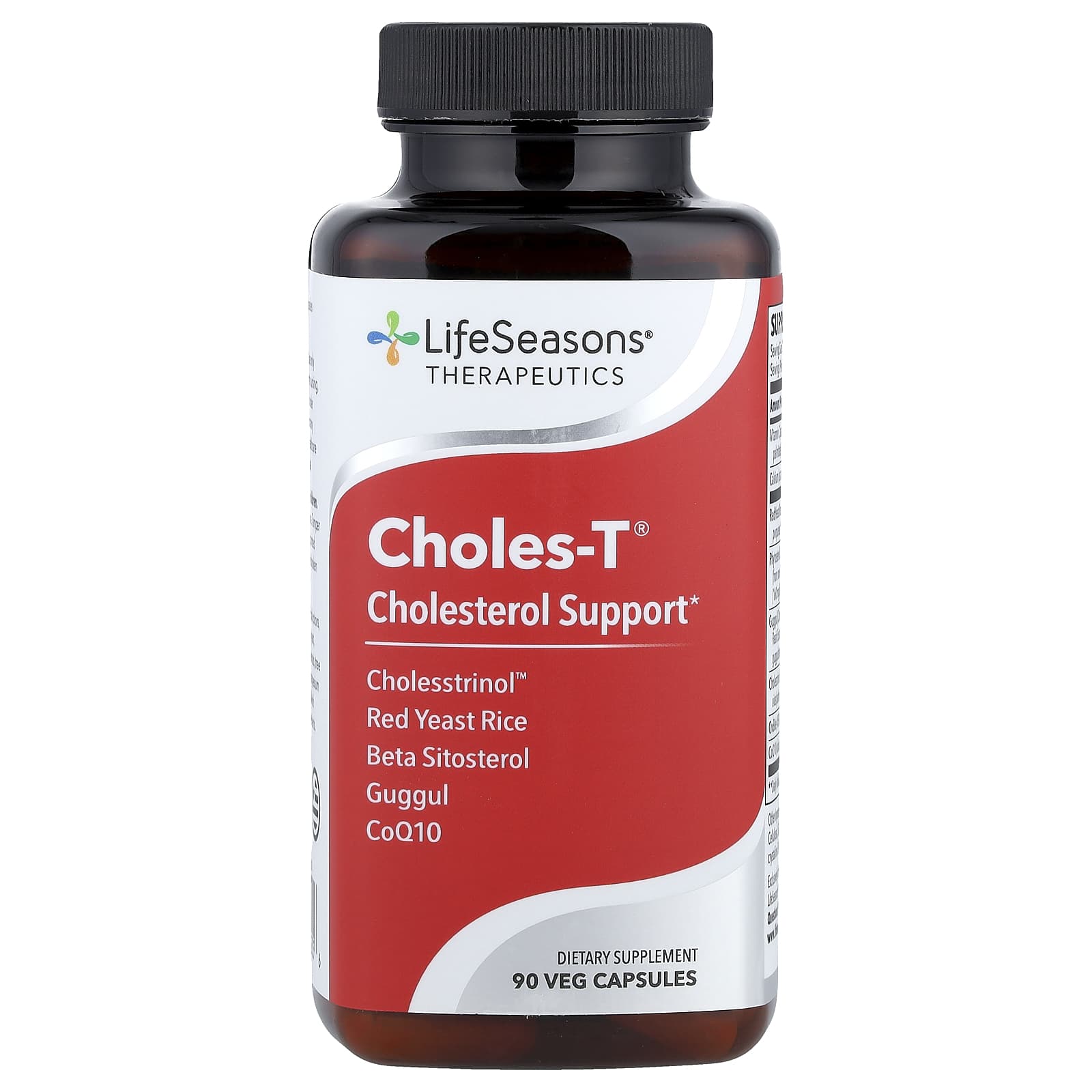
LifeSeasons Therapeutics · capsules

Choles-T

At the recorded label maximum: 3 capsules per day

Add to my list
Per day$1.30

At the label maximum of 3 capsules a day.

Per pack$38.99

90 capsules · Vitacost · checked 22 Oct 2026. Delivery is not included.

Per capsule$0.43

Pack price divided by the number of capsules in the pack.

Composition

Amounts at the recorded label maximum. Directions may give a range.

Vitamin Cas Ascorbyl Palmitate
50 mgat the recorded label maximum (1 serving × 50 mg; 3 capsules per serving)16.6666666666667 mg per capsule · calculated from 50 mg per 3 capsules
3% of 2,000 mg — US upper limit for adults, National Academiesfrom food and supplements, adults · food is not counted here · a reference value, not a legal limit
Calciumas Calcium Citrate
About this formcalcium citrate (incl. citrate malate) — about 21% of the compound is calcium itself. Absorbed without food; about 21% calcium, so tablets are larger. Reference level V0; no form is called “better” here.
50 mgat the recorded label maximum (1 serving × 50 mg; 3 capsules per serving) · as calcium itself16.6666666666667 mg per capsule · calculated from 50 mg per 3 capsules
3% of 2,000 mg — US upper limit for adults, National Academies2,500 mg (ages 19–50) · 2,000 mg (51 and older) · from food and supplements, adults · food is not counted here · a reference value, not a legal limit
Red Yeast Riceas Monascus purpureus
600 mgat the recorded label maximum (1 serving × 600 mg; 3 capsules per serving)200 mg per capsule · calculated from 600 mg per 3 capsules
No limit on file for the United StatesNone on file in any country
400 mgat the recorded label maximum (1 serving × 400 mg; 3 capsules per serving)
No limit on file for the United States
Limits in other countries (2)Croatia, France
160 mgat the recorded label maximum (1 serving × 160 mg; 3 capsules per serving)
No limit on file for the United States
Limits in other countries (2)Croatia, France
Coenzyme Q-10as Ubiquinone
About this formubiquinone. Reference level V0; no form is called “better” here.
30 mgat the recorded label maximum (1 serving × 30 mg; 3 capsules per serving)10 mg per capsule · calculated from 30 mg per 3 capsules
No limit on file for the United States
Limits in other countries (1)Eurasian Economic Union (EAEU)

Where no limit is shown, none is set or on file for the United States. That is not the same as having no maximum.

Manufacturer's directions

Directions: Take 3 capsules daily with food.

Other ingredients on the label

Hypromellose (Cellulose), Silica, Rice Bran, Microcrystalline Cellulose

Limits in other countries
CountryVitamin CCalciumBeta-SitosterolCoenzyme Q-10
United States2,000 mgreference, not a law · 3%2,000 mgreference, not a law · 3%
Comparison note2,500 mg (ages 19–50) · 2,000 mg (51 and older)
—not on file—not on file
Austria500 mgrecommendation · 10%800 mgrecommendation · 6%—not on file—not on file
Belgium1,000 mglaw · 5%1,600 mglaw · 3%—not on file—not on file
Croatia800 mglaw · 6%1,500 mglaw · 3%3,000 mglaw · 19%—not on file
Cyprus2,000 mglaw · 3%1,500 mglaw · 3%—not on file—not on file
Denmark1,000 mgrecommendation · 5%1,327 mgrecommendation · 4%—not on file—not on file
EAEU900 mglaw · 6%2,500 mglaw · 2%—not on file100 mglaw · 30%
Estonia—not on file2,500 mgrecommendation · 2%—not on file—not on file
Finland—not on file2,500 mgrecommendation · 2%—not on file—not on file
France180 mglaw · 28%800 mglaw · 6%1,700 mgrecommendation · 33%—not on file
Germany250 mgrecommendation · 20%500 mgrecommendation · 10%—not on file—not on file
Ireland2,000 mgrecommendation · 3%2,500 mgrecommendation · 2%—not on file—not on file
Italy1,000 mgrecommendation · 5%1,200 mgrecommendation · 4%—not on file—not on file
Luxembourg1,000 mglaw · 5%1,600 mglaw · 3%—not on file—not on file
Malta1,000 mgrecommendation · 5%1,500 mgrecommendation · 3%—not on file—not on file
Norway1,000 mglaw · 5%705 mglaw · 7%—not on file—not on file
Poland1,000 mgrecommendation · 5%1,500 mgrecommendation · 3%—not on file—not on file
Switzerland750 mglaw · 7%750 mglaw · 7%—not on file—not on file

Maximum amounts per daily dose of a food supplement, as each country sets them; the share is the daily amount on the label against that maximum. Law = legally binding; recommendation = an authority's recommended maximum, not binding; reference = the U.S. upper intake level for adults from all sources (National Academies), not a legal limit. Verification level V0 · Report an error

About the ingredients

Ingredient information

Ingredient guideVitamin CVitamin C, also called L-ascorbic acid, is a water-soluble vitamin. Most animals make vitamin C in the body; humans cannot and get it from food. Fruits and vegetables such as peppers, citrus fruits and kiwifruit are the main sources. Supplements contain it as ascorbic acid or as mineral salts such as sodium and calcium ascorbate.Read moreShow less
Terms and sources
water-soluble
It dissolves in water, not in fat. NIH Office of Dietary Supplements.

Vitamin C in the body

Vitamin C is needed to make collagen, carnitine and some neurotransmitters. It is also an antioxidant and can return used vitamin E to its active form. It is needed for normal immune function. It increases the absorption of iron from plant foods.

Terms and sources
collagen
A protein that holds together connective tissue, such as skin, tendons and blood vessels. NIH Office of Dietary Supplements.
carnitine
A substance cells need to get energy from fat. Linus Pauling Institute.
neurotransmitters
Chemical messengers between nerve cells.
antioxidant
A substance that limits damage from free radicals, reactive molecules made in cells.
iron from plant foods
Nonheme iron, the only form of iron in plant foods. NIH Office of Dietary Supplements.

An adult body holds from about 300 mg to about 2 g of vitamin C. White blood cells, the eyes, the adrenal and pituitary glands and the brain hold the most. Cells hold vitamin C in millimolar concentrations, blood plasma in micromolar concentrations. At 100 mg a day or more, cells appear to be saturated.

Terms and sources
about 300 mg
The lower figure is for very low intake. NIH Office of Dietary Supplements.
adrenal and pituitary glands
Small glands that make hormones: the adrenals sit above the kidneys, the pituitary below the brain.
millimolar
Thousandths of a mole per liter; micromolar means millionths. NIH Office of Dietary Supplements.
saturated
Holding as much as they take up. Above 200 mg a day, blood plasma levels rise little more.

The body absorbs about 70–90% of vitamin C at 30–180 mg a day. Above 1 g a day, less than 50% is absorbed, and unused vitamin C leaves in urine.

Terms and sources
less than 50%
Summary by the NIH Office of Dietary Supplements. Absorption in the gut runs through a dose-dependent transporter protein.

Information, not a prescription. Do not start, stop or combine supplements or medicines on your own.
Ingredient guideCalciumCalcium is the most abundant mineral in the human body. An adult body holds about 1.2–1.4 kg of it, almost all in bones and teeth. Milk, yogurt and cheese are rich sources. Supplements contain calcium as part of a compound, most often calcium carbonate or calcium citrate.Read moreShow less
Terms and sources
1.2–1.4 kg
About 1,200 g in women and 1,400 g in men. NIH Office of Dietary Supplements.

Calcium in the body

About 99% of the body's calcium is in bones and teeth. The other 1% is in the blood and soft tissues. This small part is needed for normal muscle function, nerve signaling, blood clotting and hormone release. It also takes part as blood vessels tighten and relax.

Terms and sources
bones and teeth
There it sits in hydroxyapatite, a mineral of calcium and phosphate. Linus Pauling Institute; NIH Office of Dietary Supplements.

The body keeps blood calcium in a narrow range, about 8.8–10.4 mg/dL. When intake is low, it draws calcium from bone to hold that range. A blood test therefore does not show how much calcium a person gets. Bone is rebuilt all the time; teeth are not. Vitamin D is needed to absorb calcium in the gut.

Terms and sources
8.8–10.4 mg/dL
2.2–2.6 mmol/L, total calcium in serum in healthy people. NIH Office of Dietary Supplements.
absorb calcium in the gut
Vitamin D is needed for active transport, the main route when intake is low. NIH Office of Dietary Supplements.

Information, not a prescription. Do not start, stop or combine supplements or medicines on your own.

Ingredient guidePlant sterols and stanolsPlant sterols and stanols, together called phytosterols, are plant compounds built much like cholesterol. The main plant sterols in food are beta-sitosterol, campesterol and stigmasterol. Stanols, such as sitostanol, lack one double bond; they are about 10% of food phytosterols. Supplements hold free sterols, stanols or their esters, which are bound to fatty acids, in capsules, softgels or powders.Read moreShow less
Terms and sources
built much like cholesterol
They are structurally related to cholesterol. Linus Pauling Institute, Oregon State University.
beta-sitosterol
Also written β-sitosterol. Linus Pauling Institute, Oregon State University.
lack one double bond
In the sterol ring; stanols are the saturated forms. Linus Pauling Institute, Oregon State University.
in capsules, softgels or powders
Product forms of 92 US labels with sterols or stanols alone, NIH Dietary Supplement Label Database. Tablets also appear. We counted these.

Plant sterols in the body

The body cannot make phytosterols, so all phytosterols in human blood come from the diet. Less than 5% of plant sterols eaten and less than 0.5% of plant stanols are absorbed. Gut cells pump most absorbed phytosterols straight back into the gut. Blood levels of phytosterols are usually several hundred times lower than blood cholesterol.

Terms and sources
come from the diet
Cholesterol, by contrast, comes from both the diet and the body's own production. Linus Pauling Institute, Oregon State University.
are absorbed
For cholesterol from food, the figure is about 50–60%. Linus Pauling Institute, Oregon State University.
pump
A transporter called ABCG5/G8 does this; in the liver, the same transporter moves them into bile. Linus Pauling Institute, Oregon State University.

In the gut, phytosterols take the place of cholesterol in the tiny fat droplets that carry it. More cholesterol from food and bile then leaves in the stool. LPI cites a feeding trial with 0.46 g and 2.1 g of phytosterols a day. Cholesterol absorption fell by about 10% and 25%. Cholesterol leaving in the stool rose by 36% and 74%, LPI notes.

Terms and sources
tiny fat droplets
mixed micelles: droplets of bile salts, fats and sterols that form after a meal with fat. Linus Pauling Institute, Oregon State University.
leaves in the stool
LPI: phytosterols also facilitate the excretion of biliary cholesterol in the feces.
a feeding trial
Phytosterols in drinks, compared with a dummy drink. LPI, citing Racette et al., American Journal of Clinical Nutrition, 2010.

LPI cites a meta-analysis of 124 studies of LDL cholesterol in the blood. LDL cholesterol was at least 5% lower with 0.6–1.1 g a day and about 12.4% lower with 3.3 g. These are blood measurements; LPI notes that the long-term effect on health outcomes is not known.

Terms and sources
124 studies
Ras et al., British Journal of Nutrition, 2014, as cited by LPI. Two of the three authors worked for Unilever.

Phytosterols also lower blood levels of some carotenoids, the yellow and red pigments of plants. LPI cites a meta-analysis in which blood carotenoids such as beta-carotene were about 5–20% lower with enriched foods. LPI notes that in one trial, advice to eat 5 servings of fruit and vegetables a day kept carotenoid levels.

Terms and sources
a meta-analysis
Over 1 month to 1 year. Adjusted for cholesterol, alpha-carotene, beta-carotene and lycopene may stay lower. Baumgartner et al., European Journal of Nutrition, 2017, as cited by LPI. Two of the five authors worked for Unilever.
one trial
Including 1 serving of carotenoid-rich vegetables, in people taking 2.5 g of sterol or stanol esters a day. Noakes et al., American Journal of Clinical Nutrition, 2002, as cited by LPI.

LPI notes that in the US, plant sterols and stanols added to a variety of food products are "generally recognized as safe" (GRAS), an FDA status. LPI notes that few adverse effects have been reported with regular intake for up to 1 year. LPI notes that nausea, indigestion, diarrhea and constipation have occasionally been reported. LPI notes that people with sitosterolemia should avoid foods or supplements with added plant sterols. LPI notes: Phytosterol-enriched foods and supplements are not recommended for pregnant or breastfeeding women because their safety has not been studied. LPI notes that some cholesterol medicines change how much plant sterol the body absorbs or keeps in blood.

Terms and sources
GRAS
A US status for food ingredients. Linus Pauling Institute, Oregon State University.
sitosterolemia
A very rare inherited condition in which the body absorbs and keeps far more plant sterols. Linus Pauling Institute, Oregon State University.
some cholesterol medicines
LPI: statin therapy appears to increase the absorption of plant sterols. Ezetimibe (marketed as Zetia) is another cholesterol-lowering drug that may interfere with the intestinal absorption of phytosterols.

Information, not a prescription. Do not start, stop or combine supplements or medicines on your own.

Need help choosing?

Choose the option that suits you.

Quick selection

I know my goal

$5

1–2 minutes · a few questions with fixed answers

One goal. Up to three products. Set a budget per day if you like.

Product checks
form and amount on the label, plus shop prices
Daily schedule
what to take, when, how much
Totals and limits
next to the upper limit
Reasons & sources
for each product
Prices and shops
plus food and habits
Progress
what to track, when to see a doctor

Complete the questionnaire before you pay. If no product fits any of your goals, you won’t be charged.

Order · $5View example

Full selection

I have several goals

$15

5–7 minutes · questionnaire with fixed answers

Up to three goals in one set. Where two goals overlap, one product is used for both.

Product checks
form and amount on the label, plus shop prices
Daily schedule
what to take, when, how much
Totals and limits
next to the upper limit
Reasons & sources
for each product
Prices and shops
plus food and habits
Progress
what to track, when to see a doctor

Complete the questionnaire before you pay. If no product fits any of your goals, you won’t be charged.

Order · $15View example

Expert review

I want a person to look at my supplements

$50

Written review within 48 hours of your completed questionnaire

An expert reviews your supplement list and questionnaire.

Written review
duplicates, limits, forms
Detailed questionnaire
supplements, medicines, history
Optional uploads
supplement-label photos or documents relevant to your review
Your notes
your priorities and questions
Follow-up questions
in writing, when needed
Next steps
points to discuss with your doctor

Complete the questionnaire before you pay.

Order · $50View example
Sources, label & certificates

Label record

Copied from the NIH label database (DSLD 310467) · not yet compared with the label · checked 2 Nov 2026 · Report an error

The United States has no pre-market registration for supplements.
Label on file in the NIH Dietary Supplement Label Database
checked 2 Nov 2026source: NIH DSLDReport an error

Barcode 8 53760 00205 6

Third-party certificates

No third-party certificate on file for this product.

Information, not a prescription. Do not start, stop or combine supplements or medicines on your own. If you have a health condition, are pregnant or breastfeeding, take medicines, or are under 18, talk to a doctor or pharmacist first.

Photo credits

Image: © LifeSeasons Therapeutics. Shown to identify the product. Source: iherb.com

Rights holders can ask us to remove an image or send official product photos: info@verateca.com.

Product photo

LifeSeasons Therapeutics Choles-T — enlarged pack