Terra Origin · capsules

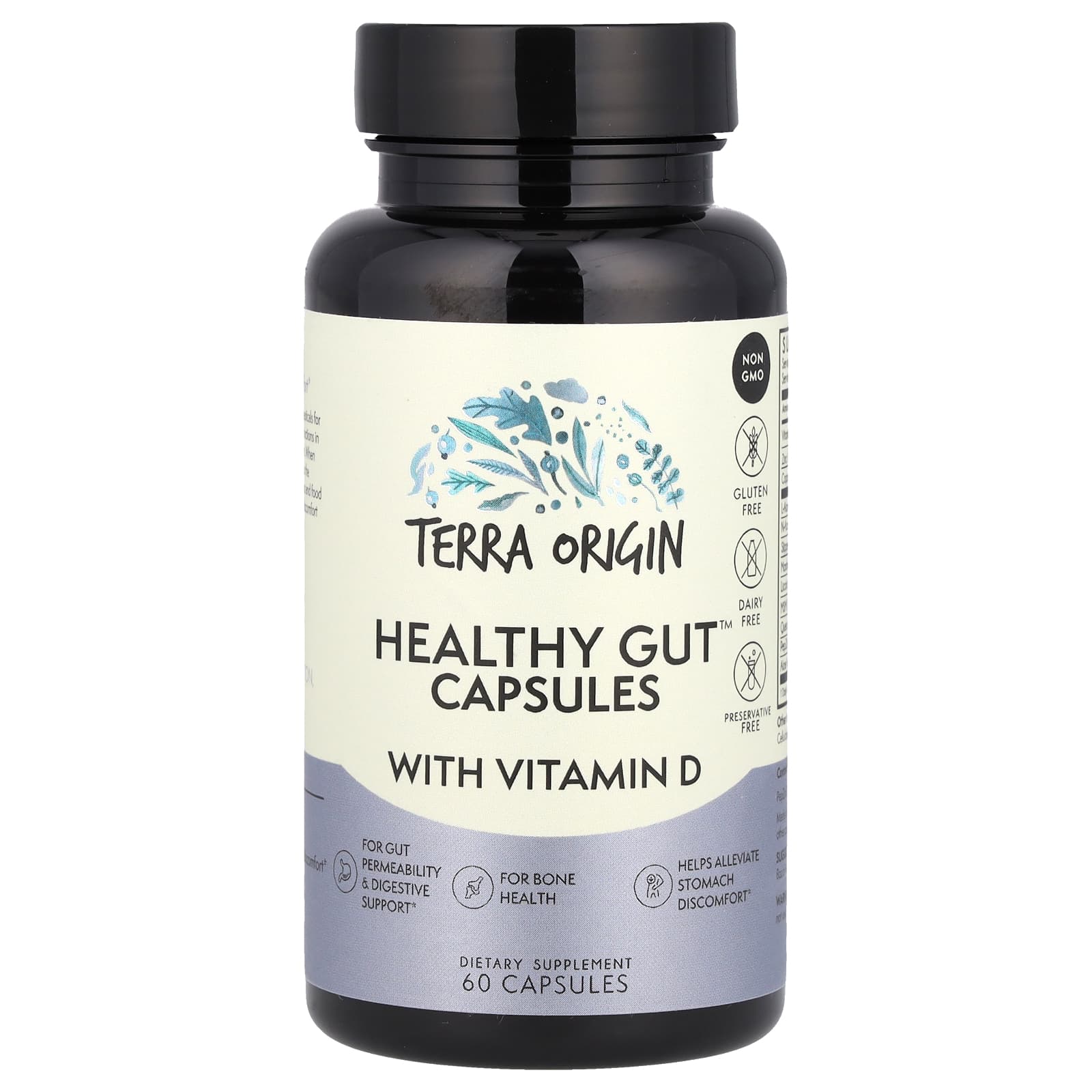
Healthy Gut Capsules with Vitamin D

2 capsules · how many a day not stated

Add to my list
Per day$0.83

Calculated at 1 serving a day (2 capsules). The label does not state how many to take daily.

Per pack$24.99

60 capsules · Vitacost · checked 22 Oct 2026. Delivery is not included.

Per capsule$0.42

Pack price divided by the number of capsules in the pack.

Composition

Recorded amounts. How many servings a day is not stated.

At the recorded label maximum, one ingredient is above the limit that applies in the United States: Vitamin D 125 mcg (US upper limit for adults, National Academies: 100 mcg).

Talk to a doctor or pharmacist.

Vitamin Das Cholecalciferol
About this formvitamin D3 (cholecalciferol). Raises vitamin D levels more than D2. Reference level V0; no form is called “better” here.
125 mcgrecorded amount; daily frequency not stated62.5 mcg per capsule · calculated from 125 mcg per 2 capsules
125% ↑ of 100 mcg — US upper limit for adults, National Academiesfrom food and supplements, adults · food is not counted here · a reference value, not a legal limit
Zincas PepZinGI
2.15 mgrecorded amount; daily frequency not stated · as zinc itself1.075 mg per capsule · calculated from 2.15 mg per 2 capsules
5% of 40 mg — US upper limit for adults, National Academiesfrom food and supplements, adults · food is not counted here · a reference value, not a legal limit
Copperas Copper Oxide
1 mgrecorded amount; daily frequency not stated500 mcg per capsule · calculated from 1 mg per 2 capsules
10% of 10 mg — US upper limit for adults, National Academiesfrom food and supplements, adults · food is not counted here · a reference value, not a legal limit
L-Alanyl-L-Glutamine
500 mgrecorded amount; daily frequency not stated250 mg per capsule · calculated from 500 mg per 2 capsules
No limit on file for the United StatesNone on file in any country
N-Acetyl-D-Glucosamine
About this formN-acetyl glucosamine. Reference level V0; no form is called “better” here.
300 mgrecorded amount; daily frequency not stated150 mg per capsule · calculated from 300 mg per 2 capsules
No limit on file for the United States
Limits in other countries (2)Croatia, Switzerland
Slippery Elm bark extract
100 mgrecorded amount; daily frequency not stated50 mg per capsule · calculated from 100 mg per 2 capsules
No limit on file for the United StatesNone on file in any country
Marshmallow Root Extract
100 mgrecorded amount; daily frequency not stated50 mg per capsule · calculated from 100 mg per 2 capsules
No limit on file for the United StatesNone on file in any country
Licorice Root Extract
100 mgrecorded amount; daily frequency not stated50 mg per capsule · calculated from 100 mg per 2 capsules
No limit on file for the United StatesNone on file in any country
MSM
100 mgrecorded amount; daily frequency not stated50 mg per capsule · calculated from 100 mg per 2 capsules
No limit on file for the United States
Limits in other countries (1)Switzerland
Quercetin Dihydrate
50 mgrecorded amount; daily frequency not stated25 mg per capsule · calculated from 50 mg per 2 capsules
No limit on file for the United StatesNone on file in any country
Aloe vera Leaf Extract
10 mgrecorded amount; daily frequency not stated5 mg per capsule · calculated from 10 mg per 2 capsules
No limit on file for the United StatesNone on file in any country

Where no limit is shown, none is set or on file for the United States. That is not the same as having no maximum.

Manufacturer's directions

Suggested Use As a dietary supplement take 2 capsules with 8oz of water; preferably in the morning or between meals.

Other ingredients on the label

Gelatin, Microcrystalline Cellulose, Magnesium Stearate (Mg Stearate)

Limits in other countries
CountryVitamin DZincCopperN-Acetyl-D-Glucosamine
United States100 mcgreference, not a law · 125% · above40 mgreference, not a law · 5%10,000 mcgreference, not a law · 10%—not on file
Austria20 mcgrecommendation · 625% · above15 mgrecommendation · 14%1 mgrecommendation · 100%—not on file
Belgium75 mcglaw · 167% · above22.5 mglaw · 10%2 mglaw · 50%—not on file
Croatia10 mcglaw · 1250% · above15 mglaw · 14%3 mglaw · 33%2,000 mglaw · 15%
Cyprus10 mcglaw · 1250% · above15 mglaw · 14%5 mglaw · 20%—not on file
Denmark95 mcgrecommendation · 132% · above11 mgrecommendation · 20%0.4 mgrecommendation · 250% · above—not on file
EAEU15 mcglaw · 833% · above25 mglaw · 9%3 mglaw · 33%—not on file
Estonia100 mcgrecommendation · 125% · above25 mgrecommendation · 9%5 mgrecommendation · 20%—not on file
Finland100 mcgrecommendation · 125% · above25 mgrecommendation · 9%5 mgrecommendation · 20%—not on file
France5 mcglaw · 2500% · above15 mglaw · 14%2,000 mcglaw · 50%—not on file
Germany20 mcgrecommendation · 625% · above6.5 mgrecommendation · 33%1 mgrecommendation · 100%—not on file
Ireland100 mcgrecommendation · 125% · above25 mgrecommendation · 9%5 mgrecommendation · 20%—not on file
Italy50 mcgrecommendation · 250% · above15 mgrecommendation · 14%2 mgrecommendation · 50%—not on file
Luxembourg50 mcglaw · 250% · above15 mglaw · 14%2 mglaw · 50%—not on file
Malta25 mcgrecommendation · 500% · above25 mgrecommendation · 9%2 mgrecommendation · 50%—not on file
Netherlands75 mcglaw · 167% · above—not on file—not on file—not on file
Norway80 mcglaw · 156% · above14 mglaw · 15%—not on file—not on file
Poland50 mcgrecommendation · 250% · above15 mgrecommendation · 14%2 mgrecommendation · 50%—not on file
Switzerland70 mcglaw · 179% · above5.3 mglaw · 41%1.6 mglaw · 63%750 mglaw · 40%

Maximum amounts per daily dose of a food supplement, as each country sets them; the share is the daily amount on the label against that maximum. Law = legally binding; recommendation = an authority's recommended maximum, not binding; reference = the U.S. upper intake level for adults from all sources (National Academies), not a legal limit. Verification level V0 · 1 more ingredients have limits on file · Report an error

About the ingredients

Ingredient information

Ingredient guideVitamin DVitamin D is a fat-soluble vitamin. The skin makes it when ultraviolet light from the sun reaches it, and a few foods contain it. Supplements contain one or both of its two main forms: vitamin D3 and vitamin D2. Labels state the amount in micrograms (mcg), international units (IU) or both.Read moreShow less
Terms and sources
fat-soluble
It dissolves in fat, not in water. NIH Office of Dietary Supplements.

Vitamin D in the body

Vitamin D from the sun, food and supplements is inactive at first. The liver turns it into 25-hydroxyvitamin D, the form a blood test measures. Mainly the kidneys then make the active form.

Terms and sources
25-hydroxyvitamin D
Also called calcidiol or 25(OH)D. Results come in nmol/L or ng/mL; 50 nmol/L equals 20 ng/mL.
active form
1,25-dihydroxyvitamin D, also called calcitriol.

Vitamin D is needed for normal absorption of calcium from the gut and for normal bones. It is also needed for normal muscle and immune function. Many tissues in the body carry vitamin D receptors.

Terms and sources
vitamin D receptors
Proteins in cells that respond to the active form of vitamin D. NIH Office of Dietary Supplements.

Information, not a prescription. Do not start, stop or combine supplements or medicines on your own.
Ingredient guideZincZinc is an essential mineral that the body needs for the work of hundreds of enzymes. An adult body holds about 1.5–2.5 g of it. Oysters, meat and other seafood are rich sources. Supplements contain zinc as part of a compound, such as zinc citrate, zinc oxide or zinc gluconate.Read moreShow less
Terms and sources
1.5–2.5 g
About 1.5 g in women and 2.5 g in men. NIH Office of Dietary Supplements.

Zinc in the body

Zinc-dependent enzymes are found in all six classes of enzymes. More than 3,000 human proteins have sites that bind zinc. In some proteins, zinc holds a fold called a zinc finger in shape. Zinc also takes part in immune function, protein and DNA synthesis, cell division and the sense of taste.

Terms and sources
all six classes of enzymes
Enzymes are proteins that speed up chemical reactions in cells. The classes are those of the International Union of Biochemistry and Molecular Biology. Linus Pauling Institute.
More than 3,000
An estimate from searches of protein data. Linus Pauling Institute.
zinc finger
Zinc fingers let some proteins bind DNA and switch genes on or off. Linus Pauling Institute.
sense of taste
NIH Office of Dietary Supplements.

Most of the body's zinc is in skeletal muscle and bone. In healthy people, blood zinc is usually 80–120 mcg/dL. These blood values do not always follow how much zinc a person gets from food or supplements. As intake rises, the body absorbs more zinc, but a smaller share of it.

Terms and sources
80–120 mcg/dL
Serum or plasma zinc, 12–18 micromoles per liter. NIH Office of Dietary Supplements.
do not always follow
They also vary with age, sex and the time of the blood draw. NIH Office of Dietary Supplements.
a smaller share
Fractional absorption drops as intake rises. NIH Office of Dietary Supplements.

NIH notes: "High zinc intakes can cause nausea, dizziness, headaches, gastric distress, vomiting, and loss of appetite. If used for weeks, doses of 50 mg zinc or more—typically from supplements or excessive use of denture adhesive creams that contain zinc—can interfere with copper absorption (which can cause low copper status), reduce immune function, and lower HDL cholesterol levels. The amount of zinc obtained from food is rarely as high as 50 mg, so the zinc in foods is unlikely to cause zinc toxicity. Very high doses of zinc from supplements (142 mg/day) might also interfere with magnesium absorption and disrupt magnesium balance."

Terms and sources
NIH notes
NIH Office of Dietary Supplements, Zinc fact sheet for health professionals, section on health risks from excessive zinc.

Information, not a prescription. Do not start, stop or combine supplements or medicines on your own.

Ingredient guideCopperCopper is an essential mineral that several enzymes need in order to work. An adult body holds about 50–120 mg of it. Shellfish, seeds and nuts, organ meats and whole grains are rich sources. Supplements contain copper as part of a compound, such as copper gluconate, copper bisglycinate or cupric oxide.Read moreShow less
Terms and sources
several enzymes
They are called cuproenzymes. They take part in energy production, iron metabolism, connective tissue synthesis and the making of brain signaling chemicals. NIH Office of Dietary Supplements.
50–120 mg
Only small amounts of copper are stored in the body. NIH Office of Dietary Supplements.

Copper in the body

One copper enzyme, ceruloplasmin, carries more than 95% of the copper in the blood plasma of healthy people. Copper-containing superoxide dismutases are the main defense of cells against oxidative damage, NIH notes. Almost two-thirds of the body's copper is in the skeleton and muscle.

Terms and sources
ceruloplasmin
Ceruloplasmin also takes part in iron metabolism. NIH Office of Dietary Supplements.
superoxide dismutases
Enzymes that break down reactive forms of oxygen. NIH Office of Dietary Supplements.

Most copper leaves the body in bile, and a small amount in urine. The body keeps its copper level steady through absorption in the gut and release from the liver into bile. No blood test reliably shows how much copper a person has, NIH notes. High intakes of zinc can interfere with copper absorption.

Terms and sources
keeps its copper level steady
NIH Office of Dietary Supplements.
No blood test
Normal serum copper is 10–25 micromoles per liter (63.5–158.9 mcg/dL). Blood copper and ceruloplasmin also change with estrogen status and inflammation. NIH Office of Dietary Supplements.
High intakes of zinc
NIH notes: "High dietary intakes of zinc can interfere with copper absorption, and excessive use of zinc supplements can lead to copper deficiency." NIH notes this is one reason the US zinc upper limit for adults is 40 mg a day.

NIH notes: "Chronic exposure to high levels of copper can result in liver damage and gastrointestinal symptoms (e.g., abdominal pain, cramps, nausea, diarrhea, and vomiting). Copper toxicity is rare in healthy individuals who do not have a hereditary copper homeostasis defect. However, copper toxicity has been reported in people who consume water containing high levels of copper as a result of stagnant water in copper-containing pipes and fixtures as well as copper alloys in water distribution systems and household plumbing that allow copper to leach into water. The Environmental Protection Agency has established a recommended upper limit for copper in public water systems of 1.3 mg/L."

Terms and sources
NIH notes
NIH Office of Dietary Supplements, Copper fact sheet for health professionals, section on health risks from excessive copper.

NIH notes: "People with Wilson’s disease, a rare, autosomal recessive disease, have a high risk of copper toxicity. Wilson’s disease, which is caused by a mutation in ATP7B, leads to abnormally high tissue levels of copper as a result of defective copper clearance. People with this disease can develop neurologic and liver damage that can result in cirrhosis. Patients can also develop acute hepatitis, hemolytic crisis, and liver failure. Lifelong copper chelation therapy or high doses of zinc can prevent permanent organ damage in these patients."

Terms and sources
NIH notes
NIH Office of Dietary Supplements, Copper fact sheet for health professionals, section on health risks from excessive copper.

NIH notes: "The FNB has established ULs for copper from food and supplements for healthy individuals based on levels associated with liver damage. The ULs do not apply to individuals who are receiving supplemental copper under medical supervision."

Terms and sources
NIH notes
NIH Office of Dietary Supplements, Copper fact sheet for health professionals, section on health risks from excessive copper. The section ends with a table of upper limits by age.

Information, not a prescription. Do not start, stop or combine supplements or medicines on your own.

Need help choosing?

Choose the option that suits you.

Quick selection

I know my goal

$5

1–2 minutes · a few questions with fixed answers

One goal. Up to three products. Set a budget per day if you like.

Product checks
form and amount on the label, plus shop prices
Daily schedule
what to take, when, how much
Totals and limits
next to the upper limit
Reasons & sources
for each product
Prices and shops
plus food and habits
Progress
what to track, when to see a doctor

Complete the questionnaire before you pay. If no product fits any of your goals, you won’t be charged.

Order · $5View example

Full selection

I have several goals

$15

5–7 minutes · questionnaire with fixed answers

Up to three goals in one set. Where two goals overlap, one product is used for both.

Product checks
form and amount on the label, plus shop prices
Daily schedule
what to take, when, how much
Totals and limits
next to the upper limit
Reasons & sources
for each product
Prices and shops
plus food and habits
Progress
what to track, when to see a doctor

Complete the questionnaire before you pay. If no product fits any of your goals, you won’t be charged.

Order · $15View example

Expert review

I want a person to look at my supplements

$50

Written review within 48 hours of your completed questionnaire

An expert reviews your supplement list and questionnaire.

Written review
duplicates, limits, forms
Detailed questionnaire
supplements, medicines, history
Optional uploads
supplement-label photos or documents relevant to your review
Your notes
your priorities and questions
Follow-up questions
in writing, when needed
Next steps
points to discuss with your doctor

Complete the questionnaire before you pay.

Order · $50View example
Sources, label & certificates

Label record

Copied from the NIH label database (DSLD 313238) · not yet compared with the label · checked 19 Oct 2026 · Report an error

The United States has no pre-market registration for supplements.
Label on file in the NIH Dietary Supplement Label Database
checked 19 Oct 2026source: NIH DSLDReport an error

Barcode 8 57668 00728 1

Third-party certificates

No third-party certificate on file for this product.

Information, not a prescription. Do not start, stop or combine supplements or medicines on your own. If you have a health condition, are pregnant or breastfeeding, take medicines, or are under 18, talk to a doctor or pharmacist first.

Photo credits

Image: © Terra Origin. Shown to identify the product. Source: iherb.com

Rights holders can ask us to remove an image or send official product photos: info@verateca.com.

Product photo

Terra Origin Healthy Gut Capsules with Vitamin D — enlarged pack