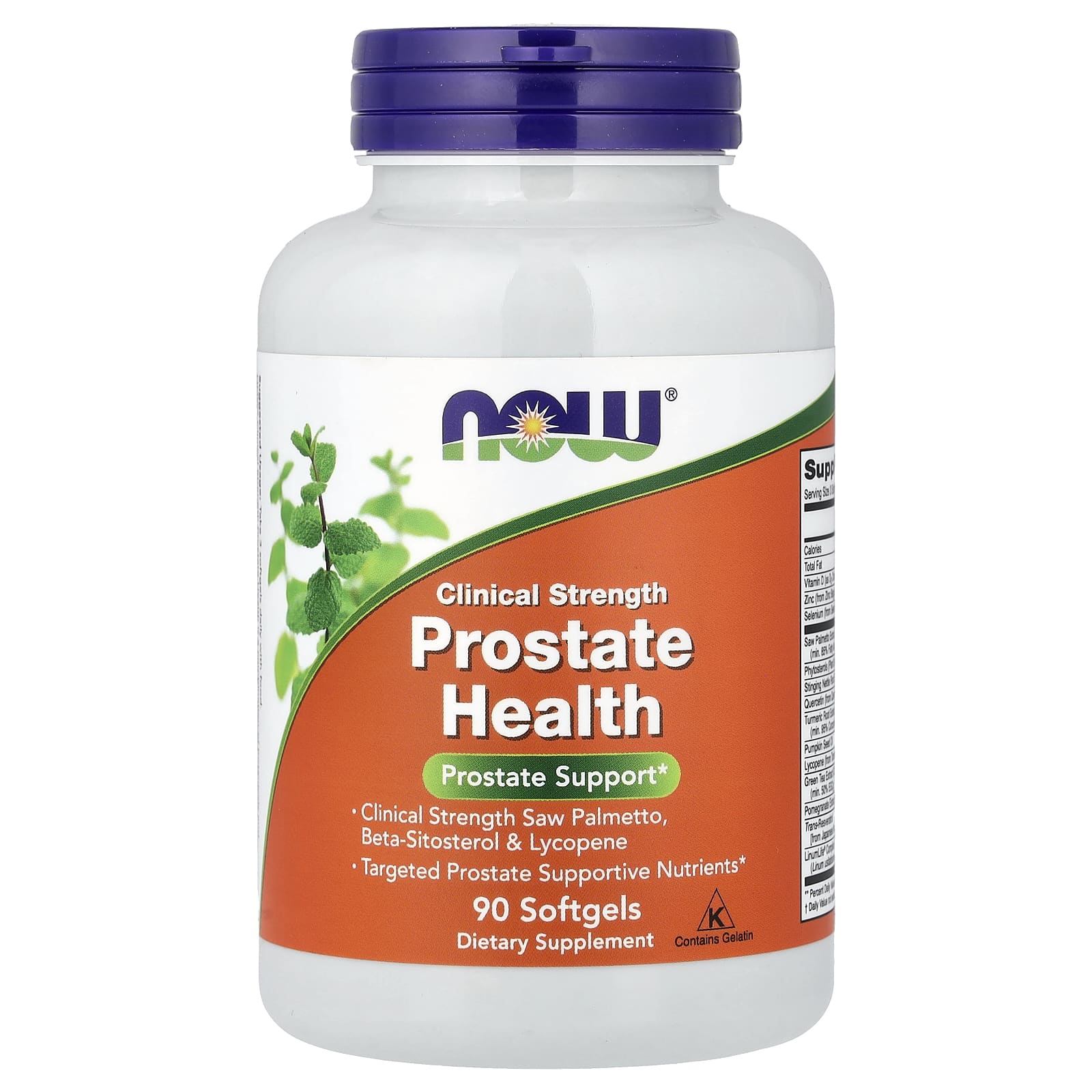
NOW · softgels

Clinical Strength Prostate Health

At the recorded label maximum: 3 softgels per day

Add to my list
Per day$0.85

At the label maximum of 3 softgels a day.

Per pack$25.49

90 softgels · Vitacost · checked 13 Nov 2026. Delivery is not included.

Per softgel$0.28

Pack price divided by the number of softgels in the pack.

Composition

Amounts at the recorded label maximum. Directions may give a range.

Vitamin Das Vitamin D3
About this formvitamin D3 (cholecalciferol). Raises vitamin D levels more than D2. Reference level V0; no form is called “better” here.
10 mcgat the recorded label maximum (1 serving × 10 mcg; 3 softgels per serving)3.33333333333333 mcg per softgel · calculated from 10 mcg per 3 softgels
10% of 100 mcg — US upper limit for adults, National Academiesfrom food and supplements, adults · food is not counted here · a reference value, not a legal limit
Zincas Albion Zinc Bisglycinate
About this formzinc bisglycinate — about 30% of the compound is zinc itself. Reference level V0; no form is called “better” here.
15 mgat the recorded label maximum (1 serving × 15 mg; 3 softgels per serving) · as zinc itself5 mg per softgel · calculated from 15 mg per 3 softgels
38% of 40 mg — US upper limit for adults, National Academiesfrom food and supplements, adults · food is not counted here · a reference value, not a legal limit
Seleniumas Albion Selenium Glycinate Complex
70 mcgat the recorded label maximum (1 serving × 70 mcg; 3 softgels per serving)23.3333333333333 mcg per softgel · calculated from 70 mcg per 3 softgels
18% of 400 mcg — US upper limit for adults, National Academiesfrom food and supplements, adults · food is not counted here · a reference value, not a legal limit
Saw Palmetto extractas Fatty Acids
320 mgat the recorded label maximum (1 serving × 320 mg; 3 softgels per serving)106.666666666667 mg per softgel · calculated from 320 mg per 3 softgels
No limit on file for the United StatesNone on file in any country
Phytosterolsas Beta-Sitosterol | Plant Sterols
850 mgat the recorded label maximum (1 serving × 850 mg; 3 softgels per serving)283.333333333333 mg per softgel · calculated from 850 mg per 3 softgels
No limit on file for the United States
Limits in other countries (2)Croatia, France
Stinging Nettle root extract
240 mgat the recorded label maximum (1 serving × 240 mg; 3 softgels per serving)80 mg per softgel · calculated from 240 mg per 3 softgels
No limit on file for the United StatesNone on file in any country
Quercetinas Quercetin Dihydrate
200 mgat the recorded label maximum (1 serving × 200 mg; 3 softgels per serving)66.6666666666667 mg per softgel · calculated from 200 mg per 3 softgels
No limit on file for the United StatesNone on file in any country
Turmeric root extractas Curcuminoids
About this formturmeric extract standardized (curcuminoids). Reference level V0; no form is called “better” here.
100 mgat the recorded label maximum (1 serving × 100 mg; 3 softgels per serving)33.3333333333333 mg per softgel · calculated from 100 mg per 3 softgels
No limit on file for the United StatesNone on file in any country
Pumpkin seed Oil
1,000 mgat the recorded label maximum (1 serving × 1,000 mg; 3 softgels per serving)333.333333333333 mg per softgel · calculated from 1,000 mg per 3 softgels
No limit on file for the United StatesNone on file in any country
Lycopeneas Tomato Extract
10 mgat the recorded label maximum (1 serving × 10 mg; 3 softgels per serving)3.33333333333333 mg per softgel · calculated from 10 mg per 3 softgels
No limit on file for the United States
Limits in other countries (2)Croatia, Eurasian Economic Union (EAEU)
Green Tea extractas EGCG
100 mgat the recorded label maximum (1 serving × 100 mg; 3 softgels per serving)33.3333333333333 mg per softgel · calculated from 100 mg per 3 softgels
No limit on file for the United StatesNone on file in any country
Pomegranate extract
100 mgat the recorded label maximum (1 serving × 100 mg; 3 softgels per serving)33.3333333333333 mg per softgel · calculated from 100 mg per 3 softgels
No limit on file for the United StatesNone on file in any country
Trans-Resveratrolas Japanese Knotweed extract
10 mgat the recorded label maximum (1 serving × 10 mg; 3 softgels per serving)3.33333333333333 mg per softgel · calculated from 10 mg per 3 softgels
No limit on file for the United StatesNone on file in any country
LinumLife Complex
25 mgat the recorded label maximum (1 serving × 25 mg; 3 softgels per serving)8.33333333333333 mg per softgel · calculated from 25 mg per 3 softgels
No limit on file for the United StatesNone on file in any country

Where no limit is shown, none is set or on file for the United States. That is not the same as having no maximum.

Manufacturer's directions

Suggested Usage: Take 3 softgels daily with food.

Other ingredients on the label

Bovine Gelatin, Glycerin, Water, Carob, Sunflower Oil, Sunflower Lecithin, Beeswax

Limits in other countries
CountryVitamin DZincSeleniumPhytosterols
United States100 mcgreference, not a law · 10%40 mgreference, not a law · 38%400 mcgreference, not a law · 18%—not on file
Austria20 mcgrecommendation · 50%15 mgrecommendation · 100%100 mcgrecommendation · 70%—not on file
Belgium75 mcglaw · 13%22.5 mglaw · 67%105 mcglaw · 67%—not on file
Croatia10 mcglaw · 100%15 mglaw · 100%100 mcglaw · 70%3,000 mglaw · 28%
Cyprus10 mcglaw · 100%15 mglaw · 100%200 mcglaw · 35%—not on file
Denmark95 mcgrecommendation · 11%11 mgrecommendation · 136% · above197 mcgrecommendation · 36%—not on file
EAEU15 mcglaw · 67%25 mglaw · 60%150 mcglaw · 47%—not on file
Estonia100 mcgrecommendation · 10%25 mgrecommendation · 60%300 mcgrecommendation · 23%—not on file
Finland100 mcgrecommendation · 10%25 mgrecommendation · 60%255 mcgrecommendation · 27%—not on file
France5 mcglaw · 200% · above15 mglaw · 100%50 mcglaw · 140% · above1,700 mgrecommendation · 50%
Germany20 mcgrecommendation · 50%6.5 mgrecommendation · 231% · above40 mcgrecommendation · 175% · above—not on file
Ireland100 mcgrecommendation · 10%25 mgrecommendation · 60%300 mcgrecommendation · 23%—not on file
Italy50 mcgrecommendation · 20%15 mgrecommendation · 100%83 mcgrecommendation · 84%—not on file
Luxembourg50 mcglaw · 20%15 mglaw · 100%82.5 mcglaw · 85%—not on file
Malta25 mcgrecommendation · 40%25 mgrecommendation · 60%200 mcgrecommendation · 35%—not on file
Netherlands75 mcglaw · 13%—not on file—not on file—not on file
Norway80 mcglaw · 13%14 mglaw · 107% · above—not on file—not on file
Poland50 mcgrecommendation · 20%15 mgrecommendation · 100%200 mcgrecommendation · 35%—not on file
Switzerland70 mcglaw · 14%5.3 mglaw · 283% · above165 mcglaw · 42%—not on file

Maximum amounts per daily dose of a food supplement, as each country sets them; the share is the daily amount on the label against that maximum. Law = legally binding; recommendation = an authority's recommended maximum, not binding; reference = the U.S. upper intake level for adults from all sources (National Academies), not a legal limit. Verification level V0 · 1 more ingredients have limits on file · Report an error

About the ingredients

Ingredient information

Ingredient guideVitamin DVitamin D is a fat-soluble vitamin. The skin makes it when ultraviolet light from the sun reaches it, and a few foods contain it. Supplements contain one or both of its two main forms: vitamin D3 and vitamin D2. Labels state the amount in micrograms (mcg), international units (IU) or both.Read moreShow less
Terms and sources
fat-soluble
It dissolves in fat, not in water. NIH Office of Dietary Supplements.

Vitamin D in the body

Vitamin D from the sun, food and supplements is inactive at first. The liver turns it into 25-hydroxyvitamin D, the form a blood test measures. Mainly the kidneys then make the active form.

Terms and sources
25-hydroxyvitamin D
Also called calcidiol or 25(OH)D. Results come in nmol/L or ng/mL; 50 nmol/L equals 20 ng/mL.
active form
1,25-dihydroxyvitamin D, also called calcitriol.

Vitamin D is needed for normal absorption of calcium from the gut and for normal bones. It is also needed for normal muscle and immune function. Many tissues in the body carry vitamin D receptors.

Terms and sources
vitamin D receptors
Proteins in cells that respond to the active form of vitamin D. NIH Office of Dietary Supplements.

Information, not a prescription. Do not start, stop or combine supplements or medicines on your own.
Ingredient guideZincZinc is an essential mineral that the body needs for the work of hundreds of enzymes. An adult body holds about 1.5–2.5 g of it. Oysters, meat and other seafood are rich sources. Supplements contain zinc as part of a compound, such as zinc citrate, zinc oxide or zinc gluconate.Read moreShow less
Terms and sources
1.5–2.5 g
About 1.5 g in women and 2.5 g in men. NIH Office of Dietary Supplements.

Zinc in the body

Zinc-dependent enzymes are found in all six classes of enzymes. More than 3,000 human proteins have sites that bind zinc. In some proteins, zinc holds a fold called a zinc finger in shape. Zinc also takes part in immune function, protein and DNA synthesis, cell division and the sense of taste.

Terms and sources
all six classes of enzymes
Enzymes are proteins that speed up chemical reactions in cells. The classes are those of the International Union of Biochemistry and Molecular Biology. Linus Pauling Institute.
More than 3,000
An estimate from searches of protein data. Linus Pauling Institute.
zinc finger
Zinc fingers let some proteins bind DNA and switch genes on or off. Linus Pauling Institute.
sense of taste
NIH Office of Dietary Supplements.

Most of the body's zinc is in skeletal muscle and bone. In healthy people, blood zinc is usually 80–120 mcg/dL. These blood values do not always follow how much zinc a person gets from food or supplements. As intake rises, the body absorbs more zinc, but a smaller share of it.

Terms and sources
80–120 mcg/dL
Serum or plasma zinc, 12–18 micromoles per liter. NIH Office of Dietary Supplements.
do not always follow
They also vary with age, sex and the time of the blood draw. NIH Office of Dietary Supplements.
a smaller share
Fractional absorption drops as intake rises. NIH Office of Dietary Supplements.

NIH notes: "High zinc intakes can cause nausea, dizziness, headaches, gastric distress, vomiting, and loss of appetite. If used for weeks, doses of 50 mg zinc or more—typically from supplements or excessive use of denture adhesive creams that contain zinc—can interfere with copper absorption (which can cause low copper status), reduce immune function, and lower HDL cholesterol levels. The amount of zinc obtained from food is rarely as high as 50 mg, so the zinc in foods is unlikely to cause zinc toxicity. Very high doses of zinc from supplements (142 mg/day) might also interfere with magnesium absorption and disrupt magnesium balance."

Terms and sources
NIH notes
NIH Office of Dietary Supplements, Zinc fact sheet for health professionals, section on health risks from excessive zinc.

Information, not a prescription. Do not start, stop or combine supplements or medicines on your own.

Ingredient guideSeleniumSelenium is an essential mineral that the body builds into about 25 proteins called selenoproteins. Brazil nuts, seafood, meat and poultry are rich food sources, and plant foods vary with the soil. Supplements contain it as selenomethionine, selenium yeast, sodium selenite, sodium selenate or other forms.Read moreShow less
Terms and sources
selenoproteins
In these proteins, selenium sits inside the amino acid selenocysteine. NIH Office of Dietary Supplements; Linus Pauling Institute.
selenium yeast
Yeast grown in a high-selenium medium; it holds selenium mainly as selenomethionine. NIH Office of Dietary Supplements.

Selenium in the body

Selenoproteins include glutathione peroxidases, thioredoxin reductases and selenoprotein P. Their roles include thyroid hormone metabolism, DNA synthesis, reproduction and protection from oxidative damage. The thyroid gland holds more selenium for its size than any other organ. Selenoprotein P, made mainly in the liver, carries selenium to other tissues.

Terms and sources
glutathione peroxidases
Enzymes that break down hydrogen peroxide and fat peroxides. Linus Pauling Institute.
thyroid hormone metabolism
NIH Office of Dietary Supplements.
more selenium for its size
NIH: "Selenium concentration is higher in the thyroid gland than in any other organ in the body…"
carries selenium
Linus Pauling Institute.

About 28% to 46% of the body's selenium is in skeletal muscle. The body keeps its selenium steady mainly through the urine. Selenomethionine can also be built into ordinary body proteins in place of the amino acid methionine. Blood selenium of 8 mcg/dL or more is usually considered sufficient in healthy people. Research suggests that selenoprotein P and glutathione peroxidase rise with supplements only when selenium status is low, NIH notes.

Terms and sources
28% to 46%
NIH Office of Dietary Supplements.
through the urine
At higher intakes, selenium also leaves through the lungs and in stool. NIH Office of Dietary Supplements.
in place of the amino acid methionine
Only proteins with selenocysteine count as selenoproteins. Linus Pauling Institute.
8 mcg/dL
Plasma or serum selenium. Hair and nail selenium show intake over months or years. NIH Office of Dietary Supplements.
NIH notes
NIH Office of Dietary Supplements.

NIH notes: "Selenosis is the result of chronically high intakes of selenium. It is most commonly characterized by hair loss and nail brittleness or loss, but other signs and symptoms can include a garlic odor in the breath, a metallic taste in the mouth, skin rash, nausea, diarrhea, fatigue, irritability, and nervous system abnormalities. The Tolerable Upper Intake Level for selenium is 400 mcg for adults, and it ranges from 45 mcg to 400 mcg for infants, children, and adolescents, depending on age."

Terms and sources
NIH notes
NIH Office of Dietary Supplements, Selenium fact sheet for health professionals, section on health risks from excessive selenium. The opening paragraph.

NIH continues: "Chronically high intakes of the organic and inorganic forms of selenium have similar effects. Early indicators of excess intake are a garlic odor in the breath and a metallic taste in the mouth. The most common clinical signs of chronically high selenium intakes, or selenosis, are hair loss and nail brittleness or loss. Other signs and symptoms include skin rash, nausea, diarrhea, fatigue, irritability, and nervous system abnormalities."

Terms and sources
NIH continues
The next paragraph of the same NIH section.

It continues: "As discussed earlier, Brazil nuts contain very high amounts of selenium (68–91 mcg per nut) and could cause selenium toxicity if consumed regularly. Acute selenium toxicity has resulted from the ingestion of misformulated over-the-counter products that contain very large amounts of selenium. In 2008, for example, 201 people experienced severe adverse reactions from taking a liquid dietary supplement that contained 200 times the labeled amount of selenium. Acute selenium toxicity can cause severe gastrointestinal and neurological symptoms; acute respiratory distress syndrome; myocardial infarction; hair loss; muscle tenderness; tremors; lightheadedness; facial flushing; kidney failure; cardiac failure; and, in rare cases, death."

Terms and sources
It continues
The next paragraph of the same NIH section.

NIH also describes a subgroup result from SELECT, a large trial of 200 mcg a day in men. NIH notes: "Further investigation in a case-cohort of 1,739 men with prostate cancer and 3,117 matched controls from the SELECT trial found that selenium supplementation did not affect prostate cancer risk in men with low baseline selenium status (based on toenail selenium levels). However, the researchers did find an increased risk of high-grade prostate cancer in men with higher baseline selenium status (≥60th percentile of toenail selenium) and recommended that men over age 55 avoid selenium supplementation at doses that exceed recommended dietary intakes."

Terms and sources
subgroup result from SELECT
NIH Office of Dietary Supplements, Selenium fact sheet for health professionals, section on selenium and health.

Information, not a prescription. Do not start, stop or combine supplements or medicines on your own.

Ingredient guidePlant sterols and stanolsPlant sterols and stanols, together called phytosterols, are plant compounds built much like cholesterol. The main plant sterols in food are beta-sitosterol, campesterol and stigmasterol. Stanols, such as sitostanol, lack one double bond; they are about 10% of food phytosterols. Supplements hold free sterols, stanols or their esters, which are bound to fatty acids, in capsules, softgels or powders.Read moreShow less
Terms and sources
built much like cholesterol
They are structurally related to cholesterol. Linus Pauling Institute, Oregon State University.
beta-sitosterol
Also written β-sitosterol. Linus Pauling Institute, Oregon State University.
lack one double bond
In the sterol ring; stanols are the saturated forms. Linus Pauling Institute, Oregon State University.
in capsules, softgels or powders
Product forms of 92 US labels with sterols or stanols alone, NIH Dietary Supplement Label Database. Tablets also appear. We counted these.

Plant sterols in the body

The body cannot make phytosterols, so all phytosterols in human blood come from the diet. Less than 5% of plant sterols eaten and less than 0.5% of plant stanols are absorbed. Gut cells pump most absorbed phytosterols straight back into the gut. Blood levels of phytosterols are usually several hundred times lower than blood cholesterol.

Terms and sources
come from the diet
Cholesterol, by contrast, comes from both the diet and the body's own production. Linus Pauling Institute, Oregon State University.
are absorbed
For cholesterol from food, the figure is about 50–60%. Linus Pauling Institute, Oregon State University.
pump
A transporter called ABCG5/G8 does this; in the liver, the same transporter moves them into bile. Linus Pauling Institute, Oregon State University.

In the gut, phytosterols take the place of cholesterol in the tiny fat droplets that carry it. More cholesterol from food and bile then leaves in the stool. LPI cites a feeding trial with 0.46 g and 2.1 g of phytosterols a day. Cholesterol absorption fell by about 10% and 25%. Cholesterol leaving in the stool rose by 36% and 74%, LPI notes.

Terms and sources
tiny fat droplets
mixed micelles: droplets of bile salts, fats and sterols that form after a meal with fat. Linus Pauling Institute, Oregon State University.
leaves in the stool
LPI: phytosterols also facilitate the excretion of biliary cholesterol in the feces.
a feeding trial
Phytosterols in drinks, compared with a dummy drink. LPI, citing Racette et al., American Journal of Clinical Nutrition, 2010.

LPI cites a meta-analysis of 124 studies of LDL cholesterol in the blood. LDL cholesterol was at least 5% lower with 0.6–1.1 g a day and about 12.4% lower with 3.3 g. These are blood measurements; LPI notes that the long-term effect on health outcomes is not known.

Terms and sources
124 studies
Ras et al., British Journal of Nutrition, 2014, as cited by LPI. Two of the three authors worked for Unilever.

Phytosterols also lower blood levels of some carotenoids, the yellow and red pigments of plants. LPI cites a meta-analysis in which blood carotenoids such as beta-carotene were about 5–20% lower with enriched foods. LPI notes that in one trial, advice to eat 5 servings of fruit and vegetables a day kept carotenoid levels.

Terms and sources
a meta-analysis
Over 1 month to 1 year. Adjusted for cholesterol, alpha-carotene, beta-carotene and lycopene may stay lower. Baumgartner et al., European Journal of Nutrition, 2017, as cited by LPI. Two of the five authors worked for Unilever.
one trial
Including 1 serving of carotenoid-rich vegetables, in people taking 2.5 g of sterol or stanol esters a day. Noakes et al., American Journal of Clinical Nutrition, 2002, as cited by LPI.

LPI notes that in the US, plant sterols and stanols added to a variety of food products are "generally recognized as safe" (GRAS), an FDA status. LPI notes that few adverse effects have been reported with regular intake for up to 1 year. LPI notes that nausea, indigestion, diarrhea and constipation have occasionally been reported. LPI notes that people with sitosterolemia should avoid foods or supplements with added plant sterols. LPI notes: Phytosterol-enriched foods and supplements are not recommended for pregnant or breastfeeding women because their safety has not been studied. LPI notes that some cholesterol medicines change how much plant sterol the body absorbs or keeps in blood.

Terms and sources
GRAS
A US status for food ingredients. Linus Pauling Institute, Oregon State University.
sitosterolemia
A very rare inherited condition in which the body absorbs and keeps far more plant sterols. Linus Pauling Institute, Oregon State University.
some cholesterol medicines
LPI: statin therapy appears to increase the absorption of plant sterols. Ezetimibe (marketed as Zetia) is another cholesterol-lowering drug that may interfere with the intestinal absorption of phytosterols.

Information, not a prescription. Do not start, stop or combine supplements or medicines on your own.

Need help choosing?

Choose the option that suits you.

Quick selection

I know my goal

$5

1–2 minutes · a few questions with fixed answers

One goal. Up to three products. Set a budget per day if you like.

Product checks
form and amount on the label, plus shop prices
Daily schedule
what to take, when, how much
Totals and limits
next to the upper limit
Reasons & sources
for each product
Prices and shops
plus food and habits
Progress
what to track, when to see a doctor

Complete the questionnaire before you pay. If no product fits any of your goals, you won’t be charged.

Order · $5View example

Full selection

I have several goals

$15

5–7 minutes · questionnaire with fixed answers

Up to three goals in one set. Where two goals overlap, one product is used for both.

Product checks
form and amount on the label, plus shop prices
Daily schedule
what to take, when, how much
Totals and limits
next to the upper limit
Reasons & sources
for each product
Prices and shops
plus food and habits
Progress
what to track, when to see a doctor

Complete the questionnaire before you pay. If no product fits any of your goals, you won’t be charged.

Order · $15View example

Expert review

I want a person to look at my supplements

$50

Written review within 48 hours of your completed questionnaire

An expert reviews your supplement list and questionnaire.

Written review
duplicates, limits, forms
Detailed questionnaire
supplements, medicines, history
Optional uploads
supplement-label photos or documents relevant to your review
Your notes
your priorities and questions
Follow-up questions
in writing, when needed
Next steps
points to discuss with your doctor

Complete the questionnaire before you pay.

Order · $50View example
Sources, label & certificates

Label record

Copied from the NIH label database (DSLD 314105) · not yet compared with the label · checked 2 Nov 2026 · Report an error

The United States has no pre-market registration for supplements.
Label on file in the NIH Dietary Supplement Label Database
checked 2 Nov 2026source: NIH DSLDReport an error

Barcode 7 33739 03348 2

Third-party certificates

No third-party certificate on file for this product.

Information, not a prescription. Do not start, stop or combine supplements or medicines on your own. If you have a health condition, are pregnant or breastfeeding, take medicines, or are under 18, talk to a doctor or pharmacist first.

Photo credits

Image: © NOW. Shown to identify the product. Source: iherb.com

Rights holders can ask us to remove an image or send official product photos: info@verateca.com.

Product photo

NOW Clinical Strength Prostate Health — enlarged pack