Pure Encapsulations · capsules

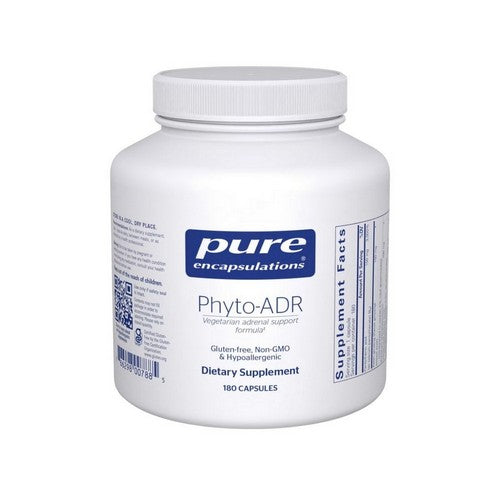
Phyto-ADR

At the recorded label maximum: 1 capsule per day

Add to my list
Per day$0.47

At the label maximum of 1 capsule a day.

Per pack$84.50

180 capsules · Vitacost · checked 21 Nov 2026. Delivery is not included.

Per capsule$0.47

Pack price divided by the number of capsules in the pack.

Composition

Amounts at the recorded label maximum. Directions may give a range.

Pantothenic Acidas Calcium Pantothenate | Vitamin B5
150 mgat the recorded label maximum (1 capsule × 150 mg)150 mg per capsule · calculated from 150 mg per 1 capsule
No US upper limitNational Academies: not determined — too little data on harm
Limits in other countries (8)Austria, Croatia, Cyprus, Eurasian Economic Union (EAEU), France, Italy, Malta, Poland
150 mgat the recorded label maximum (1 capsule × 150 mg)150 mg per capsule · calculated from 150 mg per 1 capsule
No limit on file for the United StatesNone on file in any country
Eleuthero Root Extractas Eleutherosides
100 mgat the recorded label maximum (1 capsule × 100 mg)100 mg per capsule · calculated from 100 mg per 1 capsule
No limit on file for the United StatesNone on file in any country
50 mgat the recorded label maximum (1 capsule × 50 mg)50 mg per capsule · calculated from 50 mg per 1 capsule
No limit on file for the United StatesNone on file in any country
Astragalus root extract
150 mgat the recorded label maximum (1 capsule × 150 mg)150 mg per capsule · calculated from 150 mg per 1 capsule
No limit on file for the United StatesNone on file in any country

Where no limit is shown, none is set or on file for the United States. That is not the same as having no maximum.

Manufacturer's directions

Recommendations: As a dietary supplement; take 1 capsule daily; between meals; or as directed by a health professional.

Other ingredients on the label

Cellulose, Water

Limits in other countries
CountryPantothenic Acid
United States—not on file
Austria18 mgrecommendation · 833% · above
Croatia18 mglaw · 833% · above
Cyprus1,000 mglaw · 15%
EAEU15 mglaw · 1000% · above
Estonia—not on file
Finland—not on file
France18 mglaw · 833% · above
Germany—not on file
Italy18 mgrecommendation · 833% · above
Luxembourg—not on file
Malta200 mgrecommendation · 75%
Poland200 mgrecommendation · 75%
Switzerland—not on file

Maximum amounts per daily dose of a food supplement, as each country sets them; the share is the daily amount on the label against that maximum. Law = legally binding; recommendation = an authority's recommended maximum, not binding; reference = the U.S. upper intake level for adults from all sources (National Academies), not a legal limit. Verification level V0 · Report an error

About the ingredients

Ingredient information

Ingredient guidePanax ginsengPanax ginseng is a plant whose root is sold as Asian, Korean or Chinese ginseng. It is native to Korea, northeastern China and far-eastern Siberia. Supplements contain dried or steamed root as powder, or root extracts. Extracts are often standardized to ginsenosides, a group of plant compounds.Read moreShow less
Terms and sources
Panax ginseng
Also called red ginseng or white ginseng, after how the root is prepared. NCCIH lists these common names.
ginsenosides
Also called panaxosides. Triterpene saponins, by Lee et al., 2016.

Panax ginseng in the body

Panax ginseng is not a nutrient, and the body has no daily requirement for it. Trials of it measure things such as memory tests, self-rated tiredness and mood.

Its root contains many compounds. Ginsenosides are thought to be the most important of them. Standardized root extracts have known amounts of ginsenosides.

Terms and sources
many compounds
NIH National Center for Complementary and Integrative Health (NCCIH).
the most important
NCCIH: those thought to be most important are called ginsenosides, or panaxosides. They are also found in leaves, stems and berries, by the HRG80 trial report.
Standardized
Root extracts with known and reproducible amounts of ginsenosides. Lee et al., 2016.

Several different plants are sold as ginseng. American ginseng is a related species, Panax quinquefolius, from North America. Siberian ginseng is Eleutherococcus senticosus, a plant of another genus. Ashwagandha, sometimes called Indian ginseng, does not belong to the ginseng family.

Terms and sources
Panax quinquefolius
Lee et al., 2016. The Geng 2010 review counted any Panax species as ginseng.
another genus
Its rhizomes and bark are used; its compounds include eleutherosides. Kos et al., Molecules, 2025.
Indian ginseng
NIH Office of Dietary Supplements, ashwagandha fact sheet.

NCCIH says that taking Asian ginseng by mouth, for up to 6 months, in recommended amounts "appears to be safe for most people." NCCIH notes that questions have been raised about its long-term safety. NCCIH also notes that "some experts recommend against its use for infants, children, and women who are pregnant or breastfeeding." Little is known about using it on the skin, where it might cause irritation and burning. Trouble sleeping is its most common side effect. NCCIH lists uncommon reported side effects: severe rash, liver damage and severe allergic reactions. In the words of NCCIH, Asian ginseng "may worsen autoimmune disorders and interfere with blood clotting." It might lower blood sugar; NCCIH advises: "If you have diabetes, consult your health care provider before using Asian ginseng." It might interact with some medicines. NCCIH notes that some studies suggest it "may be unsafe when taken orally during pregnancy." One of its compounds has been found to cause birth defects in animals. NCCIH advises: "If you're considering using Asian ginseng while pregnant, consult your health care provider." NCCIH adds: "Little is known about whether it's safe to use Asian ginseng while breastfeeding." For people who take any medicine, NCCIH advises talking with a health care provider first: "some herbs and medicines interact in harmful ways."

Terms and sources
up to 6 months
Short-term use, in the words of NCCIH, Asian ginseng page.

Information, not a prescription. Do not start, stop or combine supplements or medicines on your own.
Ingredient guideRhodiolaRhodiola is a plant, Rhodiola rosea, also called golden root, arctic root or rose root. It grows in cold regions and at high altitudes. Supplements contain extracts of its root and rhizome, or root powder. Extracts are often standardized to rosavins and to salidroside, compounds of the root.Read moreShow less
Terms and sources
golden root
NCCIH lists the common names arctic root, golden root, rose root, rosenroot and king's crown.
high altitudes
NIH National Center for Complementary and Integrative Health (NCCIH), rhodiola page.
rhizome
An underground stem. Panossian et al., Phytomedicine, 2010; Döring et al., Phytomedicine, 2021.
rosavins
Rosavin, rosin and rosarin. Punja et al., PLoS One, 2014.

Rhodiola in the body

Rhodiola is not a nutrient, and the body has no daily requirement for it. Trials of its extracts measure things such as mental fatigue tests, exercise tests and self-rated tiredness.

About 140 compounds have been isolated from its roots and rhizome. Rosavin is found only in Rhodiola rosea; salidroside is also found in other Rhodiola species. One trial report states that rosavins and salidroside occur in the plant at a 3 to 1 ratio. In several exercise trials, extracts were standardized to at least 3% rosavins and 1% salidroside.

Terms and sources
About 140 compounds
Among them phenylpropanoids, phenylethanoids, flavonoids and others. Panossian et al., Phytomedicine, 2010. The first author worked for the Swedish Herbal Institute.
found only in Rhodiola rosea
Punja et al., PLoS One, 2014. Booker et al. use rosavin as the marker that tells R. rosea apart from related species.
3 to 1 ratio
Punja et al., PLoS One, 2014.
at least 3% rosavins
Lu et al., Frontiers in Nutrition, 2022, on the trials in its review. Some trials did not state the content.

In one trial's source, roots grown in Alberta held from 0.2% to 10% total rosavins by dry weight. In one analysis of about 40 products, about a fifth of those sold as R. rosea held no rosavin. Another analysis confirmed the labeled salidroside and rosavins in less than a quarter of products.

Terms and sources
0.2% to 10%
Roots of different ages from different places in Alberta, Canada. For the trial, 4-year-old roots were extracted and standardized to 2.8%. Punja et al., PLoS One, 2014.
about 40 products
Powders and extracts bought from different suppliers. Most of the rest held less rosavin than products registered as herbal medicines. Booker et al., Phytomedicine, 2016.
about a fifth
One author of this analysis works for Dr. Willmar Schwabe GmbH, and two for CAMAG AG.
less than a quarter
Marchev et al., Phytochemical Analysis, 2020. A compound found only in R. crenulata among the species tested turned up in 2 of 4 products tested by NMR.

NCCIH says: "Rhodiola is possibly safe for up to 12 weeks." NCCIH adds: "Side effects may include dizziness, headache, insomnia, and either dry mouth or excessive saliva production." NCCIH also notes: "Interactions between rhodiola and losartan (a drug used for high blood pressure) have been reported." NCCIH adds: "Little is known about whether it’s safe to use rhodiola during pregnancy or while breastfeeding." NCCIH advises: "If you take any type of medicine, talk with your health care provider before using any herbal product." It adds: "some herbs and medicines interact in harmful ways."

Terms and sources
up to 12 weeks
NIH National Center for Complementary and Integrative Health (NCCIH), rhodiola page.

Information, not a prescription. Do not start, stop or combine supplements or medicines on your own.

Services

Choose the option that suits you.

Quick selection

I know my goal

$5

1–2 minutes · a few questions with fixed answers

One goal. Up to three products. Set a budget per day if you like.

Product checks
form and amount on the label, plus shop prices
Daily schedule
what to take, when, how much
Totals and limits
next to the upper limit
Reasons & sources
for each product
Prices and shops
plus food and habits
Progress
what to track, when to see a doctor

Complete the questionnaire before you pay. If no product fits any of your goals, you won’t be charged.

Order · $5View example

Full selection

I have several goals

$15

5–7 minutes · questionnaire with fixed answers

Up to three goals in one set. Where two goals overlap, one product is used for both.

Product checks
form and amount on the label, plus shop prices
Daily schedule
what to take, when, how much
Totals and limits
next to the upper limit
Reasons & sources
for each product
Prices and shops
plus food and habits
Progress
what to track, when to see a doctor

Complete the questionnaire before you pay. If no product fits any of your goals, you won’t be charged.

Order · $15View example

Expert review

I want a person to look at my supplements

$50

Written review within 48 hours of your completed questionnaire

An expert reviews your supplement list and questionnaire.

Written review
duplicates, limits, forms
Detailed questionnaire
supplements, medicines, history
Optional uploads
supplement-label photos or documents relevant to your review
Your notes
your priorities and questions
Follow-up questions
in writing, when needed
Next steps
points to discuss with your doctor

Complete the questionnaire before you pay.

Order · $50View example
Sources, label & certificates

Label record

Copied from the NIH label database (DSLD 318270) · not yet compared with the label · checked 19 Oct 2026 · Report an error

The United States has no pre-market registration for supplements.
Label on file in the NIH Dietary Supplement Label Database
checked 19 Oct 2026source: NIH DSLDReport an error

Barcode 7 66298 00788 5

Third-party certificates

No third-party certificate on file for this product.

Information, not a prescription. Do not start, stop or combine supplements or medicines on your own. If you have a health condition, are pregnant or breastfeeding, take medicines, or are under 18, talk to a doctor or pharmacist first.

Photo credits

Image: © Pure Encapsulations. Shown to identify the product. Source:

Rights holders can ask us to remove an image or send official product photos: info@verateca.com.

Product photo

Pure Encapsulations Phyto-ADR — enlarged pack