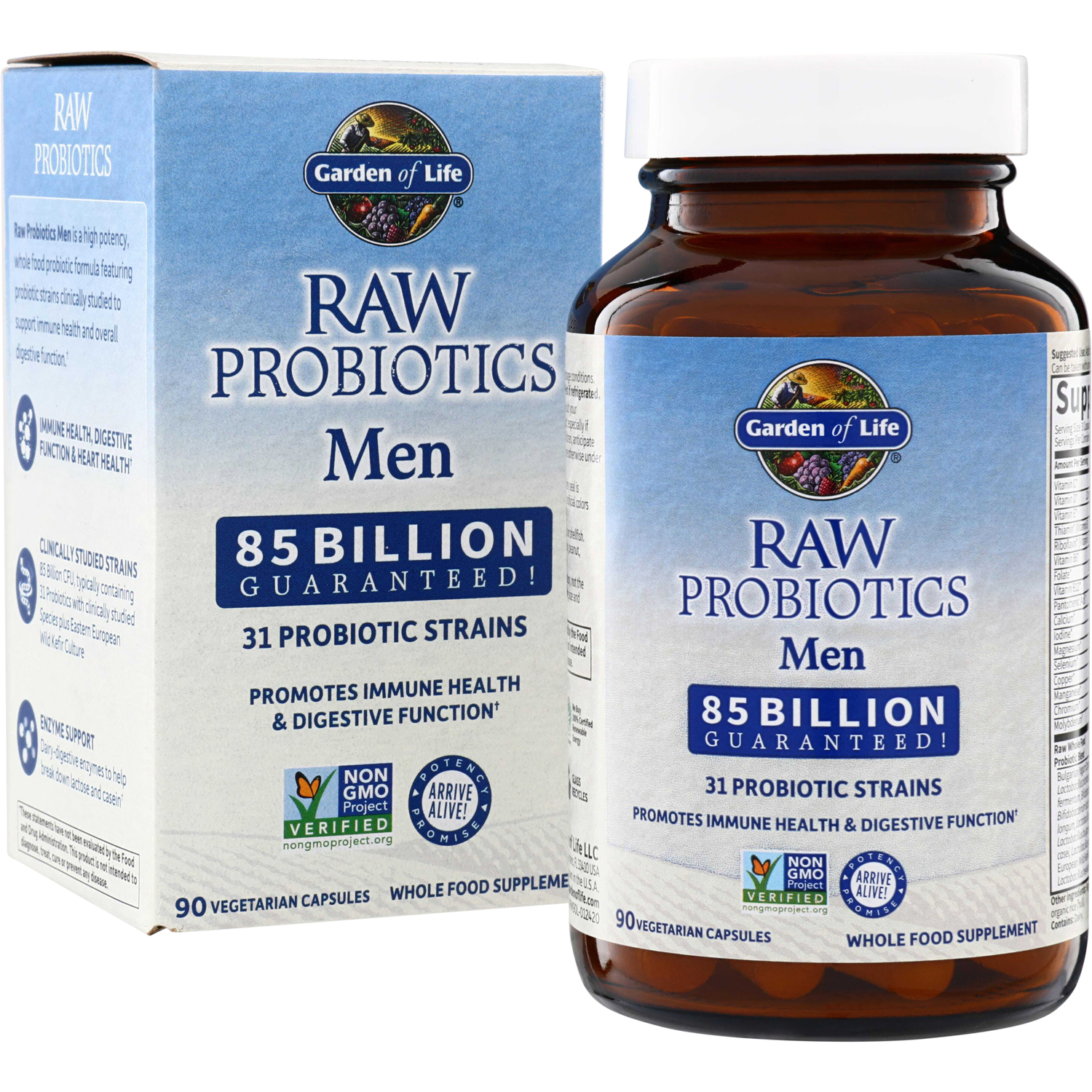
Garden of Life Raw Probiotics · capsules

Men 85 Billion

At the recorded label maximum: 3 capsules per day

Add to my list
Per day$1.40

At the label maximum of 3 capsules a day.

Per pack$41.99

90 capsules · Vitacost · checked 13 Nov 2026. Delivery is not included.

Per capsule$0.47

Pack price divided by the number of capsules in the pack.

Composition

Amounts at the recorded label maximum. Directions may give a range.

Amounts not disclosed. The label gives only the total weight of this blend, not the amount of each ingredient in it. Without the individual amounts, we cannot compare these ingredients with upper limits.

Vitamin Cas Lactobacillus bulgaricus
24 mgat the recorded label maximum (1 serving × 24 mg; 3 capsules per serving)8 mg per capsule · calculated from 24 mg per 3 capsules
1% of 2,000 mg — US upper limit for adults, National Academiesfrom food and supplements, adults · food is not counted here · a reference value, not a legal limit
Vitamin Das Lactobacillus bulgaricus
12.5 mcgat the recorded label maximum (1 serving × 12.5 mcg; 3 capsules per serving)4.16666666666667 mcg per capsule · calculated from 12.5 mcg per 3 capsules
13% of 100 mcg — US upper limit for adults, National Academiesfrom food and supplements, adults · food is not counted here · a reference value, not a legal limit
Vitamin Eas Lactobacillus bulgaricus
8 mgat the recorded label maximum (1 serving × 8 mg; 3 capsules per serving)2.66666666666667 mg per capsule · calculated from 8 mg per 3 capsules
<1% of 1,000 mg — US upper limit for adults, National Academiesvitamin E from supplements, adults · a reference value, not a legal limit
Thiamineas Lactobacillus bulgaricus | Vitamin B1
1 mgat the recorded label maximum (1 serving × 1 mg; 3 capsules per serving)333.333333333333 mcg per capsule · calculated from 1 mg per 3 capsules
No US upper limitNational Academies: not determined — too little data on harm
Limits in other countries (8)Austria, Croatia, Cyprus, Eurasian Economic Union (EAEU), France, Italy, Malta, Poland
1.13 mgat the recorded label maximum (1 serving × 1.13 mg; 3 capsules per serving)376.666666666667 mcg per capsule · calculated from 1.13 mg per 3 capsules
No US upper limitNational Academies: not determined — too little data on harm
Limits in other countries (8)Austria, Croatia, Cyprus, Eurasian Economic Union (EAEU), France, Italy, Malta, Poland
Vitamin B6as Lactobacillus bulgaricus
1.33 mgat the recorded label maximum (1 serving × 1.33 mg; 3 capsules per serving)443.333333333333 mcg per capsule · calculated from 1.33 mg per 3 capsules
1% of 100 mg — US upper limit for adults, National Academiesfrom food and supplements, adults · food is not counted here · a reference value, not a legal limit
Folateas Lactobacillus bulgaricus
133 mcgat the recorded label maximum (1 serving × 133 mcg; 3 capsules per serving)44.3333333333333 mcg per capsule · calculated from 133 mcg per 3 capsules
Not compared with 1,000 mcg — US upper limit for adults, National Academiesthe limit counts folic acid only · a reference value, not a legal limit
Vitamin B12as Lactobacillus bulgaricus
10 mcgat the recorded label maximum (1 serving × 10 mcg; 3 capsules per serving)3.33333333333333 mcg per capsule · calculated from 10 mcg per 3 capsules
No US upper limitNational Academies: not determined — too little data on harm
Limits in other countries (9)Austria, Croatia, Cyprus, Eurasian Economic Union (EAEU), France, Germany, Italy, Malta, Poland
Pantothenic Acidas Lactobacillus bulgaricus
1.92 mgat the recorded label maximum (1 serving × 1.92 mg; 3 capsules per serving)640 mcg per capsule · calculated from 1.92 mg per 3 capsules
No US upper limitNational Academies: not determined — too little data on harm
Limits in other countries (8)Austria, Croatia, Cyprus, Eurasian Economic Union (EAEU), France, Italy, Malta, Poland
Calciumas Lactobacillus bulgaricus
18 mgat the recorded label maximum (1 serving × 18 mg; 3 capsules per serving) · as calcium itself6 mg per capsule · calculated from 18 mg per 3 capsules
<1% of 2,000 mg — US upper limit for adults, National Academies2,500 mg (ages 19–50) · 2,000 mg (51 and older) · from food and supplements, adults · food is not counted here · a reference value, not a legal limit
Iodineas Lactobacillus bulgaricus
50 mcgat the recorded label maximum (1 serving × 50 mcg; 3 capsules per serving)16.6666666666667 mcg per capsule · calculated from 50 mcg per 3 capsules
5% of 1,100 mcg — US upper limit for adults, National Academiesfrom food and supplements, adults · food is not counted here · a reference value, not a legal limit
Magnesiumas Lactobacillus bulgaricus
7 mgat the recorded label maximum (1 serving × 7 mg; 3 capsules per serving) · as magnesium itself2.33333333333333 mg per capsule · calculated from 7 mg per 3 capsules
2% of 350 mg — US upper limit for adults, National Academiesmagnesium from supplements, adults · a reference value, not a legal limit
Seleniumas Lactobacillus bulgaricus
23 mcgat the recorded label maximum (1 serving × 23 mcg; 3 capsules per serving)7.66666666666667 mcg per capsule · calculated from 23 mcg per 3 capsules
6% of 400 mcg — US upper limit for adults, National Academiesfrom food and supplements, adults · food is not counted here · a reference value, not a legal limit
Copperas Lactobacillus bulgaricus
180 mcgat the recorded label maximum (1 serving × 180 mcg; 3 capsules per serving)60 mcg per capsule · calculated from 180 mcg per 3 capsules
2% of 10 mg — US upper limit for adults, National Academiesfrom food and supplements, adults · food is not counted here · a reference value, not a legal limit
Manganeseas Lactobacillus bulgaricus
670 mcgat the recorded label maximum (1 serving × 670 mcg; 3 capsules per serving)223.333333333333 mcg per capsule · calculated from 670 mcg per 3 capsules
6% of 11 mg — US upper limit for adults, National Academiesfrom food and supplements, adults · food is not counted here · a reference value, not a legal limit
Chromiumas Lactobacillus bulgaricus
40 mcgat the recorded label maximum (1 serving × 40 mcg; 3 capsules per serving)13.3333333333333 mcg per capsule · calculated from 40 mcg per 3 capsules
No US upper limitNational Academies: not determined — too little data on harm
Limits in other countries (13)Austria, Belgium, Croatia, Cyprus, Denmark, Eurasian Economic Union (EAEU), France, Germany, Italy, Luxembourg, Malta, Poland, Switzerland
Molybdenumas Lactobacillus bulgaricus
19.5 mcgat the recorded label maximum (1 serving × 19.5 mcg; 3 capsules per serving)6.5 mcg per capsule · calculated from 19.5 mcg per 3 capsules
<1% of 2,000 mcg — US upper limit for adults, National Academiesfrom food and supplements, adults · food is not counted here · a reference value, not a legal limit
Raw Whole Food Probiotic Blend
794 mgat the recorded label maximum (1 serving × 794 mg; 3 capsules per serving)
No limit on file for the United StatesNone on file in any country
Lactobacillus plantarum
Amount not disclosedpart of Raw Whole Food Probiotic Blend · not counted
No limit on file for the United StatesNone on file in any country
Lactobacillus fermentum
Amount not disclosedpart of Raw Whole Food Probiotic Blend · not counted
No limit on file for the United StatesNone on file in any country
Bifidobacterium bifidum
Amount not disclosedpart of Raw Whole Food Probiotic Blend · not counted
No limit on file for the United StatesNone on file in any country
Bifidobacterium animalis lactis
Amount not disclosedpart of Raw Whole Food Probiotic Blend · not counted
No limit on file for the United StatesNone on file in any country
Bifidobacterium longum
Amount not disclosedpart of Raw Whole Food Probiotic Blend · not counted
No limit on file for the United StatesNone on file in any country
Lactobacillus acidophilus
Amount not disclosedpart of Raw Whole Food Probiotic Blend · not counted
No limit on file for the United StatesNone on file in any country
Lactobacillus bulgaricus
Amount not disclosedpart of Raw Whole Food Probiotic Blend · not counted
No limit on file for the United StatesNone on file in any country
Lactobacillus casei
Amount not disclosedpart of Raw Whole Food Probiotic Blend · not counted
No limit on file for the United StatesNone on file in any country
Lactobacillus gasseri
Amount not disclosedpart of Raw Whole Food Probiotic Blend · not counted
No limit on file for the United StatesNone on file in any country
Lactobacillus helveticus
Amount not disclosedpart of Raw Whole Food Probiotic Blend · not counted
No limit on file for the United StatesNone on file in any country
Lactobacillus kefiranofaciens
Amount not disclosedpart of Raw Whole Food Probiotic Blend · not counted
No limit on file for the United StatesNone on file in any country
Lactobacillus kefirgranum
Amount not disclosedpart of Raw Whole Food Probiotic Blend · not counted
No limit on file for the United StatesNone on file in any country
Streptococcus thermophilus
Amount not disclosedpart of Raw Whole Food Probiotic Blend · not counted
No limit on file for the United StatesNone on file in any country
Lactobacillus kefir
Amount not disclosedpart of Raw Whole Food Probiotic Blend · not counted
No limit on file for the United StatesNone on file in any country
Lactobacillus parakefir
Amount not disclosedpart of Raw Whole Food Probiotic Blend · not counted
No limit on file for the United StatesNone on file in any country
Lactobacillus brevis
Amount not disclosedpart of Raw Whole Food Probiotic Blend · not counted
No limit on file for the United StatesNone on file in any country
Saccharomyces cerevisiae
Amount not disclosedpart of Raw Whole Food Probiotic Blend · not counted
No limit on file for the United StatesNone on file in any country
Carrot
Amount not disclosedpart of Eastern European Fruit & Veggie Blend · not counted
No limit on file for the United StatesNone on file in any country
Cherry
Amount not disclosedpart of Eastern European Fruit & Veggie Blend · not counted
No limit on file for the United StatesNone on file in any country
Strawberry
Amount not disclosedpart of Eastern European Fruit & Veggie Blend · not counted
No limit on file for the United StatesNone on file in any country
Raspberry
Amount not disclosedpart of Eastern European Fruit & Veggie Blend · not counted
No limit on file for the United StatesNone on file in any country
Amount not disclosedpart of Dairy-Digesting Enzyme Blend · not counted
No limit on file for the United StatesNone on file in any country
Protease SP
Amount not disclosedpart of Dairy-Digesting Enzyme Blend · not counted
No limit on file for the United StatesNone on file in any country
Protease S
Amount not disclosedpart of Dairy-Digesting Enzyme Blend · not counted
No limit on file for the United StatesNone on file in any country

Where no limit is shown, none is set or on file for the United States. That is not the same as having no maximum.
Manufacturer's directions

Suggested Use: Adults take 3 capsules per day; best taken as divided servings. Can be taken with or without food.

Other ingredients on the label

Cellulose, Potato Starch, Acacia Fiber, Rice Husk

Limits in other countries
CountryVitamin CVitamin DVitamin EThiamine
United States2,000 mgreference, not a law · 1%100 mcgreference, not a law · 13%1,000 mgreference, not a law · 1%—not on file
Austria500 mgrecommendation · 5%20 mcgrecommendation · 63%24 mgrecommendation · 33%4.4 mgrecommendation · 23%
Belgium1,000 mglaw · 2%75 mcglaw · 17%39 mglaw · 21%—not on file
Croatia800 mglaw · 3%10 mcglaw · 125% · above200 mglaw · 4%25 mglaw · 4%
Cyprus2,000 mglaw · 1%10 mcglaw · 125% · above800 mglaw · 1%50 mglaw · 2%
Denmark1,000 mgrecommendation · 2%95 mcgrecommendation · 13%291 mgrecommendation · 3%—not on file
EAEU900 mglaw · 3%15 mcglaw · 83%150 mglaw · 5%5 mglaw · 20%
Estonia—not on file100 mcgrecommendation · 13%300 mgrecommendation · 3%—not on file
Finland—not on file100 mcgrecommendation · 13%300 mgrecommendation · 3%—not on file
France180 mglaw · 13%5 mcglaw · 250% · above30 mglaw · 27%4.2 mglaw · 24%
Germany250 mgrecommendation · 10%20 mcgrecommendation · 63%30 mgrecommendation · 27%—not on file
Ireland2,000 mgrecommendation · 1%100 mcgrecommendation · 13%300 mgrecommendation · 3%—not on file
Italy1,000 mgrecommendation · 2%50 mcgrecommendation · 25%60 mgrecommendation · 13%25 mgrecommendation · 4%
Luxembourg1,000 mglaw · 2%50 mcglaw · 25%18 mglaw · 44%—not on file
Malta1,000 mgrecommendation · 2%25 mcgrecommendation · 50%800 IUlaw · not compared100 mgrecommendation · 1%
Netherlands—not on file75 mcglaw · 17%—not on file—not on file
Norway1,000 mglaw · 2%80 mcglaw · 16%250 mglaw · 3%—not on file
Poland1,000 mgrecommendation · 2%50 mcgrecommendation · 25%250 mgrecommendation · 3%100 mgrecommendation · 1%
Switzerland750 mglaw · 3%70 mcglaw · 18%205 mglaw · 4%—not on file

Maximum amounts per daily dose of a food supplement, as each country sets them; the share is the daily amount on the label against that maximum. Law = legally binding; recommendation = an authority's recommended maximum, not binding; reference = the U.S. upper intake level for adults from all sources (National Academies), not a legal limit. Verification level V0 · 14 more ingredients have limits on file · Report an error

About the ingredients

Ingredient information

Ingredient guideVitamin CVitamin C, also called L-ascorbic acid, is a water-soluble vitamin. Most animals make vitamin C in the body; humans cannot and get it from food. Fruits and vegetables such as peppers, citrus fruits and kiwifruit are the main sources. Supplements contain it as ascorbic acid or as mineral salts such as sodium and calcium ascorbate.Read moreShow less
Terms and sources
water-soluble
It dissolves in water, not in fat. NIH Office of Dietary Supplements.

Vitamin C in the body

Vitamin C is needed to make collagen, carnitine and some neurotransmitters. It is also an antioxidant and can return used vitamin E to its active form. It is needed for normal immune function. It increases the absorption of iron from plant foods.

Terms and sources
collagen
A protein that holds together connective tissue, such as skin, tendons and blood vessels. NIH Office of Dietary Supplements.
carnitine
A substance cells need to get energy from fat. Linus Pauling Institute.
neurotransmitters
Chemical messengers between nerve cells.
antioxidant
A substance that limits damage from free radicals, reactive molecules made in cells.
iron from plant foods
Nonheme iron, the only form of iron in plant foods. NIH Office of Dietary Supplements.

An adult body holds from about 300 mg to about 2 g of vitamin C. White blood cells, the eyes, the adrenal and pituitary glands and the brain hold the most. Cells hold vitamin C in millimolar concentrations, blood plasma in micromolar concentrations. At 100 mg a day or more, cells appear to be saturated.

Terms and sources
about 300 mg
The lower figure is for very low intake. NIH Office of Dietary Supplements.
adrenal and pituitary glands
Small glands that make hormones: the adrenals sit above the kidneys, the pituitary below the brain.
millimolar
Thousandths of a mole per liter; micromolar means millionths. NIH Office of Dietary Supplements.
saturated
Holding as much as they take up. Above 200 mg a day, blood plasma levels rise little more.

The body absorbs about 70–90% of vitamin C at 30–180 mg a day. Above 1 g a day, less than 50% is absorbed, and unused vitamin C leaves in urine.

Terms and sources
less than 50%
Summary by the NIH Office of Dietary Supplements. Absorption in the gut runs through a dose-dependent transporter protein.

Information, not a prescription. Do not start, stop or combine supplements or medicines on your own.

Ingredient guideVitamin DVitamin D is a fat-soluble vitamin. The skin makes it when ultraviolet light from the sun reaches it, and a few foods contain it. Supplements contain one or both of its two main forms: vitamin D3 and vitamin D2. Labels state the amount in micrograms (mcg), international units (IU) or both.Read moreShow less
Terms and sources
fat-soluble
It dissolves in fat, not in water. NIH Office of Dietary Supplements.

Vitamin D in the body

Vitamin D from the sun, food and supplements is inactive at first. The liver turns it into 25-hydroxyvitamin D, the form a blood test measures. Mainly the kidneys then make the active form.

Terms and sources
25-hydroxyvitamin D
Also called calcidiol or 25(OH)D. Results come in nmol/L or ng/mL; 50 nmol/L equals 20 ng/mL.
active form
1,25-dihydroxyvitamin D, also called calcitriol.

Vitamin D is needed for normal absorption of calcium from the gut and for normal bones. It is also needed for normal muscle and immune function. Many tissues in the body carry vitamin D receptors.

Terms and sources
vitamin D receptors
Proteins in cells that respond to the active form of vitamin D. NIH Office of Dietary Supplements.

Information, not a prescription. Do not start, stop or combine supplements or medicines on your own.

Ingredient guideVitamin EVitamin E is the name for eight fat-soluble compounds: four tocopherols and four tocotrienols. Alpha-tocopherol is the only form recognized to meet human needs. Supplements contain natural (d-) or synthetic (dl-) alpha-tocopherol, often as an ester. Three things are easy to confuse: the two forms, label units and what the upper limit counts. This article sorts them out.Read moreShow less

What vitamin E does

Vitamin E is an antioxidant that works in cell membranes. There, free radicals damage fats, and each damaged fat can damage the next. Alpha-tocopherol stops this chain reaction. Vitamin C can return used vitamin E to its active form. Vitamin E is also involved in immune function; studies in cells show roles in cell signaling.

After absorption, the liver sends alpha-tocopherol back into the blood with the alpha-tocopherol transfer protein. The liver breaks down the other forms, so blood and cells hold less of them.

In one study with labeled vitamin E, healthy women absorbed about 55% of a dose taken with a liquid meal. Vitamin E takes 9–12 hours to pass from a meal into the blood, carried in fat particles. The liver replaces the whole pool of alpha-tocopherol in blood plasma every day.

Information, not a prescription. Do not start, stop or combine supplements or medicines on your own.

Ingredient guideRiboflavin (Vitamin B2)Riboflavin, also called vitamin B2, is a water-soluble B vitamin. The body turns it into two coenzymes, FMN and FAD, which take part in energy production. Eggs, organ meats, milk and fortified grains are among its food sources. Three things are easy to confuse: the number on the label, the recommended amounts, and what the forms do. This article sorts them out.Read moreShow less

What riboflavin does

Riboflavin is part of two coenzymes: flavin mononucleotide (FMN) and flavin adenine dinucleotide (FAD). They play major roles in energy production; cell function, growth and development; and the metabolism of fats, drugs and steroids. The body needs FAD to make niacin (vitamin B3) from the amino acid tryptophan. It needs FMN to turn vitamin B6 into its active form.

Most riboflavin is absorbed in the upper small intestine. The body stores only small amounts. When a person takes in more, the excess is either not absorbed or leaves in the urine. Bacteria in the large intestine also make riboflavin, more after plant-based meals than after meat-based ones.

Riboflavin is yellow and glows under ultraviolet light. Ultraviolet and visible light also break it down quickly. Milk in a clear glass bottle can lose up to 50% of its riboflavin in two hours of bright sunlight.

Information, not a prescription. Do not start, stop or combine supplements or medicines on your own.

Ingredient guideVitamin B6Vitamin B6 is the name for six related water-soluble compounds: pyridoxine, pyridoxal, pyridoxamine and their phosphate forms. Its main active form, pyridoxal 5'-phosphate (PLP), is a helper molecule for more than 100 enzymes. Supplements most often contain pyridoxine hydrochloride; some contain PLP, also called P5P. Vitamin B6 is also in multivitamins and B complex products.Read moreShow less
Terms and sources
water-soluble
They dissolve in water, not in fat. NIH Office of Dietary Supplements.
helper molecule
A coenzyme: a small molecule an enzyme needs to work. Linus Pauling Institute.
pyridoxine hydrochloride
NIH Office of Dietary Supplements names it the most common form in supplements.

Vitamin B6 in the body

Vitamin B6 takes part in more than 100 enzyme reactions, mostly in the metabolism of protein. It is involved in making neurotransmitters, the chemical messengers of the nervous system. It is also involved in immune function and in making hemoglobin, the oxygen carrier in red blood cells.

Terms and sources
more than 100 enzyme reactions
NIH Office of Dietary Supplements. It also works in the metabolism of carbohydrates and fats.
neurotransmitters
Serotonin, dopamine and GABA among them. Linus Pauling Institute.
immune function
NIH Office of Dietary Supplements.

The human body cannot make vitamin B6, so it must come from food. PLP is a helper in over 4% of all enzyme reactions. Much of the body's PLP sits in muscle, bound to the enzyme that releases glucose from stored glycogen.

Terms and sources
cannot make vitamin B6
Linus Pauling Institute.
over 4%
Linus Pauling Institute.
the enzyme
Glycogen phosphorylase. Linus Pauling Institute.

Blood PLP is the most common measure of vitamin B6 status. Levels above 30 nmol/L have been the traditional sign of enough vitamin B6 in adults.

Terms and sources
Blood PLP
Plasma pyridoxal 5'-phosphate. NIH Office of Dietary Supplements.
30 nmol/L
NIH Office of Dietary Supplements.

Information, not a prescription. Do not start, stop or combine supplements or medicines on your own.

Ingredient guideFolateFolate is a water-soluble B vitamin, also called vitamin B9. It occurs naturally in many foods. Folic acid is the synthetic form used in most supplements and in fortified foods. Some supplements contain L-methylfolate or folinic acid instead. Folate is also in multivitamins, prenatal vitamins and B complex products.Read moreShow less
Terms and sources
water-soluble
It dissolves in water, not in fat. NIH Office of Dietary Supplements.
synthetic form
NIH Office of Dietary Supplements: the fully oxidized form of the vitamin.
L-methylfolate
Also called 5-MTHF or L-5-methyltetrahydrofolate. NIH Office of Dietary Supplements.
prenatal vitamins
NIH Office of Dietary Supplements lists these product types.

Folate in the body

Folate is a helper molecule that moves single carbon units between other molecules. It is needed to make DNA and RNA and to process amino acids. Folate and vitamin B12 work in the same step that turns homocysteine into the amino acid methionine.

Terms and sources
helper molecule
A coenzyme. NIH Office of Dietary Supplements. The name comes from foliage: green leafy vegetables are rich in folate, Linus Pauling Institute.
DNA and RNA
NIH Office of Dietary Supplements: folate is required for proper cell division.
same step
Methionine synthase needs both folate, as 5-methyltetrahydrofolate, and vitamin B12. Linus Pauling Institute.

Folic acid is not active until the body converts it into natural folates. The main form of folate in blood plasma is L-methylfolate. When the converting enzyme is at capacity, unconverted folic acid appears in the blood. A US national survey found unconverted folic acid in 96% of blood samples.

Terms and sources
not active
Linus Pauling Institute: folic acid "has no biological activity unless converted into folates".
main form
NIH Office of Dietary Supplements.
converting enzyme
Dihydrofolate reductase. Its activity varies greatly between people. NIH Office of Dietary Supplements.
96% of blood samples
Serum samples, NHANES 2007–2008, people aged 1 year and older. Linus Pauling Institute.

The body holds about 15 to 30 mg of folate, about half of it in the liver. Gut bacteria also make folate; how much of it the body uses is unclear. Red blood cell folate reflects intake over the longer term; folate in the blood fluid reflects recent intake. Blood homocysteine is a common marker of folate status, though vitamin B12 and other factors also affect it.

Terms and sources
15 to 30 mg
NIH Office of Dietary Supplements.
Gut bacteria
NIH Office of Dietary Supplements: folate made in the colon can be absorbed there.
Red blood cell folate
NIH Office of Dietary Supplements: above 140 ng/mL indicates adequate status. For serum folate, the cutoff is 3 ng/mL.
common marker
NIH Office of Dietary Supplements calls it a functional indicator that is not highly specific.

A common gene variant, MTHFR 677C>T, makes the enzyme that forms L-methylfolate less active. Depending on the population, 3% to 32% of people carry two copies.

Terms and sources
MTHFR 677C>T
Linus Pauling Institute. With two copies of the variant, enzyme activity is about 65% lower; with one copy, about 30% lower.
3% to 32%
20% to 53% carry one copy. Linus Pauling Institute.

Information, not a prescription. Do not start, stop or combine supplements or medicines on your own.

Ingredient guideVitamin B12Vitamin B12 is a water-soluble vitamin that contains the mineral cobalt. Only certain bacteria and archaea can make it. People get it from foods of animal origin, fortified foods and supplements. Supplements use four forms: cyanocobalamin, methylcobalamin, adenosylcobalamin and hydroxocobalamin.Read moreShow less
Terms and sources
cobalt
Because of the cobalt, compounds with vitamin B12 activity are called cobalamins. NIH Office of Dietary Supplements.
archaea
A group of single-celled microbes. Linus Pauling Institute, Oregon State University.

Vitamin B12 in the body

Vitamin B12 has the largest and most complex chemical structure of all the vitamins. It is the only vitamin that contains a metal, cobalt. In the body, it works with two enzymes. One of them turns homocysteine into the amino acid methionine.

Terms and sources
two enzymes
Methionine synthase and L-methylmalonyl-CoA mutase. NIH Office of Dietary Supplements.
homocysteine
Blood homocysteine rises quickly as vitamin B12 status declines. NIH Office of Dietary Supplements.

Vitamin B12 is needed for the development and function of the nervous system, red blood cell formation and DNA synthesis. Methylcobalamin and adenosylcobalamin are the forms the body uses. The body stores about 1–5 mg, roughly 1,000 to 2,000 times the amount a person eats in a day. In people with enough vitamin B12, supplements do not appear to change athletic performance or endurance.

Terms and sources
forms the body uses
The metabolically active forms; adenosylcobalamin is also written 5-deoxyadenosylcobalamin. Cyanocobalamin and hydroxocobalamin become active after the body converts them.
athletic performance
Summary by the NIH Office of Dietary Supplements.

In food, vitamin B12 is bound to protein, and stomach acid and enzymes release it. It then binds to intrinsic factor, a protein made in the stomach. Vitamin B12 in supplements and fortified foods is already free and skips the release step.

Terms and sources
intrinsic factor
The pair is absorbed at the end of the small intestine. NIH Office of Dietary Supplements.

Information, not a prescription. Do not start, stop or combine supplements or medicines on your own.

Ingredient guideCalciumCalcium is the most abundant mineral in the human body. An adult body holds about 1.2–1.4 kg of it, almost all in bones and teeth. Milk, yogurt and cheese are rich sources. Supplements contain calcium as part of a compound, most often calcium carbonate or calcium citrate.Read moreShow less
Terms and sources
1.2–1.4 kg
About 1,200 g in women and 1,400 g in men. NIH Office of Dietary Supplements.

Calcium in the body

About 99% of the body's calcium is in bones and teeth. The other 1% is in the blood and soft tissues. This small part is needed for normal muscle function, nerve signaling, blood clotting and hormone release. It also takes part as blood vessels tighten and relax.

Terms and sources
bones and teeth
There it sits in hydroxyapatite, a mineral of calcium and phosphate. Linus Pauling Institute; NIH Office of Dietary Supplements.

The body keeps blood calcium in a narrow range, about 8.8–10.4 mg/dL. When intake is low, it draws calcium from bone to hold that range. A blood test therefore does not show how much calcium a person gets. Bone is rebuilt all the time; teeth are not. Vitamin D is needed to absorb calcium in the gut.

Terms and sources
8.8–10.4 mg/dL
2.2–2.6 mmol/L, total calcium in serum in healthy people. NIH Office of Dietary Supplements.
absorb calcium in the gut
Vitamin D is needed for active transport, the main route when intake is low. NIH Office of Dietary Supplements.

Information, not a prescription. Do not start, stop or combine supplements or medicines on your own.

Ingredient guideIodineIodine is an essential trace element that the thyroid gland builds into the hormones thyroxine (T4) and triiodothyronine (T3). Seaweed, fish and other seafood, dairy products, eggs and iodized salt are the main food sources. Supplements contain it as potassium iodide, sodium iodide or potassium iodate, or as kelp and other seaweed.Read moreShow less
Terms and sources
thyroid gland
NIH Office of Dietary Supplements; Linus Pauling Institute.
iodized salt
Salt with added iodine. NIH Office of Dietary Supplements.
kelp
A brown seaweed. Its iodine content varies widely. NIH Office of Dietary Supplements.

Iodine in the body

Thyroid hormones regulate many biochemical reactions, including protein synthesis and enzyme activity, NIH notes. They are also needed for normal bone and nervous system development before birth and in infancy. The pituitary hormone TSH controls how much iodine the thyroid takes up and how much hormone it releases. Selenium-containing enzymes turn T4 into the active hormone T3 in the liver, brain and other tissues.

Terms and sources
NIH notes
NIH Office of Dietary Supplements.
before birth and in infancy
NIH Office of Dietary Supplements.
TSH
Thyroid-stimulating hormone, also called thyrotropin. NIH Office of Dietary Supplements.
Selenium-containing enzymes
Iodothyronine deiodinases. Linus Pauling Institute.

A healthy adult holds 15 to 20 mg of iodine; 70% to 80% of it is in the thyroid. The thyroid uses about 80 mcg of iodine a day to make its hormones. More than 90% of the iodine people eat leaves in the urine. So urinary iodine is the usual measure of iodine status. A median urinary iodine of 100–199 mcg/L shows adequate intake in a group of adults, NIH notes. TSH can stay normal when intake is low, so it is not a sensitive marker of intake, NIH notes.

Terms and sources
15 to 20 mg
NIH Office of Dietary Supplements; Linus Pauling Institute.
about 80 mcg
Linus Pauling Institute.
More than 90%
Within 24 to 48 hours, LPI notes. NIH Office of Dietary Supplements; Linus Pauling Institute.
urinary iodine
One spot sample does not show one person's status; repeated 24-hour or spot samples are more accurate for individuals. NIH Office of Dietary Supplements.
100–199 mcg/L
Median of many people's urine samples. NIH Office of Dietary Supplements.
not a sensitive marker
NIH Office of Dietary Supplements.

NIH notes: "High intakes of iodine can cause some of the same symptoms as iodine deficiency—including goiter, elevated TSH levels, and hypothyroidism—because excess iodine in susceptible individuals inhibits thyroid hormone synthesis and thereby increases TSH stimulation, which can produce goiter. Iodine-induced hyperthyroidism can also result from high iodine intakes, including when iodine is administered to treat iodine deficiency. Studies have also shown that excessive iodine intakes cause thyroiditis and thyroid papillary cancer. Cases of acute iodine poisoning are rare and are usually caused by doses of many grams. Acute poisoning symptoms include burning of the mouth, throat, and stomach; fever; abdominal pain; nausea; vomiting; diarrhea; weak pulse; and coma."

Terms and sources
NIH notes
NIH Office of Dietary Supplements, Iodine fact sheet for health professionals, section on health risks from excessive iodine. Citation numbers are left out.

It continues: "Responses to excess iodine and the doses required to cause adverse effects vary. Some people, such as those with autoimmune thyroid disease and iodine deficiency, may experience adverse effects with iodine intakes considered safe for the general population."

Terms and sources
It continues
The next paragraph of the same NIH section.

It ends: "The FNB has established iodine ULs for food and supplement intakes (Table 3). In most people, iodine intakes from foods and supplements are unlikely to exceed the UL. Long-term intakes above the UL increase the risk of adverse health effects. The ULs do not apply to individuals receiving iodine for medical treatment, but such individuals should be under the care of a physician."

Terms and sources
It ends
The last paragraph of the same NIH section. Table 3 is the NIH table of upper limits by age. FNB is the Food and Nutrition Board of the US National Academies.

NIH adds: "Results from a 2010 study, however, raise some questions as to the safety of widespread iodine supplementation in areas of relative iodine sufficiency. In this cross-sectional study, pregnant women living in Spain had a significantly increased risk of hyperthyrotropinemia (TSH >3 microU/mL) if they consumed iodine supplements in doses ≥200 mcg/day compared with those who consumed doses <100 mcg/day. These findings suggest that taking higher doses of supplemental iodine during pregnancy could induce thyroid dysfunction in some women and underscore the need for additional research into the effects on maternal thyroid function of iodine supplementation during pregnancy."

Terms and sources
NIH adds
NIH Office of Dietary Supplements, section on development before birth and in infancy. Citation numbers are left out. In the NIH text, it follows recommendations of 150 mcg a day in pregnancy and breastfeeding. They come from the American Thyroid Association and the American Academy of Pediatrics.

LPI adds: "The American Thyroid Association advises against consuming iodine (or kelp) supplements containing 500 μg/day or more of iodine."

Terms and sources
LPI adds
Linus Pauling Institute, section on safety. It cites American Thyroid Association statements. The association is a medical society, not a regulator.

Information, not a prescription. Do not start, stop or combine supplements or medicines on your own.

Ingredient guideMagnesiumMagnesium is an essential mineral: the human body cannot make it and gets it from food and drinks. An adult body holds about 25 g, mostly in bone. Supplements add to it, in forms such as magnesium citrate, glycinate and oxide.Read moreShow less

Magnesium in the body

Inside cells, magnesium is the second most common positively charged mineral, after potassium. It takes part in more than 300 enzyme systems. It is needed for normal muscle and nerve function, energy metabolism, protein synthesis, and normal bones and teeth.

Terms and sources
positively charged mineral
a cation. de Baaij et al., Physiological Reviews, 2015 (PMID 25540137).
enzyme systems
Enzymes are proteins that run chemical reactions in cells. The 300 figure is from NIH ODS. A 2015 review puts the number of enzyme reactions at over 600.
energy metabolism
How cells turn food into usable energy.

About 50–60% of the body's magnesium sits in bone. Most of the rest is in muscle and other soft tissue. Less than 1% is in the blood. A blood test sees only this small part.

Terms and sources
in the blood
In serum. The usual range is 0.75–0.95 mmol/L.

Information, not a prescription. Do not start, stop or combine supplements or medicines on your own.

Ingredient guideSeleniumSelenium is an essential mineral that the body builds into about 25 proteins called selenoproteins. Brazil nuts, seafood, meat and poultry are rich food sources, and plant foods vary with the soil. Supplements contain it as selenomethionine, selenium yeast, sodium selenite, sodium selenate or other forms.Read moreShow less
Terms and sources
selenoproteins
In these proteins, selenium sits inside the amino acid selenocysteine. NIH Office of Dietary Supplements; Linus Pauling Institute.
selenium yeast
Yeast grown in a high-selenium medium; it holds selenium mainly as selenomethionine. NIH Office of Dietary Supplements.

Selenium in the body

Selenoproteins include glutathione peroxidases, thioredoxin reductases and selenoprotein P. Their roles include thyroid hormone metabolism, DNA synthesis, reproduction and protection from oxidative damage. The thyroid gland holds more selenium for its size than any other organ. Selenoprotein P, made mainly in the liver, carries selenium to other tissues.

Terms and sources
glutathione peroxidases
Enzymes that break down hydrogen peroxide and fat peroxides. Linus Pauling Institute.
thyroid hormone metabolism
NIH Office of Dietary Supplements.
more selenium for its size
NIH: "Selenium concentration is higher in the thyroid gland than in any other organ in the body…"
carries selenium
Linus Pauling Institute.

About 28% to 46% of the body's selenium is in skeletal muscle. The body keeps its selenium steady mainly through the urine. Selenomethionine can also be built into ordinary body proteins in place of the amino acid methionine. Blood selenium of 8 mcg/dL or more is usually considered sufficient in healthy people. Research suggests that selenoprotein P and glutathione peroxidase rise with supplements only when selenium status is low, NIH notes.

Terms and sources
28% to 46%
NIH Office of Dietary Supplements.
through the urine
At higher intakes, selenium also leaves through the lungs and in stool. NIH Office of Dietary Supplements.
in place of the amino acid methionine
Only proteins with selenocysteine count as selenoproteins. Linus Pauling Institute.
8 mcg/dL
Plasma or serum selenium. Hair and nail selenium show intake over months or years. NIH Office of Dietary Supplements.
NIH notes
NIH Office of Dietary Supplements.

NIH notes: "Selenosis is the result of chronically high intakes of selenium. It is most commonly characterized by hair loss and nail brittleness or loss, but other signs and symptoms can include a garlic odor in the breath, a metallic taste in the mouth, skin rash, nausea, diarrhea, fatigue, irritability, and nervous system abnormalities. The Tolerable Upper Intake Level for selenium is 400 mcg for adults, and it ranges from 45 mcg to 400 mcg for infants, children, and adolescents, depending on age."

Terms and sources
NIH notes
NIH Office of Dietary Supplements, Selenium fact sheet for health professionals, section on health risks from excessive selenium. The opening paragraph.

NIH continues: "Chronically high intakes of the organic and inorganic forms of selenium have similar effects. Early indicators of excess intake are a garlic odor in the breath and a metallic taste in the mouth. The most common clinical signs of chronically high selenium intakes, or selenosis, are hair loss and nail brittleness or loss. Other signs and symptoms include skin rash, nausea, diarrhea, fatigue, irritability, and nervous system abnormalities."

Terms and sources
NIH continues
The next paragraph of the same NIH section.

It continues: "As discussed earlier, Brazil nuts contain very high amounts of selenium (68–91 mcg per nut) and could cause selenium toxicity if consumed regularly. Acute selenium toxicity has resulted from the ingestion of misformulated over-the-counter products that contain very large amounts of selenium. In 2008, for example, 201 people experienced severe adverse reactions from taking a liquid dietary supplement that contained 200 times the labeled amount of selenium. Acute selenium toxicity can cause severe gastrointestinal and neurological symptoms; acute respiratory distress syndrome; myocardial infarction; hair loss; muscle tenderness; tremors; lightheadedness; facial flushing; kidney failure; cardiac failure; and, in rare cases, death."

Terms and sources
It continues
The next paragraph of the same NIH section.

NIH also describes a subgroup result from SELECT, a large trial of 200 mcg a day in men. NIH notes: "Further investigation in a case-cohort of 1,739 men with prostate cancer and 3,117 matched controls from the SELECT trial found that selenium supplementation did not affect prostate cancer risk in men with low baseline selenium status (based on toenail selenium levels). However, the researchers did find an increased risk of high-grade prostate cancer in men with higher baseline selenium status (≥60th percentile of toenail selenium) and recommended that men over age 55 avoid selenium supplementation at doses that exceed recommended dietary intakes."

Terms and sources
subgroup result from SELECT
NIH Office of Dietary Supplements, Selenium fact sheet for health professionals, section on selenium and health.

Information, not a prescription. Do not start, stop or combine supplements or medicines on your own.

Ingredient guideCopperCopper is an essential mineral that several enzymes need in order to work. An adult body holds about 50–120 mg of it, and only small amounts are stored. Supplements offer it in several forms. Three things are easy to confuse: the number on the label, the recommended amounts, and what the forms do. This article sorts them out.Read moreShow less

What copper does

Copper-dependent enzymes are called cuproenzymes. They take part in energy production, iron metabolism, building connective tissue and making brain signaling chemicals. One of them, ceruloplasmin, carries 60–95% of the copper in blood plasma, says the Linus Pauling Institute. Defense against oxidative damage depends mainly on copper-containing enzymes called superoxide dismutases.

Almost two-thirds of the body's copper is in the skeleton and muscle. Most copper leaves the body in bile, and a small amount in urine. The body keeps its copper level steady through absorption in the gut and release from the liver into bile.

Information, not a prescription. Do not start, stop or combine supplements or medicines on your own.

Ingredient guideLactaseLactase is the enzyme that splits lactose, the sugar in milk, into glucose and galactose. The small intestine makes it, and in most people its activity falls during childhood. Supplements hold lactase made by molds or yeasts. They are sold as tablets, capsules and drops. Their enzyme activity is measured in units, such as FCC lactase units.Read moreShow less
Terms and sources
Lactase
Also called beta-galactosidase (Lin 1993; Montalto 2005). The human enzyme is lactase-phlorizin hydrolase (Misselwitz 2019).
most people
A 2019 review calls this the most common pattern worldwide. Misselwitz et al., Gut, 2019.
molds or yeasts
Aspergillus molds or the yeast Kluyveromyces lactis. Sources in the section below.
FCC lactase units
Units of enzyme activity from a Food Chemicals Codex test. de Vrese et al., Clinical Nutrition, 2015.

Lactase in the body

Lactase splits lactose into glucose and galactose, two sugars the gut can absorb. The enzyme sits on the surface of the small intestine lining, most of it in the middle section. Lactase activity is highest at birth. In most people worldwide, it falls during childhood, a pattern called lactase non-persistence.

Terms and sources
glucose and galactose
Both are carried into gut cells by a sodium-linked sugar transporter. Misselwitz et al., Gut, 2019.
middle section
The mid-jejunum. Misselwitz et al., Gut, 2019.
lactase non-persistence
A 2019 review calls it a normal variant of human metabolism. Misselwitz et al., Gut, 2019.

Lactase that stays active into adulthood is common in people of European ancestry. In Europeans, a single DNA letter change near the lactase gene keeps the enzyme switched on. The change first appears in skeletons from Anatolia about 10,500 years ago. Carriers had an advantage of up to 4–5% per generation.

Terms and sources
common in people of European ancestry
Also in some African, Middle Eastern and South Asian groups; rare or absent elsewhere. Itan et al., BMC Evolutionary Biology, 2010.
a single DNA letter change
LCT -13910 C>T. Other changes in the same stretch of DNA do this in Africa and the Middle East. Misselwitz et al., Gut, 2019.
Anatolia
Present-day Turkey. Misselwitz et al., Gut, 2019.
4–5% per generation
The review ranks it among the largest selection effects seen for any gene in recent human evolution. Misselwitz et al., Gut, 2019.

Lactose that is not split reaches the large intestine, where bacteria ferment it. Fermentation makes gases, including hydrogen, which is breathed out. A breath test counts a rise of 20 ppm or more within 3 hours as poor lactose digestion. A review of randomized trials found that most adults tolerated 12–15 g of lactose, about 1 cup of milk.

Terms and sources
hydrogen
Human enzymes do not make hydrogen, so hydrogen in the breath comes from gut bacteria. Misselwitz et al., Gut, 2019.
20 ppm
Parts per million of hydrogen above the starting value. Misselwitz et al., Gut, 2019.
most adults
Adults who digest lactose poorly or report symptoms after it. The review rates this evidence as moderate quality. Shaukat et al., Annals of Internal Medicine, 2010.

Lactose-free milk made with lactase is widely available, and allergic reactions to it have been reported, a 2019 review notes.

Terms and sources
a 2019 review
Misselwitz et al., Gut, 2019.

Information, not a prescription. Do not start, stop or combine supplements or medicines on your own.

Services

Choose the option that suits you.

Quick selection

I know my goal

$5

1–2 minutes · a few questions with fixed answers

One goal. Up to three products. Set a budget per day if you like.

Product checks
form and amount on the label, plus shop prices
Daily schedule
what to take, when, how much
Totals and limits
next to the upper limit
Reasons & sources
for each product
Prices and shops
plus food and habits
Progress
what to track, when to see a doctor

Complete the questionnaire before you pay. If no product fits any of your goals, you won’t be charged.

Order · $5View example

Full selection

I have several goals

$15

5–7 minutes · questionnaire with fixed answers

Up to three goals in one set. Where two goals overlap, one product is used for both.

Product checks
form and amount on the label, plus shop prices
Daily schedule
what to take, when, how much
Totals and limits
next to the upper limit
Reasons & sources
for each product
Prices and shops
plus food and habits
Progress
what to track, when to see a doctor

Complete the questionnaire before you pay. If no product fits any of your goals, you won’t be charged.

Order · $15View example

Expert review

I want a person to look at my supplements

$50

Written review within 48 hours of your completed questionnaire

An expert reviews your supplement list and questionnaire.

Written review
duplicates, limits, forms
Detailed questionnaire
supplements, medicines, history
Optional uploads
supplement-label photos or documents relevant to your review
Your notes
your priorities and questions
Follow-up questions
in writing, when needed
Next steps
points to discuss with your doctor

Complete the questionnaire before you pay.

Order · $50View example
Sources, label & certificates

Label record

Copied from the NIH label database (DSLD 321381) · not yet compared with the label · checked 19 Oct 2026 · Report an error

The United States has no pre-market registration for supplements.
Label on file in the NIH Dietary Supplement Label Database
checked 19 Oct 2026source: NIH DSLDReport an error

Barcode 6 58010 11565 0

Third-party certificates

No third-party certificate on file for this product.

Information, not a prescription. Do not start, stop or combine supplements or medicines on your own. If you have a health condition, are pregnant or breastfeeding, take medicines, or are under 18, talk to a doctor or pharmacist first.

Photo credits

Image: © Garden of Life Raw Probiotics. Shown to identify the product. Source:

Rights holders can ask us to remove an image or send official product photos: info@verateca.com.

Product photo

Garden of Life Raw Probiotics Men 85 Billion — enlarged pack