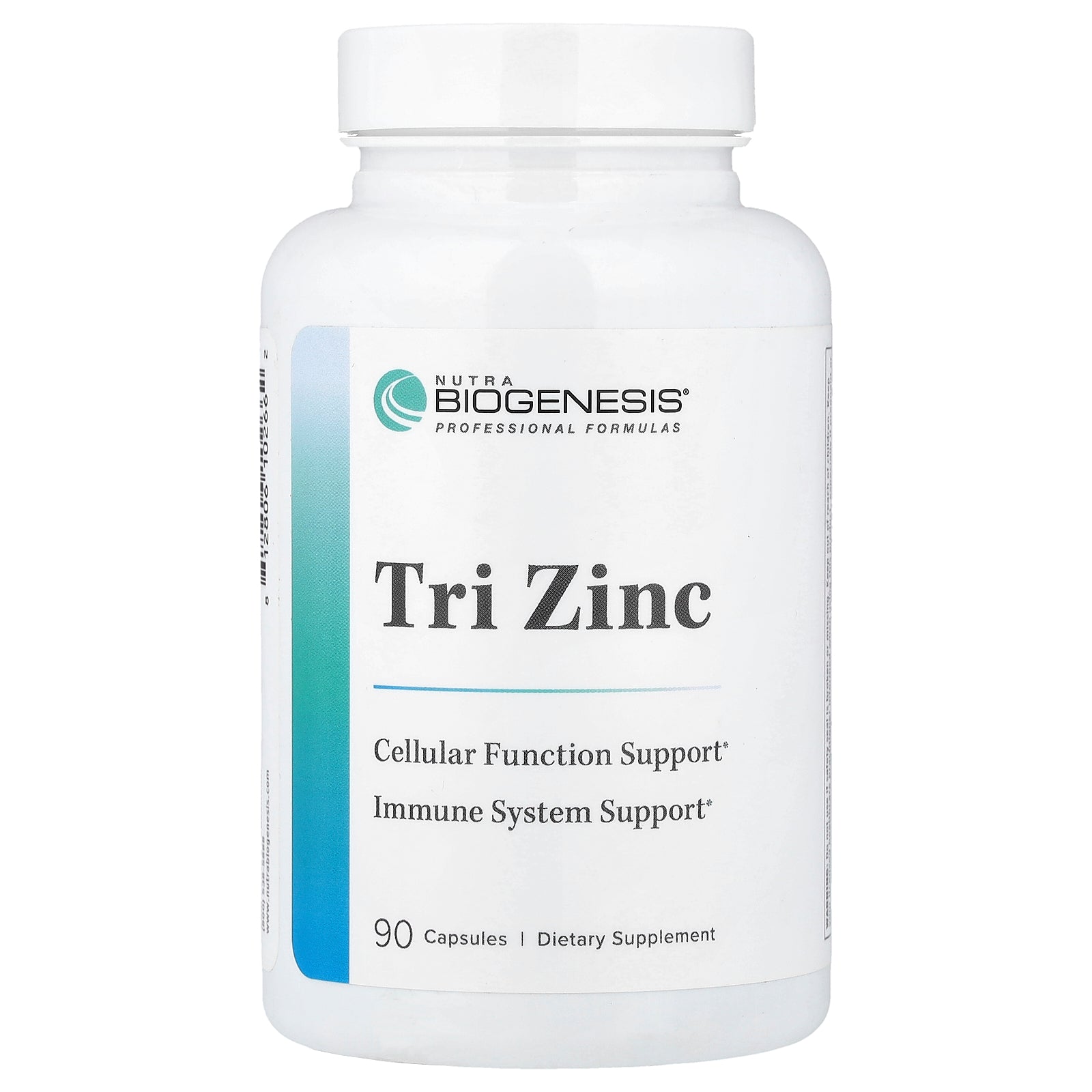
Nutra BioGenesis · capsules

Tri Zinc

At the recorded label maximum: 2 capsules per day

Add to my list
Per day$0.54

At the label maximum of 2 capsules a day.

Per pack$24.14

90 capsules · Vitacost · checked 13 Nov 2026. Delivery is not included.

Per capsule$0.27

Pack price divided by the number of capsules in the pack.

Composition

Amounts at the recorded label maximum. Directions may give a range.

Amounts not disclosed. The label gives only the total weight of this blend, not the amount of each ingredient in it. Without the individual amounts, we cannot compare these ingredients with upper limits.

At the recorded label maximum, the daily amount is 60 mg of zinc. This is above the US adult upper intake level of 40 mg a day for zinc from food and supplements. The National Academies set this scientific reference value.

Label source · Upper intake level source · Report an error

Zincas Zinc Glycinate | Zinc Histidinate | Zinc Methionate
About this formzinc bisglycinate — about 30% of the compound is zinc itself. Reference level V0; no form is called “better” here.
60 mgat the recorded label maximum (2 capsules × 30 mg) · as zinc itself30 mg per capsule · calculated from 30 mg per 1 capsule
150% ↑ of the upper intake level of 40 mg — US upper limit for adults, National Academiesfrom food and supplements, adults · food is not counted here · a reference value, not a legal limit
Copperas Copper Sebacate
2 mgat the recorded label maximum (2 capsules × 1 mg)1 mg per capsule · calculated from 1 mg per 1 capsule
20% of 10 mg — US upper limit for adults, National Academiesfrom food and supplements, adults · food is not counted here · a reference value, not a legal limit
200 mgat the recorded label maximum (2 capsules × 100 mg)100 mg per capsule · calculated from 100 mg per 1 capsule
No limit on file for the United StatesNone on file in any country
Betaineas Betaine Hydrochloride
72 mgat the recorded label maximum (2 capsules × 36 mg)36 mg per capsule · calculated from 36 mg per 1 capsule
No limit on file for the United States
Limits in other countries (3)Croatia, France, Switzerland
Amylase
Amount not disclosedpart of Proprietary Enzyme Blend · not counted
No limit on file for the United StatesNone on file in any country
Beta-Glucanase
Amount not disclosedpart of Proprietary Enzyme Blend · not counted
No limit on file for the United StatesNone on file in any country
Cellulase
Amount not disclosedpart of Proprietary Enzyme Blend · not counted
No limit on file for the United StatesNone on file in any country
Glucoamylase
Amount not disclosedpart of Proprietary Enzyme Blend · not counted
No limit on file for the United StatesNone on file in any country
Hemicellulase
Amount not disclosedpart of Proprietary Enzyme Blend · not counted
No limit on file for the United StatesNone on file in any country
Invertase
Amount not disclosedpart of Proprietary Enzyme Blend · not counted
No limit on file for the United StatesNone on file in any country
Amount not disclosedpart of Proprietary Enzyme Blend · not counted
No limit on file for the United StatesNone on file in any country
Lipase
Amount not disclosedpart of Proprietary Enzyme Blend · not counted
No limit on file for the United StatesNone on file in any country
Phytase
Amount not disclosedpart of Proprietary Enzyme Blend · not counted
No limit on file for the United StatesNone on file in any country
Protease 3.0
Amount not disclosedpart of Proprietary Enzyme Blend · not counted
No limit on file for the United StatesNone on file in any country
Protease 4.5
Amount not disclosedpart of Proprietary Enzyme Blend · not counted
No limit on file for the United StatesNone on file in any country
Protease 6.0
Amount not disclosedpart of Proprietary Enzyme Blend · not counted
No limit on file for the United StatesNone on file in any country

Where no limit is shown, none is set or on file for the United States. That is not the same as having no maximum.

Manufacturer's directions

Directions: Use only as directed. Take 1 capsule twice daily or as directed by your healthcare practitioner.

Other ingredients on the label

Cellulose, Cellulose, Acacia Gum, Ascorbyl Palmitate, Silica

Limits in other countries
CountryZincCopperBetaineLactase
United States40 mgreference, not a law · 150% · above10,000 mcgreference, not a law · 20%—not on file—not on file
Austria15 mgrecommendation · 400% · above1 mgrecommendation · 200% · above—not on file—not on file
Belgium22.5 mglaw · 267% · above2 mglaw · 100%—not on file—not on file
Croatia15 mglaw · 400% · above3 mglaw · 67%1,500 mglaw · 5%—not on file
Cyprus15 mglaw · 400% · above5 mglaw · 40%—not on file—not on file
Denmark11 mgrecommendation · 545% · above0.4 mgrecommendation · 500% · above—not on file—not on file
EAEU25 mglaw · 240% · above3 mglaw · 67%—not on file—not on file
Estonia25 mgrecommendation · 240% · above5 mgrecommendation · 40%—not on file—not on file
Finland25 mgrecommendation · 240% · above5 mgrecommendation · 40%—not on file—not on file
France15 mglaw · 400% · above2,000 mcglaw · 100%400 mgrecommendation · 18%—not on file
Germany6.5 mgrecommendation · 923% · above1 mgrecommendation · 200% · above—not on file—not on file
Ireland25 mgrecommendation · 240% · above5 mgrecommendation · 40%—not on file—not on file
Italy15 mgrecommendation · 400% · above2 mgrecommendation · 100%—not on file—not on file
Luxembourg15 mglaw · 400% · above2 mglaw · 100%—not on file—not on file
Malta25 mgrecommendation · 240% · above2 mgrecommendation · 100%—not on file—not on file
Norway14 mglaw · 429% · above—not on file—not on file—not on file
Poland15 mgrecommendation · 400% · above2 mgrecommendation · 100%—not on file—not on file
Switzerland5.3 mglaw · 1132% · above1.6 mglaw · 125% · above1,500 mglaw · 5%—not on file

Maximum amounts per daily dose of a food supplement, as each country sets them; the share is the daily amount on the label against that maximum. Law = legally binding; recommendation = an authority's recommended maximum, not binding; reference = the U.S. upper intake level for adults from all sources (National Academies), not a legal limit. Verification level V0 · Report an error

About the ingredients

Ingredient information

Ingredient guideZincZinc is an essential mineral that the body needs for the work of hundreds of enzymes. An adult body holds about 1.5–2.5 g of it. Supplements contain zinc as part of a compound, such as zinc citrate, oxide or gluconate. Three things are easy to confuse: the label number, the recommended amounts, and what the forms do. This article sorts them out.Read moreShow less

What zinc does

Zinc-dependent enzymes are found in all six classes of enzymes, the proteins that speed up chemical reactions in cells. By one estimate, more than 3,000 human proteins have sites that bind zinc. In some of them, zinc holds a fold called a zinc finger in shape. Zinc fingers let some proteins bind DNA and switch genes on or off. Zinc also takes part in immune function, protein and DNA synthesis, cell division and the sense of taste.

Most of the body's zinc is in skeletal muscle and bone. As intake rises, the body absorbs more zinc, but a smaller share of it.

Information, not a prescription. Do not start, stop or combine supplements or medicines on your own.
Ingredient guideCopperCopper is an essential mineral that several enzymes need in order to work. An adult body holds about 50–120 mg of it, and only small amounts are stored. Supplements offer it in several forms. Three things are easy to confuse: the number on the label, the recommended amounts, and what the forms do. This article sorts them out.Read moreShow less

What copper does

Copper-dependent enzymes are called cuproenzymes. They take part in energy production, iron metabolism, building connective tissue and making brain signaling chemicals. One of them, ceruloplasmin, carries 60–95% of the copper in blood plasma, says the Linus Pauling Institute. Defense against oxidative damage depends mainly on copper-containing enzymes called superoxide dismutases.

Almost two-thirds of the body's copper is in the skeleton and muscle. Most copper leaves the body in bile, and a small amount in urine. The body keeps its copper level steady through absorption in the gut and release from the liver into bile.

Information, not a prescription. Do not start, stop or combine supplements or medicines on your own.

Ingredient guideGingerGinger is the underground stem, or rhizome, of the plant Zingiber officinale. The plant is native to the warm parts of Asia. Its rhizome is used in food and in supplements. Supplements contain ginger as root powder in capsules, extracts, liquid extracts, tea, lozenges and chews.Read moreShow less
Terms and sources
rhizome
NCCIH calls the rhizome an underground stem. NCCIH, Ginger: Usefulness and Safety.
warm parts of Asia
NCCIH, Ginger: Usefulness and Safety.

Ginger in the body

Ginger is not a nutrient, and the body has no daily requirement for it. Trials in adults without a diagnosis measure things such as muscle soreness after exercise and stomach emptying.

Ginger root holds about 1–3% volatile oils and a group of pungent compounds. In fresh root, the most abundant pungent compounds are gingerols, mainly 6-gingerol. Shogaols, a dehydrated form of gingerols, are found mainly in dried and heat-treated root. Extract makers state gingerols, sometimes with shogaols, to standardize their extracts.

Terms and sources
pungent compounds
Mainly gingerols and shogaols. Zick et al., 2008.
a dehydrated form
Fresh root holds only small amounts of shogaols. Zick et al., 2008.
standardize
To keep the amount of chosen compounds the same from batch to batch. In one study, an extract standardized to 5% gingerols held 2.15% 6-gingerol by HPLC. Zick et al., 2008.

In 27 healthy adults, one dose of up to 2 g of extract left no free gingerols in blood. They appeared in blood in bound forms, mostly glucuronides, from 30 minutes after the dose. These bound forms could no longer be detected in blood by 4 hours in all but one person. Side effects in that study were all graded mild, mainly burping, a burning feeling in the chest and stomach upset.

Terms and sources
27 healthy adults
Single doses from 100 mg to 2 g of an extract with 5% gingerols. Each new group got a higher dose; there was no comparison group. Zick et al., 2008.
glucuronides
Gingerols and shogaols joined to glucuronic acid. A smaller part was bound to sulfate. Zick et al., 2008.
all but one person
One person on 2 g still had bound 6-gingerol at 8 hours. Zick et al., 2008.
graded mild
No side effect was above grade 1 on a standard toxicity scale. Zick et al., 2008.

NCCIH notes: “Ginger has been used safely in many research studies where it was taken orally (by mouth) as a dietary supplement.” It adds: “Ginger products may also be safe for topical use.” NCCIH lists side effects: “Ginger can have side effects such as abdominal discomfort, heartburn, diarrhea, and mouth and throat irritation when taken orally.” NCCIH advises: “If you take any type of medicine, talk with your health care provider before using ginger or any other herbal products; some herbs and medicines interact in harmful ways.” NCCIH also writes: “The use of ginger dietary supplements during pregnancy may be safe.” It continues: “As with all herbal supplements, if you’re considering using ginger while pregnant, consult your health care provider.” NCCIH adds: “Little is known about whether it’s safe to use ginger while breastfeeding.”

Terms and sources
NCCIH notes
NCCIH, Ginger: Usefulness and Safety.

In the cycling trial below, at most 2 of 30 cyclists reported gas, burping or fullness with either drink. In the 2-week powder trial below, no moderate or severe side effects were reported.

Terms and sources
at most 2 of 30 cyclists
Weekly 16-item questionnaire on stomach and gut symptoms. Kurtz et al., Sports, 2026.
no moderate or severe side effects
Crichton et al., Journal of Nutrition, 2023.

Information, not a prescription. Do not start, stop or combine supplements or medicines on your own.

Ingredient guideLactaseLactase is the enzyme that splits lactose, the sugar in milk, into glucose and galactose. The small intestine makes it, and in most people its activity falls during childhood. Supplements hold lactase made by molds or yeasts. They are sold as tablets, capsules and drops. Their enzyme activity is measured in units, such as FCC lactase units.Read moreShow less
Terms and sources
Lactase
Also called beta-galactosidase (Lin 1993; Montalto 2005). The human enzyme is lactase-phlorizin hydrolase (Misselwitz 2019).
most people
A 2019 review calls this the most common pattern worldwide. Misselwitz et al., Gut, 2019.
molds or yeasts
Aspergillus molds or the yeast Kluyveromyces lactis. Sources in the section below.
FCC lactase units
Units of enzyme activity from a Food Chemicals Codex test. de Vrese et al., Clinical Nutrition, 2015.

Lactase in the body

Lactase splits lactose into glucose and galactose, two sugars the gut can absorb. The enzyme sits on the surface of the small intestine lining, most of it in the middle section. Lactase activity is highest at birth. In most people worldwide, it falls during childhood, a pattern called lactase non-persistence.

Terms and sources
glucose and galactose
Both are carried into gut cells by a sodium-linked sugar transporter. Misselwitz et al., Gut, 2019.
middle section
The mid-jejunum. Misselwitz et al., Gut, 2019.
lactase non-persistence
A 2019 review calls it a normal variant of human metabolism. Misselwitz et al., Gut, 2019.

Lactase that stays active into adulthood is common in people of European ancestry. In Europeans, a single DNA letter change near the lactase gene keeps the enzyme switched on. The change first appears in skeletons from Anatolia about 10,500 years ago. Carriers had an advantage of up to 4–5% per generation.

Terms and sources
common in people of European ancestry
Also in some African, Middle Eastern and South Asian groups; rare or absent elsewhere. Itan et al., BMC Evolutionary Biology, 2010.
a single DNA letter change
LCT -13910 C>T. Other changes in the same stretch of DNA do this in Africa and the Middle East. Misselwitz et al., Gut, 2019.
Anatolia
Present-day Turkey. Misselwitz et al., Gut, 2019.
4–5% per generation
The review ranks it among the largest selection effects seen for any gene in recent human evolution. Misselwitz et al., Gut, 2019.

Lactose that is not split reaches the large intestine, where bacteria ferment it. Fermentation makes gases, including hydrogen, which is breathed out. A breath test counts a rise of 20 ppm or more within 3 hours as poor lactose digestion. A review of randomized trials found that most adults tolerated 12–15 g of lactose, about 1 cup of milk.

Terms and sources
hydrogen
Human enzymes do not make hydrogen, so hydrogen in the breath comes from gut bacteria. Misselwitz et al., Gut, 2019.
20 ppm
Parts per million of hydrogen above the starting value. Misselwitz et al., Gut, 2019.
most adults
Adults who digest lactose poorly or report symptoms after it. The review rates this evidence as moderate quality. Shaukat et al., Annals of Internal Medicine, 2010.

Lactose-free milk made with lactase is widely available, and allergic reactions to it have been reported, a 2019 review notes.

Terms and sources
a 2019 review
Misselwitz et al., Gut, 2019.

Information, not a prescription. Do not start, stop or combine supplements or medicines on your own.

Services

Choose the option that suits you.

Quick selection

I know my goal

$5

1–2 minutes · a few questions with fixed answers

One goal. Up to three products. Set a budget per day if you like.

Product checks
form and amount on the label, plus shop prices
Daily schedule
what to take, when, how much
Totals and limits
next to the upper limit
Reasons & sources
for each product
Prices and shops
plus food and habits
Progress
what to track, when to see a doctor

Complete the questionnaire before you pay. If no product fits any of your goals, you won’t be charged.

Order · $5View example

Full selection

I have several goals

$15

5–7 minutes · questionnaire with fixed answers

Up to three goals in one set. Where two goals overlap, one product is used for both.

Product checks
form and amount on the label, plus shop prices
Daily schedule
what to take, when, how much
Totals and limits
next to the upper limit
Reasons & sources
for each product
Prices and shops
plus food and habits
Progress
what to track, when to see a doctor

Complete the questionnaire before you pay. If no product fits any of your goals, you won’t be charged.

Order · $15View example

Expert review

I want a person to look at my supplements

$50

Written review within 48 hours of your completed questionnaire

An expert reviews your supplement list and questionnaire.

Written review
duplicates, limits, forms
Detailed questionnaire
supplements, medicines, history
Optional uploads
supplement-label photos or documents relevant to your review
Your notes
your priorities and questions
Follow-up questions
in writing, when needed
Next steps
points to discuss with your doctor

Complete the questionnaire before you pay.

Order · $50View example
Sources, label & certificates

Label record

Copied from the NIH label database (DSLD 323015) · not yet compared with the label · checked 19 Oct 2026 · Report an error

The United States has no pre-market registration for supplements.
Label on file in the NIH Dietary Supplement Label Database
checked 19 Oct 2026source: NIH DSLDReport an error

Barcode 8 12806 10266 2

Third-party certificates

No third-party certificate on file for this product.

Information, not a prescription. Do not start, stop or combine supplements or medicines on your own. If you have a health condition, are pregnant or breastfeeding, take medicines, or are under 18, talk to a doctor or pharmacist first.

Photo credits

Image: © Nutra BioGenesis. Shown to identify the product. Source:

Rights holders can ask us to remove an image or send official product photos: info@verateca.com.

Product photo

Nutra BioGenesis Tri Zinc — enlarged pack