21st Century · tablets

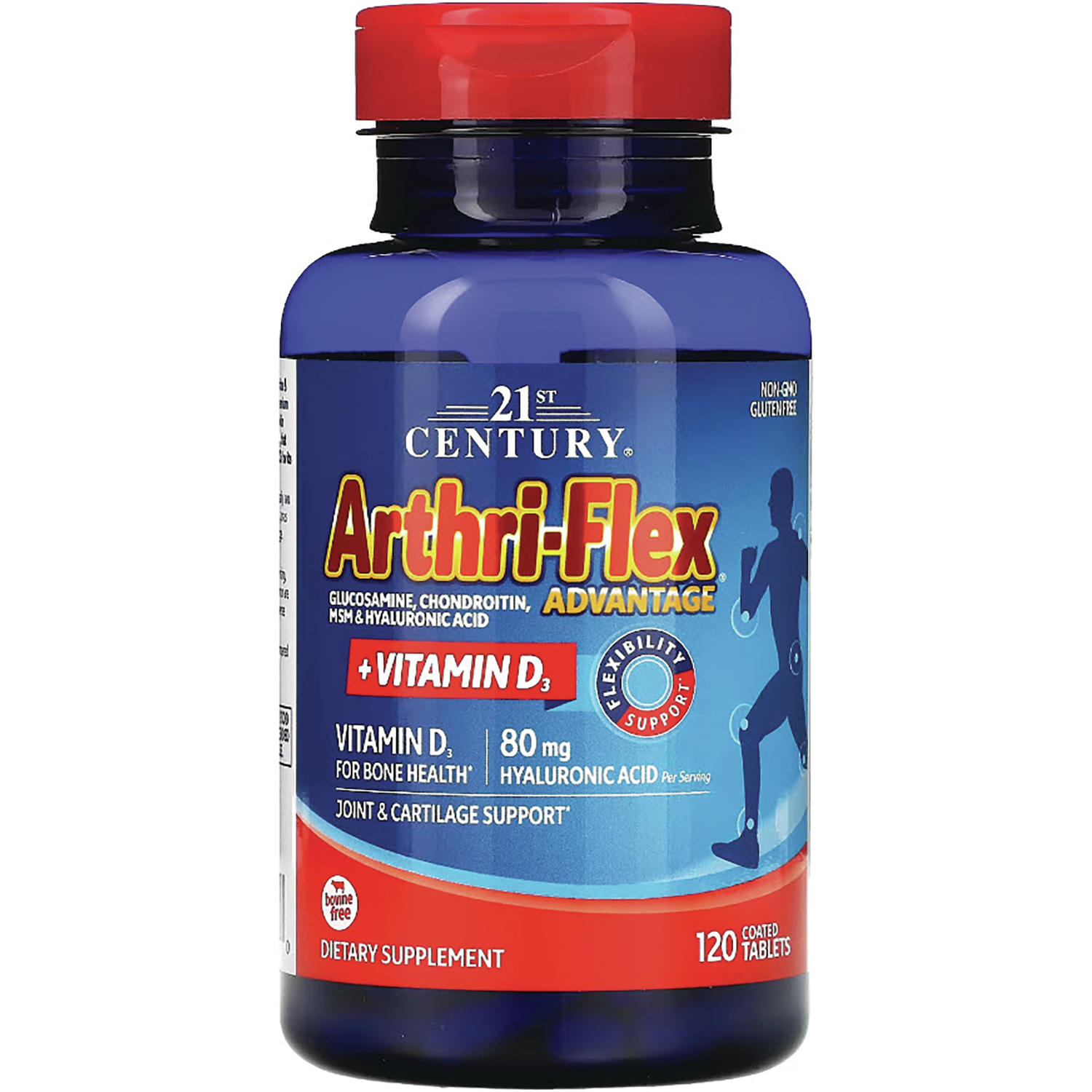
Arthri-Flex Advantage + Vitamin D3

At the recorded label maximum: 12 tablets per day

Add to my list
Per day$0.77

At the label maximum of 4 tablets a day.

Per pack$22.99

120 tablets · 21st Century · checked 20 Nov 2026. Delivery is not included.

Per tablet$0.19

Pack price divided by the number of tablets in the pack.

Composition

Amounts at the recorded label maximum. Directions may give a range.

Amounts not disclosed. The label gives only the total weight of this blend, not the amount of each ingredient in it. Without the individual amounts, we cannot compare these ingredients with upper limits.

At the recorded label maximum, the daily amount is 300 mcg of vitamin D3. This is above the US adult upper intake level of 100 mcg a day for vitamin D3 from food and supplements. The National Academies set this scientific reference value.

At the recorded label maximum, the daily amount is 1,200 mg of magnesium. This is above the US adult upper intake level of 350 mg a day for magnesium from supplements and medicines. The National Academies set this scientific reference value.

The U.S. adult upper limit of 350 mg/day for magnesium from supplements and medications is based on studies of diarrhea.

At the recorded label maximum, the daily amount is 90 mg of zinc. This is above the US adult upper intake level of 40 mg a day for zinc from food and supplements. The National Academies set this scientific reference value.

At the recorded label maximum, the daily amount is 30 mg of manganese. This is above the US adult upper intake level of 11 mg a day for manganese from food and supplements. The National Academies set this scientific reference value.

Label source · Upper intake level source: vitamin D3 · Upper intake level source: magnesium, zinc, manganese · Report an error

600 mgat the recorded label maximum (6 servings × 100 mg; 2 tablets per serving)50 mg per tablet · calculated from 100 mg per 2 tablets
30% of 2,000 mg — US upper limit for adults, National Academiesfrom food and supplements, adults · food is not counted here · a reference value, not a legal limit
Vitamin D3as Cholecalciferol
About this formvitamin D3 (cholecalciferol). Raises vitamin D levels more than D2. Reference level V0; no form is called “better” here.
300 mcgat the recorded label maximum (6 servings × 50 mcg; 2 tablets per serving)25 mcg per tablet · calculated from 50 mcg per 2 tablets
300% ↑ of the upper intake level of 100 mcg — US upper limit for adults, National Academiesfrom food and supplements, adults · food is not counted here · a reference value, not a legal limit
Magnesiumas Magnesium Glycinate
About this formmagnesium glycinate / bisglycinate — about 14% of the compound is magnesium itself. Gentle on the gut; about 14% elemental magnesium. Reference level V0; no form is called “better” here.
1,200 mgat the recorded label maximum (6 servings × 200 mg; 2 tablets per serving) · as magnesium itself100 mg per tablet · calculated from 200 mg per 2 tablets
343% ↑ of the upper intake level of 350 mg — US upper limit for adults, National Academiesmagnesium from supplements, adults · a reference value, not a legal limit
Zincas Zinc Glycinate
About this formzinc bisglycinate — about 30% of the compound is zinc itself. Reference level V0; no form is called “better” here.
90 mgat the recorded label maximum (6 servings × 15 mg; 2 tablets per serving) · as zinc itself7.5 mg per tablet · calculated from 15 mg per 2 tablets
225% ↑ of the upper intake level of 40 mg — US upper limit for adults, National Academiesfrom food and supplements, adults · food is not counted here · a reference value, not a legal limit
3 mgat the recorded label maximum (6 servings × 500 mcg; 2 tablets per serving)250 mcg per tablet · calculated from 500 mcg per 2 tablets
30% of 10 mg — US upper limit for adults, National Academiesfrom food and supplements, adults · food is not counted here · a reference value, not a legal limit
Manganeseas Manganese Glycinate
30 mgat the recorded label maximum (6 servings × 5 mg; 2 tablets per serving)2.5 mg per tablet · calculated from 5 mg per 2 tablets
273% ↑ of the upper intake level of 11 mg — US upper limit for adults, National Academiesfrom food and supplements, adults · food is not counted here · a reference value, not a legal limit
Molybdenumas Molybdenum Glycinate
1.32 mgat the recorded label maximum (6 servings × 220 mcg; 2 tablets per serving)110 mcg per tablet · calculated from 220 mcg per 2 tablets
66% of 2 mg — US upper limit for adults, National Academiesfrom food and supplements, adults · food is not counted here · a reference value, not a legal limit
Potassiumas Potassium Chloride
1,170 mgat the recorded label maximum (6 servings × 195 mg; 2 tablets per serving)97.5 mg per tablet · calculated from 195 mg per 2 tablets
No US upper limitNational Academies: not determined — too little data on harm
Limits in other countries (11)Austria, Belgium, Croatia, Denmark, Eurasian Economic Union (EAEU), France, Germany, Luxembourg, Malta, Poland, Switzerland
Glucosamine Sulfateas Glucosamine Sulfate 2KCl
About this formglucosamine sulfate. Reference level V0; no form is called “better” here.
9,000 mgat the recorded label maximum (6 servings × 1,500 mg; 2 tablets per serving)750 mg per tablet · calculated from 1,500 mg per 2 tablets
No limit on file for the United States
Limits in other countries (2)Croatia, Switzerland
Methylsulfonylmethane
9,000 mgat the recorded label maximum (6 servings × 1,500 mg; 2 tablets per serving)750 mg per tablet · calculated from 1,500 mg per 2 tablets
No limit on file for the United States
Limits in other countries (1)Switzerland
480 mgat the recorded label maximum (6 servings × 80 mg; 2 tablets per serving)
No limit on file for the United StatesNone on file in any country
Chicken Sternum Collagen Type IIas Chondroitin Sulfate
About this formhydrolyzed type II collagen (chicken sternum, BioCell). For joints; dose around one gram. Reference level V0; no form is called “better” here.
Amount not disclosedpart of Proprietary Blend · not counted
No limit on file for the United StatesNone on file in any country
Amount not disclosedpart of Proprietary Blend · not counted
No limit on file for the United StatesNone on file in any country
Boron Glycinate
Amount not disclosedpart of Proprietary Blend · not counted
Not compared with 20 mg — US upper limit for adults, National Academiesfrom food and supplements, adults · food is not counted here · a reference value, not a legal limit
Amount not disclosedpart of Proprietary Blend · not counted
No limit on file for the United StatesNone on file in any country
Grape Seed Extractas Vitis vinifera Seed Extract
Amount not disclosedpart of Proprietary Blend · not counted
No limit on file for the United StatesNone on file in any country
White Willow Bark Extractas Salix alba Bark Extract
Amount not disclosedpart of Proprietary Blend · not counted
No limit on file for the United StatesNone on file in any country

Where no limit is shown, none is set or on file for the United States. That is not the same as having no maximum.

Manufacturer's directions

Directions: As a dietary supplement; adults take four (4) tablets daily; two (2) in the morning and two (2) in teh afternoon; preferably with meals or as directed by a healthcare provider.

Other ingredients on the label

Cellulose, Stearic Acid, Croscarmellose Sodium, Magnesium Silicate (Mg Silicate), Magnesium Stearate (Mg Stearate), Polyethylene Glycol (PEG), Polyplasdone, Polyvinyl Alcohol (PVA), Silicon Dioxide (SiO2), Titanium Dioxide (TiO2)
Limits in other countries
CountryVitamin CVitamin D3MagnesiumZinc
United States2,000 mgreference, not a law · 30%100 mcgreference, not a law · 300% · above350 mgreference, not a law · 343% · above40 mgreference, not a law · 225% · above
Austria500 mgrecommendation · 120% · above20 mcgrecommendation · 1500% · above375 mgrecommendation · 320% · above15 mgrecommendation · 600% · above
Belgium1,000 mglaw · 60%75 mcglaw · 400% · above450 mglaw · 267% · above22.5 mglaw · 400% · above
Croatia800 mglaw · 75%10 mcglaw · 3000% · above375 mglaw · 320% · above15 mglaw · 600% · above
Cyprus2,000 mglaw · 30%10 mcglaw · 3000% · above300 mglaw · 400% · above15 mglaw · 600% · above
Denmark1,000 mgrecommendation · 60%95 mcgrecommendation · 316% · above233 mgrecommendation · 515% · above11 mgrecommendation · 818% · above
EAEU900 mglaw · 67%15 mcglaw · 2000% · above800 mglaw · 150% · above25 mglaw · 360% · above
Estonia—not on file100 mcgrecommendation · 300% · above250 mgrecommendation · 480% · above25 mgrecommendation · 360% · above
Finland—not on file100 mcgrecommendation · 300% · above250 mgrecommendation · 480% · above25 mgrecommendation · 360% · above
France180 mglaw · 333% · above5 mcglaw · 6000% · above300 mglaw · 400% · above15 mglaw · 600% · above
Germany250 mgrecommendation · 240% · above20 mcgrecommendation · 1500% · above250 mgrecommendation · 480% · above6.5 mgrecommendation · 1385% · above
Ireland2,000 mgrecommendation · 30%100 mcgrecommendation · 300% · above250 mgrecommendation · 480% · above25 mgrecommendation · 360% · above
Italy1,000 mgrecommendation · 60%50 mcgrecommendation · 600% · above450 mgrecommendation · 267% · above15 mgrecommendation · 600% · above
Luxembourg1,000 mglaw · 60%50 mcglaw · 600% · above562.5 mglaw · 213% · above15 mglaw · 600% · above
Malta1,000 mgrecommendation · 60%25 mcgrecommendation · 1200% · above400 mgrecommendation · 300% · above25 mgrecommendation · 360% · above
Netherlands—not on file75 mcglaw · 400% · above—not on file—not on file
Norway1,000 mglaw · 60%80 mcglaw · 375% · above350 mglaw · 343% · above14 mglaw · 643% · above
Poland1,000 mgrecommendation · 60%50 mcgrecommendation · 600% · above400 mgrecommendation · 300% · above15 mgrecommendation · 600% · above
Switzerland750 mglaw · 80%70 mcglaw · 429% · above375 mglaw · 320% · above5.3 mglaw · 1698% · above

Maximum amounts per daily dose of a food supplement, as each country sets them; the share is the daily amount on the label against that maximum. Law = legally binding; recommendation = an authority's recommended maximum, not binding; reference = the U.S. upper intake level for adults from all sources (National Academies), not a legal limit. Verification level V0 · 7 more ingredients have limits on file · Report an error

About the ingredients

Ingredient information

Ingredient guideVitamin CVitamin C, also called L-ascorbic acid, is a water-soluble vitamin. Most animals make vitamin C in the body; humans cannot and get it from food. Fruits and vegetables such as peppers, citrus fruits and kiwifruit are the main sources. Supplements contain it as ascorbic acid or as mineral salts such as sodium and calcium ascorbate.Read moreShow less
Terms and sources
water-soluble
It dissolves in water, not in fat. NIH Office of Dietary Supplements.

Vitamin C in the body

Vitamin C is needed to make collagen, carnitine and some neurotransmitters. It is also an antioxidant and can return used vitamin E to its active form. It is needed for normal immune function. It increases the absorption of iron from plant foods.

Terms and sources
collagen
A protein that holds together connective tissue, such as skin, tendons and blood vessels. NIH Office of Dietary Supplements.
carnitine
A substance cells need to get energy from fat. Linus Pauling Institute.
neurotransmitters
Chemical messengers between nerve cells.
antioxidant
A substance that limits damage from free radicals, reactive molecules made in cells.
iron from plant foods
Nonheme iron, the only form of iron in plant foods. NIH Office of Dietary Supplements.

An adult body holds from about 300 mg to about 2 g of vitamin C. White blood cells, the eyes, the adrenal and pituitary glands and the brain hold the most. Cells hold vitamin C in millimolar concentrations, blood plasma in micromolar concentrations. At 100 mg a day or more, cells appear to be saturated.

Terms and sources
about 300 mg
The lower figure is for very low intake. NIH Office of Dietary Supplements.
adrenal and pituitary glands
Small glands that make hormones: the adrenals sit above the kidneys, the pituitary below the brain.
millimolar
Thousandths of a mole per liter; micromolar means millionths. NIH Office of Dietary Supplements.
saturated
Holding as much as they take up. Above 200 mg a day, blood plasma levels rise little more.

The body absorbs about 70–90% of vitamin C at 30–180 mg a day. Above 1 g a day, less than 50% is absorbed, and unused vitamin C leaves in urine.

Terms and sources
less than 50%
Summary by the NIH Office of Dietary Supplements. Absorption in the gut runs through a dose-dependent transporter protein.

Information, not a prescription. Do not start, stop or combine supplements or medicines on your own.

Ingredient guideVitamin DVitamin D is a fat-soluble vitamin. The skin makes it when ultraviolet light from the sun reaches it, and a few foods contain it. Supplements contain one or both of its two main forms: vitamin D3 and vitamin D2. Labels state the amount in micrograms (mcg), international units (IU) or both.Read moreShow less
Terms and sources
fat-soluble
It dissolves in fat, not in water. NIH Office of Dietary Supplements.

Vitamin D in the body

Vitamin D from the sun, food and supplements is inactive at first. The liver turns it into 25-hydroxyvitamin D, the form a blood test measures. Mainly the kidneys then make the active form.

Terms and sources
25-hydroxyvitamin D
Also called calcidiol or 25(OH)D. Results come in nmol/L or ng/mL; 50 nmol/L equals 20 ng/mL.
active form
1,25-dihydroxyvitamin D, also called calcitriol.

Vitamin D is needed for normal absorption of calcium from the gut and for normal bones. It is also needed for normal muscle and immune function. Many tissues in the body carry vitamin D receptors.

Terms and sources
vitamin D receptors
Proteins in cells that respond to the active form of vitamin D. NIH Office of Dietary Supplements.

Information, not a prescription. Do not start, stop or combine supplements or medicines on your own.

Ingredient guideMagnesiumMagnesium is an essential mineral: the human body cannot make it and gets it from food and drinks. An adult body holds about 25 g, mostly in bone. Supplements add to it, in forms such as magnesium citrate, glycinate and oxide.Read moreShow less

Magnesium in the body

Inside cells, magnesium is the second most common positively charged mineral, after potassium. It takes part in more than 300 enzyme systems. It is needed for normal muscle and nerve function, energy metabolism, protein synthesis, and normal bones and teeth.

Terms and sources
positively charged mineral
a cation. de Baaij et al., Physiological Reviews, 2015 (PMID 25540137).
enzyme systems
Enzymes are proteins that run chemical reactions in cells. The 300 figure is from NIH ODS. A 2015 review puts the number of enzyme reactions at over 600.
energy metabolism
How cells turn food into usable energy.

About 50–60% of the body's magnesium sits in bone. Most of the rest is in muscle and other soft tissue. Less than 1% is in the blood. A blood test sees only this small part.

Terms and sources
in the blood
In serum. The usual range is 0.75–0.95 mmol/L.

Information, not a prescription. Do not start, stop or combine supplements or medicines on your own.

Ingredient guideZincZinc is an essential mineral that the body needs for the work of hundreds of enzymes. An adult body holds about 1.5–2.5 g of it. Supplements contain zinc as part of a compound, such as zinc citrate, oxide or gluconate. Three things are easy to confuse: the label number, the recommended amounts, and what the forms do. This article sorts them out.Read moreShow less

What zinc does

Zinc-dependent enzymes are found in all six classes of enzymes, the proteins that speed up chemical reactions in cells. By one estimate, more than 3,000 human proteins have sites that bind zinc. In some of them, zinc holds a fold called a zinc finger in shape. Zinc fingers let some proteins bind DNA and switch genes on or off. Zinc also takes part in immune function, protein and DNA synthesis, cell division and the sense of taste.

Most of the body's zinc is in skeletal muscle and bone. As intake rises, the body absorbs more zinc, but a smaller share of it.

Information, not a prescription. Do not start, stop or combine supplements or medicines on your own.

Ingredient guideCopperCopper is an essential mineral that several enzymes need in order to work. An adult body holds about 50–120 mg of it, and only small amounts are stored. Supplements offer it in several forms. Three things are easy to confuse: the number on the label, the recommended amounts, and what the forms do. This article sorts them out.Read moreShow less

What copper does

Copper-dependent enzymes are called cuproenzymes. They take part in energy production, iron metabolism, building connective tissue and making brain signaling chemicals. One of them, ceruloplasmin, carries 60–95% of the copper in blood plasma, says the Linus Pauling Institute. Defense against oxidative damage depends mainly on copper-containing enzymes called superoxide dismutases.

Almost two-thirds of the body's copper is in the skeleton and muscle. Most copper leaves the body in bile, and a small amount in urine. The body keeps its copper level steady through absorption in the gut and release from the liver into bile.

Information, not a prescription. Do not start, stop or combine supplements or medicines on your own.

Ingredient guideHyaluronic AcidHyaluronic acid is a long sugar chain found in skin, the eye and joint fluid. Supplements contain it as hyaluronic acid or its salt, sodium hyaluronate. It is made by bacterial fermentation or extracted from rooster combs. This page is about taking it by mouth; injections and skin creams are other topics.Read moreShow less

Hyaluronic acid in the body

Hyaluronic acid is a long chain of two sugars that repeat in turn. One chain can weigh up to 6 million daltons. That is about 16,000 repeats of the sugar pair, by our calculation. In the body it is present as a salt, hyaluronate. It is found in high amounts in skin, the umbilical cord and the clear gel inside the eye. It is also present in joint fluid, cartilage and blood vessels.

Terms and sources
two sugars
glucuronic acid and N-acetylglucosamine. Liu et al., Microbial Cell Factories, 2011.
daltons
a unit of molecular mass. Liu et al., Microbial Cell Factories, 2011.
16,000 repeats
6,000,000 divided by 379, the mass of one sugar pair in daltons.
clear gel inside the eye
the vitreous humor. The name joins hyaloid, meaning glassy, and uronic acid. Meyer and Palmer described it in 1934, from cattle eyes. Liu et al., Microbial Cell Factories, 2011.
joint fluid
Fraser et al., 1997, find it in all tissues and body fluids of vertebrates.

In rats, more than half of the body's hyaluronic acid is in the skin. About a quarter is in the skeleton and connective structures, and less than a tenth in muscle. In women's skin, it made up 0.030% of skin weight at ages 19–47. The share fell to 0.015% at age 60 and 0.007% at age 75.

Terms and sources
In rats
Rats of 250 g held 40–60 mg in total. Reed et al., Acta Physiologica Scandinavica, 1988.
women's skin
Skin samples from women aged about 19 to 75. Longas et al., Carbohydrate Research, 1987.

In tissues, the half-life of hyaluronic acid ranges from less than 1 day to several days. Hyaluronic acid that reaches the blood has a half-life of 2–5 minutes. Cells lining the small vessels of the liver remove most of it. At only 0.1% in water, the chains tangle and the solution becomes thick. Roles proposed for it include lubrication and control of water in tissues.

Terms and sources
half-life
the time it takes for half of it to be broken down. Fraser et al., Journal of Internal Medicine, 1997.
becomes thick
highly viscous. Liu et al., Microbial Cell Factories, 2011.
Roles proposed
Fraser et al., Journal of Internal Medicine, 1997.

What happens to swallowed hyaluronic acid has been studied mostly in rats. In a 2008 rat study, 87–96% of a radioactive label was recovered, almost all of it in feces. Some of the label still appeared in joints, bones and skin. A 2016 rat study found no hyaluronic acid in feces. Gut bacteria broke it into small pieces, which passed through rat large intestine tissue in lab tests.

Terms and sources
radioactive label
technetium-99m attached to hyaluronic acid. Dogs were also studied. Balogh et al., Journal of Agricultural and Food Chemistry, 2008.
2016 rat study
It measured hyaluronic acid itself, not a label. Kimura et al., Journal of Medicinal Food, 2016. Five of six authors work for Kewpie, a maker of hyaluronic acid.
small pieces
oligosaccharides, short chains of sugar pairs. Pieces of 1, 2 and more sugar pairs reached rat skin.

Information, not a prescription. Do not start, stop or combine supplements or medicines on your own.

Ingredient guideBoswelliaBoswellia is the gum resin of Boswellia serrata, a tree native to Northern Africa, India and the Middle East. It is also called Indian frankincense. Supplements contain extracts of the resin, some standardized to boswellic acids, its triterpene acids. Some extracts also keep the resin's volatile compounds.Read moreShow less
Terms and sources
native to Northern Africa, India and the Middle East
NCCIH, Boswellia: Usefulness and Safety.
Indian frankincense
Riva et al., Phytomedicine, 2016, a trial report below.
boswellic acids
Hammer et al. name AKBA, KBBA, β-boswellic acid and 3-acetyl-β-boswellic acid as the main ones. Hammer et al., Nutrients, 2026, a trial report below.
volatile compounds
Such as α-thujene. Joseph et al., Biological and Pharmaceutical Bulletin, 2024, a trial report below.

Boswellia in the body

Boswellia is not a nutrient, and the body has no daily requirement for it. Trials in adults without a diagnosis measure pain tests and boswellic acids in blood.

In one trial, blood boswellic acids were higher when an extract was taken with a high-fat meal than fasting. Two α-boswellic acids were detectable only with the meal. Hammer et al. write that blood AKBA after oral intake stays far below the level that blocks 5-lipoxygenase in lab tests.

Terms and sources
In one trial
Sterk et al., Planta Medica, 2004, below.
5-lipoxygenase
An enzyme of inflammation signaling that AKBA blocks in lab tests. Hammer et al., Nutrients, 2026, a trial report below.

Information, not a prescription. Do not start, stop or combine supplements or medicines on your own.

Services

Choose the option that suits you.

Quick selection

I know my goal

$5

1–2 minutes · a few questions with fixed answers

One goal. Up to three products. Set a budget per day if you like.

Product checks
form and amount on the label, plus shop prices
Daily schedule
what to take, when, how much
Totals and limits
next to the upper limit
Reasons & sources
for each product
Prices and shops
plus food and habits
Progress
what to track, when to see a doctor

Complete the questionnaire before you pay. If no product fits any of your goals, you won’t be charged.

Order · $5View example

Full selection

I have several goals

$15

5–7 minutes · questionnaire with fixed answers

Up to three goals in one set. Where two goals overlap, one product is used for both.

Product checks
form and amount on the label, plus shop prices
Daily schedule
what to take, when, how much
Totals and limits
next to the upper limit
Reasons & sources
for each product
Prices and shops
plus food and habits
Progress
what to track, when to see a doctor

Complete the questionnaire before you pay. If no product fits any of your goals, you won’t be charged.

Order · $15View example

Expert review

I want a person to look at my supplements

$50

Written review within 48 hours of your completed questionnaire

An expert reviews your supplement list and questionnaire.

Written review
duplicates, limits, forms
Detailed questionnaire
supplements, medicines, history
Optional uploads
supplement-label photos or documents relevant to your review
Your notes
your priorities and questions
Follow-up questions
in writing, when needed
Next steps
points to discuss with your doctor

Complete the questionnaire before you pay.

Order · $50View example
Sources, label & certificates

Label record

Copied from the NIH label database (DSLD 326310) · not yet compared with the label · checked 19 Oct 2026 · Report an error

The United States has no pre-market registration for supplements.
Label on file in the NIH Dietary Supplement Label Database
checked 19 Oct 2026source: NIH DSLDReport an error

Barcode 7 40985 22623 0

Third-party certificates

No third-party certificate on file for this product.

Information, not a prescription. Do not start, stop or combine supplements or medicines on your own. If you have a health condition, are pregnant or breastfeeding, take medicines, or are under 18, talk to a doctor or pharmacist first.

Photo credits

Image: © 21st Century. Shown to identify the product. Source:

Rights holders can ask us to remove an image or send official product photos: info@verateca.com.

Product photo

21st Century Arthri-Flex Advantage + Vitamin D3 — enlarged pack