Havasu Nutrition · capsules

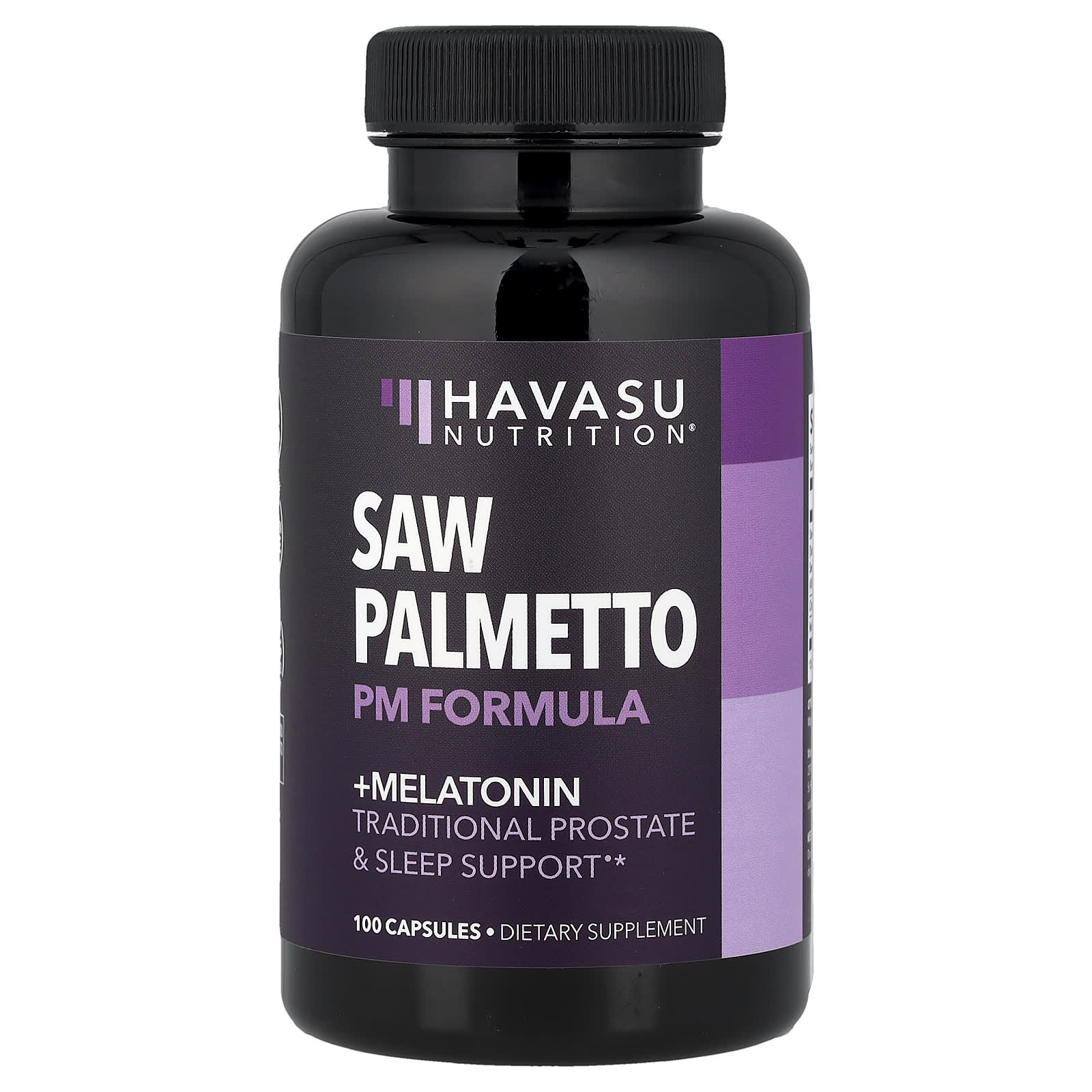
Saw Palmetto PM Formula

1 capsule · how many a day not stated

Add to my list
Per day$0.28

Calculated at 1 serving a day (1 capsule). The label does not state how many to take daily.

Per pack$28.11

100 capsules · Vitacost · checked 22 Oct 2026. Delivery is not included.

Per capsule$0.28

Pack price divided by the number of capsules in the pack.

Composition

Recorded amounts. How many servings a day is not stated.

Saw Palmetto Blendas Saw Palmetto Fruit Extract | Saw Palmetto, Powder
500 mgrecorded amount; daily frequency not stated500 mg per capsule · calculated from 500 mg per 1 capsule
No limit on file for the United StatesNone on file in any country
25 mgrecorded amount; daily frequency not stated25 mg per capsule · calculated from 25 mg per 1 capsule
No limit on file for the United StatesNone on file in any country
3 mgrecorded amount; daily frequency not stated3 mg per capsule · calculated from 3 mg per 1 capsule
No limit on file for the United States
Limits in other countries (3)Croatia, France, Italy

Where no limit is shown, none is set or on file for the United States. That is not the same as having no maximum.

Manufacturer's directions

Directions: Take one capsule at night; preferably after the last meal.

Other ingredients on the label

Rice Flour, Hypromellose, Magnesium Stearate (Mg Stearate), Silicon Dioxide (SiO2)

Limits in other countries
CountryMelatonin
Croatia1 mglaw · 300% · above
France1.9 mgrecommendation · 158% · above
Italy1 mgrecommendation · 300% · above

Maximum amounts per daily dose of a food supplement, as each country sets them; the share is the daily amount on the label against that maximum. Law = legally binding; recommendation = an authority's recommended maximum, not binding; reference = the U.S. upper intake level for adults from all sources (National Academies), not a legal limit. Verification level V0 · Report an error

About the ingredients

Ingredient information

Ingredient guideChamomileChamomile is a plant whose dried flower heads are brewed as herbal tea and used in supplements. NCCIH describes two types, German and Roman chamomile, and its fact sheet focuses on German chamomile. Products contain dried flowers, flower extracts, liquid extracts or essential oil, alone or in blends.Read moreShow less
Terms and sources
dried flower heads
Chamomile tea is brewed from dried flower heads. McKay and Blumberg, Phytotherapy Research, 2006.
German chamomile
Matricaria recutita, also named Chamomilla recutita or Matricaria chamomilla. NCCIH, Chamomile: Usefulness and Safety.
NCCIH
NIH National Center for Complementary and Integrative Health.
flower extracts
EMA's public summary on matricaria flower names cut flowers and dry or liquid extracts, for herbal medicines. Some of these medicines combine it with other herbs. Essential oil: McKay and Blumberg, Phytotherapy Research, 2006.

Chamomile in the body

Chamomile is not a nutrient, and the body has no daily requirement for it. German chamomile is Matricaria recutita; Roman chamomile is a different plant, Chamaemelum nobile. Tea and supplements use the dried flower heads.

Terms and sources
Matricaria recutita
Also named Chamomilla recutita or Matricaria chamomilla. NCCIH, Chamomile: Usefulness and Safety.
Chamaemelum nobile
Carnat et al., Fitoterapia, 2004.
dried flower heads
McKay and Blumberg, Phytotherapy Research, 2006.

The flowers hold flavonoids, mainly apigenin, quercetin, patuletin and luteolin, and their glucosides. The essential oil of the flowers holds mainly alpha-bisabolol and its oxides, and azulenes such as chamazulene. In one analysis, apigenin and its glucosides were found in the ligulate florets, not in the tubular florets. Free apigenin does not occur in living flowers; it forms after harvest from apigenin 7-glycoside. In one study of healthy men, apigenin forms in urine equaled 34% of the apigenin in chamomile tea.

Terms and sources
flavonoids
Plant pigments of the polyphenol family. McKay and Blumberg, Phytotherapy Research, 2006.
azulenes
McKay and Blumberg, Phytotherapy Research, 2006.
ligulate florets
Ligulate means strap-shaped. Redaelli et al., Planta Medica, 1981. The first author's affiliation is the research laboratory of Bonomelli S.p.A.
forms after harvest
So its share in dried flowers depends on post-harvest conditions. Schreiber et al., Planta Medica, 1990.
one study of healthy men
Borges et al., Free Radical Biology and Medicine, 2022. The drinks were not given in random order. We could not read the full text.

NCCIH writes: “Chamomile is likely safe when used orally in amounts commonly found in teas and other foods.” It adds: “It is possibly safe when used by adults and children orally for medicinal purposes over the short term.” And: “Using chamomile on the skin in adults and children or as an oral rinse for medicinal purposes is possibly safe at certain doses and over the short term.” NCCIH notes: “Side effects are uncommon and may include nausea, dizziness, and allergic reactions, including severe hypersensitivity reactions and anaphylaxis, in some people.” It adds: “If used near the eyes, chamomile might cause eye irritation.” On allergy, NCCIH writes: “People are more likely to experience allergic reactions to chamomile if they’re allergic to related plants such as ragweed, chrysanthemums, marigolds, or daisies.” NCCIH also writes: “Chamomile might have some of the same effects as estrogen.” It adds: “Preliminary studies suggest that taking chamomile along with birth control pills might decrease the effects of birth control pills.” And: “In addition, chamomile might worsen any condition that is sensitive to exposure to estrogen, such as breast or uterine cancer.” On medicines, NCCIH writes: “Interactions between chamomile and some drugs metabolized by the liver and warfarin (a blood thinner) have been reported, and there are theoretical reasons to suspect that chamomile might interact with other drugs as well, such as sedatives.” NCCIH advises: “If you take any type of medicine, talk with your health care provider before using chamomile or other herbal products; some herbs and medicines interact in harmful ways.” It also writes: “Little is known about whether it’s safe to use chamomile during pregnancy or while breastfeeding.” This page is about chamomile taken by mouth.

Terms and sources
NCCIH writes
NIH National Center for Complementary and Integrative Health (NCCIH), Chamomile: Usefulness and Safety. Its section What Do We Know About Safety? is quoted here in full. The fact sheet focuses on German chamomile.

Information, not a prescription. Do not start, stop or combine supplements or medicines on your own.
Ingredient guideMelatoninMelatonin is a hormone that the brain makes in darkness. It is involved in the timing of the body's 24-hour rhythms and of sleep. Supplements come as tablets, capsules, gummies, liquids and lozenges, with immediate or extended release. Most melatonin in supplements is made synthetically.Read moreShow less

Melatonin in the body

Melatonin is the main hormone of the pineal gland, a small gland deep in the brain. The gland makes it from the amino acid tryptophan, by way of serotonin. Its daily rise and fall gives the body's 24-hour rhythms a signal of night and day.

Terms and sources
pineal gland
Tordjman et al., Current Neuropharmacology, 2017.
by way of serotonin
Tryptophan becomes 5-hydroxytryptophan, then serotonin, then melatonin. Tordjman et al., Current Neuropharmacology, 2017.
24-hour rhythms
circadian rhythms. Melatonin rhythms are used as a marker of the body's internal time. Tordjman et al., Current Neuropharmacology, 2017.

Darkness increases melatonin production, and light at night reduces it. Signals about light travel from the eyes to the pineal gland through the brain's master clock. Release starts soon after sunset and peaks between 2 and 4 a.m. At night, blood levels are 80–120 pg/mL; in daytime, 10–20 pg/mL.

Terms and sources
light at night
NCCIH, melatonin fact sheet. Tordjman et al., Current Neuropharmacology, 2017.
master clock
the suprachiasmatic nucleus of the hypothalamus. Tordjman et al., Current Neuropharmacology, 2017.
80–120 pg/mL
picograms per milliliter of serum. About 80% of melatonin is made at night. Tordjman et al., Current Neuropharmacology, 2017.

The gut holds at least 400 times more melatonin than the pineal gland. The liver breaks down most melatonin; about 5% leaves in urine unchanged. Melatonin was first isolated in 1958, from cattle pineal glands.

Terms and sources
400 times
Cells of the gut lining also make melatonin. Tordjman et al., Current Neuropharmacology, 2017.
The liver
Tordjman et al., Current Neuropharmacology, 2017.
1958
By Aaron Lerner. Tordjman et al., Current Neuropharmacology, 2017.

Information, not a prescription. Do not start, stop or combine supplements or medicines on your own.

Need help choosing?

Choose the option that suits you.

Quick selection

I know my goal

$5

1–2 minutes · a few questions with fixed answers

One goal. Up to three products. Set a budget per day if you like.

Product checks
form and amount on the label, plus shop prices
Daily schedule
what to take, when, how much
Totals and limits
next to the upper limit
Reasons & sources
for each product
Prices and shops
plus food and habits
Progress
what to track, when to see a doctor

Complete the questionnaire before you pay. If no product fits any of your goals, you won’t be charged.

Order · $5View example

Full selection

I have several goals

$15

5–7 minutes · questionnaire with fixed answers

Up to three goals in one set. Where two goals overlap, one product is used for both.

Product checks
form and amount on the label, plus shop prices
Daily schedule
what to take, when, how much
Totals and limits
next to the upper limit
Reasons & sources
for each product
Prices and shops
plus food and habits
Progress
what to track, when to see a doctor

Complete the questionnaire before you pay. If no product fits any of your goals, you won’t be charged.

Order · $15View example

Expert review

I want a person to look at my supplements

$50

Written review within 48 hours of your completed questionnaire

An expert reviews your supplement list and questionnaire.

Written review
duplicates, limits, forms
Detailed questionnaire
supplements, medicines, history
Optional uploads
supplement-label photos or documents relevant to your review
Your notes
your priorities and questions
Follow-up questions
in writing, when needed
Next steps
points to discuss with your doctor

Complete the questionnaire before you pay.

Order · $50View example
Sources, label & certificates

Label record

Copied from the NIH label database (DSLD 326586) · not yet compared with the label · checked 19 Oct 2026 · Report an error

The United States has no pre-market registration for supplements.
Label on file in the NIH Dietary Supplement Label Database
checked 19 Oct 2026source: NIH DSLDReport an error

Barcode 8 50008 46401 0

Third-party certificates

No third-party certificate on file for this product.

Information, not a prescription. Do not start, stop or combine supplements or medicines on your own. If you have a health condition, are pregnant or breastfeeding, take medicines, or are under 18, talk to a doctor or pharmacist first.

Photo credits

Image: © Havasu Nutrition. Shown to identify the product. Source: iherb.com

Rights holders can ask us to remove an image or send official product photos: info@verateca.com.

Product photo

Havasu Nutrition Saw Palmetto PM Formula — enlarged pack