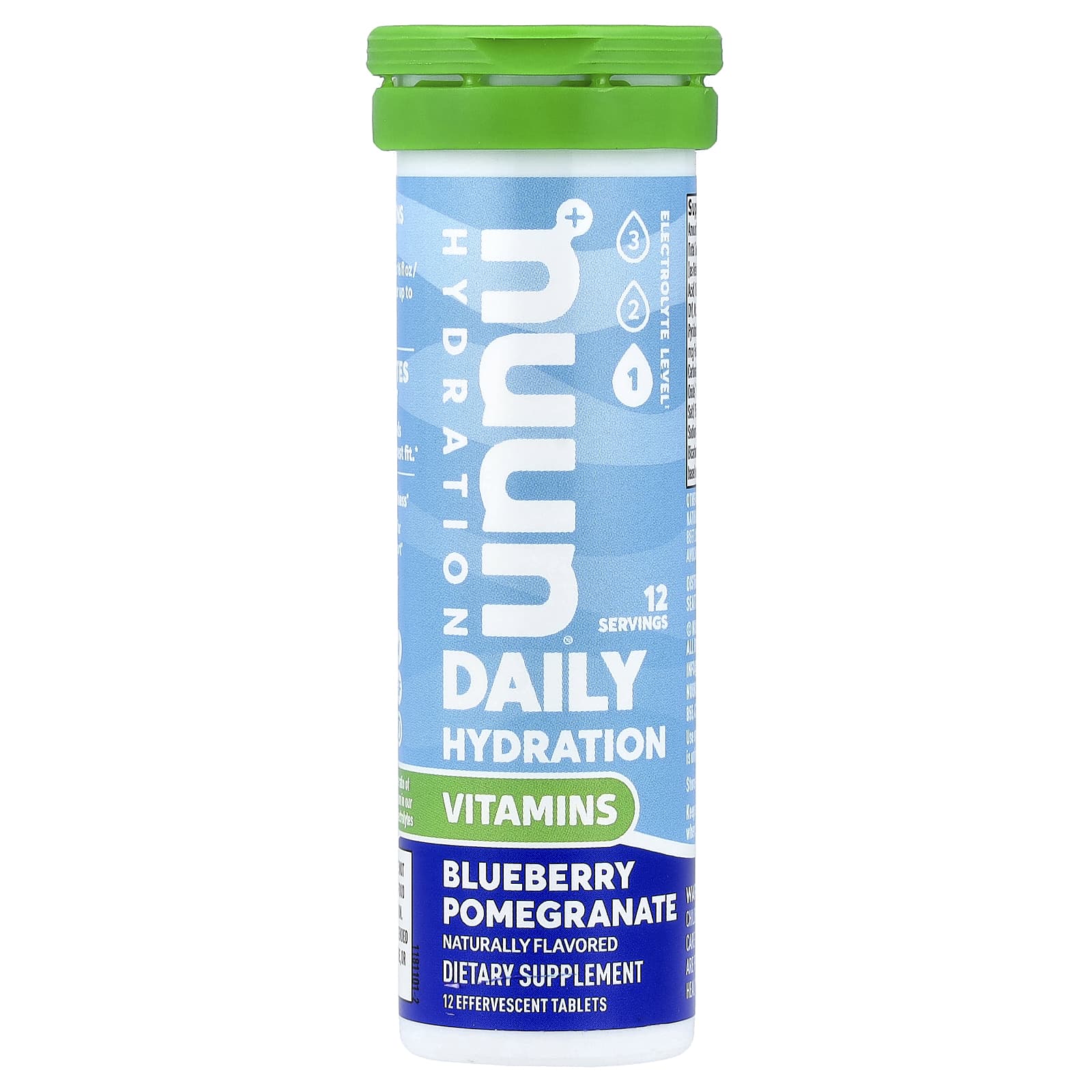
Nuun · tablets

Hydration Blueberry Pomegranate

At the recorded label maximum: 2 tablets per day

Add to my list
Per day$1.12

At the label maximum of 2 tablets a day.

Per pack$6.70

12 tablets · Vitacost · checked 22 Oct 2026. Delivery is not included.

Per tablet$0.56

Pack price divided by the number of tablets in the pack.

Composition

Amounts at the recorded label maximum. Directions may give a range.

Vitamin Aas Retinyl Acetate
About this formretinol / retinyl esters. Reference level V0; no form is called “better” here.
225 mcgat the recorded label maximum (2 tablets × 112.5 mcg)112.5 mcg per tablet · calculated from 112.5 mcg per 1 tablet
8% of 3,000 mcg — US upper limit for adults, National Academiesfrom food and supplements, adults · food is not counted here · a reference value, not a legal limit
Vitamin Cas Ascorbic Acid
20 mgat the recorded label maximum (2 tablets × 10 mg)10 mg per tablet · calculated from 10 mg per 1 tablet
1% of 2,000 mg — US upper limit for adults, National Academiesfrom food and supplements, adults · food is not counted here · a reference value, not a legal limit
Vitamin Das Ergocalciferol
About this formvitamin D2 (ergocalciferol). Reference level V0; no form is called “better” here.
10 mcgat the recorded label maximum (2 tablets × 5 mcg)5 mcg per tablet · calculated from 5 mcg per 1 tablet
10% of 100 mcg — US upper limit for adults, National Academiesfrom food and supplements, adults · food is not counted here · a reference value, not a legal limit
Vitamin Eas D-Alpha-Tocopherol
About this formd-alpha-tocopherol (natural). 1 IU natural = 0.67 mg; synthetic 1 IU = 0.45 mg. Reference level V0; no form is called “better” here.
4 mgat the recorded label maximum (2 tablets × 2 mg)2 mg per tablet · calculated from 2 mg per 1 tablet
<1% of 1,000 mg — US upper limit for adults, National Academiesvitamin E from supplements, adults · a reference value, not a legal limit
Vitamin B6as Pyridoxal 5-Phosphate
500 mcgat the recorded label maximum (2 tablets × 250 mcg)250 mcg per tablet · calculated from 250 mcg per 1 tablet
<1% of 100 mg — US upper limit for adults, National Academiesfrom food and supplements, adults · food is not counted here · a reference value, not a legal limit
Folateas folic acid 160 mcg · 272 mcg DFE
About this formfolic acid. Reference level V0; no form is called “better” here.
What is DFE?DFE — dietary folate equivalents: one scale for folic acid and food folate. The body absorbs more folic acid, so it counts for more.
160 mcgat the recorded label maximum (2 tablets × 80 mcg)
16% of 1,000 mcg — US upper limit for adults, National Academiesfolate from supplements, adults · a reference value, not a legal limit
Calciumas Calcium Carbonate
About this formcalcium carbonate — about 40% of the compound is calcium itself. Most calcium per gram; take with food. Reference level V0; no form is called “better” here.
30 mgat the recorded label maximum (2 tablets × 15 mg) · as calcium itself15 mg per tablet · calculated from 15 mg per 1 tablet
2% of 2,000 mg — US upper limit for adults, National Academies2,500 mg (ages 19–50) · 2,000 mg (51 and older) · from food and supplements, adults · food is not counted here · a reference value, not a legal limit
Magnesiumas Magnesium Oxide
About this formmagnesium oxide — about 60% of the compound is magnesium itself. Most magnesium per gram, cheapest, less well absorbed. Reference level V0; no form is called “better” here.
30 mgat the recorded label maximum (2 tablets × 15 mg) · as magnesium itself15 mg per tablet · calculated from 15 mg per 1 tablet
9% of 350 mg — US upper limit for adults, National Academiesmagnesium from supplements, adults · a reference value, not a legal limit
Chlorideas Himalayan Pink Sea Salt
150 mgat the recorded label maximum (2 tablets × 75 mg)75 mg per tablet · calculated from 75 mg per 1 tablet
No limit on file for the United States
Limits in other countries (1)Croatia
Potassiumas Potassium Bicarbonate
300 mgat the recorded label maximum (2 tablets × 150 mg)150 mg per tablet · calculated from 150 mg per 1 tablet
No US upper limitNational Academies: not determined — too little data on harm
Limits in other countries (11)Austria, Belgium, Croatia, Denmark, Eurasian Economic Union (EAEU), France, Germany, Luxembourg, Malta, Poland, Switzerland

Where no limit is shown, none is set or on file for the United States. That is not the same as having no maximum.

Manufacturer's directions

Directions for useAdd 1 tablet to 16 fl oz/475 ml of water up to 2 times a day.

Other ingredients on the label

Dextrose, Citric Acid, Natural Flavors, Other Natural Flavors, Beet Juice, Stevia Leaf Extract, Avocado Oil, Riboflavin

Limits in other countries
CountryVitamin AVitamin CVitamin DVitamin E
United States3,000 mcgreference, not a law · 8%2,000 mgreference, not a law · 1%100 mcgreference, not a law · 10%1,000 mgreference, not a law · 0%
Austria900 mcgrecommendation · 25%500 mgrecommendation · 4%20 mcgrecommendation · 50%24 mgrecommendation · 17%
Belgium1,200 mcglaw · 19%1,000 mglaw · 2%75 mcglaw · 13%39 mglaw · 10%
Croatia1,500 mcglaw · 15%800 mglaw · 3%10 mcglaw · 100%200 mglaw · 2%
Cyprus2,300 mcglaw · 10%2,000 mglaw · 1%10 mcglaw · 100%800 mglaw · 1%
Denmark—not on file1,000 mgrecommendation · 2%95 mcgrecommendation · 11%291 mgrecommendation · 1%
EAEU3,000 mcglaw · 8%900 mglaw · 2%15 mcglaw · 67%150 mglaw · 3%
Estonia3,000 mcgrecommendation · 8%—not on file100 mcgrecommendation · 10%300 mgrecommendation · 1%
Finland3,000 mcgrecommendation · 8%—not on file100 mcgrecommendation · 10%300 mgrecommendation · 1%
France800 mcglaw · 28%180 mglaw · 11%5 mcglaw · 200% · above30 mglaw · 13%
Germany200 mcgrecommendation · 113% · above250 mgrecommendation · 8%20 mcgrecommendation · 50%30 mgrecommendation · 13%
Ireland3,000 mcgrecommendation · 8%2,000 mgrecommendation · 1%100 mcgrecommendation · 10%300 mgrecommendation · 1%
Italy1,200 mcgrecommendation · 19%1,000 mgrecommendation · 2%50 mcgrecommendation · 20%60 mgrecommendation · 7%
Luxembourg1,200 mcglaw · 19%1,000 mglaw · 2%50 mcglaw · 20%18 mglaw · 22%
Malta1,500 mcgrecommendation · 15%1,000 mgrecommendation · 2%25 mcgrecommendation · 40%800 IUlaw · not compared
Netherlands1,200 mcglaw · 19%—not on file75 mcglaw · 13%—not on file
Norway—not on file1,000 mglaw · 2%80 mcglaw · 13%250 mglaw · 2%
Poland800 mcgrecommendation · 28%1,000 mgrecommendation · 2%50 mcgrecommendation · 20%250 mgrecommendation · 2%
Switzerland1,360 mcglaw · 17%750 mglaw · 3%70 mcglaw · 14%205 mglaw · 2%

Maximum amounts per daily dose of a food supplement, as each country sets them; the share is the daily amount on the label against that maximum. Law = legally binding; recommendation = an authority's recommended maximum, not binding; reference = the U.S. upper intake level for adults from all sources (National Academies), not a legal limit. Verification level V0 · 6 more ingredients have limits on file · Report an error

About the ingredients

Ingredient information

Ingredient guideVitamin AVitamin A is the name for a group of fat-soluble compounds, mainly retinol and retinyl esters. Animal foods contain it as preformed vitamin A; plants contain carotenoids, some of which the body converts into it. Supplements contain retinyl acetate, retinyl palmitate, beta-carotene or a combination. Amounts are given in mcg RAE; older labels used IU.Read moreShow less
Terms and sources
fat-soluble
They dissolve in fat, not in water. NIH Office of Dietary Supplements.
carotenoids
Provitamin A carotenoids: beta-carotene, alpha-carotene and beta-cryptoxanthin. NIH Office of Dietary Supplements.
mcg RAE
Micrograms of retinol activity equivalents. The unit counts how much retinol each form gives the body.

Vitamin A in the body

Vitamin A is part of rhodopsin, the protein in the retina that responds to light. It is needed for normal vision. It is also involved in immune function, cell communication, growth and development, and reproduction.

Terms and sources
rhodopsin
The light-sensitive pigment of the eye's rod cells, which see in dim light. NIH Office of Dietary Supplements; Linus Pauling Institute.
normal vision
NIH Office of Dietary Supplements. It is also needed for the normal surface of the eye.
cell communication
NIH Office of Dietary Supplements. Vitamin A takes part in the growth and specialization of cells.

The body turns retinol into retinal and retinoic acid, the two main active forms. Most of the body's vitamin A is stored in the liver as retinyl esters. Blood retinol levels stay steady until the stores in the liver are almost used up.

Terms and sources
retinoic acid
It switches genes on and off; Linus Pauling Institute counts more than 500 genes that respond to it.
retinyl esters
Retinol joined to a fatty acid, such as retinyl palmitate. NIH Office of Dietary Supplements.
stay steady
NIH Office of Dietary Supplements. So a blood test is not always a reliable guide to the stores. See Green 2016 below: normal blood retinol with low stores.

Plants make hundreds of carotenoids; only about 10% of them can be converted to retinol. The body converts beta-carotene into vitamin A in the gut, through an enzyme. Lutein, zeaxanthin and lycopene are carotenoids that the body does not convert into vitamin A.

Terms and sources
about 10%
Linus Pauling Institute.
an enzyme
Beta-carotene monooxygenase type 1 (BCMO1). Conversion rates may vary with genes. NIH Office of Dietary Supplements.
does not convert
NIH Office of Dietary Supplements calls them non-provitamin A carotenoids.

Information, not a prescription. Do not start, stop or combine supplements or medicines on your own.

Ingredient guideVitamin CVitamin C, also called L-ascorbic acid, is a water-soluble vitamin. Most animals make vitamin C in the body; humans cannot and get it from food. Fruits and vegetables such as peppers, citrus fruits and kiwifruit are the main sources. Supplements contain it as ascorbic acid or as mineral salts such as sodium and calcium ascorbate.Read moreShow less
Terms and sources
water-soluble
It dissolves in water, not in fat. NIH Office of Dietary Supplements.

Vitamin C in the body

Vitamin C is needed to make collagen, carnitine and some neurotransmitters. It is also an antioxidant and can return used vitamin E to its active form. It is needed for normal immune function. It increases the absorption of iron from plant foods.

Terms and sources
collagen
A protein that holds together connective tissue, such as skin, tendons and blood vessels. NIH Office of Dietary Supplements.
carnitine
A substance cells need to get energy from fat. Linus Pauling Institute.
neurotransmitters
Chemical messengers between nerve cells.
antioxidant
A substance that limits damage from free radicals, reactive molecules made in cells.
iron from plant foods
Nonheme iron, the only form of iron in plant foods. NIH Office of Dietary Supplements.

An adult body holds from about 300 mg to about 2 g of vitamin C. White blood cells, the eyes, the adrenal and pituitary glands and the brain hold the most. Cells hold vitamin C in millimolar concentrations, blood plasma in micromolar concentrations. At 100 mg a day or more, cells appear to be saturated.

Terms and sources
about 300 mg
The lower figure is for very low intake. NIH Office of Dietary Supplements.
adrenal and pituitary glands
Small glands that make hormones: the adrenals sit above the kidneys, the pituitary below the brain.
millimolar
Thousandths of a mole per liter; micromolar means millionths. NIH Office of Dietary Supplements.
saturated
Holding as much as they take up. Above 200 mg a day, blood plasma levels rise little more.

The body absorbs about 70–90% of vitamin C at 30–180 mg a day. Above 1 g a day, less than 50% is absorbed, and unused vitamin C leaves in urine.

Terms and sources
less than 50%
Summary by the NIH Office of Dietary Supplements. Absorption in the gut runs through a dose-dependent transporter protein.

Information, not a prescription. Do not start, stop or combine supplements or medicines on your own.

Ingredient guideVitamin DVitamin D is a fat-soluble vitamin. The skin makes it when ultraviolet light from the sun reaches it, and a few foods contain it. Supplements contain one or both of its two main forms: vitamin D3 and vitamin D2. Labels state the amount in micrograms (mcg), international units (IU) or both.Read moreShow less
Terms and sources
fat-soluble
It dissolves in fat, not in water. NIH Office of Dietary Supplements.

Vitamin D in the body

Vitamin D from the sun, food and supplements is inactive at first. The liver turns it into 25-hydroxyvitamin D, the form a blood test measures. Mainly the kidneys then make the active form.

Terms and sources
25-hydroxyvitamin D
Also called calcidiol or 25(OH)D. Results come in nmol/L or ng/mL; 50 nmol/L equals 20 ng/mL.
active form
1,25-dihydroxyvitamin D, also called calcitriol.

Vitamin D is needed for normal absorption of calcium from the gut and for normal bones. It is also needed for normal muscle and immune function. Many tissues in the body carry vitamin D receptors.

Terms and sources
vitamin D receptors
Proteins in cells that respond to the active form of vitamin D. NIH Office of Dietary Supplements.

Information, not a prescription. Do not start, stop or combine supplements or medicines on your own.

Ingredient guideVitamin EVitamin E is the name for eight fat-soluble compounds: four tocopherols and four tocotrienols. Alpha-tocopherol is the only form recognized to meet human needs for vitamin E. Nuts, seeds and vegetable oils are rich food sources. Supplements contain natural (d-) or synthetic (dl-) alpha-tocopherol, often as an acetate or succinate.Read moreShow less
Terms and sources
fat-soluble
They dissolve in fat, not in water. NIH Office of Dietary Supplements.
acetate or succinate
Esters: alpha-tocopherol joined to acetic or succinic acid, which keeps it longer in storage.

Vitamin E in the body

Vitamin E is an antioxidant that stops a chain reaction of fat oxidation in cell membranes. Vitamin C can return used vitamin E to its active form. Vitamin E is also involved in immune function; studies in cells show roles in cell signaling.

Terms and sources
chain reaction of fat oxidation
Free radicals damage fats in cell membranes, and each damaged fat can damage the next. Alpha-tocopherol stops this chain. Linus Pauling Institute.
Vitamin C
Linus Pauling Institute.
studies in cells
Mainly test-tube studies of cells. NIH Office of Dietary Supplements.

After absorption, the liver sends alpha-tocopherol back into the blood and breaks down the other forms. So blood and cells hold less of the other forms than of alpha-tocopherol.

Terms and sources
sends alpha-tocopherol back
Through the alpha-tocopherol transfer protein in the liver. NIH Office of Dietary Supplements.

In one study with labeled vitamin E, healthy women absorbed about 55% of a dose. Vitamin E takes 9–12 hours to pass from a meal into the blood. The liver replaces the whole pool of alpha-tocopherol in blood plasma every day.

Terms and sources
about 55%
Linus Pauling Institute, citing Traber 2019. The dose was taken with a liquid meal. The rest left in the stool. A published correction to that article added missing supplementary files only.
9–12 hours
It travels from the gut in fat particles called chylomicrons; a later meal speeds this up. Linus Pauling Institute.
every day
Linus Pauling Institute.

Information, not a prescription. Do not start, stop or combine supplements or medicines on your own.

Ingredient guideVitamin B6Vitamin B6 is the name for six related water-soluble compounds: pyridoxine, pyridoxal, pyridoxamine and their phosphate forms. Its main active form, pyridoxal 5'-phosphate (PLP), is a helper molecule for more than 100 enzymes. Supplements most often contain pyridoxine hydrochloride; some contain PLP, also called P5P. Vitamin B6 is also in multivitamins and B complex products.Read moreShow less
Terms and sources
water-soluble
They dissolve in water, not in fat. NIH Office of Dietary Supplements.
helper molecule
A coenzyme: a small molecule an enzyme needs to work. Linus Pauling Institute.
pyridoxine hydrochloride
NIH Office of Dietary Supplements names it the most common form in supplements.

Vitamin B6 in the body

Vitamin B6 takes part in more than 100 enzyme reactions, mostly in the metabolism of protein. It is involved in making neurotransmitters, the chemical messengers of the nervous system. It is also involved in immune function and in making hemoglobin, the oxygen carrier in red blood cells.

Terms and sources
more than 100 enzyme reactions
NIH Office of Dietary Supplements. It also works in the metabolism of carbohydrates and fats.
neurotransmitters
Serotonin, dopamine and GABA among them. Linus Pauling Institute.
immune function
NIH Office of Dietary Supplements.

The human body cannot make vitamin B6, so it must come from food. PLP is a helper in over 4% of all enzyme reactions. Much of the body's PLP sits in muscle, bound to the enzyme that releases glucose from stored glycogen.

Terms and sources
cannot make vitamin B6
Linus Pauling Institute.
over 4%
Linus Pauling Institute.
the enzyme
Glycogen phosphorylase. Linus Pauling Institute.

Blood PLP is the most common measure of vitamin B6 status. Levels above 30 nmol/L have been the traditional sign of enough vitamin B6 in adults.

Terms and sources
Blood PLP
Plasma pyridoxal 5'-phosphate. NIH Office of Dietary Supplements.
30 nmol/L
NIH Office of Dietary Supplements.

Information, not a prescription. Do not start, stop or combine supplements or medicines on your own.

Ingredient guideFolateFolate is a water-soluble B vitamin, also called vitamin B9. It occurs naturally in many foods. Folic acid is the synthetic form used in most supplements and in fortified foods. Some supplements contain L-methylfolate or folinic acid instead. Folate is also in multivitamins, prenatal vitamins and B complex products.Read moreShow less
Terms and sources
water-soluble
It dissolves in water, not in fat. NIH Office of Dietary Supplements.
synthetic form
NIH Office of Dietary Supplements: the fully oxidized form of the vitamin.
L-methylfolate
Also called 5-MTHF or L-5-methyltetrahydrofolate. NIH Office of Dietary Supplements.
prenatal vitamins
NIH Office of Dietary Supplements lists these product types.

Folate in the body

Folate is a helper molecule that moves single carbon units between other molecules. It is needed to make DNA and RNA and to process amino acids. Folate and vitamin B12 work in the same step that turns homocysteine into the amino acid methionine.

Terms and sources
helper molecule
A coenzyme. NIH Office of Dietary Supplements. The name comes from foliage: green leafy vegetables are rich in folate, Linus Pauling Institute.
DNA and RNA
NIH Office of Dietary Supplements: folate is required for proper cell division.
same step
Methionine synthase needs both folate, as 5-methyltetrahydrofolate, and vitamin B12. Linus Pauling Institute.

Folic acid is not active until the body converts it into natural folates. The main form of folate in blood plasma is L-methylfolate. When the converting enzyme is at capacity, unconverted folic acid appears in the blood. A US national survey found unconverted folic acid in 96% of blood samples.

Terms and sources
not active
Linus Pauling Institute: folic acid "has no biological activity unless converted into folates".
main form
NIH Office of Dietary Supplements.
converting enzyme
Dihydrofolate reductase. Its activity varies greatly between people. NIH Office of Dietary Supplements.
96% of blood samples
Serum samples, NHANES 2007–2008, people aged 1 year and older. Linus Pauling Institute.

The body holds about 15 to 30 mg of folate, about half of it in the liver. Gut bacteria also make folate; how much of it the body uses is unclear. Red blood cell folate reflects intake over the longer term; folate in the blood fluid reflects recent intake. Blood homocysteine is a common marker of folate status, though vitamin B12 and other factors also affect it.

Terms and sources
15 to 30 mg
NIH Office of Dietary Supplements.
Gut bacteria
NIH Office of Dietary Supplements: folate made in the colon can be absorbed there.
Red blood cell folate
NIH Office of Dietary Supplements: above 140 ng/mL indicates adequate status. For serum folate, the cutoff is 3 ng/mL.
common marker
NIH Office of Dietary Supplements calls it a functional indicator that is not highly specific.

A common gene variant, MTHFR 677C>T, makes the enzyme that forms L-methylfolate less active. Depending on the population, 3% to 32% of people carry two copies.

Terms and sources
MTHFR 677C>T
Linus Pauling Institute. With two copies of the variant, enzyme activity is about 65% lower; with one copy, about 30% lower.
3% to 32%
20% to 53% carry one copy. Linus Pauling Institute.

Information, not a prescription. Do not start, stop or combine supplements or medicines on your own.

Ingredient guideCalciumCalcium is the most abundant mineral in the human body. An adult body holds about 1.2–1.4 kg of it, almost all in bones and teeth. Milk, yogurt and cheese are rich sources. Supplements contain calcium as part of a compound, most often calcium carbonate or calcium citrate.Read moreShow less
Terms and sources
1.2–1.4 kg
About 1,200 g in women and 1,400 g in men. NIH Office of Dietary Supplements.

Calcium in the body

About 99% of the body's calcium is in bones and teeth. The other 1% is in the blood and soft tissues. This small part is needed for normal muscle function, nerve signaling, blood clotting and hormone release. It also takes part as blood vessels tighten and relax.

Terms and sources
bones and teeth
There it sits in hydroxyapatite, a mineral of calcium and phosphate. Linus Pauling Institute; NIH Office of Dietary Supplements.

The body keeps blood calcium in a narrow range, about 8.8–10.4 mg/dL. When intake is low, it draws calcium from bone to hold that range. A blood test therefore does not show how much calcium a person gets. Bone is rebuilt all the time; teeth are not. Vitamin D is needed to absorb calcium in the gut.

Terms and sources
8.8–10.4 mg/dL
2.2–2.6 mmol/L, total calcium in serum in healthy people. NIH Office of Dietary Supplements.
absorb calcium in the gut
Vitamin D is needed for active transport, the main route when intake is low. NIH Office of Dietary Supplements.

Information, not a prescription. Do not start, stop or combine supplements or medicines on your own.

Ingredient guideMagnesiumMagnesium is an essential mineral: the human body cannot make it and gets it from food and drinks. An adult body holds about 25 g, mostly in bone. Supplements add to it, in forms such as magnesium citrate, glycinate and oxide.Read moreShow less

Magnesium in the body

Inside cells, magnesium is the second most common positively charged mineral, after potassium. It takes part in more than 300 enzyme systems. It is needed for normal muscle and nerve function, energy metabolism, protein synthesis, and normal bones and teeth.

Terms and sources
positively charged mineral
a cation. de Baaij et al., Physiological Reviews, 2015 (PMID 25540137).
enzyme systems
Enzymes are proteins that run chemical reactions in cells. The 300 figure is from NIH ODS. A 2015 review puts the number of enzyme reactions at over 600.
energy metabolism
How cells turn food into usable energy.

About 50–60% of the body's magnesium sits in bone. Most of the rest is in muscle and other soft tissue. Less than 1% is in the blood. A blood test sees only this small part.

Terms and sources
in the blood
In serum. The usual range is 0.75–0.95 mmol/L.

Information, not a prescription. Do not start, stop or combine supplements or medicines on your own.

Need help choosing?

Choose the option that suits you.

Quick selection

I know my goal

$5

1–2 minutes · a few questions with fixed answers

One goal. Up to three products. Set a budget per day if you like.

Product checks
form and amount on the label, plus shop prices
Daily schedule
what to take, when, how much
Totals and limits
next to the upper limit
Reasons & sources
for each product
Prices and shops
plus food and habits
Progress
what to track, when to see a doctor

Complete the questionnaire before you pay. If no product fits any of your goals, you won’t be charged.

Order · $5View example

Full selection

I have several goals

$15

5–7 minutes · questionnaire with fixed answers

Up to three goals in one set. Where two goals overlap, one product is used for both.

Product checks
form and amount on the label, plus shop prices
Daily schedule
what to take, when, how much
Totals and limits
next to the upper limit
Reasons & sources
for each product
Prices and shops
plus food and habits
Progress
what to track, when to see a doctor

Complete the questionnaire before you pay. If no product fits any of your goals, you won’t be charged.

Order · $15View example

Expert review

I want a person to look at my supplements

$50

Written review within 48 hours of your completed questionnaire

An expert reviews your supplement list and questionnaire.

Written review
duplicates, limits, forms
Detailed questionnaire
supplements, medicines, history
Optional uploads
supplement-label photos or documents relevant to your review
Your notes
your priorities and questions
Follow-up questions
in writing, when needed
Next steps
points to discuss with your doctor

Complete the questionnaire before you pay.

Order · $50View example
Sources, label & certificates

Label record

Copied from the NIH label database (DSLD 328772) · not yet compared with the label · checked 19 Oct 2026 · Report an error

The United States has no pre-market registration for supplements.
Label on file in the NIH Dietary Supplement Label Database
checked 19 Oct 2026source: NIH DSLDReport an error

Barcode 8 11660 02166 9

Third-party certificates

No third-party certificate on file for this product.

Information, not a prescription. Do not start, stop or combine supplements or medicines on your own. If you have a health condition, are pregnant or breastfeeding, take medicines, or are under 18, talk to a doctor or pharmacist first.

Photo credits

Image: © Nuun. Shown to identify the product. Source: iherb.com

Rights holders can ask us to remove an image or send official product photos: info@verateca.com.

Product photo

Nuun Hydration Blueberry Pomegranate — enlarged pack