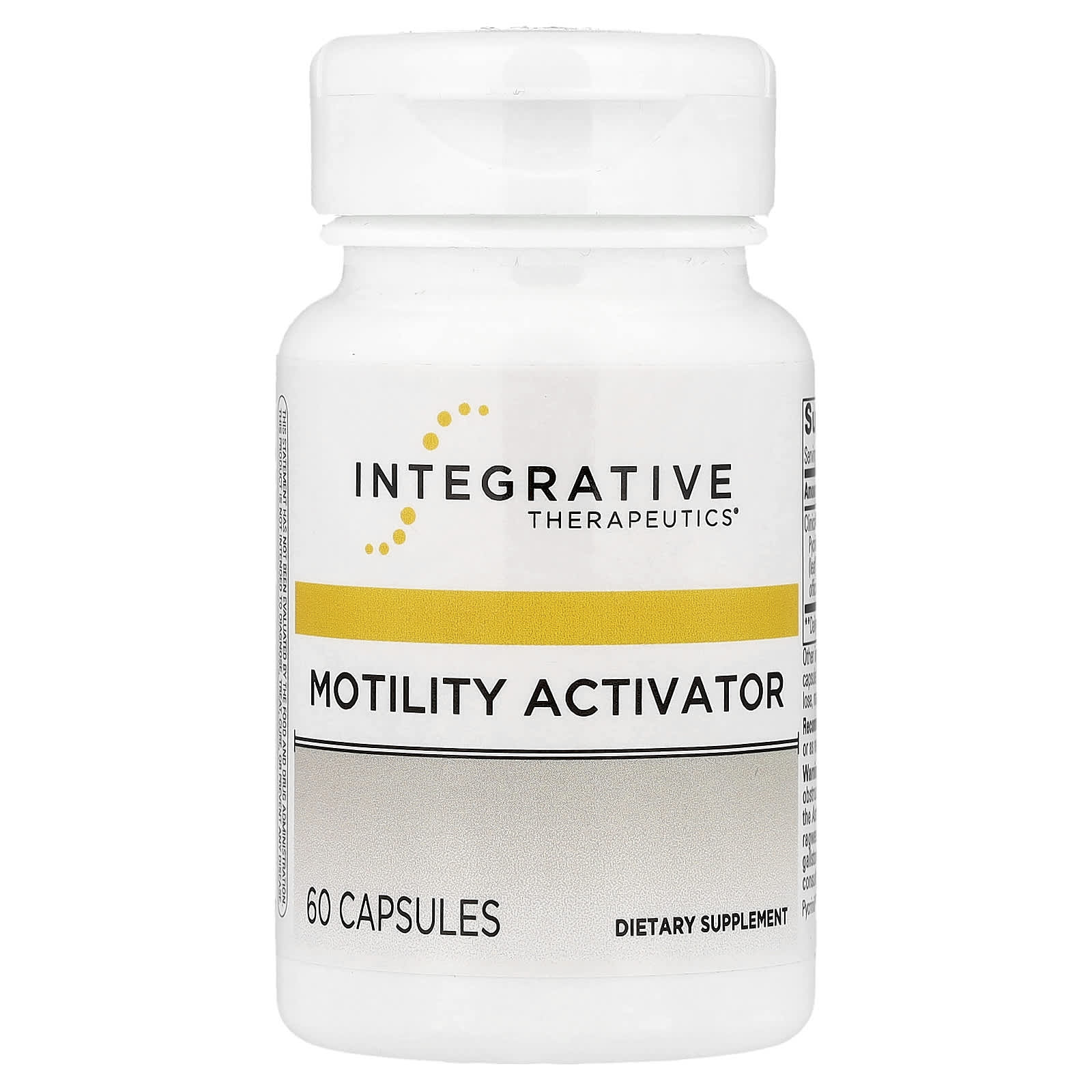
Integrative Therapeutics · capsules

Motility Activator

At the recorded label maximum: 2 capsules per day

Add to my list
Per day$1.43

At the label maximum of 2 capsules a day.

Per pack$43.00

60 capsules · Vitacost · checked 23 Oct 2026. Delivery is not included.

Per capsule$0.72

Pack price divided by the number of capsules in the pack.

Composition

Amounts at the recorded label maximum. Directions may give a range.

200 mgat the recorded label maximum (2 capsules × 100 mg)100 mg per capsule · calculated from 100 mg per 1 capsule
No limit on file for the United StatesNone on file in any country
40 mgat the recorded label maximum (2 capsules × 20 mg)20 mg per capsule · calculated from 20 mg per 1 capsule
No limit on file for the United StatesNone on file in any country

Where no limit is shown, none is set or on file for the United States. That is not the same as having no maximum.

Manufacturer's directions

Recommendation: Adults take 1 capsule twice daily; or as recommended by a healthcare professional.

Other ingredients on the label

Dicalcium Phosphate (DCP), Hypromellose, Cellulose, Sodium Croscarmellose, Magnesium Stearate (Mg Stearate), Silica

Limits in other countries

No dose limits on file for the ingredients of this product.

About the ingredients

Ingredient information

Ingredient guideArtichoke leaf extractArtichoke leaf extract is made from the leaves of the globe artichoke, Cynara cardunculus, also named Cynara scolymus. As a vegetable, people eat the immature flower head, not the leaves. Supplements contain leaf extract in capsules and tablets, leaf powder or liquid extracts, alone or in blends.Read moreShow less
Terms and sources
Cynara cardunculus
Botanists now place globe artichoke, cultivated cardoon and wild cardoon in this one species. Sonnante et al., Annals of Botany, 2007.
immature flower head
Also called the capitulum or head. Sonnante et al., Annals of Botany, 2007.

Artichoke leaf extract in the body

Artichoke leaf extract is not a nutrient, and the body has no daily requirement for it. Globe artichoke belongs to the Asteraceae family and comes from the Mediterranean basin. Its wild ancestor is wild cardoon; cultivated cardoon, the same species, is grown for its leaf stalks. The edible portion is typically only 30–40% of the plant's biomass.

Terms and sources
Asteraceae family
Sonnante et al., Annals of Botany, 2007.
wild ancestor
Wild cardoon is the progenitor of both crops. Sonnante et al., Annals of Botany, 2007.
30–40% of the plant's biomass
The stems and leaves are discarded or used as animal feed or fertilizer. Olas, Nutrients, 2024. The review summarizes earlier work.

The main phenolic compounds of the leaf extract are caffeoylquinic acids and flavonoids. Cynarin is one of the dicaffeoylquinic acids. Of all parts of the plant, the leaves hold the most luteolin. Cynarin rises as the plant grows, from 0.01% to 0.05% of dry matter. Leaves and stems also hold bitter compounds called sesquiterpenes, such as cynaropicrin.

Terms and sources
caffeoylquinic acids
Mono- and dicaffeoylquinic acids, such as chlorogenic acid and cynarin, and caffeic acid. Wittemer et al., Phytomedicine, 2005.
flavonoids
Such as luteolin-7-O-glucoside. Wittemer et al., Phytomedicine, 2005.
dicaffeoylquinic acids
Sonnante et al., Annals of Botany, 2007.
the most luteolin
Olas, Nutrients, 2024.
0.01% to 0.05%
Olas, Nutrients, 2024. The review summarizes earlier analyses.
sesquiterpenes
The review says they are believed to taste very bitter. Olas, Nutrients, 2024.

In 14 healthy volunteers, the extract's own caffeoylquinic acids and luteolin glycosides were not found in blood or urine. Instead, blood and urine held their breakdown products, such as caffeic, ferulic and isoferulic acid. These peaked within 1 hour; dihydrocaffeic and dihydroferulic acid peaked only after 6–7 hours. Luteolin appeared only in bound forms, with a peak within half an hour. In another study of 10 volunteers, urine held ferulic, isoferulic, dihydroferulic and vanillic acid after the extract.

Terms and sources
14 healthy volunteers
Each took two different leaf extracts, one after the other. Wittemer et al., Phytomedicine, 2005. The first author's affiliation is Lichtwer Pharma AG.
breakdown products
All but dihydroferulic acid were present as sulfates or glucuronides. Wittemer et al., Phytomedicine, 2005.
6–7 hours
The authors read this as two different routes of breakdown. Wittemer et al., Phytomedicine, 2005.
bound forms
As sulfate or glucuronide, not as the glucoside in the extract and not as free luteolin. Wittemer et al., Phytomedicine, 2005.
10 volunteers
The abstract says three capsules of 320 mg artichoke extract, given every 4 hours (at 0, 4 and 8 hours). It does not say which part of the plant was used. Rechner et al., Free Radical Research, 2001.

Neither the US complementary health center (NCCIH) nor the NIH Office of Dietary Supplements has a fact sheet on artichoke. So the safety text on this page comes from the EU herbal medicine monograph.

Terms and sources
a fact sheet
Artichoke is not in NCCIH's Herbs at a Glance list or in the ODS list of fact sheets. National Center for Complementary and Integrative Health; NIH Office of Dietary Supplements.

The European Medicines Agency's EU herbal medicine monograph on artichoke leaf covers it as a traditional herbal medicine. For these herbal medicines, it states for children: "The use in children under 12 years of age is not recommended (see section 4.4 ‘Special warnings and precautions for use’)." On how long to use it, it states: "If the symptoms persist longer than 2 weeks during the use of the medicinal product, a doctor or a qualified health care practitioner should be consulted." Under contraindications, it lists: "Hypersensitivity to the active substance or to plants of the Asteraceae family (Compositae)." It also lists: "Obstruction of bile duct, cholangitis, liver disease, gallstones and any other biliary disorders that require medical supervision and advice." Under special warnings, it adds: "The use in children under 12 years of age has not been established due to lack of adequate data." Under interactions with other medicines, it states: "None reported." The monograph also states: "Safety during pregnancy and lactation has not been established. In the absence of sufficient data, the use during pregnancy and lactation is not recommended." It adds: "No fertility data available." On driving, it states: "No studies on the effect on the ability to drive and use machines have been performed." As side effects, it notes: "Slight diarrhoea with abdominal spasm, epigastric complaints like nausea, and heartburn have been reported. The frequency is not known." It adds: "Allergic reactions may occur. The frequency is not known." And: "If other adverse reactions not mentioned above occur, a doctor or a qualified health care practitioner should be consulted." On taking too much, it states: "No case of overdose has been reported." On laboratory safety data, it states: "Not required as per Article 16c(1)(a)(iii) of Directive 2001/83/EC, unless necessary for the safe use of the product." It adds: "Adequate tests on reproductive toxicity, genotoxicity and carcinogenicity have not been performed." In a later periodic review, the EMA committee found no new data that called for a revision of the monograph.

Terms and sources
EU herbal medicine monograph
Cynara cardunculus L. (syn. Cynara scolymus L.), folium. The quotes below are from it. EU herbal medicine monograph on artichoke leaf, European Medicines Agency.
contraindications
Reasons not to use the product, in medicine labeling terms. EU herbal medicine monograph on artichoke leaf, European Medicines Agency.
a later periodic review
Reports in the EU safety database were non-serious. The committee found them covered by the side-effect section. It notes a rat study where rosuvastatin blood levels were lower with the extract. The committee did not find this a reason to revise. Addendum to the assessment report on artichoke leaf, European Medicines Agency.

Information, not a prescription. Do not start, stop or combine supplements or medicines on your own.
Ingredient guideGingerGinger is the underground stem, or rhizome, of the plant Zingiber officinale. The plant is native to the warm parts of Asia. Its rhizome is used in food and in supplements. Supplements contain ginger as root powder in capsules, extracts, liquid extracts, tea, lozenges and chews.Read moreShow less
Terms and sources
rhizome
NCCIH calls the rhizome an underground stem. NCCIH, Ginger: Usefulness and Safety.
warm parts of Asia
NCCIH, Ginger: Usefulness and Safety.

Ginger in the body

Ginger is not a nutrient, and the body has no daily requirement for it. Trials in adults without a diagnosis measure things such as muscle soreness after exercise and stomach emptying.

Ginger root holds about 1–3% volatile oils and a group of pungent compounds. In fresh root, the most abundant pungent compounds are gingerols, mainly 6-gingerol. Shogaols, a dehydrated form of gingerols, are found mainly in dried and heat-treated root. Extract makers state gingerols, sometimes with shogaols, to standardize their extracts.

Terms and sources
pungent compounds
Mainly gingerols and shogaols. Zick et al., 2008.
a dehydrated form
Fresh root holds only small amounts of shogaols. Zick et al., 2008.
standardize
To keep the amount of chosen compounds the same from batch to batch. In one study, an extract standardized to 5% gingerols held 2.15% 6-gingerol by HPLC. Zick et al., 2008.

In 27 healthy adults, one dose of up to 2 g of extract left no free gingerols in blood. They appeared in blood in bound forms, mostly glucuronides, from 30 minutes after the dose. These bound forms could no longer be detected in blood by 4 hours in all but one person. Side effects in that study were all graded mild, mainly burping, a burning feeling in the chest and stomach upset.

Terms and sources
27 healthy adults
Single doses from 100 mg to 2 g of an extract with 5% gingerols. Each new group got a higher dose; there was no comparison group. Zick et al., 2008.
glucuronides
Gingerols and shogaols joined to glucuronic acid. A smaller part was bound to sulfate. Zick et al., 2008.
all but one person
One person on 2 g still had bound 6-gingerol at 8 hours. Zick et al., 2008.
graded mild
No side effect was above grade 1 on a standard toxicity scale. Zick et al., 2008.

NCCIH notes: “Ginger has been used safely in many research studies where it was taken orally (by mouth) as a dietary supplement.” It adds: “Ginger products may also be safe for topical use.” NCCIH lists side effects: “Ginger can have side effects such as abdominal discomfort, heartburn, diarrhea, and mouth and throat irritation when taken orally.” NCCIH advises: “If you take any type of medicine, talk with your health care provider before using ginger or any other herbal products; some herbs and medicines interact in harmful ways.” NCCIH also writes: “The use of ginger dietary supplements during pregnancy may be safe.” It continues: “As with all herbal supplements, if you’re considering using ginger while pregnant, consult your health care provider.” NCCIH adds: “Little is known about whether it’s safe to use ginger while breastfeeding.”

Terms and sources
NCCIH notes
NCCIH, Ginger: Usefulness and Safety.

In the cycling trial below, at most 2 of 30 cyclists reported gas, burping or fullness with either drink. In the 2-week powder trial below, no moderate or severe side effects were reported.

Terms and sources
at most 2 of 30 cyclists
Weekly 16-item questionnaire on stomach and gut symptoms. Kurtz et al., Sports, 2026.
no moderate or severe side effects
Crichton et al., Journal of Nutrition, 2023.

Information, not a prescription. Do not start, stop or combine supplements or medicines on your own.

Need help choosing?

Choose the option that suits you.

Quick selection

I know my goal

$5

1–2 minutes · a few questions with fixed answers

One goal. Up to three products. Set a budget per day if you like.

Product checks
form and amount on the label, plus shop prices
Daily schedule
what to take, when, how much
Totals and limits
next to the upper limit
Reasons & sources
for each product
Prices and shops
plus food and habits
Progress
what to track, when to see a doctor

Complete the questionnaire before you pay. If no product fits any of your goals, you won’t be charged.

Order · $5View example

Full selection

I have several goals

$15

5–7 minutes · questionnaire with fixed answers

Up to three goals in one set. Where two goals overlap, one product is used for both.

Product checks
form and amount on the label, plus shop prices
Daily schedule
what to take, when, how much
Totals and limits
next to the upper limit
Reasons & sources
for each product
Prices and shops
plus food and habits
Progress
what to track, when to see a doctor

Complete the questionnaire before you pay. If no product fits any of your goals, you won’t be charged.

Order · $15View example

Expert review

I want a person to look at my supplements

$50

Written review within 48 hours of your completed questionnaire

An expert reviews your supplement list and questionnaire.

Written review
duplicates, limits, forms
Detailed questionnaire
supplements, medicines, history
Optional uploads
supplement-label photos or documents relevant to your review
Your notes
your priorities and questions
Follow-up questions
in writing, when needed
Next steps
points to discuss with your doctor

Complete the questionnaire before you pay.

Order · $50View example
Sources, label & certificates

Label record

Copied from the NIH label database (DSLD 328776) · not yet compared with the label · checked 19 Oct 2026 · Report an error

The United States has no pre-market registration for supplements.
Label on file in the NIH Dietary Supplement Label Database
checked 19 Oct 2026source: NIH DSLDReport an error

Barcode 8 71791 11000 7

Third-party certificates

No third-party certificate on file for this product.

Information, not a prescription. Do not start, stop or combine supplements or medicines on your own. If you have a health condition, are pregnant or breastfeeding, take medicines, or are under 18, talk to a doctor or pharmacist first.

Photo credits

Image: © Integrative Therapeutics. Shown to identify the product. Source: iherb.com

Rights holders can ask us to remove an image or send official product photos: info@verateca.com.

Product photo

Integrative Therapeutics Motility Activator — enlarged pack