Country Life · capsules

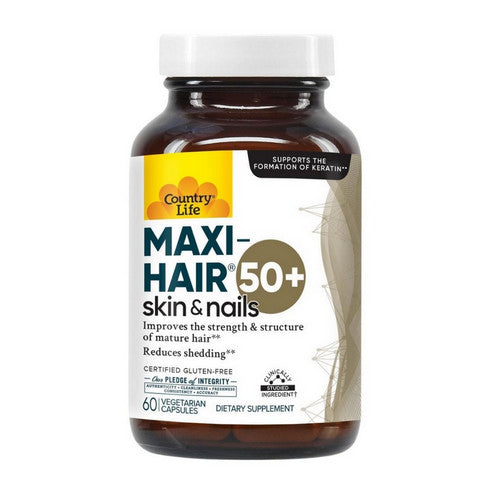
Maxi-Hair 50+

At the recorded label maximum: 2 capsules per day

Add to my list
Per day$0.93

At the label maximum of 2 capsules a day.

Per pack$27.79

60 capsules · Country Life · checked 20 Nov 2026. Delivery is not included.

Per capsule$0.46

Pack price divided by the number of capsules in the pack.

Composition

Amounts at the recorded label maximum. Directions may give a range.

Amounts not disclosed. The label gives only the total weight of this blend, not the amount of each ingredient in it. Without the individual amounts, we cannot compare these ingredients with upper limits.

18 mgat the recorded label maximum (1 serving × 18 mg; 2 capsules per serving)9 mg per capsule · calculated from 18 mg per 2 capsules
51% of 35 mg — US upper limit for adults, National Academiesniacin from supplements, adults · a reference value, not a legal limit
2 mgat the recorded label maximum (1 serving × 2 mg; 2 capsules per serving)1 mg per capsule · calculated from 2 mg per 2 capsules
2% of 100 mg — US upper limit for adults, National Academiesfrom food and supplements, adults · food is not counted here · a reference value, not a legal limit
2.5 mgat the recorded label maximum (1 serving × 2.5 mg; 2 capsules per serving)1.25 mg per capsule · calculated from 2.5 mg per 2 capsules
No US upper limitNational Academies: not determined — too little data on harm
Limits in other countries (7)Austria, Croatia, Cyprus, Eurasian Economic Union (EAEU), France, Italy, Malta
Pantothenic Acidas Calcium D-Pantothenate
13.7 mgat the recorded label maximum (1 serving × 13.7 mg; 2 capsules per serving)6.85 mg per capsule · calculated from 13.7 mg per 2 capsules
No US upper limitNational Academies: not determined — too little data on harm
Limits in other countries (8)Austria, Croatia, Cyprus, Eurasian Economic Union (EAEU), France, Italy, Malta, Poland
Zincas Zinc Citrate
About this formzinc citrate — about 31% of the compound is zinc itself. Reference level V0; no form is called “better” here.
22 mgat the recorded label maximum (1 serving × 22 mg; 2 capsules per serving) · as zinc itself11 mg per capsule · calculated from 22 mg per 2 capsules
55% of 40 mg — US upper limit for adults, National Academiesfrom food and supplements, adults · food is not counted here · a reference value, not a legal limit
1.65 mgat the recorded label maximum (1 serving × 1.65 mg; 2 capsules per serving)825 mcg per capsule · calculated from 1.65 mg per 2 capsules
16% of 10 mg — US upper limit for adults, National Academiesfrom food and supplements, adults · food is not counted here · a reference value, not a legal limit
L-Cysteineas L-Cysteine Hydrochloride
Amount not disclosedpart of Maxi-Hair 50+ Blend · not counted
No limit on file for the United StatesNone on file in any country

Where no limit is shown, none is set or on file for the United States. That is not the same as having no maximum.

Manufacturer's directions

Directions: For results in 3-6 months; adults take two (2) capsules daily; preferably in the morning after breakfast.

Other ingredients on the label

Hypromellose, Cellulose, Stearic Acid, Magnesium Stearate (Mg Stearate), Silica

Limits in other countries
CountryNiacinVitamin B6BiotinPantothenic Acid
United States35 mgreference, not a law · 51%100 mgreference, not a law · 2%—not on file—not on file
Austria32 mgrecommendation · 56%5.6 mgrecommendation · 36%150 mcgrecommendation · 1667% · above18 mgrecommendation · 76%
Belgium54 mglaw · 33%6 mglaw · 33%—not on file—not on file
Croatia35 mglaw · 51%20 mglaw · 10%150 mcglaw · 1667% · above18 mglaw · 76%
Cyprus150 mglaw · 12%100 mglaw · 2%2,500 mcglaw · 100%1,000 mglaw · 1%
Denmark891 mgrecommendation · 2%10 mgrecommendation · 20%—not on file—not on file
EAEU60 mglaw · 30%6 mglaw · 33%150 mcglaw · 1667% · above15 mglaw · 91%
Estonia10 mgrecommendation · 180% · above25 mgrecommendation · 8%—not on file—not on file
Finland—not on file12 mgrecommendation · 17%—not on file—not on file
France54 mglaw · 33%2 mglaw · 100%450 mcglaw · 556% · above18 mglaw · 76%
Germany160 mgrecommendation · 11%0.9 mgrecommendation · 222% · above—not on file—not on file
Ireland900 mgrecommendation · 2%25 mgrecommendation · 8%—not on file—not on file
Italy54 mgrecommendation · 33%9.5 mgrecommendation · 21%450 mcgrecommendation · 556% · above18 mgrecommendation · 76%
Luxembourg48 mglaw · 38%4.2 mglaw · 48%—not on file—not on file
Malta—not on file10 mglaw · 20%900 mcgrecommendation · 278% · above200 mgrecommendation · 7%
Netherlands—not on file21 mglaw · 10%—not on file—not on file
Poland830 mgrecommendation · 2%6 mgrecommendation · 33%—not on file200 mgrecommendation · 7%
Switzerland600 mglaw · 3%15 mglaw · 13%—not on file—not on file

Maximum amounts per daily dose of a food supplement, as each country sets them; the share is the daily amount on the label against that maximum. Law = legally binding; recommendation = an authority's recommended maximum, not binding; reference = the U.S. upper intake level for adults from all sources (National Academies), not a legal limit. Verification level V0 · 2 more ingredients have limits on file · Report an error

About the ingredients

Ingredient information

Ingredient guideNiacin (vitamin B3)Niacin, also called vitamin B3, is a B vitamin that dissolves in water. The body turns it into NAD, a coenzyme that more than 400 enzymes need. Supplements contain nicotinic acid, niacinamide or inositol hexanicotinate, which is often sold as no-flush niacin. Amounts are counted in niacin equivalents, which include niacin the body makes from tryptophan.Read moreShow less
Terms and sources
vitamin B3
Niacin is the general name for nicotinic acid, nicotinamide and related compounds. NIH Office of Dietary Supplements.
coenzyme
A small molecule that an enzyme needs to run its reaction.
niacinamide
Another name for nicotinamide.
niacin equivalents
1 mg of niacin, or 60 mg of tryptophan, counts as 1 mg NE. NIH Office of Dietary Supplements.

Niacin in the body

All tissues in the body convert niacin into NAD, its main active form. More than 400 enzymes need NAD, more than for any other vitamin-derived coenzyme. NAD carries energy from carbohydrates, fats and proteins to ATP, the cell's energy currency. NADP, a second active form, is needed to make cholesterol and fatty acids.

Terms and sources
NAD
Nicotinamide adenine dinucleotide. NIH Office of Dietary Supplements.
400 enzymes
NIH Office of Dietary Supplements.
ATP
Adenosine triphosphate. NIH Office of Dietary Supplements.
NADP
Nicotinamide adenine dinucleotide phosphate. All tissues except skeletal muscle make it from NAD. NIH Office of Dietary Supplements.

Niacin is the general name for nicotinic acid, nicotinamide and related compounds. None of them is related to the nicotine in tobacco, despite the similar names. The body makes NAD from nicotinamide in two steps and from nicotinic acid in three.

Terms and sources
related compounds
Such as nicotinamide riboside. NIH Office of Dietary Supplements.
nicotine in tobacco
Linus Pauling Institute.
two steps
Two enzyme reactions; the route from nicotinic acid has three. Linus Pauling Institute.

The body absorbs almost all niacin, even from doses of 3–4 g. The liver changes the remaining excess into compounds that leave the body in urine. Blood niacin levels are not a reliable guide to how much niacin the body has. Researchers measure two niacin breakdown products in urine instead.

Terms and sources
almost all niacin
Mostly in the small intestine, some in the stomach. NIH Office of Dietary Supplements.
remaining excess
Red blood cells keep some excess as a reserve. NIH Office of Dietary Supplements.
compounds
Methylated products such as N1-methyl-nicotinamide. NIH Office of Dietary Supplements.
not a reliable guide
NIH Office of Dietary Supplements.
two niacin breakdown products
N1-methyl-nicotinamide and N1-methyl-2-pyridone-5-carboxamide. NIH calls it "the most sensitive and reliable measure of niacin status."

Information, not a prescription. Do not start, stop or combine supplements or medicines on your own.
Ingredient guideVitamin B6Vitamin B6 is the name for six related water-soluble compounds: pyridoxine, pyridoxal, pyridoxamine and their phosphate forms. Its main active form, pyridoxal 5'-phosphate (PLP), is a helper molecule for more than 100 enzymes. Supplements most often contain pyridoxine hydrochloride; some contain PLP, also called P5P. Vitamin B6 is also in multivitamins and B complex products.Read moreShow less
Terms and sources
water-soluble
They dissolve in water, not in fat. NIH Office of Dietary Supplements.
helper molecule
A coenzyme: a small molecule an enzyme needs to work. Linus Pauling Institute.
pyridoxine hydrochloride
NIH Office of Dietary Supplements names it the most common form in supplements.

Vitamin B6 in the body

Vitamin B6 takes part in more than 100 enzyme reactions, mostly in the metabolism of protein. It is involved in making neurotransmitters, the chemical messengers of the nervous system. It is also involved in immune function and in making hemoglobin, the oxygen carrier in red blood cells.

Terms and sources
more than 100 enzyme reactions
NIH Office of Dietary Supplements. It also works in the metabolism of carbohydrates and fats.
neurotransmitters
Serotonin, dopamine and GABA among them. Linus Pauling Institute.
immune function
NIH Office of Dietary Supplements.

The human body cannot make vitamin B6, so it must come from food. PLP is a helper in over 4% of all enzyme reactions. Much of the body's PLP sits in muscle, bound to the enzyme that releases glucose from stored glycogen.

Terms and sources
cannot make vitamin B6
Linus Pauling Institute.
over 4%
Linus Pauling Institute.
the enzyme
Glycogen phosphorylase. Linus Pauling Institute.

Blood PLP is the most common measure of vitamin B6 status. Levels above 30 nmol/L have been the traditional sign of enough vitamin B6 in adults.

Terms and sources
Blood PLP
Plasma pyridoxal 5'-phosphate. NIH Office of Dietary Supplements.
30 nmol/L
NIH Office of Dietary Supplements.

Information, not a prescription. Do not start, stop or combine supplements or medicines on your own.

Ingredient guideBiotinBiotin is a water-soluble B vitamin; labels also call it vitamin B7. Many foods contain it, mostly bound to protein. Mammals cannot make biotin, but some bacteria, yeasts, molds, algae and plants can. Supplements sell it alone, in B-complex products and in some multivitamins.Read moreShow less
Terms and sources
vitamin B7
Or D-biotin or vitamin H. Names as written on labels in the NIH Dietary Supplement Label Database.
some bacteria, yeasts, molds, algae and plants
Linus Pauling Institute, Oregon State University.

Biotin in the body

Biotin works with five enzymes called carboxylases. They carry out key steps in the metabolism of fatty acids, glucose and amino acids. Biotin also has roles in gene regulation and cell signaling. It was discovered in 1927, and 40 more years of research were needed to establish it as a vitamin.

Terms and sources
five enzymes
Propionyl-CoA carboxylase, pyruvate carboxylase, methylcrotonyl-CoA carboxylase and acetyl-CoA carboxylases 1 and 2. NIH Office of Dietary Supplements.
1927
Linus Pauling Institute, Oregon State University.

In food, most biotin is bound to protein. Gut enzymes, including one called biotinidase, release free biotin, which the small intestine absorbs. Most biotin in the body is stored in the liver. Most bacteria in the gut make biotin; whether people absorb meaningful amounts of it is unknown. In healthy adults, blood biotin is 133–329 pmol/L. Blood biotin rises with large doses taken by mouth.

Terms and sources
biotinidase
The enzyme that frees biotin from its protein-bound forms. NIH Office of Dietary Supplements.
Most bacteria in the gut
Linus Pauling Institute, Oregon State University.
blood biotin
Serum biotin. In urine: 18–127 nmol per 24 hours. NIH Office of Dietary Supplements.

NIH notes that biotin supplements “are often promoted for hair, skin, and nail health.” It adds: “However, these claims are supported, at best, by only a few case reports and small studies.” It also notes: “Future studies are needed to determine whether biotin supplements might improve hair, nail, and skin health, especially among healthy individuals.”

Terms and sources
NIH notes
NIH Office of Dietary Supplements, Biotin fact sheet for health professionals, section on hair, nail and skin health.

Information, not a prescription. Do not start, stop or combine supplements or medicines on your own.

Ingredient guideZincZinc is an essential mineral that the body needs for the work of hundreds of enzymes. An adult body holds about 1.5–2.5 g of it. Supplements contain zinc as part of a compound, such as zinc citrate, oxide or gluconate. Three things are easy to confuse: the label number, the recommended amounts, and what the forms do. This article sorts them out.Read moreShow less

What zinc does

Zinc-dependent enzymes are found in all six classes of enzymes, the proteins that speed up chemical reactions in cells. By one estimate, more than 3,000 human proteins have sites that bind zinc. In some of them, zinc holds a fold called a zinc finger in shape. Zinc fingers let some proteins bind DNA and switch genes on or off. Zinc also takes part in immune function, protein and DNA synthesis, cell division and the sense of taste.

Most of the body's zinc is in skeletal muscle and bone. As intake rises, the body absorbs more zinc, but a smaller share of it.

Information, not a prescription. Do not start, stop or combine supplements or medicines on your own.

Ingredient guideCopperCopper is an essential mineral that several enzymes need in order to work. An adult body holds about 50–120 mg of it, and only small amounts are stored. Supplements offer it in several forms. Three things are easy to confuse: the number on the label, the recommended amounts, and what the forms do. This article sorts them out.Read moreShow less

What copper does

Copper-dependent enzymes are called cuproenzymes. They take part in energy production, iron metabolism, building connective tissue and making brain signaling chemicals. One of them, ceruloplasmin, carries 60–95% of the copper in blood plasma, says the Linus Pauling Institute. Defense against oxidative damage depends mainly on copper-containing enzymes called superoxide dismutases.

Almost two-thirds of the body's copper is in the skeleton and muscle. Most copper leaves the body in bile, and a small amount in urine. The body keeps its copper level steady through absorption in the gut and release from the liver into bile.

Information, not a prescription. Do not start, stop or combine supplements or medicines on your own.

Services

Choose the option that suits you.

Quick selection

I know my goal

$5

1–2 minutes · a few questions with fixed answers

One goal. Up to three products. Set a budget per day if you like.

Product checks
form and amount on the label, plus shop prices
Daily schedule
what to take, when, how much
Totals and limits
next to the upper limit
Reasons & sources
for each product
Prices and shops
plus food and habits
Progress
what to track, when to see a doctor

Complete the questionnaire before you pay. If no product fits any of your goals, you won’t be charged.

Order · $5View example

Full selection

I have several goals

$15

5–7 minutes · questionnaire with fixed answers

Up to three goals in one set. Where two goals overlap, one product is used for both.

Product checks
form and amount on the label, plus shop prices
Daily schedule
what to take, when, how much
Totals and limits
next to the upper limit
Reasons & sources
for each product
Prices and shops
plus food and habits
Progress
what to track, when to see a doctor

Complete the questionnaire before you pay. If no product fits any of your goals, you won’t be charged.

Order · $15View example

Expert review

I want a person to look at my supplements

$50

Written review within 48 hours of your completed questionnaire

An expert reviews your supplement list and questionnaire.

Written review
duplicates, limits, forms
Detailed questionnaire
supplements, medicines, history
Optional uploads
supplement-label photos or documents relevant to your review
Your notes
your priorities and questions
Follow-up questions
in writing, when needed
Next steps
points to discuss with your doctor

Complete the questionnaire before you pay.

Order · $50View example
Sources, label & certificates

Label record

Copied from the NIH label database (DSLD 333208) · not yet compared with the label · checked 19 Oct 2026 · Report an error

The United States has no pre-market registration for supplements.
Label on file in the NIH Dietary Supplement Label Database
checked 19 Oct 2026source: NIH DSLDReport an error

Barcode 0 15794 05023 0

Third-party certificates

No third-party certificate on file for this product.

Information, not a prescription. Do not start, stop or combine supplements or medicines on your own. If you have a health condition, are pregnant or breastfeeding, take medicines, or are under 18, talk to a doctor or pharmacist first.

Photo credits

Image: © Country Life. Shown to identify the product. Source:

Rights holders can ask us to remove an image or send official product photos: info@verateca.com.

Product photo

Country Life Maxi-Hair 50+ — enlarged pack