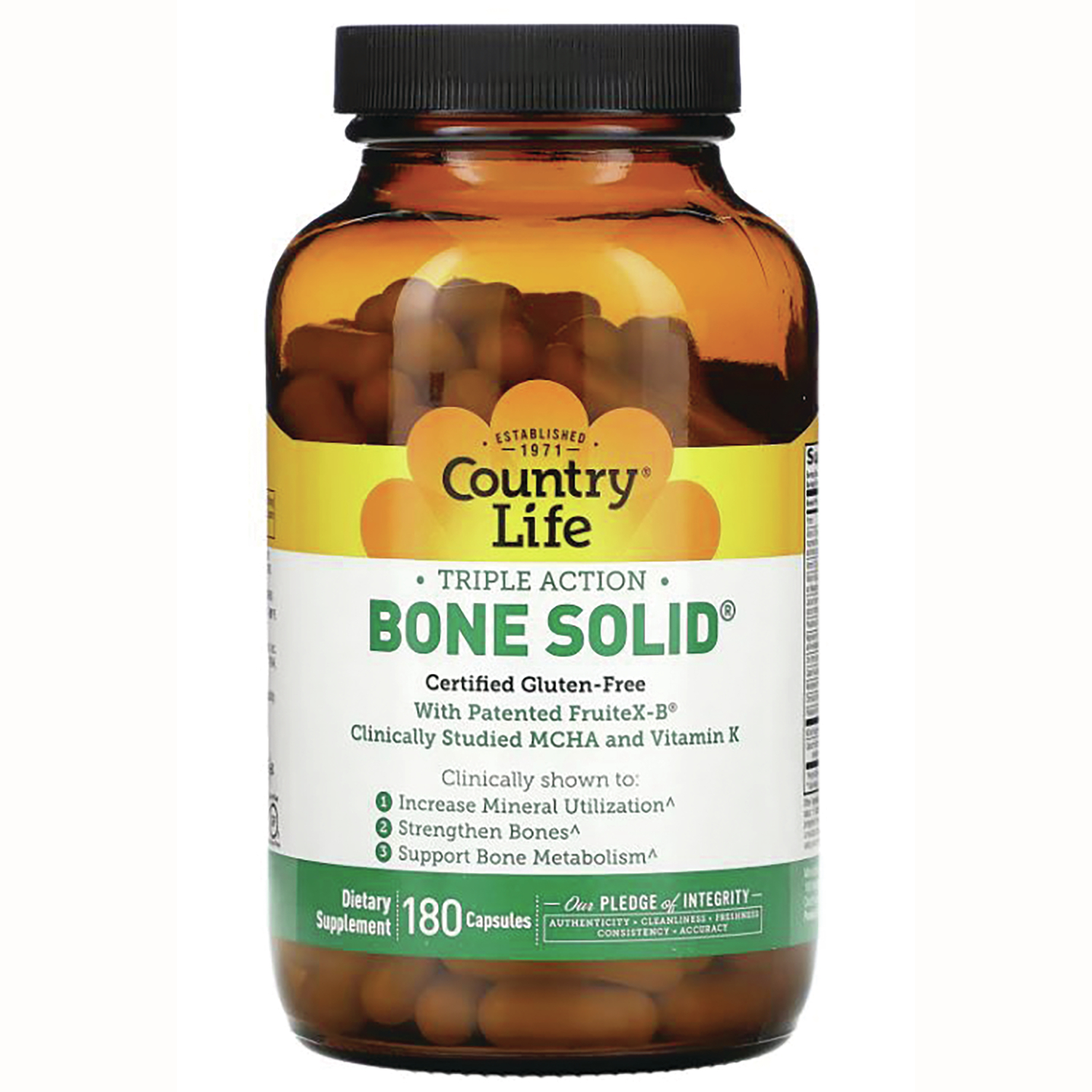
Country Life · capsules

Bone Solid

At the recorded label maximum: 6 capsules per day

Add to my list
Per day$1.03

At the label maximum of 6 capsules a day.

Per pack$30.99

180 capsules · Country Life · checked 20 Nov 2026. Delivery is not included.

Per capsule$0.17

Pack price divided by the number of capsules in the pack.

Composition

Amounts at the recorded label maximum. Directions may give a range.

Amounts not disclosed. The label gives only the total weight of this blend, not the amount of each ingredient in it. Without the individual amounts, we cannot compare these ingredients with upper limits.

At the recorded label maximum, the daily amount is 2,022 mg of calcium. This is above the US adult upper intake level of 2,000 mg a day for calcium from food and supplements. The National Academies set this scientific reference value.

At the recorded label maximum, the daily amount is 1,000 mg of magnesium. This is above the US adult upper intake level of 350 mg a day for magnesium from supplements and medicines. The National Academies set this scientific reference value.

The U.S. adult upper limit of 350 mg/day for magnesium from supplements and medications is based on studies of diarrhea.

Label source · Upper intake level source · Report an error

200 mgat the recorded label maximum (2 servings × 100 mg; 3 capsules per serving)33.3333333333333 mg per capsule · calculated from 100 mg per 3 capsules
10% of 2,000 mg — US upper limit for adults, National Academiesfrom food and supplements, adults · food is not counted here · a reference value, not a legal limit
Vitamin Das Vitamin D3
About this formvitamin D3 (cholecalciferol). Raises vitamin D levels more than D2. Reference level V0; no form is called “better” here.
50 mcgat the recorded label maximum (2 servings × 25 mcg; 3 capsules per serving)8.33333333333334 mcg per capsule · calculated from 25 mcg per 3 capsules
50% of 100 mcg — US upper limit for adults, National Academiesfrom food and supplements, adults · food is not counted here · a reference value, not a legal limit
Vitamin Kas Phytonadione
About this formvitamin K1 (phylloquinone). Reference level V0; no form is called “better” here.
240 mcgat the recorded label maximum (2 servings × 120 mcg; 3 capsules per serving)
No US upper limitNational Academies: not determined — too little data on harm
Limits in other countries (12)Austria, Belgium, Croatia, Denmark, Eurasian Economic Union (EAEU), France, Germany, Italy, Luxembourg, Malta, Poland, Switzerland
Calciumas Calcium Ascorbate | Calcium Fructoborate | Microcrystalline Hydroxyapatite | Tricalcium Phosphate
About this formcalcium phosphate — about 39% of the compound is calcium itself. Reference level V0; no form is called “better” here.
2,022 mgat the recorded label maximum (2 servings × 1,011 mg; 3 capsules per serving) · as calcium itself337 mg per capsule · calculated from 1,011 mg per 3 capsules
101% ↑ of the upper intake level of 2,000 mg — US upper limit for adults, National Academies2,500 mg (ages 19–50) · 2,000 mg (51 and older) · from food and supplements, adults · food is not counted here · a reference value, not a legal limit
Phosphorusas Microcrystalline Hydroxyapatite | Tricalcium Phosphate
1,000 mgat the recorded label maximum (2 servings × 500 mg; 3 capsules per serving)166.666666666667 mg per capsule · calculated from 500 mg per 3 capsules
33% of 3,000 mg — US upper limit for adults, National Academies4,000 mg (ages 19–70) · 3,000 mg (71 and older) · from food and supplements, adults · food is not counted here · a reference value, not a legal limit
1,000 mgat the recorded label maximum (2 servings × 500 mg; 3 capsules per serving) · as magnesium itself166.666666666667 mg per capsule · calculated from 500 mg per 3 capsules
286% ↑ of the upper intake level of 350 mg — US upper limit for adults, National Academiesmagnesium from supplements, adults · a reference value, not a legal limit
Zincas Zinc Ascorbate | Zinc Citrate
About this formzinc citrate — about 31% of the compound is zinc itself. Reference level V0; no form is called “better” here.
22 mgat the recorded label maximum (2 servings × 11 mg; 3 capsules per serving) · as zinc itself3.66666666666667 mg per capsule · calculated from 11 mg per 3 capsules
55% of 40 mg — US upper limit for adults, National Academiesfrom food and supplements, adults · food is not counted here · a reference value, not a legal limit
Boron
12 mgat the recorded label maximum (2 servings × 6 mg; 3 capsules per serving)2 mg per capsule · calculated from 6 mg per 3 capsules
60% of 20 mg — US upper limit for adults, National Academiesfrom food and supplements, adults · food is not counted here · a reference value, not a legal limit
Menaquinoneas Menaquinone-7
About this formvitamin K2 MK-7. Long-acting; dosed in micrograms. Reference level V0; no form is called “better” here.
Amount not disclosedpart of Proprietary Blend · not counted
No US upper limitNational Academies: not determined — too little data on harm
Limits in other countries (12)Austria, Belgium, Croatia, Denmark, Eurasian Economic Union (EAEU), France, Germany, Italy, Luxembourg, Malta, Poland, Switzerland

Where no limit is shown, none is set or on file for the United States. That is not the same as having no maximum.

Manufacturer's directions

Directions: Adults take three (3) capsules twice daily with food (for a total of 6 per day).

Other ingredients on the label

Cellulose, Stearic Acid, Magnesium Stearate (Mg Stearate), Silica

Limits in other countries
CountryVitamin CVitamin DMenaquinoneCalcium
United States2,000 mgreference, not a law · 10%100 mcgreference, not a law · 50%—not on file2,000 mgreference, not a law · 101% · above
Comparison note2,500 mg (ages 19–50) · 2,000 mg (51 and older)
Austria500 mgrecommendation · 40%20 mcgrecommendation · 250% · above75 mcgrecommendation · 320% · above800 mgrecommendation · 253% · above
Belgium1,000 mglaw · 20%75 mcglaw · 67%210 mcglaw · 114% · above1,600 mglaw · 126% · above
Croatia800 mglaw · 25%10 mcglaw · 500% · above100 mcglaw · 240% · above1,500 mglaw · 135% · above
Cyprus2,000 mglaw · 10%10 mcglaw · 500% · above—not on file1,500 mglaw · 135% · above
Denmark1,000 mgrecommendation · 20%95 mcgrecommendation · 53%919 mcgrecommendation · 26%1,327 mgrecommendation · 152% · above
EAEU900 mglaw · 22%15 mcglaw · 333% · above360 mcglaw · 67%2,500 mglaw · 81%
Estonia—not on file100 mcgrecommendation · 50%—not on file2,500 mgrecommendation · 81%
Finland—not on file100 mcgrecommendation · 50%—not on file2,500 mgrecommendation · 81%
France180 mglaw · 111% · above5 mcglaw · 1000% · above25 mcglaw · 960% · above800 mglaw · 253% · above
Germany250 mgrecommendation · 80%20 mcgrecommendation · 250% · above80 mcgrecommendation · 300% · above500 mgrecommendation · 404% · above
Ireland2,000 mgrecommendation · 10%100 mcgrecommendation · 50%—not on file2,500 mgrecommendation · 81%
Italy1,000 mgrecommendation · 20%50 mcgrecommendation · 100%200 mcgrecommendation · 120% · above1,200 mgrecommendation · 169% · above
Luxembourg1,000 mglaw · 20%50 mcglaw · 100%112.5 mcglaw · 213% · above1,600 mglaw · 126% · above
Malta1,000 mgrecommendation · 20%25 mcgrecommendation · 200% · above1,000 mcgrecommendation · 24%1,500 mgrecommendation · 135% · above
Netherlands—not on file75 mcglaw · 67%—not on file—not on file
Norway1,000 mglaw · 20%80 mcglaw · 63%—not on file705 mglaw · 287% · above
Poland1,000 mgrecommendation · 20%50 mcgrecommendation · 100%200 mcgrecommendation · 120% · above1,500 mgrecommendation · 135% · above
Switzerland750 mglaw · 27%70 mcglaw · 71%225 mcglaw · 107% · above750 mglaw · 270% · above

Maximum amounts per daily dose of a food supplement, as each country sets them; the share is the daily amount on the label against that maximum. Law = legally binding; recommendation = an authority's recommended maximum, not binding; reference = the U.S. upper intake level for adults from all sources (National Academies), not a legal limit. Verification level V0 · 4 more ingredients have limits on file · Report an error

About the ingredients

Ingredient information

Ingredient guideVitamin CVitamin C, also called L-ascorbic acid, is a water-soluble vitamin. Most animals make vitamin C in the body; humans cannot and get it from food. Fruits and vegetables such as peppers, citrus fruits and kiwifruit are the main sources. Supplements contain it as ascorbic acid or as mineral salts such as sodium and calcium ascorbate.Read moreShow less
Terms and sources
water-soluble
It dissolves in water, not in fat. NIH Office of Dietary Supplements.

Vitamin C in the body

Vitamin C is needed to make collagen, carnitine and some neurotransmitters. It is also an antioxidant and can return used vitamin E to its active form. It is needed for normal immune function. It increases the absorption of iron from plant foods.

Terms and sources
collagen
A protein that holds together connective tissue, such as skin, tendons and blood vessels. NIH Office of Dietary Supplements.
carnitine
A substance cells need to get energy from fat. Linus Pauling Institute.
neurotransmitters
Chemical messengers between nerve cells.
antioxidant
A substance that limits damage from free radicals, reactive molecules made in cells.
iron from plant foods
Nonheme iron, the only form of iron in plant foods. NIH Office of Dietary Supplements.

An adult body holds from about 300 mg to about 2 g of vitamin C. White blood cells, the eyes, the adrenal and pituitary glands and the brain hold the most. Cells hold vitamin C in millimolar concentrations, blood plasma in micromolar concentrations. At 100 mg a day or more, cells appear to be saturated.

Terms and sources
about 300 mg
The lower figure is for very low intake. NIH Office of Dietary Supplements.
adrenal and pituitary glands
Small glands that make hormones: the adrenals sit above the kidneys, the pituitary below the brain.
millimolar
Thousandths of a mole per liter; micromolar means millionths. NIH Office of Dietary Supplements.
saturated
Holding as much as they take up. Above 200 mg a day, blood plasma levels rise little more.

The body absorbs about 70–90% of vitamin C at 30–180 mg a day. Above 1 g a day, less than 50% is absorbed, and unused vitamin C leaves in urine.

Terms and sources
less than 50%
Summary by the NIH Office of Dietary Supplements. Absorption in the gut runs through a dose-dependent transporter protein.

Information, not a prescription. Do not start, stop or combine supplements or medicines on your own.

Ingredient guideVitamin DVitamin D is a fat-soluble vitamin. The skin makes it when ultraviolet light from the sun reaches it, and a few foods contain it. Supplements contain one or both of its two main forms: vitamin D3 and vitamin D2. Labels state the amount in micrograms (mcg), international units (IU) or both.Read moreShow less
Terms and sources
fat-soluble
It dissolves in fat, not in water. NIH Office of Dietary Supplements.

Vitamin D in the body

Vitamin D from the sun, food and supplements is inactive at first. The liver turns it into 25-hydroxyvitamin D, the form a blood test measures. Mainly the kidneys then make the active form.

Terms and sources
25-hydroxyvitamin D
Also called calcidiol or 25(OH)D. Results come in nmol/L or ng/mL; 50 nmol/L equals 20 ng/mL.
active form
1,25-dihydroxyvitamin D, also called calcitriol.

Vitamin D is needed for normal absorption of calcium from the gut and for normal bones. It is also needed for normal muscle and immune function. Many tissues in the body carry vitamin D receptors.

Terms and sources
vitamin D receptors
Proteins in cells that respond to the active form of vitamin D. NIH Office of Dietary Supplements.

Information, not a prescription. Do not start, stop or combine supplements or medicines on your own.

Ingredient guideCalciumCalcium is the most abundant mineral in the human body. An adult body holds about 1.2–1.4 kg of it, almost all in bones and teeth. Milk, yogurt and cheese are rich sources. Supplements contain calcium as part of a compound, most often calcium carbonate or calcium citrate.Read moreShow less
Terms and sources
1.2–1.4 kg
About 1,200 g in women and 1,400 g in men. NIH Office of Dietary Supplements.

Calcium in the body

About 99% of the body's calcium is in bones and teeth. The other 1% is in the blood and soft tissues. This small part is needed for normal muscle function, nerve signaling, blood clotting and hormone release. It also takes part as blood vessels tighten and relax.

Terms and sources
bones and teeth
There it sits in hydroxyapatite, a mineral of calcium and phosphate. Linus Pauling Institute; NIH Office of Dietary Supplements.

The body keeps blood calcium in a narrow range, about 8.8–10.4 mg/dL. When intake is low, it draws calcium from bone to hold that range. A blood test therefore does not show how much calcium a person gets. Bone is rebuilt all the time; teeth are not. Vitamin D is needed to absorb calcium in the gut.

Terms and sources
8.8–10.4 mg/dL
2.2–2.6 mmol/L, total calcium in serum in healthy people. NIH Office of Dietary Supplements.
absorb calcium in the gut
Vitamin D is needed for active transport, the main route when intake is low. NIH Office of Dietary Supplements.

Information, not a prescription. Do not start, stop or combine supplements or medicines on your own.

Ingredient guideMagnesiumMagnesium is an essential mineral: the human body cannot make it and gets it from food and drinks. An adult body holds about 25 g, mostly in bone. Supplements add to it, in forms such as magnesium citrate, glycinate and oxide.Read moreShow less

Magnesium in the body

Inside cells, magnesium is the second most common positively charged mineral, after potassium. It takes part in more than 300 enzyme systems. It is needed for normal muscle and nerve function, energy metabolism, protein synthesis, and normal bones and teeth.

Terms and sources
positively charged mineral
a cation. de Baaij et al., Physiological Reviews, 2015 (PMID 25540137).
enzyme systems
Enzymes are proteins that run chemical reactions in cells. The 300 figure is from NIH ODS. A 2015 review puts the number of enzyme reactions at over 600.
energy metabolism
How cells turn food into usable energy.

About 50–60% of the body's magnesium sits in bone. Most of the rest is in muscle and other soft tissue. Less than 1% is in the blood. A blood test sees only this small part.

Terms and sources
in the blood
In serum. The usual range is 0.75–0.95 mmol/L.

Information, not a prescription. Do not start, stop or combine supplements or medicines on your own.

Ingredient guideZincZinc is an essential mineral that the body needs for the work of hundreds of enzymes. An adult body holds about 1.5–2.5 g of it. Supplements contain zinc as part of a compound, such as zinc citrate, oxide or gluconate. Three things are easy to confuse: the label number, the recommended amounts, and what the forms do. This article sorts them out.Read moreShow less

What zinc does

Zinc-dependent enzymes are found in all six classes of enzymes, the proteins that speed up chemical reactions in cells. By one estimate, more than 3,000 human proteins have sites that bind zinc. In some of them, zinc holds a fold called a zinc finger in shape. Zinc fingers let some proteins bind DNA and switch genes on or off. Zinc also takes part in immune function, protein and DNA synthesis, cell division and the sense of taste.

Most of the body's zinc is in skeletal muscle and bone. As intake rises, the body absorbs more zinc, but a smaller share of it.

Information, not a prescription. Do not start, stop or combine supplements or medicines on your own.

Services

Choose the option that suits you.

Quick selection

I know my goal

$5

1–2 minutes · a few questions with fixed answers

One goal. Up to three products. Set a budget per day if you like.

Product checks
form and amount on the label, plus shop prices
Daily schedule
what to take, when, how much
Totals and limits
next to the upper limit
Reasons & sources
for each product
Prices and shops
plus food and habits
Progress
what to track, when to see a doctor

Complete the questionnaire before you pay. If no product fits any of your goals, you won’t be charged.

Order · $5View example

Full selection

I have several goals

$15

5–7 minutes · questionnaire with fixed answers

Up to three goals in one set. Where two goals overlap, one product is used for both.

Product checks
form and amount on the label, plus shop prices
Daily schedule
what to take, when, how much
Totals and limits
next to the upper limit
Reasons & sources
for each product
Prices and shops
plus food and habits
Progress
what to track, when to see a doctor

Complete the questionnaire before you pay. If no product fits any of your goals, you won’t be charged.

Order · $15View example

Expert review

I want a person to look at my supplements

$50

Written review within 48 hours of your completed questionnaire

An expert reviews your supplement list and questionnaire.

Written review
duplicates, limits, forms
Detailed questionnaire
supplements, medicines, history
Optional uploads
supplement-label photos or documents relevant to your review
Your notes
your priorities and questions
Follow-up questions
in writing, when needed
Next steps
points to discuss with your doctor

Complete the questionnaire before you pay.

Order · $50View example
Sources, label & certificates

Label record

Copied from the NIH label database (DSLD 333252) · not yet compared with the label · checked 19 Oct 2026 · Report an error

The United States has no pre-market registration for supplements.
Label on file in the NIH Dietary Supplement Label Database
checked 19 Oct 2026source: NIH DSLDReport an error

Barcode 0 15794 05033 9

Third-party certificates

Label mentions: Please help us in our mission; recycle this box & bottle after use. Like/follow us on our social platforms for new product news, recipes, giveaways and more! Tag us for a chance to be featured. @CountryLifeVitamins Facebook Instagram, Looking for joint support? also try... Flex-Able Advanced: Includes three clinically studied ingredients Increases joint mobility, comfort, and flexibility Supports overall joint health Based on human clinical studies with UC-II collagen.. Not yet checked against the certifiers’ registries.

Information, not a prescription. Do not start, stop or combine supplements or medicines on your own. If you have a health condition, are pregnant or breastfeeding, take medicines, or are under 18, talk to a doctor or pharmacist first.

Photo credits

Image: © Country Life. Shown to identify the product. Source:

Rights holders can ask us to remove an image or send official product photos: info@verateca.com.

Product photo

Country Life Bone Solid — enlarged pack