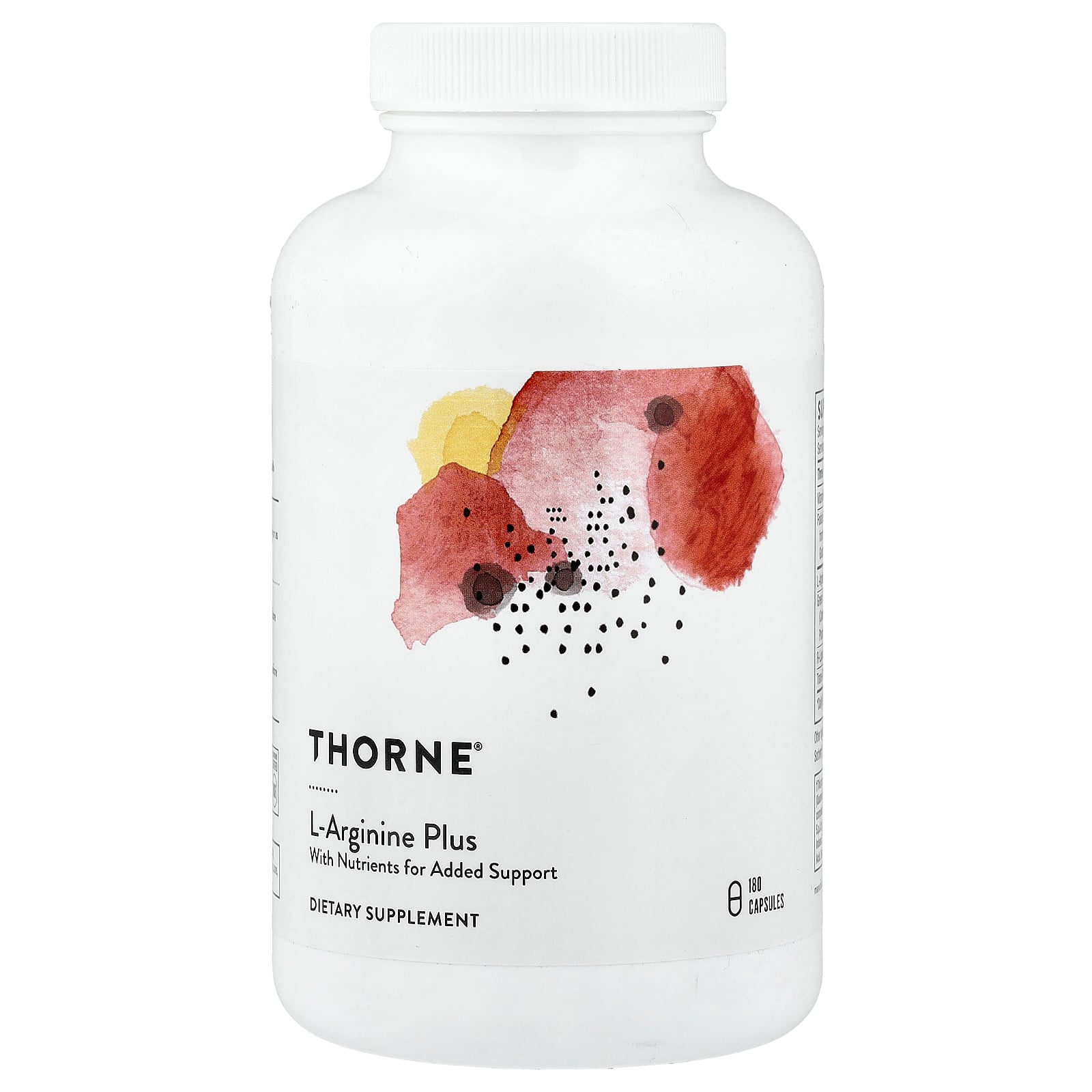
Thorne · capsules

L-Arginine Plus

At the recorded label maximum: 6 capsules per day

Add to my list
Per day$2.50

At the label maximum of 6 capsules a day.

Per pack$75.00

180 capsules · Vita Living · checked 20 Nov 2026. Delivery is not included.

Per capsule$0.42

Pack price divided by the number of capsules in the pack.

Composition

Amounts at the recorded label maximum. Directions may give a range.

600 mgat the recorded label maximum (2 servings × 300 mg; 3 capsules per serving)100 mg per capsule · calculated from 300 mg per 3 capsules
30% of 2,000 mg — US upper limit for adults, National Academiesfrom food and supplements, adults · food is not counted here · a reference value, not a legal limit
1.84 mgat the recorded label maximum (2 servings × 920 mcg; 3 capsules per serving)306.666666666667 mcg per capsule · calculated from 920 mcg per 3 capsules
Not compared with 1 mg — US upper limit for adults, National Academiesthe limit counts folic acid only · a reference value, not a legal limit
L-Arginine
2,000 mgat the recorded label maximum (2 servings × 1,000 mg; 3 capsules per serving)333.333333333333 mg per capsule · calculated from 1,000 mg per 3 capsules
No limit on file for the United StatesNone on file in any country
Trans-Resveratrol
100 mgat the recorded label maximum (2 servings × 50 mg; 3 capsules per serving)16.6666666666667 mg per capsule · calculated from 50 mg per 3 capsules
No limit on file for the United StatesNone on file in any country

Where no limit is shown, none is set or on file for the United States. That is not the same as having no maximum.

Manufacturer's directions

Suggested use: Take 3 capsules two times daily or as recommended by your health-care practitioner.

Other ingredients on the label

high and low viscosity Hydroxypropyl Methylcellulose, Hypromellose (derived from Cellulose), Leucine, Silicon Dioxide (SiO2)

Limits in other countries
CountryVitamin CFolate
United States2,000 mgreference, not a law · 30%1,000 mcgreference, not a law · not compared
Austria500 mgrecommendation · 120% · above600 mcgrecommendation · 307% · above
Belgium1,000 mglaw · 60%500 mcglaw · 368% · above
Croatia800 mglaw · 75%600 mcglaw · 307% · above
Cyprus2,000 mglaw · 30%400 mcglaw · 460% · above
Denmark1,000 mgrecommendation · 60%1,000 mcgrecommendation · 184% · above
EAEU900 mglaw · 67%600 mcglaw · 307% · above
Estonia—not on file1,000 mcgrecommendation · 184% · above
Finland—not on file1,000 mcgrecommendation · 184% · above
France180 mglaw · 333% · above200 mcglaw · 920% · above
Germany250 mgrecommendation · 240% · above200 mcgrecommendation · 920% · above
Ireland2,000 mgrecommendation · 30%1,000 mcgrecommendation · 184% · above
Italy1,000 mgrecommendation · 60%400 mcgrecommendation · 460% · above
Luxembourg1,000 mglaw · 60%400 mcglaw · 460% · above
Malta1,000 mgrecommendation · 60%1,000 mcgrecommendation · 184% · above
Norway1,000 mglaw · 60%960 mcglaw · 192% · above
Poland1,000 mgrecommendation · 60%600 mcgrecommendation · 307% · above
Switzerland750 mglaw · 80%750 mcglaw · 245% · above

Maximum amounts per daily dose of a food supplement, as each country sets them; the share is the daily amount on the label against that maximum. Law = legally binding; recommendation = an authority's recommended maximum, not binding; reference = the U.S. upper intake level for adults from all sources (National Academies), not a legal limit. Verification level V0 · Report an error

About the ingredients

Ingredient information

Ingredient guideVitamin CVitamin C, also called L-ascorbic acid, is a water-soluble vitamin. Most animals make vitamin C in the body; humans cannot and get it from food. Fruits and vegetables such as peppers, citrus fruits and kiwifruit are the main sources. Supplements contain it as ascorbic acid or as mineral salts such as sodium and calcium ascorbate.Read moreShow less
Terms and sources
water-soluble
It dissolves in water, not in fat. NIH Office of Dietary Supplements.

Vitamin C in the body

Vitamin C is needed to make collagen, carnitine and some neurotransmitters. It is also an antioxidant and can return used vitamin E to its active form. It is needed for normal immune function. It increases the absorption of iron from plant foods.

Terms and sources
collagen
A protein that holds together connective tissue, such as skin, tendons and blood vessels. NIH Office of Dietary Supplements.
carnitine
A substance cells need to get energy from fat. Linus Pauling Institute.
neurotransmitters
Chemical messengers between nerve cells.
antioxidant
A substance that limits damage from free radicals, reactive molecules made in cells.
iron from plant foods
Nonheme iron, the only form of iron in plant foods. NIH Office of Dietary Supplements.

An adult body holds from about 300 mg to about 2 g of vitamin C. White blood cells, the eyes, the adrenal and pituitary glands and the brain hold the most. Cells hold vitamin C in millimolar concentrations, blood plasma in micromolar concentrations. At 100 mg a day or more, cells appear to be saturated.

Terms and sources
about 300 mg
The lower figure is for very low intake. NIH Office of Dietary Supplements.
adrenal and pituitary glands
Small glands that make hormones: the adrenals sit above the kidneys, the pituitary below the brain.
millimolar
Thousandths of a mole per liter; micromolar means millionths. NIH Office of Dietary Supplements.
saturated
Holding as much as they take up. Above 200 mg a day, blood plasma levels rise little more.

The body absorbs about 70–90% of vitamin C at 30–180 mg a day. Above 1 g a day, less than 50% is absorbed, and unused vitamin C leaves in urine.

Terms and sources
less than 50%
Summary by the NIH Office of Dietary Supplements. Absorption in the gut runs through a dose-dependent transporter protein.

Information, not a prescription. Do not start, stop or combine supplements or medicines on your own.
Ingredient guideFolateFolate is a water-soluble B vitamin, also called vitamin B9. It occurs naturally in many foods. Folic acid is the synthetic form used in most supplements and in fortified foods. Some supplements contain L-methylfolate or folinic acid instead. Folate is also in multivitamins, prenatal vitamins and B complex products.Read moreShow less
Terms and sources
water-soluble
It dissolves in water, not in fat. NIH Office of Dietary Supplements.
synthetic form
NIH Office of Dietary Supplements: the fully oxidized form of the vitamin.
L-methylfolate
Also called 5-MTHF or L-5-methyltetrahydrofolate. NIH Office of Dietary Supplements.
prenatal vitamins
NIH Office of Dietary Supplements lists these product types.

Folate in the body

Folate is a helper molecule that moves single carbon units between other molecules. It is needed to make DNA and RNA and to process amino acids. Folate and vitamin B12 work in the same step that turns homocysteine into the amino acid methionine.

Terms and sources
helper molecule
A coenzyme. NIH Office of Dietary Supplements. The name comes from foliage: green leafy vegetables are rich in folate, Linus Pauling Institute.
DNA and RNA
NIH Office of Dietary Supplements: folate is required for proper cell division.
same step
Methionine synthase needs both folate, as 5-methyltetrahydrofolate, and vitamin B12. Linus Pauling Institute.

Folic acid is not active until the body converts it into natural folates. The main form of folate in blood plasma is L-methylfolate. When the converting enzyme is at capacity, unconverted folic acid appears in the blood. A US national survey found unconverted folic acid in 96% of blood samples.

Terms and sources
not active
Linus Pauling Institute: folic acid "has no biological activity unless converted into folates".
main form
NIH Office of Dietary Supplements.
converting enzyme
Dihydrofolate reductase. Its activity varies greatly between people. NIH Office of Dietary Supplements.
96% of blood samples
Serum samples, NHANES 2007–2008, people aged 1 year and older. Linus Pauling Institute.

The body holds about 15 to 30 mg of folate, about half of it in the liver. Gut bacteria also make folate; how much of it the body uses is unclear. Red blood cell folate reflects intake over the longer term; folate in the blood fluid reflects recent intake. Blood homocysteine is a common marker of folate status, though vitamin B12 and other factors also affect it.

Terms and sources
15 to 30 mg
NIH Office of Dietary Supplements.
Gut bacteria
NIH Office of Dietary Supplements: folate made in the colon can be absorbed there.
Red blood cell folate
NIH Office of Dietary Supplements: above 140 ng/mL indicates adequate status. For serum folate, the cutoff is 3 ng/mL.
common marker
NIH Office of Dietary Supplements calls it a functional indicator that is not highly specific.

A common gene variant, MTHFR 677C>T, makes the enzyme that forms L-methylfolate less active. Depending on the population, 3% to 32% of people carry two copies.

Terms and sources
MTHFR 677C>T
Linus Pauling Institute. With two copies of the variant, enzyme activity is about 65% lower; with one copy, about 30% lower.
3% to 32%
20% to 53% carry one copy. Linus Pauling Institute.

Information, not a prescription. Do not start, stop or combine supplements or medicines on your own.

Services

Choose the option that suits you.

Quick selection

I know my goal

$5

1–2 minutes · a few questions with fixed answers

One goal. Up to three products. Set a budget per day if you like.

Product checks
form and amount on the label, plus shop prices
Daily schedule
what to take, when, how much
Totals and limits
next to the upper limit
Reasons & sources
for each product
Prices and shops
plus food and habits
Progress
what to track, when to see a doctor

Complete the questionnaire before you pay. If no product fits any of your goals, you won’t be charged.

Order · $5View example

Full selection

I have several goals

$15

5–7 minutes · questionnaire with fixed answers

Up to three goals in one set. Where two goals overlap, one product is used for both.

Product checks
form and amount on the label, plus shop prices
Daily schedule
what to take, when, how much
Totals and limits
next to the upper limit
Reasons & sources
for each product
Prices and shops
plus food and habits
Progress
what to track, when to see a doctor

Complete the questionnaire before you pay. If no product fits any of your goals, you won’t be charged.

Order · $15View example

Expert review

I want a person to look at my supplements

$50

Written review within 48 hours of your completed questionnaire

An expert reviews your supplement list and questionnaire.

Written review
duplicates, limits, forms
Detailed questionnaire
supplements, medicines, history
Optional uploads
supplement-label photos or documents relevant to your review
Your notes
your priorities and questions
Follow-up questions
in writing, when needed
Next steps
points to discuss with your doctor

Complete the questionnaire before you pay.

Order · $50View example
Sources, label & certificates

Label record

Copied from the NIH label database (DSLD 336346) · not yet compared with the label · checked 19 Oct 2026 · Report an error

The United States has no pre-market registration for supplements.
Label on file in the NIH Dietary Supplement Label Database
checked 19 Oct 2026source: NIH DSLDReport an error

Barcode 6 93749 52601 8

Third-party certificates

No third-party certificate on file for this product.

Information, not a prescription. Do not start, stop or combine supplements or medicines on your own. If you have a health condition, are pregnant or breastfeeding, take medicines, or are under 18, talk to a doctor or pharmacist first.

Photo credits

Image: © Thorne. Shown to identify the product. Source:

Rights holders can ask us to remove an image or send official product photos: info@verateca.com.

Product photo

Thorne L-Arginine Plus — enlarged pack